OKI for pain and fever
Italy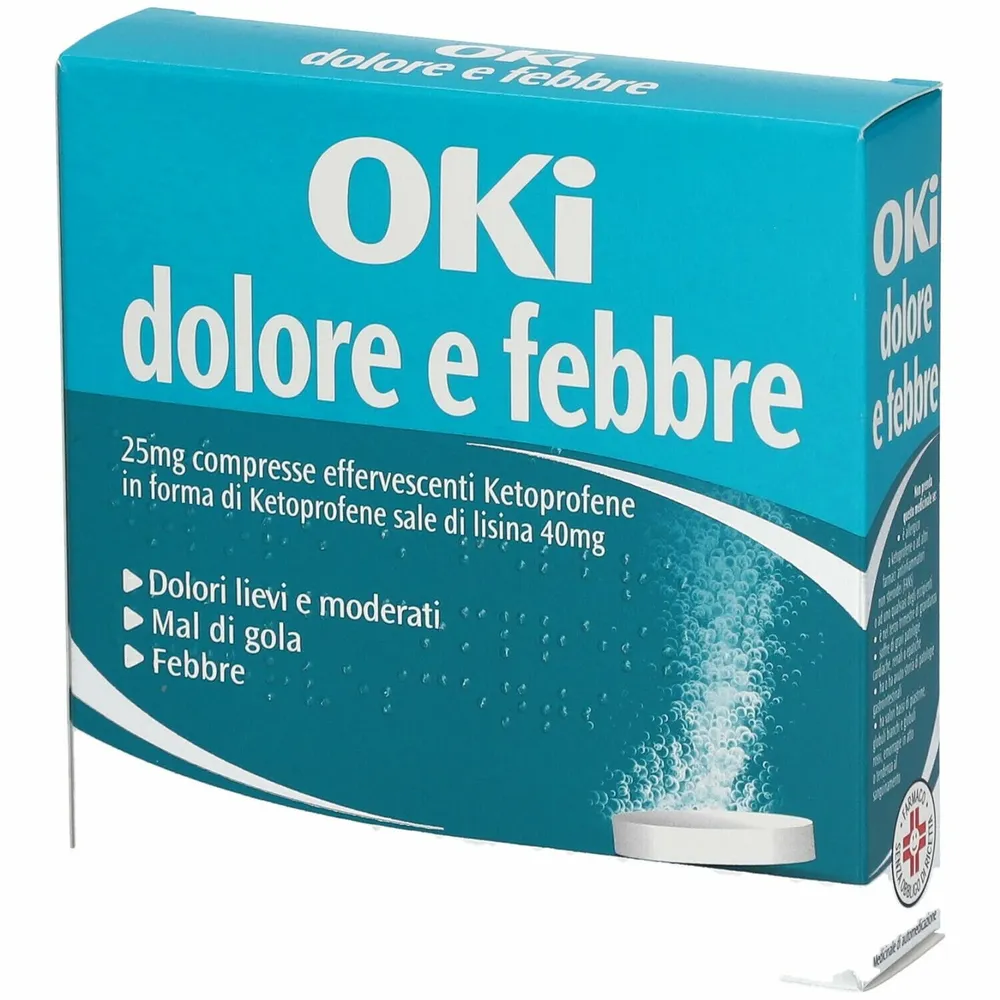
Table of Contents
- PACKAGE LEAFLET
- Package leaflet: Information for the user
- OKi pain and fever 25 mg effervescent tablets
- 1. What OKi pain and fever is and what it is used for
- 2. What you should know before taking OKi Pain and Fever
- 3. How to take OKi pain and fever
- 4. Possible side effects
- 5. How to store OKi pain and fever
- 6. Package contents and other information
PACKAGE LEAFLET
Package leaflet: Information for the user
OKi pain and fever 25 mg effervescent tablets
Ketoprofen
Please read this leaflet carefully before taking this medicine because it contains
important information for you.
Always take this medicine exactly as described in this leaflet or as your doctor or
pharmacist has instructed you.
- Keep this leaflet. You may need to read it again.
- If you need more information or advice, consult your pharmacist.
- If you experience any side effect, including those not listed in this leaflet, contact your doctor or pharmacist. See section 4.
- Consult your doctor if you do not notice improvement or if your symptoms worsen after 3 days of fever or 5 days of pain.
Contents of this leaflet
- What OKi pain and fever is and what it is used for
- What you need to know before taking OKi pain and fever
- How to take OKi pain and fever
- Possible side effects
- How to store OKi pain and fever
- Contents of the pack and other information
1. What OKi pain and fever is and what it is used for
The active substance of this medicine is ketoprofen lysine salt, which belongs to a group of medicines called "Non-Steroidal Anti-Inflammatory Drugs" (NSAIDs). These medicines provide short-term relief by modifying the body's response to pain, swelling, and elevated temperature. Ketoprofen lysine salt is a salt of ketoprofen that is rapidly and completely absorbed by the body. It is used to relieve mild to moderate pain, such as muscle and joint pain, headache, pain associated with sore throat, toothache, and menstrual pain, as well as fever in adults aged 18 years and older.
Consult a doctor if you do not feel better or if you feel worse after 3 days in case of fever and 5 days in case of pain.
2. What you should know before taking OKi Pain and Fever
Do not take OKi Pain and Fever:
-
if you are allergic (hypersensitive) to ketoprofen or to any of the other ingredients of this medicine (listed in section 6)
-
if you have asthma or have previously experienced allergic reactions (hypersensitivity) to NSAIDs (e.g. acetylsalicylic acid, ibuprofen)
-
during the third trimester of pregnancy (from week 29 onwards). See section 2 “Pregnancy and breastfeeding”
-
if you have a severe heart disease causing heart malfunction
-
if you have or have previously had intestinal problems such as:
- active or recurrent peptic ulcer or ulcers in the stomach or intestine
- intestinal bleeding
- perforation in the stomach or esophagus (gastrointestinal perforation)
- any of the above conditions caused by treatment with an NSAID
- pain or discomfort during digestion, which may include nausea, vomiting, heartburn, bloating, and stomach discomfort (chronic dyspepsia)
- inflammation of the stomach lining (gastritis)
-
if you have a low number of blood cells (leucopenia or thrombocytopenia), active bleeding, or a tendency to bleed during treatment with medicines used to prevent blood clots (anticoagulants)
-
if you have severe kidney or liver problems
Warnings and precautions
If you notice signs of skin rash, red and painful skin around body orifices (mucous membranes), or allergic reactions after taking OKi Pain and Fever, stop taking this medicine and contact your doctor immediately.
If you notice signs of bleeding in the stomach or intestine (e.g. bright red stools, black tarry stools, vomiting blood or dark particles resembling coffee grounds), stop taking this medicine and contact your doctor immediately.
If you notice signs of ulceration or perforation (symptoms of which may include severe stomach pain, chills, nausea, vomiting, heartburn) after taking OKi Pain and Fever, stop taking this medicine and contact your doctor immediately.
Elderly patients may be more likely to experience adverse effects from NSAIDs, particularly affecting the stomach and intestines, which can be fatal. Elderly patients should use this medicine with caution.
Adverse effects can be minimized by using the lowest effective dose for the shortest possible time needed to relieve symptoms.
Anti-inflammatory/pain-relieving medicines such as ketoprofen may be associated with a small increased risk of heart attack or stroke, especially when taken at high doses and for long periods. Do not exceed the recommended treatment duration or dose.
Inform your doctor or pharmacist before taking this medicine if you have high blood pressure, weakened heart function, arterial disease, and/or problems with blood vessels supplying the brain, or if you are at higher risk of developing such conditions (e.g. if you have diabetes, high blood cholesterol levels, or are a smoker).
Inform your doctor if you experience palpitations, i.e. sensations of rapid, uncomfortable, or irregular heartbeat.
The use of OKi Pain and Fever together with other medicines containing NSAIDs (e.g. ibuprofen, acetylsalicylic acid, celecoxib) must be avoided.
Stop taking this medicine if you develop vision problems such as blurred vision.
Since OKi Pain and Fever is intended to treat symptoms such as fever, it may mask more serious underlying conditions. If symptoms persist, inform your doctor.
Long-term use of painkillers to relieve headache may worsen headaches.
Page 2 of 7
Talk to your doctor or pharmacist before taking OKi Pain and Fever:
- if you are pregnant, trying to become pregnant, or breastfeeding (see section 2 “Pregnancy and breastfeeding”)
- if you have fluid retention and swelling
- if you have a blood disorder (e.g. anaemia)
- if you have a liver disease
- if you have a kidney disease
- if you have allergies (e.g. hay fever)
- if you have hepatic porphyria (a rare blood disorder characterized by impaired activity of one of the liver enzymes), as the medicine may trigger an attack.
Children and adolescents
Do not administer lysine ketoprofen to children under 18 years of age.
Other medicines and OKi Pain and Fever
Inform your doctor or pharmacist if you are currently taking, have recently taken, or might take any other medicines, including those obtained without a prescription or herbal medicines.
Tell your doctor or pharmacist if you take/use any of the following medicines:
- medicines to improve blood flow, such as anticoagulants (acetylsalicylic acid, warfarin, heparin, ticlopidine, dabigatran, or clopidogrel), thrombolytics (reteplase, streptokinase), peripheral vasodilators (pentoxifylline), prasugrel, coumarins
- certain antibiotics (e.g. quinolones, sulfonamides)
- medicines used after organ transplantation to prevent rejection (e.g. cyclosporine, tacrolimus)
- medicines used for certain types of mental illness and depression (e.g. lithium, venlafaxine, and selective serotonin reuptake inhibitors (SSRIs))
- other NSAIDs (e.g. acetylsalicylic acid, ibuprofen) or paracetamol
- diuretics (medicines that increase urine production) such as bendroflumethiazide
- glucocorticosteroids (steroid hormones such as hydrocortisone or prednisolone)
- antiretroviral medicines used to treat HIV infections (e.g. ritonavir, zidovudine)
- medicines for treating high blood pressure (e.g. ramipril, captopril, enalapril, losartan, irbesartan)
- muscle relaxants such as baclofen
- medicines used to treat heart failure and control heart rhythm (e.g. digoxin, digitoxin)
- medicines for treating diabetes (e.g. gliclazide)
- medicines used to treat cancer (e.g. erlotinib, pemetrexed, methotrexate)
- medicines for treating gout (e.g. probenecid)
- phenytoin – an antiepileptic medicine
- penicillamine – a medicine used to treat rheumatoid arthritis
- gemeprost (a medicine used to treat gynaecological problems)
- if you plan to use mifepristone as a contraceptive method
OKi Pain and Fever with alcohol
Alcohol may irritate the throat, stomach, and intestines; therefore, consuming alcohol together with NSAIDs may increase the risk of bleeding and ulceration.
Pregnancy and breastfeeding
Page 3 of 7
Do not take this medicine during the third trimester of pregnancy. As a precaution, it is advisable to avoid taking this medicine during the first or second trimester of pregnancy.
If you are pregnant, suspect you may be pregnant, are planning a pregnancy, or are breastfeeding, ask your doctor or pharmacist for advice before taking this medicine.
Driving and using machines
If, after taking OKi Pain and Fever, you experience drowsiness, dizziness, blurred vision, or seizures, do not drive, operate machinery, or perform activities requiring high levels of alertness (see section 4 “Possible side effects”).
OKi Pain and Fever contains sodium
This medicine contains 322 mg of sodium (the main component of table salt) per effervescent tablet. This corresponds to 16% of the maximum daily dietary intake recommended for an adult.
OKi Pain and Fever contains sorbitol
This medicine contains 147 mg of sorbitol per effervescent tablet.
3. How to take OKi pain and fever
Take this medicine exactly as stated in this leaflet or as directed by your doctor or pharmacist. If you have any doubts, consult your doctor or pharmacist.
The recommended dose is 1 tablet up to 3 times daily, as needed.
Wait at least four hours between each tablet.
Do not exceed the recommended dose.
Dissolve 1 tablet in a glass of water before administration.
If symptoms persist or worsen, or if new symptoms occur, consult your doctor or pharmacist.
Use in children
Ketoprofen lysine salt must not be taken by children under 18 years of age.
Use in elderly patients
Do not take more than 1 tablet of OKi pain and fever in 24 hours.
If you take more OKi pain and fever than you should
If you have accidentally taken more OKi pain and fever than you should, you may experience drowsiness or nausea. Contact a doctor immediately, even if you feel well.
If you forget to take OKi pain and fever
Do not take a double dose to make up for the missed dose.
If you forget to take OKi pain and fever, take it as soon as possible. Do not take a double dose to compensate for the missed dose; ensure you wait at least 4 hours between doses and do not exceed the maximum limit of 3 tablets per day.
If you stop taking OKi pain and fever
You should stop taking this medicine as soon as you feel better. If you have any questions about the use of this medicine, consult your doctor or pharmacist.
4. Possible side effects
Page 4 of 7
Like all medicines, this medicine can cause side effects, although not everyone experiences them. Side effects can be minimized by taking the lowest effective dose for the shortest duration necessary to relieve symptoms.
Stop taking OKi Pain and Fever and contact a doctor immediately if, at any time during treatment with OKi Pain and Fever, you develop:
- signs of intestinal bleeding, such as bright red stools (faeces), black tarry stools, vomiting blood or dark particles resembling coffee grounds
- signs of skin rashes, severe skin reactions, or blistering of the skin, mouth, or eyes
- signs of a severe allergic reaction, such as:
- difficulty breathing or unexplained wheezing
- dizziness or rapid heartbeat
- swelling of the lips, face, throat, or tongue
- worsening of Crohn’s disease and colitis (chronic inflammatory bowel diseases characterized by symptoms such as abdominal pain, diarrhoea, fever, and weight loss)
Tell your doctor if you experience:
- fever, sore throat, mouth ulcers, headache, vomiting, unexplained bleeding or bruising, severe fatigue
- indigestion, stomach or abdominal pain, constipation, diarrhoea, flatulence or malaise, chest pain or rapid and irregular heartbeat
- liver or kidney problems associated with swelling of the arms and legs
Side effects associated with OKi Pain and Fever may include:
Common (may affect up to 1 in 10 people)
- indigestion (dyspepsia), nausea, abdominal pain, vomiting
Uncommon (may affect up to 1 in 100 people)
- headache, dizziness, drowsiness
- constipation, diarrhoea, flatulence, inflammation of the stomach lining
- swelling due to fluid retention
- itching, skin rashes, irritations
- fatigue
Rare (may affect up to 1 in 1,000 people)
- iron deficiency (anaemia) due to bleeding
- numbness, tingling
- blurred vision
- ringing in the ears (tinnitus)
- asthma
- inflammation of the lining of the mouth
- stomach ulcers
- liver inflammation (hepatitis), increased liver enzymes, yellowing of the skin or whites of the eyes (jaundice)
- weight gain
Not known (frequency cannot be determined from available data)
- changes in blood cell and platelet counts
- allergic reactions (anaphylaxis)
- impairment of the glands located above the kidneys (adrenal glands)
- high blood pressure, flushing (vasodilation)
Page 5 of 7
- heart failure
- kidney failure, kidney inflammation, abnormalities in kidney function tests
- colitis
- worsening of gastrointestinal conditions
- dark or black stools
- presence of blood in vomit
- blocked or runny nose (rhinitis)
- throat swelling
- swelling of the deeper layers of the skin caused by excess fluid (e.g. in the face or hands)
- difficulty breathing (dyspnoea)
- headache
- breathing difficulty caused by narrowing of the airways
- uncontrolled muscle contractions (convulsions)
- sensitivity to sunlight or UV lamps
- taste disturbances
- behavioural changes
- hair loss
- itchy skin rash
- bleeding of the stomach and/or intestines, whose symptoms may include severe stomach pain, chills, nausea, vomiting, vomiting blood or dark particles resembling coffee grounds, heartburn, bright red or black tarry stools
Reporting of side effects
If you experience any side effect, including those not listed in this leaflet, talk to your doctor or pharmacist. You can also report side effects directly via the national reporting system at https://www.aifa.gov.it/content/segnalazioni-reazioni-avverse.
By reporting side effects, you can help provide more information on the safety of this medicine.
5. How to store OKi pain and fever
Keep this medicine out of the sight and reach of children.
Store it in the original packaging (pouch or tube) to protect it from light and moisture.
Do not use this medicine after the expiry date stated on the box, pouch, and tube after "EXP". The expiry date refers to the last day of that month.
Do not dispose of any medicine via wastewater or household waste. Ask your pharmacist how to dispose of medicines you no longer use. This will help protect the environment.
6. Package contents and other information
What OKi dolore e febbre contains
- The active substance is ketoprofen. Each tablet contains 25 mg of ketoprofen as ketoprofen lysine salt 40 mg.
- The other components are: mannitol (E421), sodium hydrogen carbonate (E500), citric acid (E330), orange flavour, sorbitol (E420), sodium carbonate (E500), leucine, sodium saccharin (E954), polysorbate 20 (E432), simethicone, anhydrous colloidal silica (E551).
Description of the appearance of OKi dolore e febbre and the contents of the pack
Page 6 of 7
OKi dolore e febbre effervescent tablets are white, round, flat tablets with an orange flavour. The tablets are supplied in tubes or sachets containing 8, 10, 12, 15, 16, 20, 24 tablets.
Not all pack sizes may be marketed.
Marketing Authorization Holder
Dompé farmaceutici S.p.A.
Via San Martino 12
20122 Milano
Italy
Manufacturer
E-Pharma Trento S.p.A.
Frazione Ravina
Via Provina, 2
38123 Trento
Italy
This medicinal product is authorised in the European Economic Area Member States under the following names:
Netherlands: Sprintafen 25 mg Bruistablet
Poland: Sprintafen 25 mg Tabletka musująca
Finland: Sprintafen 25 mg Poretabletti
Hungary: Sprintafen 25 mg Pezsgötabletta
Italy: OKi dolore e febbre
France: Ketoprofene Dompé 25 mg Comprimé Effervescent
Spain: Sprintafen 25 mg Comprimido Efervescente
Portugal: Sprintafen 25 mg Comprimido Efervescente
Page 7 of 7