Oczyesa
ItalyTable of Contents
- Package leaflet: Information for the patient
- Oczyesa 20 mg prolonged-release injectable solution in a pre-filled pen
- 1. What Oczyesa is and what it is used for
- 2. What you need to know before using Oczyesa
- 3. How to use Oczyesa
- 4. Possible side effects
- 5. How to store Oczyesa
- 6. Package contents and other information
- Oczyesa 20 mg prolonged-release injectable solution in pre-filled pen
Package leaflet: Information for the patient
Oczyesa 20 mg prolonged-release injectable solution in a pre-filled pen
octreotide
Please read all of this leaflet carefully before using this medicine because it contains important information for you.
- Keep this leaflet. You may need to read it again.
- If you have any questions, ask your doctor or pharmacist.
- This medicine has been prescribed for you only. Do not give it to others, even if their symptoms are the same as yours, as it may be harmful.
- If you experience any side effects, including those not listed in this leaflet, tell your doctor or pharmacist. See section 4.
Contents of this leaflet
- What Oczyesa is and what it is used for
- What you need to know before using Oczyesa
- How to use Oczyesa
- Possible side effects
- How to store Oczyesa
- Contents of the pack and other information
1. What Oczyesa is and what it is used for
Oczyesa contains the active substance octreotide. Octreotide is a synthetic form of somatostatin,
a natural substance in the body that controls the release of human growth hormone.
Octreotide works in the same way as somatostatin, but its effect lasts longer and therefore
does not need to be administered as frequently.
Oczyesa is used for maintenance treatment in adults with acromegaly, a condition
in which the body produces an excessive amount of growth hormone. It is used in patients who have
already shown to benefit from medicines such as somatostatin.
Normally, growth hormone regulates the growth of tissues, organs, and bones. In people with
acromegalia, increased production of growth hormone (usually caused by a non-cancerous tumour of the pituitary gland) causes an enlargement of bones and certain tissues, and symptoms such as headaches, excessive sweating, numbness in the hands and feet, fatigue, and joint pain. Treatment with Oczyesa can help relieve these symptoms.
2. What you need to know before using Oczyesa
Do not use Oczyesa
- if you are allergic to octreotide or to any of the other ingredients of this medicine (listed in section 6).
Warnings and precautions
Talk to your doctor or pharmacist before using Oczyesa or during treatment if you have:
-
heart problems, because this medicine may affect the speed and regularity of your heartbeat;
-
gallbladder problems, because long-term use of Oczyesa may cause gallstones to form;
-
diabetes, because Oczyesa may affect your blood sugar levels. A persistent increase in blood sugar levels may occur during long-term use. Low blood sugar levels have also been reported. Therefore, your doctor may recommend monitoring of blood sugar levels and diabetes treatment.
If you have type 1 diabetes and are being treated with insulin, your insulin dose may need to be reduced during treatment with Oczyesa. -
a history of vitamin B12 deficiency. Since this medicine may reduce vitamin B12 levels in the blood, your doctor may periodically check your vitamin B12 levels during treatment with Oczyesa.
Monitoring during treatment
Pituitary tumors that produce excess growth hormone and cause acromegaly may sometimes grow larger, leading to serious complications such as vision problems. It is essential to monitor for possible tumor growth during treatment with Oczyesa. If tumor expansion occurs, your doctor may prescribe a different treatment.
Your doctor will regularly monitor your liver function during treatment and may also check your thyroid function if you are receiving prolonged treatment with Oczyesa.
Children and adolescents
Oczyesa is not recommended for children and adolescents under 18 years of age. The safety and benefits of this medicine have not been established in this age group.
Other medicines and Oczyesa
Tell your doctor or pharmacist if you are taking, have recently taken, or might take any other medicines.
Inform your doctor if you are taking any of the following medicines, as their activity or side effects may change when used together with Oczyesa. If you are taking these medicines, your doctor may need to adjust their doses:
- medicines called beta-blockers (e.g., atenolol, metoprolol) and calcium channel blockers (e.g., amlodipine, verapamil), used to treat high blood pressure or heart conditions;
- medicines used to control fluid and electrolyte balance;
- insulin or other medicines used to treat diabetes;
- quinidine: a medicine used to treat irregular heartbeat;
- terfenadine: a medicine used to treat allergic conditions;
- cyclosporine: a medicine used to prevent organ transplant rejection and to treat severe skin diseases and severe inflammation of the eyes and joints.
Pregnancy, breastfeeding and fertility
If you are pregnant, think you might be pregnant, are planning to become pregnant, or are breastfeeding, consult your doctor or pharmacist before taking this medicine.
If you are pregnant, the use of Oczyesa should be avoided.
It is not known whether Oczyesa passes into breast milk. Do not breastfeed during treatment with Oczyesa.
Women of childbearing age must use effective contraception during treatment.
Driving and using machines
Oczyesa does not affect or affects only slightly the ability to drive and use machines.
Avoid driving or operating machinery if your reaction ability is reduced due to side effects such as dizziness, asthenia, or headache.
Oczyesa contains alcohol
This medicine contains 63 mg of alcohol (ethanol) per dosage unit, equivalent to 63 mg/1 mL (6.5% w/w). The amount in one dose of this medicine is equivalent to less than 2 mL of beer or 1 mL of wine.
The small amount of alcohol in this medicine will not produce significant effects.
3. How to use Oczyesa
Use this medicine exactly as instructed by your doctor or pharmacist. If you have
any doubts, consult your doctor or pharmacist.
The recommended dose is 20 mg every 4 weeks. Oczyesa may be administered up to
1 week before or 1 week after the scheduled 4-weekly dose under exceptional
circumstances (e.g., missed dose, treatment non-adherence, etc.).
When switching from another octreotide or lanreotide treatment to Oczyesa, the first dose of
Oczyesa should be administered at the end of the daily or monthly dosing interval of the previous
treatment.
Your doctor will regularly assess the effectiveness of the treatment for you in terms of IGF-1 levels and symptom control. If symptom control is not maintained or the medicine is not tolerated,
you may be switched to another somatostatin analogue.
Oczyesa is administered as a single subcutaneous (subcutaneous (s.c.)) injection into the abdomen, thigh, or buttocks. Injections must not be given in other areas. For monthly injections, it is important to change the injection site each time. You may receive multiple injections in the same general area, but each injection must be administered at a different spot.
You must receive instructions on the correct way to inject Oczyesa. Read the “Instructions for use” for the pre-filled pen carefully before using Oczyesa.
Detailed instructions on how to use Oczyesa are provided at the end of this leaflet.
If you use more Oczyesa than you should
If you have used more Oczyesa than you should, contact your doctor immediately.
Symptoms of overdose include: abnormal or irregular heartbeat, low blood pressure, cardiac arrest (heart stops beating), reduced oxygen supply to the brain, severe upper abdominal pain, yellowing of the skin and eyes, nausea (feeling sick), loss of appetite, diarrhoea, weakness, fatigue, lack of energy, weight loss, liver enlargement, discomfort, and high levels of lactic acid in the blood.
If you forget to use Oczyesa
Do not take a double dose to make up for a forgotten dose. Take the next dose as soon as you remember.
If you stop using Oczyesa
Do not stop treatment with this medicine without first consulting your doctor. If you stop treatment with Oczyesa, symptoms of acromegaly may return.
If you have any questions about the use of this medicine, ask your doctor or pharmacist.
4. Possible side effects
Like all medicines, this medicine can cause side effects, although not everybody will get them.
Some side effects can be serious. Immediately inform your doctor if you experience any of the following:
Very common (may affect more than 1 in 10 people)
- Gallstones (cholelithiasis), causing sudden back pain
- High blood glucose levels (hyperglycaemia)
Common (may affect up to 1 in 10 people)
- Underactive thyroid gland (hypothyroidism) with fatigue, weight gain, and changes in skin and hair
- Changes in thyroid function (thyroid disorder), detected by blood tests
- Inflammation of the gallbladder (cholecystitis); symptoms may include pain in the upper right part of the abdomen (stomach), fever, nausea
- Low blood glucose levels (hypoglycaemia)
- Condition in which the body has difficulty maintaining normal glucose levels (impaired glucose tolerance)
- Slow heart rate (bradycardia)
Uncommon (may affect up to 1 in 100 people)
- Non-cancerous tumour of the blood vessels in the liver
- Dehydration; symptoms may include thirst, reduced urine production, dark-coloured urine, dry and flushed skin
- Fast heart rate (tachycardia)
Not known (frequency cannot be estimated from the available data)
- Hypersensitivity (allergic) reactions, including skin rash
- Severe, sudden allergic reaction (anaphylaxis) which may cause difficulty swallowing or breathing, swelling and tingling, possibly leading to low blood pressure with dizziness or loss of consciousness
- Inflammation of the pancreas (pancreatitis); symptoms may include sudden pain in the upper abdomen, nausea, vomiting, and diarrhoea
- Reduced bile flow from the liver due to blockage (cholestasis)
- Inflammation of the liver (hepatitis, cholestatic hepatitis); symptoms may include nausea, vomiting, loss of appetite, general feeling of being unwell, itching sensation, pale-coloured urine
- Yellowing of the skin and eyes (jaundice)
- Low levels of platelets in the blood, components that help blood to clot (thrombocytopenia), which may cause bleeding and bruising.
Other side effects
Inform your doctor or pharmacist if you notice any of the side effects listed below.
They are usually mild and tend to disappear with continued treatment.
Very common (may affect more than 1 in 10 people)
- Abdominal pain
- Constipation
- Nausea
- Diarrhoea
- Flatulence (gas)
- Headache
- Local reactions at the injection site
Common (may affect up to 1 in 10 people)
- Dizziness
- Weakness
- Difficulty breathing (dyspnoea)
- Indigestion (dyspepsia)
- Discomfort, feeling of fullness or bloating of the abdomen (abdominal distension)
- Vomiting
- Excess fat in the faeces (steatorrhoea)
- Change in stool colour
- Loss of appetite (anorexia)
- Increased levels of bilirubin in the blood (hyperbilirubinaemia), a waste product from the breakdown of red blood cells
- Increased levels of liver enzymes (increased transaminases)
- Hair loss (alopecia)
- Itching sensation (pruritus)
- Skin rash
- Joint pain (arthralgia)
Not known (frequency cannot be estimated from the available data)
- Itchy skin rash (urticaria)
- Increased levels of liver enzymes (alkaline phosphatase, gamma-glutamyl transferase) in the blood
Reporting of side effects
If you experience any side effects, including those not listed in this leaflet, talk to your doctor or pharmacist.
You can also report side effects directly via the national reporting system listed in Annex V. By reporting side effects, you can help provide more information on the safety of this medicine.
5. How to store Oczyesa
Keep this medicine out of sight and reach of children.
Do not use this medicine after the expiry date stated on the carton, pouch, and prefilled pen after "Exp/EXP". The expiry date refers to the last day of that month.
Do not refrigerate.
Store in the original packaging to protect the medicine from oxygen and light.
Do not use this medicine if visible particles are observed or if it appears cloudy.
Oczyesa is for single use only. The used prefilled pen must be discarded.
Do not dispose of medicines via wastewater or household waste. Ask your pharmacist how to dispose of medicines no longer in use. This will help protect the environment.
6. Package contents and other information
What Oczyesa contains
- The active substance is octreotide hydrochloride equivalent to 20 mg of octreotide. The volume of each pre-filled pen is 1 mL, containing 20 mg of octreotide.
- The other components are glyceryl dioleate, soybean phosphatidylcholine, anhydrous ethanol (see also section 2, “Oczyesa contains alcohol”), propylene glycol (E1520), edetic acid, ethanolamine.
Description of the appearance of Oczyesa and contents of the pack
Oczyesa is a prolonged-release injectable solution. Each pre-filled pen contains a clear, yellowish to yellow liquid.
Each pack contains 1 pre-filled pen with cap, non-visible needle with protective cap and needle cover, inserted into an autoinjector.
The pre-filled pen is contained in a sealed aluminium pouch. The pack contains a small white cylinder, included solely for preservation purposes.
Marketing Authorisation Holder
Camurus AB
Rydbergs torg 4
SE-224 84 Lund
Sweden
[email protected]
Manufacturer
Rechon Life Science AB
Soldattorpsvägen 5
SE-216 13 Limhamn
Sweden
Other sources of information
More detailed information on this medicinal product is available on the website of the European Medicines Agency, https://www.ema.europa.eu/. In addition, links to other websites on rare diseases and related therapeutic treatments are provided.
INSTRUCTIONS FOR USE
Oczyesa 20 mg prolonged-release injectable solution in pre-filled pen
octreotide
Single use
Pre-filled pen
For subcutaneous use
The instructions for use contain information on how to use Oczyesa.
Read all instructions for use carefully before using the pre-filled pen of Oczyesa.
Keep the instructions for use as you may need to read them again.
Do not administer the injection to yourself or others until you have been shown how to use
the pre-filled pen of Oczyesa. Your healthcare provider will show you or the person caring for you
how to prepare and inject the dose of this medicine before you attempt to do it for the first time.
For any questions, contact your healthcare provider.
Parts of the pre-filled pen of Oczyesa before and after use
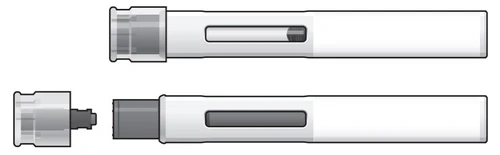
Before use:
After use:

Note: The package contains a small white cylinder, included solely for storage purposes.
Do not remove it!
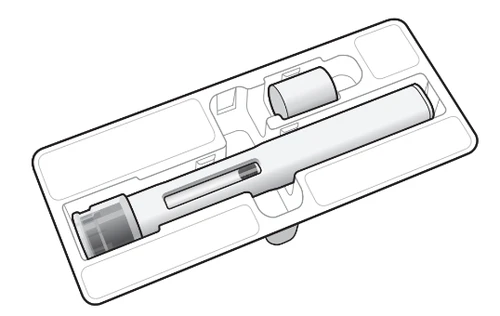
Important information to know before injecting this medicine
- For single use only (do not reuse the pre-filled pen of Oczyesa).
- For subcutaneous injection only (inject directly into the fatty layer under the skin).
- Do not inject intravascularly (into the bloodstream), intradermally (into the skin layer), or intramuscularly (into the muscle).
- Do not use this medicine after the expiry date stated on the box, pouch, or pre-filled pen.
- Do not use if the pre-filled pen appears damaged.
- Do not use if the packaging (cardboard box and pouch) or seal is damaged.
- Do not remove the protective cap until ready to administer the injection.
Storage of the pre-filled pen of Oczyesa
- Store the pre-filled pen in its original packaging to protect the medicine from oxygen and light.
- Do not refrigerate the pre-filled pen.
- Keep Oczyesa out of the sight and reach of children.
Preparation for injection of Oczyesa
Step 1. Gather supplies
Place all necessary supplies for
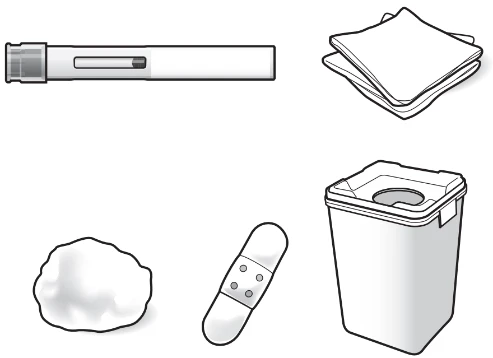
injection on a clean, flat surface:
- Pre-filled pen of Oczyesa
- Alcohol wipe (not included)
- Cotton ball or gauze (not included)
- Adhesive bandage (not included)
- Sharps disposal container (not included) (see Step 10)
Step 2. Inspect the pre-filled pen of Oczyesa
- Remove the pouch from the box. Open the pouch and remove the pre-filled pen.
- Check the label to ensure that
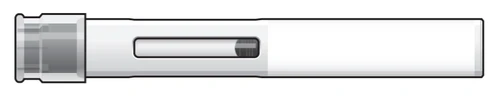
the medicine is correct.
- Check the expiry date printed on the box, pouch, or pre-filled pen. Do not use the pre-filled pen of Oczyesa after the expiry date.
- Check that the liquid is yellowish to yellow in color and clear. An air bubble may be visible. This is normal.
- Do not use this medicine if visible particles are present or if the solution appears cloudy.
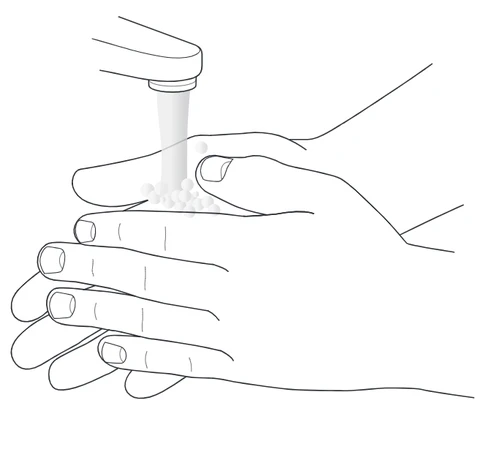
Step 3. Wash hands
- Wash hands thoroughly with soap and water. Dry hands completely.
Step 4. Choose the injection site
- Select an injection site (abdomen, thigh, or buttocks).
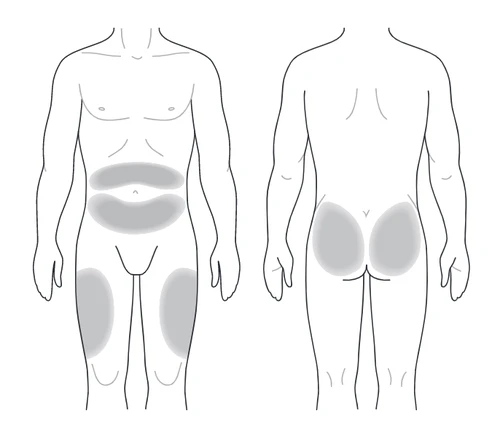
Choose a site within the injection area where sufficient fatty tissue (subcutaneous) is present. Each injection area may have multiple injection sites.
- You may need help from someone who has been trained in administering injections if you cannot reach certain areas.
- Do not inject into areas where the skin is tender, damaged, bruised, or scarred.
- Do not inject into a recent injection site within the selected injection area.
- Do not inject within 5 cm of the navel.
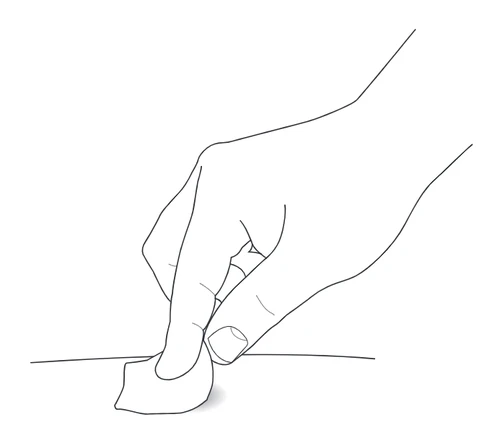
Step 5. Clean the injection site
- Clean the injection site with an alcohol wipe.
- Allow the injection site to dry before administering the injection.
- Do not touch the cleaned area again before the injection.
Step 6. Remove and discard the protective cap
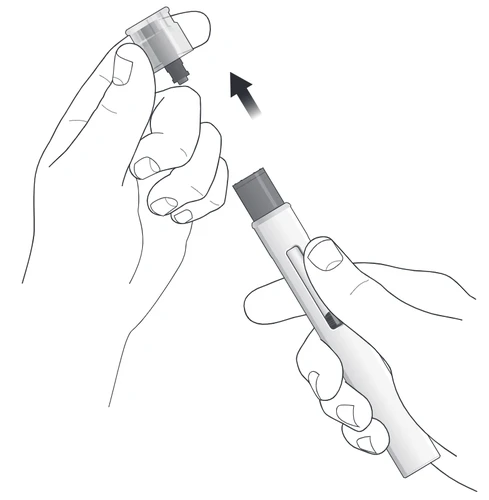
- Hold the pre-filled pen of Oczyesa in one hand with the tip pointing upward. With the other hand, pull off the protective cap. Some force may be required to remove it. Do not twist or swing the cap.
- Do not reattach the cap. Discard the protective cap immediately.
- A drop of liquid may be visible at the needle tip. This is normal.
- Do not touch or press the needle safety shield. This could activate the pre-filled pen.
Injecting Oczyesa
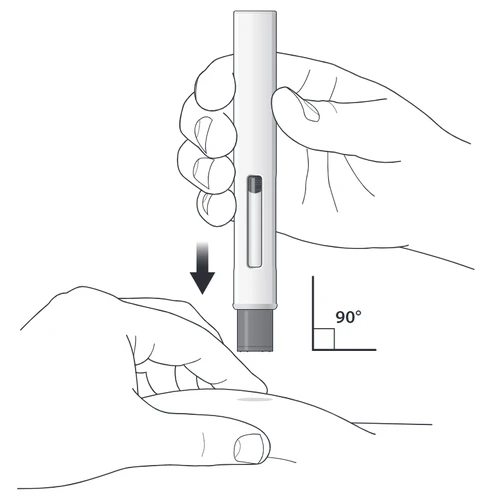
Step 7. Prepare to begin injection
- Lift and hold the skin at the injection site between your thumb and fingers. Keep the skin lifted until
the injection is complete. - With the other hand, hold the pre-filled pen so that the inspection window is visible.
- Position the pre-filled pen vertically (at a 90-degree angle) and flat against the lifted skin.
Step 8. Administer the injection
A
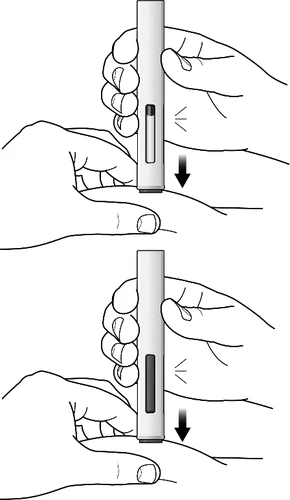
Inject Oczyesa by following the steps shown in figures A,
B, and C.
- Press the pre-filled pen firmly against the skin until fully seated. This will cause the needle safety shield to retract into the pre-filled pen.
- You will hear a first click, indicating that the injection has started.
- The plunger will move downward through the inspection window.
- Continue to hold the pre-filled pen downward. B
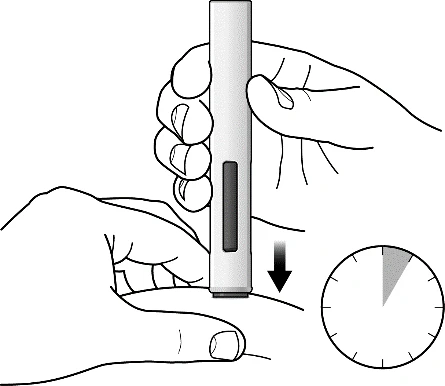
- When you hear the second click, continue to hold the pre-filled pen downward for another 5 seconds.
- Check that the plunger is fully visible in the inspection window.
C
5
Step 9. Remove the pre-filled pen of Oczyesa
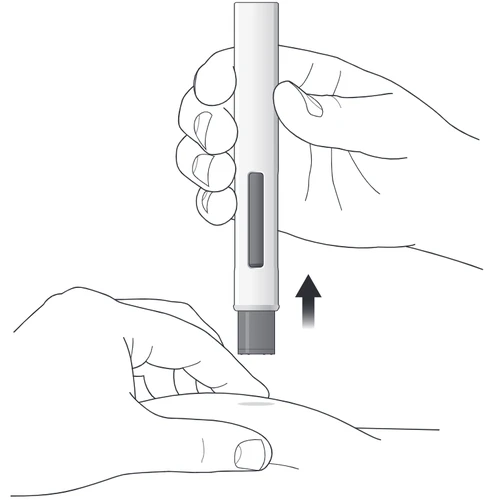
- Remove the pre-filled pen from the skin. The injection is now complete and you may release the lifted skin.
- The needle is automatically shielded by the safety mechanism to prevent needlestick injury.
- A small amount of blood or fluid at the injection site may occur. This is normal. Apply a cotton ball or gauze and a bandage if needed.
- Do not rub the injection site.
Disposal of the pre-filled pen of Oczyesa
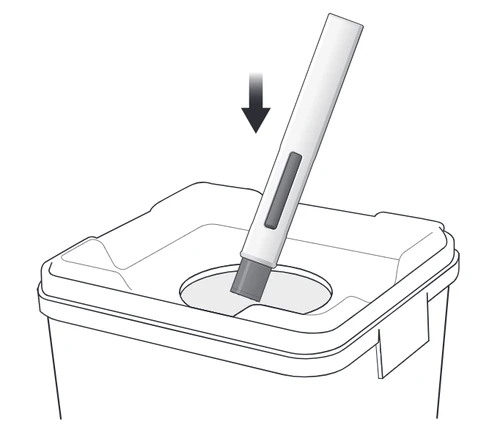
Step 10. Dispose of the pre-filled pen of Oczyesa
Immediately after use, discard (dispose of) the pre-filled pen of Oczyesa in a sharps disposal container.
Do not dispose of pre-filled pens of Oczyesa in household waste.
Any unused medicine and waste materials derived from this medicine must be disposed of in accordance with local regulations.