Octilia
Italy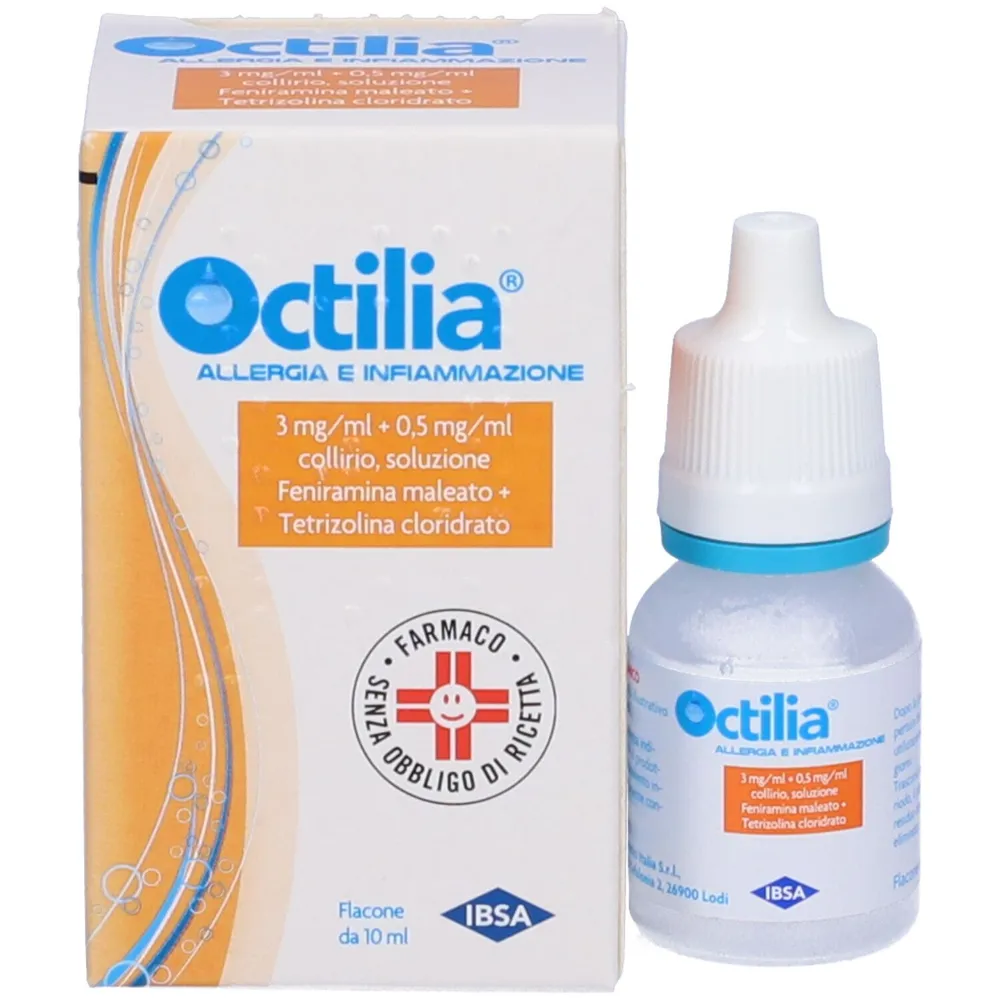
Table of Contents
- PACKAGE LEAFLET: INFORMATION FOR THE USER
- 1. WHAT OCTILIA IS AND WHAT IT IS USED FOR
- 2. WHAT YOU NEED TO KNOW BEFORE USING OCTILIA
- 3. HOW TO USE OCTILIA
- 4. POSSIBLE ADVERSE REACTIONS
- 5. HOW TO STORE OCTILIA
- 6. PACK CONTENTS AND OTHER INFORMATION
- OCTILIA 0.5 mg/ml eye drops, solution, 10 ml bottle
- 1. WHAT OCTILIA IS AND WHAT IT IS USED FOR
- 2. WHAT YOU SHOULD KNOW BEFORE USING OCTILIA
- 3. HOW TO USE OCTILIA
- 4. POSSIBLE ADVERSE REACTIONS
- 5. HOW TO STORE OCTILIA
- 6. CONTENTS OF THE PACKAGE AND OTHER INFORMATION
PACKAGE LEAFLET: INFORMATION FOR THE USER
OCTILIA 0.5 mg/ml eye drops, solution in single-dose container, 10 single-dose units of 0.5 ml
Tetrizoline hydrochloride
Please read this leaflet carefully before using this medicine because it contains important information for you.
- Keep this leaflet. You may need to read it again.
- If you have any questions, ask your doctor or pharmacist.
- This medicine has been prescribed for you. Do not give it to other people, even if their symptoms are the same as yours, as it could be harmful.
- If you experience any adverse reaction, including those not listed in this leaflet, contact your doctor or pharmacist.
- Contact your doctor if you do not notice improvement or if your symptoms worsen after a short period of time.
Contents of this leaflet:
- What OCTILIA is and what it is used for
- What you need to know before using OCTILIA
- How to use OCTILIA
- Possible side effects
- How to store OCTILIA
- Contents of the pack and other information
1. WHAT OCTILIA IS AND WHAT IT IS USED FOR
OCTILIA is an ophthalmic decongestant.
OCTILIA is indicated for the symptomatic treatment of eye irritations caused by smoke, wind, salt water, prolonged exposure to light, allergic conjunctivitis, and other irritants.
2. WHAT YOU NEED TO KNOW BEFORE USING OCTILIA
Do not use OCTILIA
- if you are hypersensitive to tetrizoline or to any of the excipients
- if you have narrow-angle glaucoma (increased intraocular pressure)
- if you have severe eye diseases
- if you have heart problems or suffer from high blood pressure (hypertension)
- if you have a tumor of the adrenal gland (pheochromocytoma)
- if you have overactive thyroid (hyperthyroidism)
- if you have diabetes being treated with insulin
- if you are taking monoamine oxidase inhibitor drugs (so-called MAOIs) or other medicines that may cause increased blood pressure
- if you have dry rhinitis
- if you have inflammation of the cornea and ocular conjunctiva (keratoconjunctivitis)
- in children under three years of age; use of the product in children over three years of age is at the discretion of the physician.
- if the aluminum pouch or containers are visibly damaged.
Warnings and precautions
Talk to your doctor or pharmacist before taking OCTILIA.
In particular:
- if you are over 65 years of age
- if you have eye infections, pus, foreign bodies in the eye, mechanical, chemical or thermal injuries
- if you experience eye pain, headache, sudden visual field disturbances, appearance of visual spots, intense eye redness, light intolerance or diplopia
- if you have hypertension, hyperthyroidism, severe cardiovascular diseases or hyperglycemia due to diabetes mellitus
- if you have temporary mydriasis (pupil dilation)
- if you have swelling and itching around the eye (hyperemia and rebound hyperemia)
Caution for those engaged in sports: the product contains substances prohibited in doping.
Administration differing from the recommended dosage regimen or route of administration is prohibited.
Other medicines and OCTILIA
Do not use OCTILIA if you are being treated with monoamine oxidase inhibitor drugs (a specific class of antidepressants) or with tricyclic antidepressants, as severe hypertensive crises may occur.
Do not use OCTILIA if you are taking medicines that may cause an increase in blood pressure.
In any case, inform your doctor if you are taking or have recently taken any other medicine, including those without a prescription.
Children and adolescents
OCTILIA is contraindicated in children under three years of age; use of the product in children older than three years is at the discretion of the physician.
Pregnancy and breastfeeding
If you are pregnant, suspect you may be pregnant, planning a pregnancy, or breastfeeding, consult your doctor or pharmacist before taking this medicine.
Driving and using machines
OCTILIA has no effect on the ability to drive or operate machinery. In rare cases, the ability to drive and use machinery may be impaired due to slight and temporary blurring of vision.
3. HOW TO USE OCTILIA
Use this medicine exactly as stated in this leaflet or as instructed by your doctor or pharmacist. If you have any doubts, consult your doctor or pharmacist.
This medicine is for ophthalmic use.
Dosage
The recommended dose is 1 or 2 drops of OCTILIA in each eye 2–3 times a day.
Do not exceed the recommended doses.
Use this medicine only for short-term treatment.
Consult your doctor if symptoms recur repeatedly or if you notice any recent changes in their characteristics.
Instructions for use
After opening the protective pouch, separate a single-dose container from the others. Remove the cap by twisting and pulling it off. Instill one or two drops of OCTILIA into the eye by gently squeezing the body of the container. To avoid contamination of the product, avoid contact between the dropper tip and any surface.
This product should be used exclusively for minor eye irritations. If you do not experience relief within 48 hours, or if redness worsens or persists, discontinue use and consult a doctor.
Stop treatment as soon as symptoms disappear. Treatment should not last longer than one week.
If you use more OCTILIA than you should
Accidental ingestion or prolonged use of OCTILIA at excessive doses may lead to toxic effects. Ingestion of ophthalmic tetrizoline solution may be associated with cardiovascular instability, central nervous system (CNS) depression including drowsiness and coma, and respiratory depression including apnea.
Symptoms associated with overdose include: pupil dilation, blue discoloration of the skin and mucous membranes, nausea, fever, cramps, altered heart rhythm, cardiac arrest, hypertension, pulmonary edema, and respiratory and mental disturbances.
Keep the product out of reach of children, as accidental ingestion may cause profound sedation.
In case of accidental ingestion or overdose of OCTILIA, inform your doctor immediately or go to the nearest hospital.
If you forget to use OCTILIA
Do not use a double dose to make up for the missed dose.
If you stop using OCTILIA
If you have any questions about using this medicine, consult your doctor or pharmacist.
4. POSSIBLE ADVERSE REACTIONS
Like all medicines, OCTILIA may cause adverse reactions, although not everyone experiences them.
Uncommon (affects from 1 to 10 users out of 1,000): redness of the ocular mucosa, dry eyes, hyperemia, palpitations, headache, tremor, weakness, sweating, and increased blood pressure.
Rare (affects from 1 to 10 users out of 10,000): blurred vision, conjunctival irritation, and pupil dilation (mydriasis).
Prolonged and frequent use may lead to dry eye syndrome.
Only with very high doses can hypertension, cardiac disorders, or hyperglycemia occur.
Following the instructions provided in this leaflet reduces the risk of adverse reactions.
Reporting of adverse reactions
If you experience any adverse reaction, including those not listed in this leaflet, please contact your doctor or pharmacist. You may also report adverse reactions directly via the national reporting system at the following website: https://www.aifa.gov.it/content/segnalazioni-reazioni-avverse. By reporting adverse reactions, you can help provide more information on the safety of this medicine.
5. HOW TO STORE OCTILIA
Keep this medicine out of sight and reach of children.
Store this medicine below 30°C.
Do not use this medicine after the expiry date stated on the carton (“Exp.”). The expiry date refers to the last day of the month indicated, provided the product remains unopened and is stored correctly.
Do not use this medicine if you notice any signs of deterioration in the solution.
Do not dispose of this medicine via wastewater or household waste. Ask your pharmacist how to dispose of medicines you no longer use. This will help protect the environment.
Validity after opening
Use immediately after opening and discard any remaining solution.
6. PACK CONTENTS AND OTHER INFORMATION
What OCTILIA contains
The active substance is Tetrizoline hydrochloride.
The excipients are: Sodium chloride, Boric acid, Borax, Sodium hydroxide or Hydrochloric acid (for pH adjustment), Water for injections.
Description of the appearance of OCTILIA and pack contents
Carton containing 10 single-dose units of 0.5 ml each, divided into 2 strips of 5 units, individually packaged in aluminium sachets.
Marketing Authorization Holder and Manufacturer:
IBSA Farmaceutici Italia S.r.l., Via Martiri di Cefalonia 2, 26900 Lodi
Tel. 03716171 Fax. 0371617244
Manufacturer
Farmigea S.p.A., Via G.B. Oliva, 8 – 56121 Pisa
Tel: 05031211; Fax: 050-3121255; e-mail: [email protected]
PACKAGE LEAFLET: INFORMATION FOR THE USER
OCTILIA 0.5 mg/ml eye drops, solution, 10 ml bottle
tetrahydrozoline hydrochloride
Please read this leaflet carefully before using this medicine because it contains important information for you.
Always use this medicine exactly as described in this leaflet or as your doctor or pharmacist has instructed you.
- Keep this leaflet. You may need to read it again.
- If you need more information or advice, consult your pharmacist.
- If you experience any side effects, including those not listed in this leaflet, contact your doctor or pharmacist. See section 4.
- Contact your doctor if you do not notice improvement or if your symptoms worsen after a short period of time.
Contents of this leaflet:
- What OCTILIA is and what it is used for
- What you need to know before using OCTILIA
- How to use OCTILIA
- Possible side effects
- How to store OCTILIA
- Contents of the pack and other information
1. WHAT OCTILIA IS AND WHAT IT IS USED FOR
OCTILIA is an ophthalmic decongestant.
OCTILIA is indicated for the symptomatic treatment of eye irritations caused by smoke, wind, salt water, prolonged exposure to light, allergic conjunctivitis, and other irritating agents.
2. WHAT YOU SHOULD KNOW BEFORE USING OCTILIA
Do not use OCTILIA
- if you are hypersensitive to tetrahydrozoline or to any of the excipients
- if you have narrow-angle glaucoma (increased intraocular pressure)
- if you have severe eye diseases
- if you have heart problems or suffer from high blood pressure (hypertension)
- if you have a tumor of the adrenal gland (pheochromocytoma)
- if you have overactive thyroid (hyperthyroidism)
- if you have diabetes being treated with insulin
- if you are taking monoamine oxidase inhibitor drugs (so-called MAOIs) or other medicines that may cause an increase in blood pressure
- if you have dry rhinitis
- if you have inflammation of the cornea and conjunctiva (keratoconjunctivitis)
- in children under three years of age; use in children over three years of age is at the discretion of the physician
- if the container is visibly damaged
Warnings and precautions
Consult your doctor or pharmacist before using OCTILIA.
In particular:
- if you are over 65 years of age
- if you have eye infections, pus, foreign bodies in the eye, or mechanical, chemical or thermal injuries
- if you experience eye pain, headache, sudden visual field disturbances, appearance of visual spots, intense eye redness, light sensitivity, or diplopia (double vision)
- if you have hypertension, hyperthyroidism, severe cardiovascular diseases, or hyperglycemia due to diabetes mellitus
- if you have temporary mydriasis (pupil dilation)
- if you have swelling and itching around the eye (hyperemia and rebound hyperemia)
- if you wear soft contact lenses (for further information, see section “OCTILIA contains benzalkonium chloride”)
Attention for athletes: This product contains substances prohibited in doping. Any use differing from the recommended dosage regimen or route of administration is forbidden.
Other medicines and OCTILIA
Do not use OCTILIA if you are being treated with monoamine oxidase inhibitor drugs (a specific class of antidepressants) or with tricyclic antidepressants, as severe hypertensive crises may occur.
Do not use OCTILIA if you are taking other medicines that may increase blood pressure.
In any case, inform your doctor if you are taking or have recently taken any other medicines, including those without a prescription.
Children and adolescents
OCTILIA is contraindicated in children under three years of age. Use in children over three years of age is at the discretion of the physician.
Pregnancy and breastfeeding
If you are pregnant, think you may be pregnant, are planning to become pregnant, or are breastfeeding, consult your doctor or pharmacist before using this medicine.
Driving and using machines
OCTILIA has no relevant effect on the ability to drive or operate machinery. In rare cases, the ability to drive or use machinery may be impaired due to slight and temporary blurring of vision.
OCTILIA contains benzalkonium chloride
This medicine contains 0.01 mg of benzalkonium chloride per dose (maximum 2 drops), equivalent to 0.1 mg/ml. Benzalkonium chloride may be absorbed by soft contact lenses and may change their color. Remove contact lenses before using this medicine and wait 15 minutes before reinserting them. Benzalkonium chloride may also cause eye irritation, especially if you have dry eye or corneal disorders (damage to the cornea, the eye’s most superficial transparent layer). If you experience any unusual sensation, burning, or pain in the eye after using this medicine, consult your doctor.
3. HOW TO USE OCTILIA
Use this medicine exactly as stated in this leaflet or as directed by your doctor or pharmacist. If you have any doubts, consult your doctor or pharmacist.
This medicine is for ophthalmic use.
Dosage
The recommended dose is 1 or 2 drops of OCTILIA in each eye 2–3 times a day.
Do not exceed the recommended doses.
Use this medicine only for short-term treatment.
Consult your doctor if symptoms recur repeatedly or if you notice any recent changes in their characteristics.
How to use
Administer one or two drops of OCTILIA by applying gentle pressure on the body of the bottle.
To avoid contamination of the product, avoid contact between the dropper tip and any surface.
This product should be used exclusively for minor eye irritations. If you do not experience relief within 48 hours, or if redness increases or persists, discontinue use and consult a doctor.
Stop treatment as soon as symptoms disappear. Treatment should not last longer than one week.
If you use more OCTILIA than you should
Accidental ingestion or prolonged use of OCTILIA at excessive doses may lead to toxic effects. Ingestion of tetryzoline ophthalmic solution may be associated with cardiovascular instability, central nervous system depression including drowsiness and coma, and respiratory depression including apnea.
Symptoms associated with overdose include: pupil dilation, blue discoloration of the skin and mucous membranes, nausea, fever, cramps, altered heart rhythm, cardiac arrest, hypertension, pulmonary edema, and respiratory and mental disturbances.
Keep the product out of the reach of children, as accidental ingestion may cause severe sedation.
In case of accidental ingestion or overdose of OCTILIA, contact your doctor immediately or go to the nearest hospital.
If you forget to use OCTILIA
Do not use a double dose to make up for the missed dose.
If you stop using OCTILIA
If you have any questions about using this medicine, consult your doctor or pharmacist.
4. POSSIBLE ADVERSE REACTIONS
Like all medicines, OCTILIA may cause adverse reactions, although not everyone experiences them.
Uncommon (affects from 1 to 10 users out of 1,000): redness of the ocular mucosa, dry eyes, hyperemia, palpitations, headache, tremor, weakness, sweating, and increased blood pressure.
Rare (affects from 1 to 10 users out of 10,000): blurred vision, conjunctival irritation, and pupil dilation (mydriasis).
Prolonged and frequent use may lead to dry eye syndrome.
Only with very high doses can hypertension, cardiac disorders, or hyperglycemia occur.
Following the instructions contained in this leaflet reduces the risk of adverse reactions.
Reporting of adverse reactions
If you experience any adverse reaction, including those not listed in this leaflet, contact your doctor or pharmacist. You may also report adverse reactions directly via the national reporting system at the following address: https://www.aifa.gov.it/content/segnalazioni-reazioni-avverse. By reporting adverse reactions, you can help provide more information on the safety of this medicine.
5. HOW TO STORE OCTILIA
Keep this medicine out of the sight and reach of children.
Do not store the medicine above 25°C.
Do not use this medicine after the expiry date stated on the carton (“Exp.”). The expiry date refers to the last day of the month in the original packaging, when stored correctly.
Do not use this medicine if you notice any signs of deterioration of the solution.
Do not dispose of this medicine via wastewater or household waste. Ask your pharmacist how to dispose of medicines you no longer use. This will help protect the environment.
Validity after opening
Use within 4 weeks of opening the bottle.
6. CONTENTS OF THE PACKAGE AND OTHER INFORMATION
What OCTILIA contains
The active substance is tetrizoline hydrochloride.
The excipients are: sodium chloride, boric acid, borax, benzalkonium chloride solution, disodium edetate,
sodium hydroxide or hydrochloric acid (for pH adjustment), water for injections.
Description of the appearance of OCTILIA and contents of the package
10 ml bottle with a dedicated dropper.
Marketing Authorization Holder and Manufacturer:
Marketing Authorization Holder:
IBSA Farmaceutici Italia S.r.l., Via Martiri di Cefalonia 2, 26900 Lodi
Tel. 03716171 Fax. 0371617244 e-mail: [email protected]
Manufacturer:
Farmigea S.p.A., Via G.B. Oliva 8, 56121 Pisa (PI), Italy