Obizur
Italy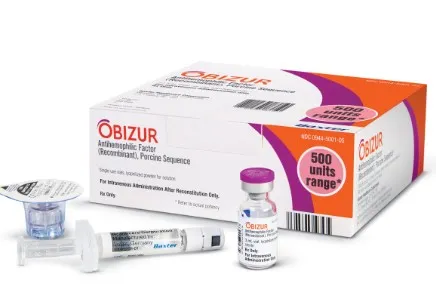
Table of Contents
- Patient Information Leaflet
- OBIZUR 500 U powder and solvent for injectable solution
- 1. What OBIZUR is and what it is used for
- 2. What you need to know before receiving OBIZUR
- 3. How OBIZUR is administered
- 4. Possible side effects
- 5. How OBIZUR is stored
- 6. Package contents and other information
- The following information is intended exclusively for healthcare professionals:
Patient Information Leaflet
OBIZUR 500 U powder and solvent for injectable solution
susoctocog alfa
This medicinal product is subject to additional monitoring. This will allow for rapid identification of new safety information. You can help by reporting any side effects you experience while taking this medicine. See the end of section 4 for information on how to report side effects.
Please read this leaflet carefully before using this medicine because it contains important information for you.
- Keep this leaflet. You may need to read it again.
- If you have any questions, consult your doctor.
- If you experience any side effects, including those not listed in this leaflet, consult your doctor. See section 4.
Contents of this leaflet
- What OBIZUR is and what it is used for
- What you need to know before receiving OBIZUR
- How OBIZUR is administered
- Possible side effects
- How to store OBIZUR
- Contents of the pack and other information
1. What OBIZUR is and what it is used for
OBIZUR contains the active substance susoctocog alfa, antihaemophilic factor VIII, with porcine sequence.
Factor VIII is necessary for blood to clot and to stop bleeding.
In patients with acquired haemophilia, factor VIII does not work properly because the patient
has developed antibodies against their own factor VIII, which neutralize this blood clotting factor.
OBIZUR is used for the treatment of bleeding episodes in adults with acquired haemophilia
(a bleeding disorder caused by deficient factor VIII activity due to the development of antibodies).
The neutralizing effect of these antibodies on OBIZUR is lower compared to their effect on human factor VIII.
OBIZUR restores the missing factor VIII activity and helps blood to form clots at the site of bleeding.
2. What you need to know before receiving OBIZUR
The medicine must be used only in a hospital setting and requires clinical monitoring of the patient's bleeding status.
OBIZUR must not be administered
- if you are allergic to susoctocog alfa or to any of the other ingredients of this medicine (listed in section 6);
- if you are allergic to hamster proteins (which may be present in trace amounts in OBIZUR as residuals from the manufacturing process);
- if you have congenital haemophilia A with inhibitors (CHAWI).
If you have any doubts, consult your doctor before receiving this medicine.
Warnings and precautions
Talk to your doctor before receiving OBIZUR.
Hypersensitivity
There is a rare possibility that you may develop an allergic reaction to OBIZUR. You should be aware of the early signs of allergic reactions (see section 4 for signs and symptoms).
If any of these symptoms occur, the infusion must be stopped. Severe symptoms, including difficulty breathing and fainting (or feeling faint), require emergency treatment in hospital.
Inhibitors
Your doctor may check whether you have inhibitory antibodies against porcine factor VIII, as well as any increases in such antibodies.
Your doctor will monitor your blood factor VIII levels to confirm that you are receiving an adequate amount of factor VIII. Your doctor will also ensure that bleeding is adequately controlled.
Cardiovascular events
Consult your doctor if you have or have had cardiovascular disease in the past, or if you have a known risk of thrombosis (diseases caused by blood clots in normal blood vessels), as thromboembolic disorders cannot be ruled out with persistently elevated factor VIII levels.
Children and adolescents
There is no information available on the use of OBIZUR in children and adolescents under 18 years of age.
Other medicines and OBIZUR
Inform your doctor if you are currently using, have recently used, or might use any other medicines.
No interactions between OBIZUR and other medicines are known.
Pregnancy and breastfeeding
If you are pregnant, suspect you may be pregnant, planning to become pregnant, or are breastfeeding, consult your doctor before using this medicine.
Driving and using machines
OBIZUR does not affect the ability to drive or operate machinery.
OBIZUR contains sodium
Once prepared, this medicine contains 4.6 mg of sodium per millilitre. This corresponds to 0.23% of the maximum daily recommended dietary intake for an adult. Each dose requires the use of multiple vials.
Consult your doctor if you are on a low-sodium diet.
OBIZUR contains polysorbate 80
This medicine contains up to 0.05 mg of polysorbate 80 per each mL of reconstituted solution, equivalent to 0.05 mg/mL. Polysorbates may cause allergic reactions. Inform your doctor if you have known allergies.
3. How OBIZUR is administered
Treatment with OBIZUR will be managed by a doctor experienced in treating patients with
haemophilia (bleeding disorders).
The doctor will calculate the dose of OBIZUR (in units, or U) based on your condition and body weight.
The frequency and duration of administration will depend on how effective OBIZUR proves to be.
Usually, replacement therapy with OBIZUR is a temporary treatment until the bleeding episode resolves
or until antibodies against factor VIII are eliminated.
Your doctor will monitor you to check whether you have antibodies against OBIZUR.
The recommended initial dose is 200 U per kilogram of body weight, administered by intravenous injection.
The doctor will regularly measure factor VIII activity to determine the dose and frequency of subsequent
OBIZUR administrations.
Bleeding usually responds within the first 24 hours, and the doctor will adjust the dose and duration of
OBIZUR treatment until the bleeding stops.
The total volume of reconstituted OBIZUR must be administered at a rate of 1-2 mL per minute.
If you have any doubts about the use of this medicine, consult your doctor.
4. Possible side effects
Like all medicines, this medicine can cause side effects, although not everyone experiences them.
If a sudden allergic reaction occurs, stop the injection immediately.
If any of the following initial symptoms appear, contact your doctor immediately:
- swelling of the lips and tongue;
- burning and irritation at the injection site;
- chills, flushing;
- hives, generalized itching;
- headache, low blood pressure;
- lethargy, nausea, restlessness;
- rapid heartbeat, chest tightness;
- tingling, vomiting;
- wheezing.
Very common side effects (may affect more than 1 in 10 people)
- Development of inhibitory antibodies and increase in pre-existing antibodies against the medicine, which may result in loss of efficacy and continued occurrence of bleeding.
Reporting of side effects
If you experience any side effect, including those not listed in this leaflet, consult your doctor. You may also report side effects directly via the national reporting system listed in Annex V. Reporting side effects can help provide more information on the safety of this medicine.
5. How OBIZUR is stored
Keep this medicine out of the sight and reach of children.
Do not use this medicine after the expiry date stated on the carton, vial, and pre-filled syringe after Exp. The expiry date refers to the last day of that month.
Store in a refrigerator (2 °C – 8 °C).
Do not freeze.
Use the reconstituted solution immediately, but no later than 3 hours after complete dissolution of the powder.
After reconstitution, the solution should appear clear and colourless.
Do not administer if particulate matter is present or if there is any change in colour.
Since this medicine is used during hospitalization, hospital staff are responsible for its proper storage before and during use, as well as for its proper disposal.
Name and batch number
Medical personnel are strongly advised to record the name and batch number of the medicine each time OBIZUR is used, in order to maintain a link between the treatment and the medicine batch.
6. Package contents and other information
What OBIZUR contains
- The active substance is susoctocog alfa (porcine-sequence antihaemophilic factor, produced using recombinant DNA technology). Each vial of powder contains 500 U of susoctocog alfa.
- The other components of the powder are polysorbate 80 (E433) (see section 2, “OBIZUR contains polysorbate 80”), sodium chloride (see section 2, “OBIZUR contains sodium”), calcium chloride dihydrate (E509), sucrose, tromethamine, hydrochloric acid tromethamine, and sodium citrate (E331).
- The solvent is 1 mL of sterile water for injectable preparations.
Description of the appearance of OBIZUR and contents of the pack
A pack contains 1, 5 or 10 of the following:
- A glass vial containing 500 U of white powder of OBIZUR, with a butyl rubber stopper coated with a fluoropolymer film and flip-off cap;
- A pre-filled glass syringe with a bromobutyl rubber stopper coated with a fluoropolymer film on the contact side, containing 1 mL of sterile water for injectable preparations, with a bromobutyl rubber cap and Luer lock adapter;
- A liquid transfer device with an integrated plastic needle.
Marketing Authorisation Holder
Baxalta Innovations GmbH
Industriestrasse 67
1221 Vienna
Austria
Manufacturer
Takeda Manufacturing Austria AG
Industriestrasse 67
1221 Vienna
Austria
For further information about this medicinal product, please contact the local representative of the Marketing Authorisation Holder:
België/Belgique/Belgien Lietuva
Takeda Belgium NV Takeda, UAB
Tél/Tel: +32 2 464 06 11 Tel: +370 521 09 070
[email protected] [email protected]
България Luxembourg/Luxemburg
Такеда България ЕООД Takeda Belgium NV
Тел.: +359 2 958 27 36 Tél/Tel: +32 2 464 06 11
[email protected] [email protected]
Česká republika Magyarország
Takeda Pharmaceuticals Czech Republic s.r.o. Takeda Pharma Kft.
Tel: +420 234 722 722 Tel.: +36 1 270 7030
[email protected] [email protected]
Danmark Malta
Takeda Pharma A/S Τakeda HELLAS S.A.
Tlf.: +45 46 77 10 10 Tel: +30 210 6387800
[email protected] [email protected]
Deutschland Nederland
Takeda GmbH Takeda Nederland B.V.
Tel: +49 (0)800 825 3325 Tel: +31 20 203 5492
[email protected] [email protected]
Eesti Norge
Takeda Pharma OÜ Takeda AS
Tel: +372 6177 669 Tlf: +47 800 800 30
[email protected] [email protected]
Ελλάδα Österreich
Τakeda ΕΛΛΑΣ Α.Ε. Takeda Pharma Ges.m.b.H.
Tηλ: +30 210 6387800 Tel: +43 (0) 800-20 80 50
[email protected] [email protected]
España Polska
Takeda Farmacéutica España, S.A. Takeda Pharma Sp. z o.o.
Tel: +34 917 90 42 22 Tel.: +48223062447
[email protected] [email protected]
France Portugal
Takeda France SAS Takeda Farmacêuticos Portugal, Lda.
Tél: +33 1 40 67 33 00 Tel: +351 21 120 1457
[email protected] [email protected]
Hrvatska România
Takeda Pharmaceuticals Croatia d.o.o. Takeda Pharmaceuticals SRL
Tel: +385 1 377 88 96 Tel: +40 21 335 03 91
[email protected] [email protected]
Ireland Slovenija
Takeda Products Ireland Ltd Takeda Pharmaceuticals farmacevtska družba d.o.o.
Tel: 1800 937 970 Tel: +386 (0) 59 082 480
[email protected] [email protected]
Ísland Slovenská republika
Vistor ehf. Takeda Pharmaceuticals Slovakia s.r.o.
Sími: +354 535 7000 Tel: +421 (2) 20 602 600
[email protected] [email protected]
Italia Suomi/Finland
Takeda Italia S.p.A. Takeda Oy
Tel: +39 06 502601 Puh/Tel: 0800 774 051
[email protected] [email protected]
Κύπρος Sverige
Τakeda ΕΛΛΑΣ Α.Ε. Takeda Pharma AB
Τηλ: +30 210 6387800 Tel: 020 795 079
[email protected] [email protected]
Latvija
Takeda Latvia SIA
Tel: +371 67840082
[email protected]
This medicinal product has been authorised under “exceptional circumstances”. This means that, because the disease is rare, it has not been possible to obtain complete information about this medicinal product. The European Medicines Agency will review any new information on this medicinal product annually, and this package leaflet will be updated if necessary.
Other sources of information
More detailed information on this medicinal product is available on the website of the European Medicines Agency: https://www.ema.europa.eu.
The following information is intended exclusively for healthcare professionals:
PREPARATION AND ADMINISTRATION INSTRUCTIONS
Preparation
Before beginning reconstitution, ensure the following are available:
- the calculated number of vials of powder;
- the same number of pre-filled syringes with 1 mL of solvent and sterile vial adapters;
- alcohol swabs;
- a sterile, large-capacity syringe capable of holding the final volume of the reconstituted product.
The procedures described below are provided as general guidelines for the preparation and
reconstitution of OBIZUR. Repeat the reconstitution instructions below for each vial of powder to be reconstituted.
Reconstitution
During the reconstitution procedure, use aseptic technique.
- Allow the vial of OBIZUR powder and the pre-filled syringe with solvent to reach room temperature.
- Remove the plastic cap from the vial of OBIZUR powder ( Figure A ).
- Wipe the rubber stopper with an alcohol swab (not provided) and allow it to dry before use.
- Peel off the packaging cover of the vial adapter ( Figure B ). Do not touch the Luer lock (end) in the center of the vial adapter. Do not remove the vial adapter from its packaging.
- Place the vial adapter packaging on a clean surface with the Luer lock facing upward.
- Remove the tamper-evident cap from the pre-filled syringe with solvent ( Figure C ).
- Firmly holding the vial adapter packaging, connect the pre-filled syringe with solvent to the vial adapter by pushing the syringe tip downward onto the Luer lock in the center of the adapter and rotating the syringe clockwise until securely attached. Do not overtighten ( Figure D ).
- Remove the plastic packaging ( Figure E ).
- Place the vial of OBIZUR powder on a clean, flat, rigid surface. Place the vial adapter over the vial of OBIZUR powder and firmly push the filter perforator of the adapter through the center of the rubber closure of the vial until the transparent plastic cap snaps into place on the vial ( Figure F ).
- Push the plunger down slowly to inject all of the solvent from the syringe into the vial of OBIZUR powder.
- Gently swirl (in a circular motion) the vial of OBIZUR powder without removing the syringe until the powder is completely dissolved/reconstituted ( Figure G ). Before administration, visually inspect the reconstituted solution for particulate matter. Do not use if particulate matter is present or if discoloration occurs.
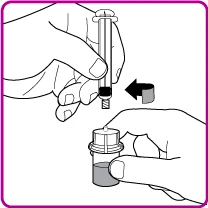
- With one hand holding the vial with the adapter, firmly grasp the barrel of the pre-filled syringe with the other hand and unscrew the syringe from the vial adapter by rotating it counterclockwise ( Figure H ).
- Use OBIZUR immediately and within 3 hours after reconstitution, if stored at room temperature.
Figure A Figure B Figure C Figure D
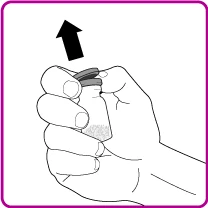
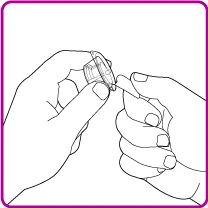
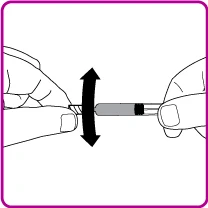
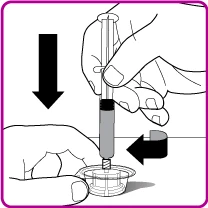
Figure E Figure F Figure G Figure H
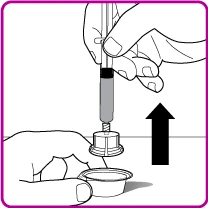
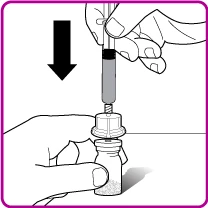
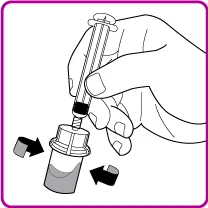
Administration
For intravenous injection only.
- Before administration, visually inspect the reconstituted OBIZUR solution for particulate matter and discoloration. The solution should appear clear and colorless. Do not administer if particulate matter or discoloration is present.
- Do not administer OBIZUR in the same line or container as other injectable medications.
Using aseptic technique, administer according to the following procedure:
- After reconstituting all vials, connect a large-capacity syringe to the vial adapter by gently pushing the syringe tip downward onto the Luer lock at the center of the adapter and rotating the syringe clockwise until securely attached.
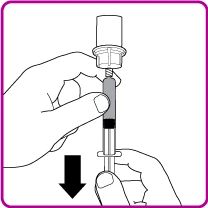
- Invert the vial; inject air from the syringe into the vial and withdraw the reconstituted OBIZUR into the syringe ( Figure I ).
- Unscrew the large-capacity syringe from the vial adapter by rotating counterclockwise and repeat the procedure for all reconstituted OBIZUR vials until the total required volume is obtained.
- Administer the reconstituted OBIZUR intravenously at a rate of 1–2 mL per minute. Figure I
The initial dose of OBIZUR required for a given patient is calculated using the following formula:
Initial dose (U/kg) ÷ Medicinal product concentration (U/vial) × Body weight (kg) = Number of vials
Example of initial dose calculation for a patient weighing 70 kg:
200 U/kg ÷ 500 U/vial × 70 kg = 28 vials
Dosage
The recommended initial dose is 200 U per kilogram of body weight, administered by intravenous injection.
| Type of bleeding | Desired minimum factor VIII activity (units per dL or % of normal value) | Initial dose (units per kg) | Subsequent dose | Frequency and duration of subsequent administration |
| Mild to moderate bleeding from superficial muscles / absence of neurovascular compromise and joint hemorrhage | >50% | 200 | Determine subsequent doses based on clinical response and in order to | Administer every 4–12 hours, adjusting frequency according to clinical response and factor VIII activity |
| Type of bleeding | Desired minimum factor VIII activity (units per dL or % of normal value) | Initial dose (units per kg) | Subsequent dose | Frequency and duration of subsequent administration |
| Intramuscular, retroperitoneal, gastrointestinal, intracranial, moderate to severe bleeding | >80% | maintain the desired minimum factor VIII activity | measured factor VIII activity |