Obgemsa
Italy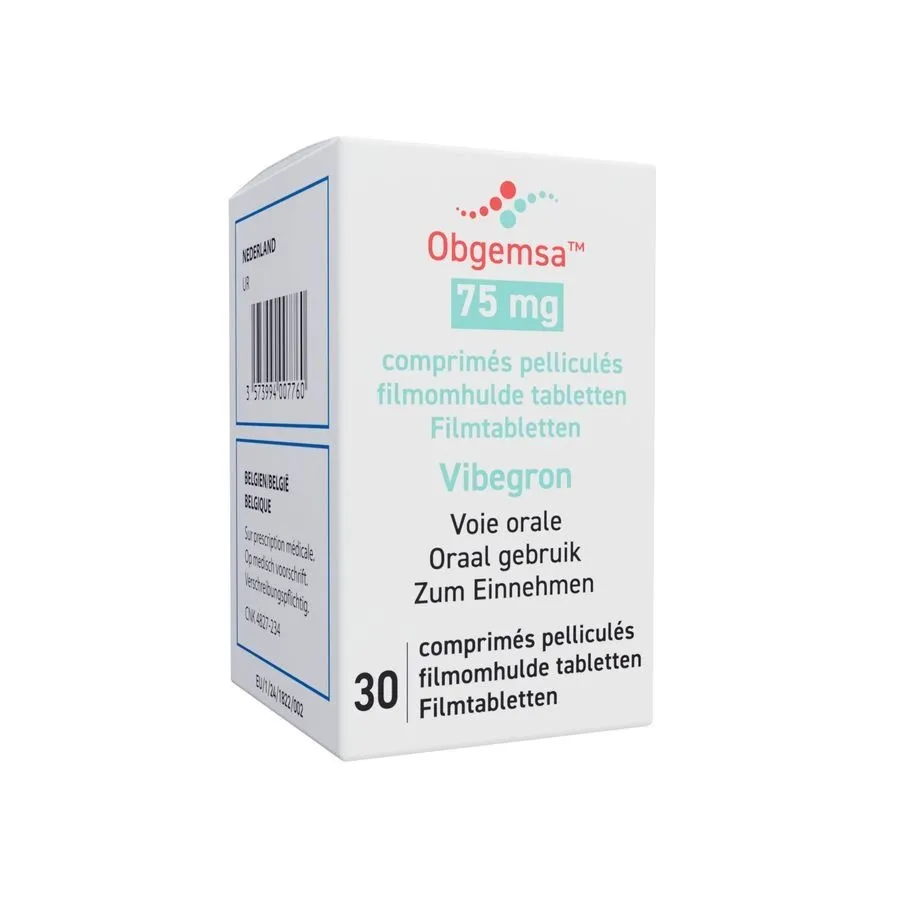
Table of Contents
Package leaflet: Information for the patient
Obgemsa 75 mg film-coated tablets
vibegron
This medicinal product is subject to additional monitoring. This will allow rapid identification of new
safety information. You can help by reporting any side effects you experience while taking this
medicinal product. See the end of section 4 for information on how to report side effects.
Please read all of this leaflet carefully before you start taking this medicine as it contains
important information for you.
- Keep this leaflet. You may need to read it again.
- If you have any questions, ask your doctor or pharmacist.
- This medicine has been prescribed for you only. Do not give it to other people, even if they have the same symptoms as you, because it may be harmful.
- If you experience any side effect, including those not listed in this leaflet, talk to your doctor or pharmacist. See section 4.
Contents of this leaflet
- What Obgemsa is and what it is used for
- What you need to know before taking Obgemsa
- How to take Obgemsa
- Possible side effects
- How to store Obgemsa
- Contents of the pack and other information
1. What Obgemsa is and what it is used for
Obgemsa contains the active substance vibegron. It is a relaxant of the bladder muscle
(a so-called beta-3 adrenergic receptor agonist) that reduces the activity of an overactive bladder
and treats the associated symptoms.
Obgemsa is used to treat symptoms of overactive bladder in adults, such as:
- sudden need to empty the bladder (urgency)
- need to empty the bladder more often than normal (increased urinary frequency)
- inability to control bladder emptying with loss of urine (urgency urinary incontinence)
2. What you need to know before taking Obgemsa
Do not take Obgemsa
- if you are allergic to vibegron or to any of the other ingredients of this medicine (listed in section 6).
Warnings and precautions
Talk to your doctor or pharmacist before taking Obgemsa:
- if you have problems emptying your bladder or have a weak urinary stream, or if you are taking other medicines for the treatment of overactive bladder syndrome, such as anticholinergic medicines, for example oxybutynin, diphenhydramine, solifenacin. Obgemsa must not be used if you have severe liver problems or end-stage renal disease.
Children and adolescents
Do not give this medicine to children and adolescents under 18 years of age, as the safety and efficacy of Obgemsa in this age group have not yet been established.
Other medicines and Obgemsa
Tell your doctor or pharmacist if you are taking, have recently taken, or might take any other medicines.
Inform your doctor if you are taking digoxin (a medicine used to treat heart failure or heart rhythm disorders). Your doctor will monitor blood levels of this medicine. If blood levels are outside the normal range, your doctor may decide to adjust the dose of digoxin.
Inform your doctor if you are taking dabigatran etexilate (an anticoagulant), apixaban (an anticoagulant), or rivaroxaban (an antithrombotic agent). These medicines may require dose adjustments by your doctor.
Pregnancy and breastfeeding
Women of childbearing potential
If you suspect you are pregnant or are planning a pregnancy, you must not take Obgemsa. This is because the effect of the medicine on the unborn baby is unknown.
Pregnancy
If you are pregnant, you must not take Obgemsa. This is because it is unknown how this medicine will affect the baby.
Breastfeeding
This medicine is likely to pass into breast milk, but the risks to the baby are unknown. Therefore, you must not breastfeed while taking Obgemsa.
Driving and using machines
Obgemsa has no effect or has a negligible effect on the ability to drive and use machines.
Obgemsa contains lactose
If your doctor has diagnosed you with an intolerance to certain sugars, contact him/her before taking this medicine.
Obgemsa contains sodium
This medicine contains less than 1 mmol (23 mg) of sodium per tablet, i.e., it is essentially “sodium-free”.
3. How to take Obgemsa
Take this medicine exactly as your doctor has instructed you. If you have any doubts, consult your doctor or pharmacist.
The recommended dose of this medicine is 1 tablet daily.
Swallow the tablet with a glass of water. If necessary, the tablet may be crushed and mixed with 1 tablespoon (approximately 15 mL) of soft food (e.g. apple puree). Take the mixture and drink a glass of water immediately afterwards. Once mixed with food, take the mixture immediately. You may take the tablet with or without food.
If you take more Obgemsa than you should
If you have taken more tablets than prescribed, contact your doctor, pharmacist or hospital immediately. If someone else has accidentally taken your tablets, contact your doctor, pharmacist or hospital immediately. Symptoms of overdose may include gastrointestinal disturbances, headache and breathing difficulties.
If you forget to take Obgemsa
If you forget to take a dose, take the next dose at the usual time the following day. Do not take a double dose to make up for the forgotten tablet. If you forget to take several doses, contact your doctor and follow their advice.
If you stop taking Obgemsa
Do not stop treatment with Obgemsa prematurely if you do not see an immediate effect. Your bladder may need some time to adjust. Continue taking the tablets.
Do not stop taking Obgemsa when symptoms improve, as stopping treatment may cause symptoms of overactive bladder syndrome to return. Consult your doctor before stopping Obgemsa.
If you have any doubts about how to use this medicine, consult your doctor or pharmacist.
4. Possible side effects
Like all medicines, this medicine can cause side effects, although not everybody gets them.
An uncommon side effect (may affect up to 1 in 100 people) is the inability to empty the bladder (urinary retention). Obgemsa may increase the difficulty in emptying the bladder, especially if you have an obstruction to bladder emptying or if you are taking other medicines to treat overactive bladder. Contact your doctor immediately if you are unable to empty your bladder.
Other side effects include:
Common side effects (may affect up to 1 in 10 people)
- headache
- diarrhoea
- nausea
- constipation
- urinary tract infection (infection of the tubes that carry urine)
- increased urinary residual volume (an increase in the amount of urine left in the bladder after voluntary urination)
Uncommon side effects (may affect up to 1 in 100 people)
- hot flush
- urinary retention, including straining to urinate (inability to empty the bladder)
- rash (including itchy rash and redness)
Reporting of side effects
If you get any side effects, including ones not listed in this leaflet, talk to your doctor or pharmacist.
You can also report side effects directly via the national reporting system detailed in Annex V.
Reporting side effects can help provide more information on the safety of this medicine.
5. How to store Obgemsa
Keep this medicine out of the sight and reach of children.
Do not use this medicine after the expiry date stated on the carton and vial after
Exp. The expiry date refers to the last day of that month.
This medicine does not require any special storage conditions.
Do not dispose of medicines via wastewater or household waste. Ask your pharmacist how to dispose of medicines you no longer use. This will help protect the environment.
6. Package contents and other information
What Obgemsa contains
- The active substance is vibegron. Each film-coated tablet contains 75 mg of vibegron.
- The other components are:
- Tablet core: mannitol, microcrystalline cellulose, croscarmellose sodium, hydroxypropylcellulose and magnesium stearate. See section 2 “Obgemsa contains sodium”.
- Coating: aluminium lake containing indigo carmine (E132), hypromellose, iron oxide yellow (E172), lactose, titanium dioxide (E171) and triacetin. See section 2 “Obgemsa contains lactose”.
Description of the appearance of Obgemsa and package contents
Obgemsa film-coated tablets (tablets) are oval, light green in colour, with "V75" engraved on one side and smooth on the other side. The tablet size is approximately 9 mm (length) x 4 mm (width) × 3 mm (height).
Obgemsa is available in white plastic bottles, square or round, with child-resistant plastic closures.
Pack sizes: 7, 30 or 90 film-coated tablets.
Not all pack sizes may be marketed.
Marketing Authorisation Holder
PIERRE FABRE MEDICAMENT
Les Cauquillous
81500 Lavaur
France
Manufacturer
PATHEON FRANCE
40 boulevard de Champaret
38300 Bourgoin Jallieu
France
Other sources of information
More detailed information on this medicinal product is available on the website of the European Medicines Agency: http://www.ema.europa.eu.
This leaflet is available in all languages of the European Union/European Economic Area on the European Medicines Agency website.