Nyvepria
Italy
Table of Contents
Package leaflet: Information for the user
Nyvepria 6 mg solution for injection
pegfilgrastim
Please read all of this leaflet carefully before you use this medicine because it contains important information for you.
- Keep this leaflet. You may need to read it again.
- If you have any questions, ask your doctor, pharmacist or nurse.
- This medicine has been prescribed for you only. Do not give it to other people, even if their symptoms are the same as yours, because it could be harmful.
- If you get any side effects, including those not listed in this leaflet, tell your doctor, pharmacist or nurse. See section 4.
Contents of this leaflet
- What Nyvepria is and what it is used for
- What you need to know before using Nyvepria
- How to use Nyvepria
- Possible side effects
- How to store Nyvepria
- Contents of the pack and other information
1. What Nyvepria is and what it is used for
Nyvepria contains the active substance pegfilgrastim. It is used in patients receiving cytotoxic chemotherapy (medicines that destroy rapidly growing cells) to reduce the duration of neutropenia (low number of neutrophils, a type of white blood cells) and to prevent febrile neutropenia (low number of white blood cells with fever). Nyvepria should be used in adults aged 18 years and older.
White blood cells are important for fighting infections. If the number of white blood cells drops too low due to cytotoxic chemotherapy, the body may be unable to fight microorganisms, increasing the risk of developing infections. Pegfilgrastim is very similar to a natural protein produced by the body called granulocyte colony-stimulating factor, and it stimulates the bone marrow to produce more white blood cells, helping the body to fight infections.
2. What you need to know before using Nyvepria
Do not use Nyvepria
- if you are allergic to pegfilgrastim, filgrastim, or any of the other ingredients of this medicine (listed in section 6).
Warnings and precautions
Talk to your doctor, pharmacist, or nurse before using Nyvepria:
- if you have recently had a serious lung infection (pneumonia), fluid in the lungs (pulmonary edema), inflammation of the lungs (pulmonary interstitial disease), or an abnormal finding on X-ray (pulmonary infiltration);
- if you know you have abnormal blood cell counts (for example, increased white blood cells or anemia) or low platelet levels (thrombocytopenia), which reduces your body’s ability to clot blood. Your doctor may wish to monitor you closely;
- if you have sickle cell anemia. Your doctor may wish to monitor you closely.
Talk to your doctor, pharmacist, or nurse while you are taking Nyvepria:
- if you have breast or lung cancer, pegfilgrastim in combination with chemotherapy and/or radiotherapy may increase the risk of a pre-cancerous blood condition called myelodysplastic syndrome (MDS) or a blood cancer called acute myeloid leukemia (AML). Symptoms may include fatigue, fever, and easy bruising or bleeding.
- if you experience an allergic reaction including weakness, low blood pressure, difficulty breathing, swelling of the face, lips, tongue, or other parts of the body (anaphylaxis), flushing, redness, skin rash, or hives and itchy skin areas;
- if you develop cough or fever and have difficulty breathing. This may be a sign of acute respiratory distress syndrome (ARDS);
- if you experience one or more of the following side effects:
- swelling or bloating, less frequent urination, difficulty breathing, abdominal swelling (of the stomach) and a feeling of fullness, and a general feeling of fatigue. These could be symptoms of a condition called capillary leak syndrome, which causes blood to leak from small vessels in the body. See section 4;
- if you have pain in the upper left side of the abdomen or pain at the tip of the shoulder. These could be signs of a problem with the spleen (splenomegaly);
- if you develop fever, abdominal pain, malaise, and back pain, these may be symptoms of inflammation of the aorta (the large blood vessel carrying blood from the heart to the rest of the body). This disorder may rarely occur in cancer patients and healthy donors.
Your doctor will regularly check your blood and urine, as Nyvepria may damage your kidneys (glomerulonephritis).
Severe skin reactions have been observed with the use of pegfilgrastim (Stevens-Johnson syndrome, a skin condition causing painful blisters and sores on the skin and mucous membranes, especially in the mouth). If you notice any of the following symptoms, stop using Nyvepria and seek immediate medical help: red, "target-shaped" or circular patches, often with central blisters, typically on the trunk, skin peeling, mouth, throat, nose, genital, or eye ulcers, which may be preceded by fever and flu-like symptoms. See section 4.
Consult your doctor about the risks of developing blood cancer. If you have a blood cancer or your doctor has told you that you are at risk of developing one, you must not use Nyvepria unless otherwise instructed.
Loss of response to pegfilgrastim
If treatment with pegfilgrastim does not work or stops working, your doctor will investigate why this has occurred, including the possibility that you have developed antibodies that neutralize the activity of pegfilgrastim.
Children and adolescents
Nyvepria is not recommended for use in children and adolescents, as there is insufficient information available regarding its safety and effectiveness.
Other medicines and Nyvepria
Inform your doctor or pharmacist if you are taking, have recently taken, or might take any other medicines.
Pregnancy and breastfeeding
If you are pregnant, think you might be pregnant, planning to become pregnant, or are breastfeeding, ask your doctor or pharmacist for advice before taking this medicine.
Nyvepria has not been studied in pregnant women. Therefore, your doctor may decide that you should not take this medicine.
If you become pregnant while being treated with Nyvepria, consult your doctor.
Unless otherwise directed by your doctor, you must stop breastfeeding while using Nyvepria.
Driving and using machines
Nyvepria does not alter or alters negligibly the ability to drive vehicles or use machinery.
Nyvepria contains sorbitol (E420) and sodium
This medicine contains 30 mg of sorbitol in each pre-filled syringe, equivalent to 50 mg/mL.
The additive effect of co-administering medicines containing sorbitol (or fructose) and dietary intake of sorbitol (or fructose) should be considered.
This medicine contains less than 1 mmol of sodium (23 mg) per 6 mg dose, i.e., essentially 'sodium-free'.
3. How to use Nyvepria
Nyvepria is intended for adults aged 18 years and older.
Use this medicine exactly as instructed by your doctor. If you have any doubts, consult your doctor or pharmacist.
The recommended dose is one subcutaneous injection (injection under the skin) of 6 mg using a pre-filled syringe, to be administered at least 24 hours after the last dose of chemotherapy, at the end of each chemotherapy cycle.
How to self-administer Nyvepria injections
Your doctor may determine that you can self-administer Nyvepria injections. Your doctor or nurse will show you how to perform the injection correctly. Do not attempt to self-inject unless you have been properly trained to do so.
Refer to the section at the end of this leaflet for detailed instructions on how to administer the injection.
Nyvepria.
Do not shake Nyvepria vigorously, as this may compromise its activity.
If you use more Nyvepria than you should
If you use more Nyvepria than you should, contact your doctor, pharmacist, or nurse for advice.
If you forget to inject Nyvepria
If you have forgotten your dose of Nyvepria, contact your doctor to determine when to administer the next injection.
If you have any doubts about the use of this medicine, consult your doctor, pharmacist, or nurse.
4. Possible side effects
Like all medicines, this medicine can cause side effects, although not everyone gets them.
Immediately inform your doctor if you experience any of the following side effects:
- swelling or puffiness, less frequent urination, difficulty breathing, abdominal swelling (of the stomach) and a feeling of fullness, and a general feeling of tiredness. These symptoms usually develop rapidly.
These could be symptoms of a rare condition (may occur in up to 1 in 100 people) called capillary leak syndrome, which causes blood to leak from small blood vessels into the body and requires urgent treatment.
Very common: may affect more than 1 in 10 people
- bone pain. Your doctor will advise you on what to take to relieve bone pain.
- nausea and headache.
Common: may affect up to 1 in 10 people
- pain at the injection site;
- general pain and joint and muscle pain;
- some blood changes may occur, but these will be detected during routine blood tests. White blood cell levels may temporarily rise. Platelet levels may decrease, causing bruising;
- chest pain not related to heart problems.
Uncommon: may affect up to 1 in 100 people
- allergic-type reactions, including flushing and redness, skin rash and itchy skin lesions;
- severe allergic reactions including anaphylaxis (weakness, drop in blood pressure, difficulty breathing, facial swelling);
- enlargement of the spleen (the spleen is an organ located in the abdomen to the left of the stomach, involved in the production and removal of blood cells and part of the immune system). Inform your doctor if you have enlargement of the spleen in the upper left part of the abdomen;
- rupture of the spleen, which can be fatal. It is important that you contact your doctor immediately if you feel pain in the upper left part of the abdomen or left shoulder, as this may indicate spleen problems;
- breathing problems. Contact your doctor if you have cough, fever and difficulty breathing;
- cases of Sweet's syndrome (purple-coloured, raised and painful skin lesions on limbs and sometimes on face and neck, associated with fever) have been reported;
- cutaneous vasculitis (inflammation of the skin blood vessels);
- kidney damage (called glomerulonephritis);
- redness at the injection site;
- coughing up blood (haemoptysis);
- blood disorders (myelodysplastic syndrome [MDS] or acute myeloid leukaemia [AML]).
Rare: may affect up to 1 in 1,000 people
- inflammation of the aorta (the large blood vessel carrying blood from the heart to the rest of the body), see section 2;
- bleeding from the lungs (pulmonary haemorrhage);
- Stevens-Johnson syndrome, which may present as reddish patches or round spots, often with central blisters, located on the trunk, skin peeling, mouth ulcers, and sores in the throat, nose, genitals and eyes, and may be preceded by fever and flu-like symptoms. If you develop these symptoms, stop using Nyvepria and contact your doctor or seek immediate medical assistance. See also section 2.
Reporting of side effects
If you experience any side effect, including those not listed in this leaflet, talk to your doctor, pharmacist or nurse. You can also report side effects directly via the national reporting system detailed in Annex V. By reporting side effects, you can help provide more information on the safety of this medicine.
5. How to store Nyvepria
Keep this medicine out of the sight and reach of children.
Do not use this medicine after the expiry date which is stated on the carton and on the label of the
syringe after Exp. The expiry date refers to the last day of that month.
Store in a refrigerator (2°C – 8°C).
You may remove Nyvepria from the refrigerator and keep it at room temperature (not above 25°C) for
up to 15 days. Once the syringe has been removed from the refrigerator and has reached room temperature (not above 25°C), it must be used within 15 days or must be discarded.
Do not freeze. Nyvepria may be used if it has been accidentally frozen once for less than 24 hours.
Keep the pre-filled syringe in the outer packaging to protect the medicine from light.
Do not use this medicine if you notice that it is cloudy or if particles are visible.
Do not dispose of any medicine via wastewater or household waste. Ask your pharmacist how to dispose of medicines you no longer use. This will help protect the environment.
6. Package contents and other information
What Nyvepria contains
- The active substance is pegfilgrastim. Each pre-filled syringe contains 6 mg of pegfilgrastim in 0.6 mL of solution.
- The other components are sodium acetate trihydrate, glacial acetic acid, sorbitol (E420), polysorbate 20 and water for injections (see section 2 “Nyvepria contains sorbitol (E420) and sodium acetate”).
Description of the appearance of Nyvepria and contents of the pack
Nyvepria is a clear, colourless, particle-free injectable solution in a pre-filled syringe (6 mg/0.6 mL).
Each pack contains 1 glass pre-filled syringe with a stainless steel needle, needle cap and an automatic needle protection system.
Marketing Authorisation Holder
Pfizer Europe MA EEIG
Boulevard de la Plaine 17
1050 Brussels
Belgium
Manufacturer
Hospira Zagreb d.o.o.
Prudnička cesta 60
10291 Prigorje Brdovečko
Croatia
For further information about this medicinal product, please contact the local representative of the Marketing Authorisation Holder:
België/Belgique/Belgien Κύπρος
Luxembourg/Luxemburg PFIZER EΛΛAΣ A.E. (CYPRUS BRANCH)
Pfizer NV/SA T \ : +357 22 817690
Tél/Tel: +32 (0)2 554 62 11
Česká Republika Magyarország
Pfizer, spol. s r.o. Pfizer Kft.
Tel: +420-283-004-111 Tel: +36 1 488 3700
Danmark Malta
Pfizer ApS Drugsales Ltd
Tlf.: +45 44 20 11 00 Tel: +356 21 419 070/1/2
Deutschland Nederland
PFIZER PHARMA GmbH Pfizer bv
Tel: +49 (0)30 550055-51000 Tel: +31 (0)800 63 34 636
България Norge
Пфайзер Люксембург САРЛ, Pfizer AS
Клон България Tlf: +47 67 52 61 00
Teл: +359 2 970 4333
Eesti Österreich
Pfizer Luxembourg SARL Eesti filiaal Pfizer Corporation Austria Ges.m.b.H.
Tel: +372 666 7500 Tel: +43 (0)1 521 15-0
Ελλάδα Polska
PFIZER EΛΛAΣ A.E. Pfizer Polska Sp. z o.o.
Τηλ.: +30 210 67 85 800 Tel.: +48 22 335 61 00
España Portugal
Pfizer, S.L. Laboratórios Pfizer, Lda.
Tel: +34 91 490 99 00 Tel: +351 21 423 5500
France România
Pfizer Pfizer Romania S.R.L
Tél: +33 (0)1 58 07 34 40 Tel: +40 (0) 21 207 28 00
Hrvatska Slovenija
Pfizer Croatia d.o.o. Pfizer Luxembourg SARL
Tel: +385 1 3908 777 Pfizer, podružnica za svetovanje s področja
farmacevtske dejavnosti, Ljubljana
Tel: +386 (0)1 52 11 400
Ireland Slovenská Republika
Pfizer Healthcare Ireland Unlimited Company Pfizer Luxembourg SARL, organizačná zložka
Tel: +1800 633 363 (toll free) Tel: +421 2 3355 5500
Tel: +44 (0)1304 616161
Ísland Suomi/Finland
Icepharma hf. Pfizer Oy
Tel: +354 540 8000 Puh/Tel: +358 (0)9 430 040
Italia Sverige
Pfizer S.r.l. Pfizer AB
Tel: +39 06 33 18 21 Tel: +46 (0)8 550 520 00
Latvija
Pfizer Luxembourg SARL filiāle Latvijā
Tel. +371 67035775
Lietuva
Pfizer Luxembourg SARL filialas Lietuvoje
Tel. +3705 2514000
Other sources of information
More detailed information on this medicinal product is available on the European Medicines Agency website: https://www.ema.europa.eu
| Instructions for using Nyvepria: | |
Guide to the parts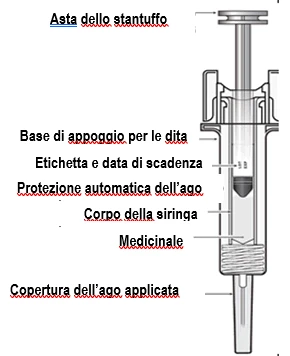 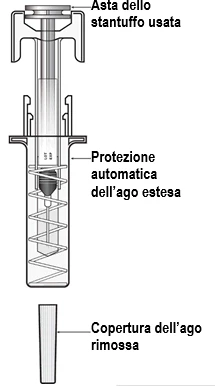 | |
| Before use | After use |
| Important | |
| Before using a prefilled syringe of Nyvepria with automatic needle protection system, read these important instructions:
• It is important that you do not administer the injection unless you have received proper instructions from your doctor or healthcare professional. If you have any questions about how to give the injection, consult your doctor or healthcare professional for assistance.
• Ensure that the name Nyvepria appears on both the box and the label of the prefilled syringe.
• Check the box and the label of the prefilled syringe to confirm that the dosage is 6 mg (6 mg/0.6 mL).
• Nyvepria is administered as an injection into the tissue just beneath the skin (subcutaneous injection).
Do not use the prefilled syringe if the expiration date has passed the last day of the month indicated.
Do not remove the needle cap from the prefilled syringe until you are ready to administer the injection.
Do not use the prefilled syringe if it has been dropped on a hard surface. Use a new prefilled syringe and contact your doctor or healthcare professional.
Do not activate the prefilled syringe before administering the injection.
Do not remove the transparent automatic needle shield from the prefilled syringe.
Do not remove the detachable label from the prefilled syringe before injecting the medicine.
Contact your doctor or healthcare professional if you have any questions. | |
| Step 1: Preparation | |
| A | Remove the prefilled syringe box from the refrigerator. Remove the inner packaging of the prefilled syringe from the outer packaging by tearing open the cover, and gather the materials needed for the injection: alcohol swabs, a cotton ball or gauze, a plaster (bandage), and a sharps disposal container (not included). |
| For a more comfortable injection, allow the prefilled syringe to reach room temperature (not exceeding 25°C) for about 30 minutes before injection. Wash your hands thoroughly with soap and water. Place the new prefilled syringe and the necessary injection materials on a clean, well-lit work surface.
Do not heat the syringe using a heat source such as hot water or microwave.
Do not expose the prefilled syringe to direct sunlight.
Do not shake the prefilled syringe.
• Keep the prefilled syringe out of the sight and reach of children. | |
B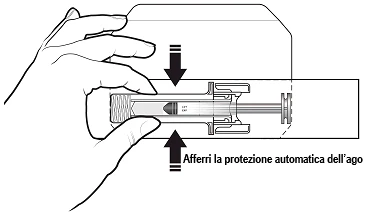 | Open the inner packaging of the syringe by tearing open the cover. Grasp the automatic needle shield of the prefilled syringe to remove the syringe from the box. |
| For safety reasons:
Do not grasp the plunger rod.
Do not grasp the needle cap. | |
C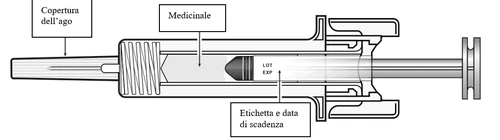 | Inspect the medicine and the prefilled syringe. |
| Do not use the prefilled syringe if: • the medicine is cloudy or contains particles. It should be a clear, colourless liquid. • any parts appear cracked or broken. • the needle cap is missing or the needle is not securely attached. • the expiration date printed on the label has passed the last day of the month indicated. In all such cases, contact your doctor or healthcare professional. | |
Step 2: Preparation
Wash your hands thoroughly. Prepare and clean the injection site.
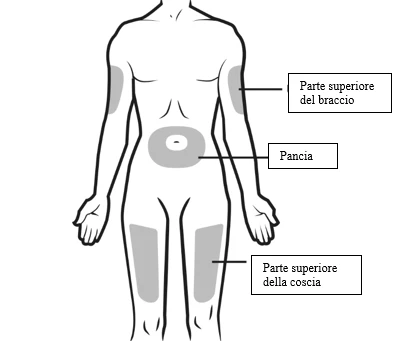
You can use:
- the upper thigh.
- the abdomen, except for an area of 5 centimetres directly around the navel.
- the outer upper arm (only if someone else is giving you the injection).
Clean the injection site with an alcohol swab. Allow the skin to dry.
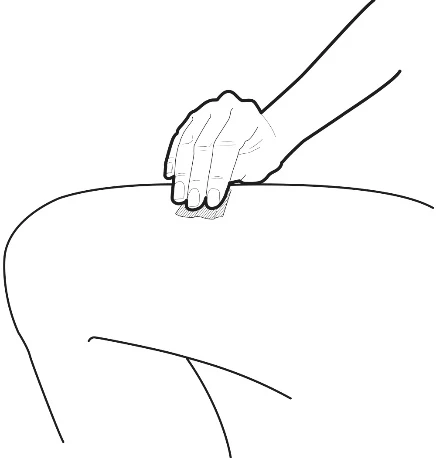
Do not touch the injection site before injecting.

Do not inject into areas where the skin is tender, bruised, red, or hard. Avoid injecting
into areas with scars or stretch marks.
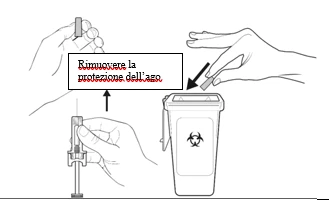
| B | Hold the pre-filled syringe by the automatic needle cover. Carefully remove the needle cap by pulling it outward and away from the body. Dispose of the needle cap in a sharps container. Do not re-cap the needle. |
 | |
| C | Lift the injection site to create a stable surface.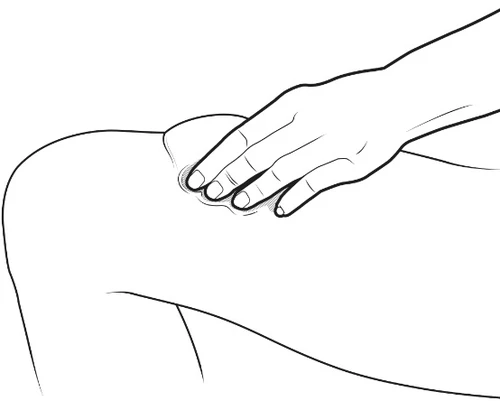 |
It is important to keep the skin lifted during injection. | |
| Step 3: Injection | |
| A | Keep the skin lifted. INSERT the needle into the skin at an angle between 45° and 90°.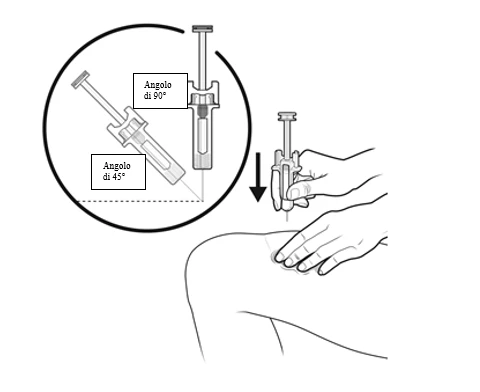 |
| Do not touch the cleaned area of the skin. | |
| B | PUSH the plunger rod with slow and steady pressure until it reaches the bottom. |
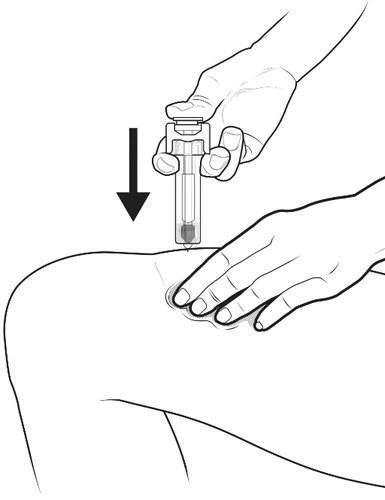 | |
| C | When the syringe is empty, REMOVE the syringe from the skin.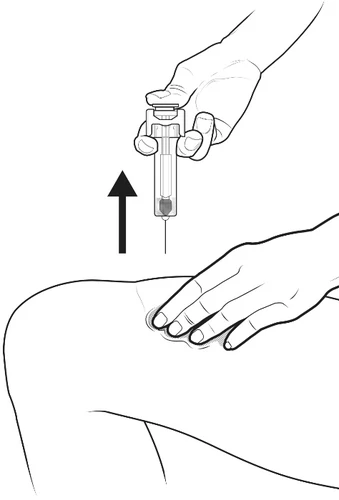 |
After releasing the plunger rod, the automatic needle safety cover of the pre-filled syringe will securely cover the injection needle. Do not re-cap used pre-filled syringes. When removing the syringe, if there is still medicine remaining in the syringe barrel, this means you have not injected the full dose. Contact your doctor or healthcare professional immediately. 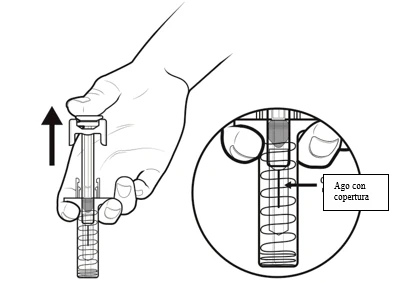 | |
For healthcare professionals only
The trade name and batch number of the administered product must be clearly
recorded in the patient's file.
Remove and retain the label from the pre-filled syringe.
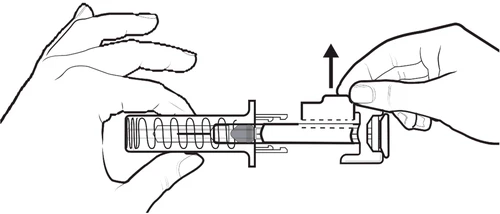
Rotate the plunger rod to move the label to a position where it can be removed.
| Step 4: Finish | |
| A | Dispose of the used pre-filled syringe and other materials in a sharps disposal container.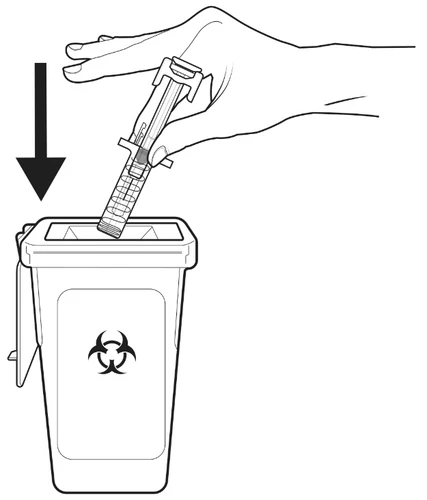 |
| Medicines must be disposed of in accordance with local regulations. Ask your pharmacist how to dispose of medicines you no longer use. This will help protect the environment. Keep the syringe and the sharps disposal container out of sight and reach of children. Do not reuse the pre-filled syringe. Do not recycle pre-filled syringes or dispose of them in household waste. | |
| B | Check the injection site. |
| If you see any blood, press a cotton ball or gauze pad on the injection site. Do not rub the injection site. Apply a plaster if needed. | |