Nustendi
Italy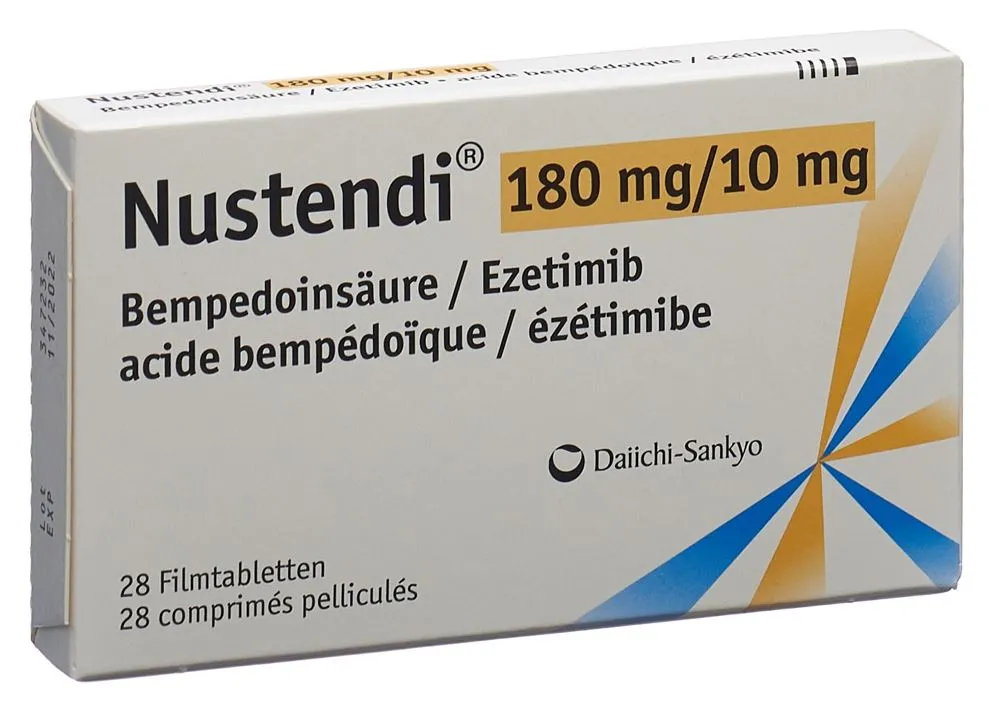
Table of Contents
Package leaflet: Information for the patient
Nustendi 180 mg/10 mg film-coated tablets
bempedoic acid / ezetimibe
Please read all of this leaflet carefully before taking this medicine because it contains
important information for you.
- Keep this leaflet. You may need to read it again.
- If you have any questions, ask your doctor or pharmacist.
- This medicine has been prescribed for you only. Do not give it to other people, even if they have the same symptoms as you, because it may be harmful.
- If you experience any side effects, including those not listed in this leaflet, contact your doctor or pharmacist. See section 4.
Contents of this leaflet
- What Nustendi is and what it is used for
- What you need to know before taking Nustendi
- How to take Nustendi
- Possible side effects
- How to store Nustendi
- Contents of the pack and other information
1. What Nustendi is and what it is used for
What Nustendi is and how it works
Nustendi is a medicine that reduces levels of "bad" cholesterol (also called "LDL cholesterol"), a type of fat found in the blood. Nustendi may also help reduce cardiovascular risk by lowering levels of bad cholesterol.
Nustendi contains two active substances that reduce cholesterol in two different ways:
- bempedoic acid reduces cholesterol production in the liver and increases removal of LDL cholesterol from the blood;
- ezetimibe acts in the intestine by reducing the amount of cholesterol absorbed from food.
What Nustendi is used for
- Adults with primary hypercholesterolaemia or mixed dyslipidaemia, conditions that cause high levels of cholesterol in the blood. It is given as an addition to diet for cholesterol reduction.
- Adults with high levels of cholesterol in the blood who already have cardiovascular disease or who have other conditions that increase their risk of cardiovascular events.
Nustendi is given in the following cases:
- if you have previously taken a statin (such as simvastatin, a medicine commonly used to treat high cholesterol) together with ezetimibe, but LDL cholesterol levels were not sufficiently reduced;
- if you have previously taken ezetimibe alone, but LDL cholesterol levels were not sufficiently reduced;
- as a replacement for bempedoic acid and ezetimibe when used as separate tablets.
2. What you need to know before taking Nustendi
Do not take Nustendi
- if you are allergic to bempedoic acid, ezetimibe, or any of the other ingredients of this medicine (listed in section 6);
- if you are pregnant;
- if you are breastfeeding;
- if you are taking more than 40 mg of simvastatin per day (another medicine used to lower cholesterol);
- together with a statin, if you currently have liver problems.
- Nustendi contains ezetimibe. If Nustendi is taken together with a statin, you must also read the information about ezetimibe in the package leaflet of that specific statin.
Warnings and precautions
Talk to your doctor or pharmacist before taking Nustendi:
- if you have ever had gout;
- if you have severe kidney problems;
- if you have moderate or severe liver problems. In such cases, Nustendi is not recommended.
Your doctor will prescribe a blood test before starting treatment with Nustendi together with a statin (a medicine used to lower cholesterol) to check your liver function.
If you are taking statins, contact your doctor immediately if you experience unexplained muscle pain, tenderness, or muscle weakness (see section "Other medicines and Nustendi").
If you are planning to become pregnant, consult your doctor first, who will advise you on how to stop treatment with Nustendi before stopping any form of contraception.
Children and adolescents
Do not give Nustendi to children and adolescents under 18 years of age, as this medicine has not been studied in this age group.
Other medicines and Nustendi
Tell your doctor or pharmacist if you are taking, have recently taken, or might take any other medicines. In particular, inform your doctor if you are taking any medicine containing any of the following active substances:
- atorvastatin, fluvastatin, pitavastatin, pravastatin, rosuvastatin, simvastatin (used to lower cholesterol and known as statins). Taking a statin together with Nustendi may increase the risk of muscle disorders. Inform your doctor immediately of any unexplained muscle pain, tenderness, or weakness;
- bosentan (used to treat a condition called pulmonary arterial hypertension);
- fimasartan (used to treat hypertension and heart failure);
- asunaprevir, glecaprevir, grazoprevir, voxilaprevir (used to treat hepatitis C);
- fenofibrate or gemfibrozil (also used to lower cholesterol). There is no information available on the effects of using Nustendi together with medicines called fibrates used to lower cholesterol;
- cyclosporine (often used in patients who have had an organ transplant);
- colestyramine (also used to lower cholesterol), as it affects the way ezetimibe works;
- medicines used to prevent blood clots, such as warfarin, acenocoumarol, fluindione, and phenprocoumon.
Pregnancy and breastfeeding
Do not take this medicine if you are pregnant, trying to become pregnant, or suspect you might be pregnant, as it may harm the unborn baby. If you become pregnant while taking this medicine, contact your doctor immediately and stop taking Nustendi.
- Pregnancy Before starting treatment, make sure you are not pregnant and that your method of contraception is effective, as advised by your doctor. If you are taking oral contraceptives and experience an episode of diarrhoea or vomiting lasting more than 2 days, use an alternative method of contraception (e.g., condoms, diaphragm) for 7 days after symptoms resolve.
If, after starting treatment with Nustendi, you decide you wish to become pregnant, inform your doctor, as your treatment will need to be changed.
- Breastfeeding Do not take Nustendi if you are breastfeeding, as it is not known whether the medicine passes into breast milk.
Driving and using machines
Nustendi has a minor influence on the ability to drive and use machines.
However, some people may experience dizziness after taking Nustendi. Avoid driving or operating machinery if you feel your reaction ability is impaired.
Nustendi contains lactose and sodium
If your doctor has diagnosed you with an intolerance to certain sugars, contact them before taking this medicine.
This medicine contains less than 1 mmol (23 mg) of sodium per tablet, i.e., essentially 'sodium-free'.
3. How to take Nustendi
Take this medicine exactly as directed by your doctor or pharmacist. If you have any doubts, consult your doctor or pharmacist.
The recommended dose is one tablet once daily.
If you are taking cholestyramine, take Nustendi at least 2 hours before or at least 4 hours after taking cholestyramine.
Swallow the tablet whole with food or between meals.
If you take more Nustendi than you should
Contact your doctor or pharmacist immediately.
If you forget to take Nustendi
If you realize you have forgotten:
- a dose on the same day, take the missed dose even if it is later than usual, then take the next dose at the scheduled time the following day;
- the dose from the previous day, take the tablet at the scheduled time and do not make up for the missed dose.
If you stop taking Nustendi
Do not stop treatment with Nustendi without consulting your doctor, as cholesterol levels may rise again.
If you have any questions about how to use this medicine, consult your doctor or pharmacist.
4. Possible side effects
Like all medicines, this medicine can cause side effects, although not everybody gets them.
Contact your doctor immediately if you experience any of the following serious side effects (frequency not known):
- muscle pain, tenderness or weakness (myopathy/rhabdomyolysis)
- yellowing of the skin and eyes, abdominal pain, dark urine, swollen ankles, reduced appetite and feeling tired, which could be signs of liver problems (hepatitis)
- allergic reactions including skin rash and hives; skin redness, sometimes with target-like lesions (hypersensitivity/erythema multiforme)
- difficulty breathing or swelling of the face, lips, throat or tongue (anaphylaxis/angioedema)
- gallstones or inflammation of the gallbladder (cholelithiasis/cholecystitis) (which may cause abdominal pain, nausea, vomiting), inflammation of the pancreas often with severe abdominal pain (pancreatitis)
- decrease in platelets, which may cause bruising/bleeding (thrombocytopenia).
Other side effects may occur with the following frequencies:
Common (may affect up to 1 in 10 people)
- reduction in the number of red blood cells (anaemia)
- reduced haemoglobin (the red blood cell protein that carries oxygen)
- increased levels of uric acid in the blood
- high levels of uric acid in the blood causing swelling and pain in the joints (gout)
- reduced appetite
- dizziness, headache
- hypertension
- cough
- constipation, diarrhoea, abdominal pain
- nausea
- dry mouth
- abdominal bloating and gas, inflammation of the gastric mucosa (gastritis)
- blood test results indicating liver abnormalities
- muscle spasm, muscle pain, pain in shoulders, legs or arms, back pain
- blood test showing increased levels of creatine kinase (a laboratory test to check for muscle damage)
- muscle weakness, joint pain (arthralgia)
- increased levels of creatinine and blood urea nitrogen in the blood (laboratory tests to check kidney function)
- unusual tiredness (fatigue) or weakness (asthenia)
- reduction in glomerular filtration rate (a measure of kidney function)
Uncommon (may affect up to 1 in 100 people)
- hot flush
- pain in the upper stomach, heartburn, indigestion
- itching
- swelling of the legs or hands
- neck pain, chest pain, pain
- weight loss
- muscle weakness
Not known (frequency cannot be estimated from the available data)
- tingling sensation
- depression
- shortness of breath
Reporting of side effects
If you get any side effects, including those not listed in this leaflet, talk to your doctor or pharmacist. You can also report side effects directly via the national reporting system listed in Annex V. Reporting side effects can help provide more information on the safety of this medicine.
5. How to store Nustendi
Keep this medicine out of the sight and reach of children.
Do not use this medicine after the expiry date which is stated on the blister after EXP and on the carton after Scad. The expiry date refers to the last day of that month.
This medicine does not require any special storage temperature. Store in the original packaging to protect the medicine from moisture.
Do not dispose of any medicine via wastewater or household waste. Ask your pharmacist how to dispose of medicines you no longer use. This will help protect the environment.
6. Package contents and other information
What Nustendi contains
- The active substances are bempedoic acid and ezetimibe. Each film-coated tablet contains 180 mg of bempedoic acid and 10 mg of ezetimibe.
- The other components are:
- lactose monohydrate (see the end of section 2 “Nustendi contains lactose and sodium”)
- microcrystalline cellulose (E460)
- sodium starch glycolate (type A) (see the end of section 2 “Nustendi contains lactose and sodium”)
- hydroxypropylcellulose (E463)
- magnesium stearate (E470b)
- anhydrous colloidal silica (E551)
- sodium lauryl sulfate (E487) (see the end of section 2 “Nustendi contains lactose and sodium”)
- povidone (K30) (E1201)
- partially hydrolysed polyvinyl alcohol (E1203), talc (E553b), titanium dioxide (E171), aluminium lake containing indigo carmine (E132), glycerol monocaprylocaprate, aluminium lake containing brilliant blue FCF (E133)
Description of the appearance of Nustendi and the contents of the pack
The film-coated tablets are blue, oval-shaped, with “818” engraved on one side and “ESP” on the other side. Tablet dimensions: 15 mm × 7 mm × 5 mm.
Nustendi is supplied in plastic/aluminum blisters in packs of 10, 14, 28, 30, 84, 90, 98 or 100 film-coated tablets, or in divisible unit-dose blisters in packs of 10 × 1, 50 × 1 or 100 × 1 film-coated tablets.
Not all pack sizes may be marketed in your country.
Marketing Authorisation Holder
Daiichi Sankyo Europe GmbH
Zielstattstrasse 48
81379 Munich
Germany
Manufacturer
Daiichi Sankyo Europe GmbH
Luitpoldstrasse 1
85276 Pfaffenhofen
Germany
For further information on this medicinal product, please contact the local representative of the Marketing Authorisation Holder:
België/Belgique/Belgien Lietuva
Daiichi Sankyo Belgium N.V.-S.A Zentiva, k.s.
Tél/Tel: +32-(0) 2 227 18 80 Tel: +370 52152025
България Luxembourg/Luxemburg
Zentiva, k.s. Daiichi Sankyo Belgium N.V.-S.A
Тел.: + 359 24417136 Tél/Tel: +32-(0) 2 227 18 80
Česká republika Magyarország
Zentiva, k.s. Daiichi Sankyo Europe GmbH
Tel: +420 267 241 111 Tel.: +49-(0) 89 7808 0
Danmark Malta
Daiichi Sankyo Europe GmbH Daiichi Sankyo Europe GmbH
Tlf: +49-(0) 89 7808 0 Tel: +49-(0) 89 7808 0
Deutschland Nederland
Daiichi Sankyo Deutschland GmbH Daiichi Sankyo Nederland B.V.
Tel: +49-(0) 89 7808 0 Tel: +31-(0) 20 4 07 20 72
Eesti Norge
Zentiva, k.s. Daiichi Sankyo Europe GmbH
Tel: +372 52 70308 Tlf: +49-(0) 89 7808 0
Ελλάδα Österreich
Daiichi Sankyo Europe GmbH Daiichi Sankyo Austria GmbH
Τηλ: +49-(0) 89 7808 0 Tel: +43 (0) 1 485 86 42 0
España Polska
Daiichi Sankyo España, S.A. Daiichi Sankyo Europe GmbH
Tel: +34 91 539 99 11 Tel.: +49-(0) 89 7808 0
France Portugal
Daiichi Sankyo France S.A.S. Daiichi Sankyo Portugal, Unip. LDA
Tél: +33 (0) 1 55 62 14 60 Tel: +351 21 4232010
Hrvatska România
Zentiva d.o.o. Daiichi Sankyo Europe GmbH
Tel: +385 1 6641 830 Tel: +49-(0) 89 7808 0
Ireland Slovenija
Daiichi Sankyo Ireland Ltd Daiichi Sankyo Europe GmbH
Tel: +353-(0) 1 489 3000 Tel: +49-(0) 89 7808 0
Ísland Slovenská republika
Daiichi Sankyo Europe GmbH Zentiva, a.s.
Sími: +49-(0) 89 7808 0 Tel: +421 2 3918 3010
Italia Suomi/Finland
Daiichi Sankyo Italia S.p.A. Daiichi Sankyo Europe GmbH
Tel: +39-06 85 2551 Puh/Tel: +49-(0) 89 7808 0
Κύπρος Sverige
Daiichi Sankyo Europe GmbH Daiichi Sankyo Europe GmbH
Τηλ: +49-(0) 89 7808 0 Tel: +49-(0) 89 7808 0
Latvija United Kingdom (Northern Ireland)
Zentiva, k.s. Daiichi Sankyo Europe GmbH
Tel: +371 67893939 Tel: +49-(0) 89 7808 0
Other sources of information
More detailed information on this medicinal product is available on the website of the European Medicines Agency, https://www.ema.europa.eu/.