Norepinephrine tartrate Laboratoire Aguettant
Italy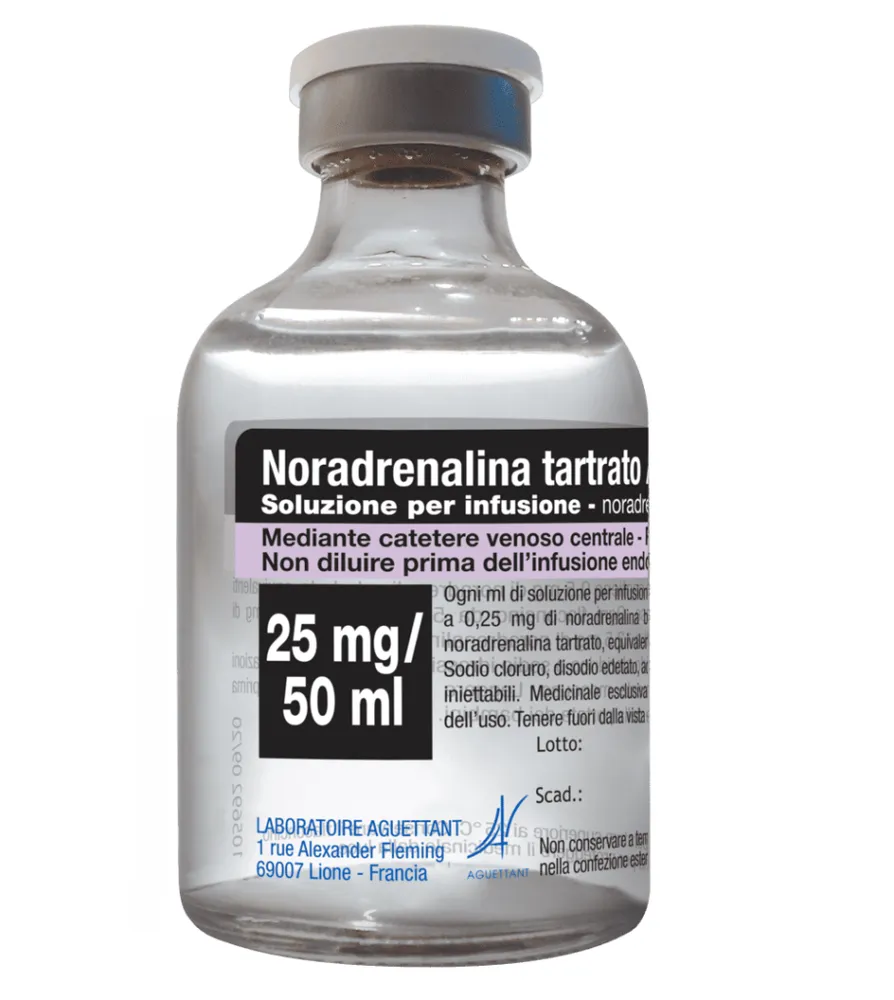
Table of Contents
- Package leaflet: Information for the user
- 1. What Noradrenaline tartrate Laboratoire Aguettant is and what it is used for
- 2. What you need to know before being given Noradrenaline Tartrate Laboratoire Aguettant
- 3. How Noradrenaline Tartrate Laboratoire Aguettant is administered
- 4. Possible side effects
- 5. How to store Noradrenaline Tartrate Laboratoire Aguettant
- 6. Package contents and other information
- The following information is intended exclusively for physicians or healthcare professionals
Package leaflet: Information for the user
Noradrenaline tartrate Laboratoire Aguettant 2 mg/ml concentrate for solution for infusion
noradrenaline (norepinephrine) tartrate
Please read all of this leaflet carefully before you start using this medicine because it contains important information for you.
- Keep this leaflet. You may need to read it again.
- If you have any questions, ask your doctor, pharmacist, or nurse.
- This medicine has been prescribed for you only. Do not give it to other people, even if their symptoms are the same as yours, as it may be harmful.
- If you experience any adverse reactions, including those not listed in this leaflet, tell your doctor, pharmacist, or nurse. See section 4.
Contents of this leaflet
- What Noradrenaline tartrate Laboratoire Aguettant is and what it is used for
- What you need to know before receiving Noradrenaline tartrate Laboratoire Aguettant
- How Noradrenaline tartrate Laboratoire Aguettant is administered
- Possible side effects
- How to store Noradrenaline tartrate Laboratoire Aguettant
- Contents of the pack and other information
1. What Noradrenaline tartrate Laboratoire Aguettant is and what it is used for
Noradrenaline tartrate Laboratoire Aguettant contains the active substance noradrenaline (norepinephrine), which causes narrowing of blood vessels (vasoconstriction).
Noradrenaline tartrate Laboratoire Aguettant is indicated in adults for emergency restoration of blood pressure in cases of acute hypotension (low blood pressure).
2. What you need to know before being given Noradrenaline Tartrate Laboratoire Aguettant
Noradrenaline Tartrate Laboratoire Aguettant must not be administered
- if you are allergic to noradrenaline (norepinephrine) tartrate or to any of the other ingredients of this medicine (listed in section 6);
- in case of hypotension (low blood pressure) caused by hypovolemia (low blood volume);
- if you are taking certain anesthetics, such as halothane or cyclopropane (this may increase the risk of irregular heartbeat).
Warnings and precautions
Talk to your doctor, pharmacist, or nurse before receiving Noradrenaline Tartrate Laboratoire Aguettant if:
- you have severe left ventricular dysfunction (a heart condition);
- you suffer from coronary thrombosis (blood clot in a blood vessel of the heart), mesenteric thrombosis (blood clot in a vein draining blood from the intestine), or peripheral vascular thrombosis (blood clot in a vein of the arm or leg);
- you have hypotension (low blood pressure) following myocardial infarction (heart attack);
- you have variant or Prinzmetal’s angina;
- you develop heart rhythm disturbances during treatment (in this case, a reduced dose may be required);
- you suffer from hyperthyroidism (a thyroid gland disorder);
- diabetes mellitus;
- you are elderly.
Additional monitoring tests you may be required to undergo during treatment:
During treatment, your arterial pressure and heart rate will be monitored frequently to avoid hypertension (high blood pressure).
Children and adolescents
The safety and efficacy of norepinephrine in children under 18 years of age have not yet been established. Therefore, its use in children is not recommended.
Other medicines and Noradrenaline Tartrate Laboratoire Aguettant
Inform your doctor or pharmacist if you are taking, have recently taken, or might take any other medicines.
The following medicines may affect the effect of Noradrenaline Tartrate Laboratoire Aguettant:
- Halothane, cyclopropane, chloroform, enflurane, or other halogenated anesthetics are contraindicated (see section 2 of this leaflet, subsection “must not be given to you”): these medicines are anesthetics, induce insensitivity to pain, and are used before certain surgical procedures. Taking these medicines together with noradrenaline (norepinephrine) tartrate may increase the risk of irregular heartbeat.
- Amitriptyline, imipramine, trimipramine, moclobemide, iproniazid, phenelzine, fluoxetine, sertraline, desipramine: these medicines are used to treat depression. Taking any of these medicines together with noradrenaline (norepinephrine) tartrate may dangerously increase its blood concentration and thus its pressor effect.
- Digitalis glycosides may occasionally cause irregular heartbeat.
- Levodopa may enhance the effects of noradrenaline (norepinephrine) tartrate.
- Antihistamines, because some may block the uptake of catecholamines by peripheral tissues and increase the toxicity of injected noradrenaline (norepinephrine) tartrate.
- Chlorpheniramine hydrochloride, tripelennamine hydrochloride: significantly increase the toxicity of noradrenaline (norepinephrine) tartrate.
- Non-selective MAO inhibitors (or within 14 days of stopping such therapy): increased pressor action of sympathomimetics, which is usually moderate. These should be used only under strict medical supervision.
- Selective MAO-A inhibitors: by extrapolation from non-selective MAO inhibitors, risk of increased pressor effect. These should be used only under strict medical supervision.
- Linezolid, an antibiotic (a medicine used to treat infections caused by bacteria and other microorganisms) that may dangerously increase the blood concentration of noradrenaline (norepinephrine) tartrate and thus its pressor effect.
- Alpha and beta-blockers: taking these medicines together with noradrenaline (norepinephrine) tartrate may increase the risk of severe hypertension (high blood pressure).
- Thyroid hormones, cardiac glycosides, antiarrhythmics: taking these medicines together with noradrenaline (norepinephrine) tartrate may cause potentiation of cardiac effects.
- Ergot alkaloids or oxytocin may enhance vasopressor and vasoconstrictive effects (increasing blood pressure).
- Desmopressin or vasopressin: their antidiuretic effect may be reduced.
- Lithium reduces the effect of noradrenaline (norepinephrine) tartrate.
- Guanethidine, guanadrel, reserpine, methyldopa, tricyclic antidepressants, amphetamine, doxapram, mazindol, Rauwolfia alkaloids: may potentiate the effects of noradrenaline (norepinephrine) tartrate.
- Propofol: concomitant administration may lead to propofol infusion syndrome (PRIS).
Pregnancy and breastfeeding
If you are pregnant, suspect you may be pregnant, planning a pregnancy, or breastfeeding, consult your doctor before receiving this medicine. Noradrenaline tartrate may cause harm to the unborn child. Your doctor will decide whether to administer noradrenaline tartrate to you.
It is not known whether this medicine is excreted in human breast milk. Since many medicines are excreted in human breast milk, caution should be exercised when administering norepinephrine to nursing women.
Driving and using machines
Since this medicine is administered in a hospital setting, your doctor will inform you when you are able to drive or operate machinery.
Noradrenaline Tartrate Laboratoire Aguettant contains sodium
This medicine contains 3.3 mg of sodium (a main component of table salt) per ml. This corresponds to 0.16% of the maximum daily dietary intake recommended for an adult.
3. How Noradrenaline Tartrate Laboratoire Aguettant is administered
Noradrenaline Tartrate Laboratoire Aguettant will be administered to you in hospital by a doctor or a nurse.
Dosage
Noradrenaline Tartrate Laboratoire Aguettant is first diluted and then infused into a vein. It must not be mixed with other medicines. The dose of noradrenaline (norepinephrine) tartrate depends on the patient's condition. Your doctor will know the appropriate dose to use. The initial dose is 0.8–1.6 mg of noradrenaline (norepinephrine) tartrate per hour (equivalent to 0.4–0.8 mg of noradrenaline (norepinephrine) base per hour). The dose may then be adjusted using an infusion pump according to the response to treatment, aiming to normalize blood pressure. Your doctor will monitor your blood pressure and blood volume.
If you are given more noradrenaline (norepinephrine) than you should
It is unlikely that you will receive an excessive dose, as this medicine is administered in a hospital setting. However, if you have any concerns, speak to your doctor or nurse.
Symptoms that may occur following an overdose of noradrenaline (norepinephrine) tartrate include very high blood pressure, slow heart rate, severe headache, light sensitivity, chest pain, brain hemorrhage, pallor, fever, excessive sweating, vomiting, and fluid in the lungs causing shortness of breath.
If you have any further questions about the use of this medicine, ask your doctor, pharmacist, or nurse.
4. Possible side effects
Like all medicines, this medicine can cause side effects, although not everyone experiences them.
The frequency of the side effects listed is unknown (cannot be estimated from the available data).
Immediately inform your doctor or nurse if you experience:
- difficulty or irregularity in breathing
- rapid, slow or irregular heartbeat, palpitations
- chest or throat pain
Inform your doctor or nurse as soon as possible if you experience:
- anxiety, insomnia, confusion, headache, psychotic state, weakness, tremor, decreased alertness, loss of appetite, nausea, vomiting
- high blood pressure
- pallor (loss of skin colour), sweating, light sensitivity
- gangrene (pain and coldness in the extremities, which may become purple to very dark/black, with tissue death)
- skin necrosis if the infusion is not administered directly into a vein
- acute glaucoma (eye problem)
- skin sloughing, bluish skin colour, hot flushes or skin redness, rash, hives or itching
- urinary retention
Reporting of side effects
If you experience any side effect, including those not listed in this leaflet, consult your doctor or pharmacist. You may also report side effects directly via the national reporting system at: https://www.aifa.gov.it/content/segnalazioni-reazioni-avverse.
By reporting side effects, you can help provide more information on the safety of this medicine.
5. How to store Noradrenaline Tartrate Laboratoire Aguettant
Keep this medicine out of the sight and reach of children.
Do not use this medicine after the expiry date stated on the carton and on the label of the vial after EXP. The expiry date refers to the last day of that month.
Do not store above 25 °C. Keep the vial in the outer carton to protect the medicine from light.
Do not dispose of any medicine via wastewater or household waste. Ask your pharmacist how to dispose of medicines you no longer use. This will help protect the environment.
6. Package contents and other information
What Noradrenaline Tartrate Laboratoire Aguettant contains
- The active substance is noradrenaline (norepinephrine) tartrate. Each ml of concentrate for solution for infusion contains 2 mg of noradrenaline (norepinephrine) tartrate, equivalent to 1 mg of noradrenaline (norepinephrine). Each 4 ml vial contains 8 mg of noradrenaline (norepinephrine) tartrate, equivalent to 4 mg of noradrenaline (norepinephrine). Each 8 ml vial contains 16 mg of noradrenaline (norepinephrine) tartrate, equivalent to 8 mg of noradrenaline (norepinephrine).
- The other components are sodium chloride, sodium hydroxide or hydrochloric acid, and water for injections.
Description of the appearance of Noradrenaline Tartrate Laboratoire Aguettant and the contents of the pack
Clear, colourless or slightly yellowish solution with pH 3.0–4.0, packaged in a transparent glass vial of 4 ml or 8 ml.
Packs of 10, 50 or 100 vials.
Not all pack sizes may be marketed.
Marketing Authorisation Holder
Laboratoire Aguettant
1 rue Alexander Fleming
69007 Lyon
France
Manufacturer
Laboratoire Aguettant
1 rue Alexander Fleming
69007 Lyon
France
or
Delpharm Tours
Rue Paul Langevin
37 170 Chambray-Les-Tours
France
or
Haupt Pharma Livron
1 rue Comte de Sinard,
26250 Livron Sur Drome
France
This medicinal product is authorised in the European Economic Area (EEA) Member States and in the United Kingdom (Northern Ireland) under the following names:
BE, LU: Noradrenaline (Norepinephrine) Aguettant
NL: Noradrenaline Aguettant
ES: Noradrenalina Aguettant
BG: Noradrenalin Aguettant
DK, FI, IS, NO, SE: Noradrenalin Laboratoire Aguettant
AT, DE: Norepinephrin Aguettant
UK (NI), IE: Noradrenaline (Norepinephrine)
PT: Noradrenalina Aguettant
IT: Noradrenalina tartrato Laboratoire Aguettant
The following information is intended exclusively for physicians or healthcare professionals
Route of administration
For intravenous use only, after dilution. Single-use.
The infusion must be administered at a controlled rate using a syringe pump, an infusion pump, or a drip device.
Instructions for dilution
This product must be inspected visually before administration. Use only if the solution is clear and colourless or slightly yellowish, free from particles or precipitates. Do not use vials that are pink or darker than pale yellow, or that contain a precipitate.
Add 2 ml of Noradrenaline Tartrate Laboratoire Aguettant to 48 ml of 5% glucose solution (or sodium chloride 9 mg/ml (0.9%) or dextrose physiological saline solution) for administration via syringe pump.
Alternatively, add 20 ml of Noradrenaline Tartrate Laboratoire Aguettant to 480 ml of 5% glucose solution (or sodium chloride 9 mg/ml (0.9%) or dextrose physiological saline solution) for administration via drip device.
When diluted, the final concentration of the infusion solution is generally 80 mg/l of noradrenaline (norepinephrine) tartrate (equivalent to 40 mg/l of noradrenaline (norepinephrine)).
If other dilutions are used, carefully verify the calculation before starting treatment.
In the absence of specific data, this medicinal product must not be mixed with other medicinal products.
After dilution: The physico-chemical stability of the diluted product (in 5% dextrose, in sodium chloride 9 mg/ml (0.9%) or in dextrose physiological saline solution) has been demonstrated for 48 hours at 30 °C.
However, from a microbiological standpoint, the diluted product should be used immediately. If the product is not used immediately, the duration and conditions of storage are the sole responsibility of the user.
Dosage
Initial infusion rate:
The initial infusion rate should be between 10 ml/hour and 20 ml/hour (from 0.16 ml/min to 0.33 ml/min). This corresponds to 0.8–1.6 mg/hour of noradrenaline (norepinephrine) tartrate (equivalent to 0.4–0.8 mg/hour of noradrenaline (norepinephrine) base).
Dose titration:
Once the infusion of noradrenaline (norepinephrine) tartrate has been initiated, the dose should be titrated according to the observed pressor effect. The dose required to achieve and maintain normotension may vary widely between individuals. The goal should be to establish a low-normal systolic blood pressure (100–120 mmHg) or to achieve an adequate mean arterial pressure (greater than 65–80 mmHg, depending on the patient's condition).