Norepinephrine tartrate Aguettant
Italy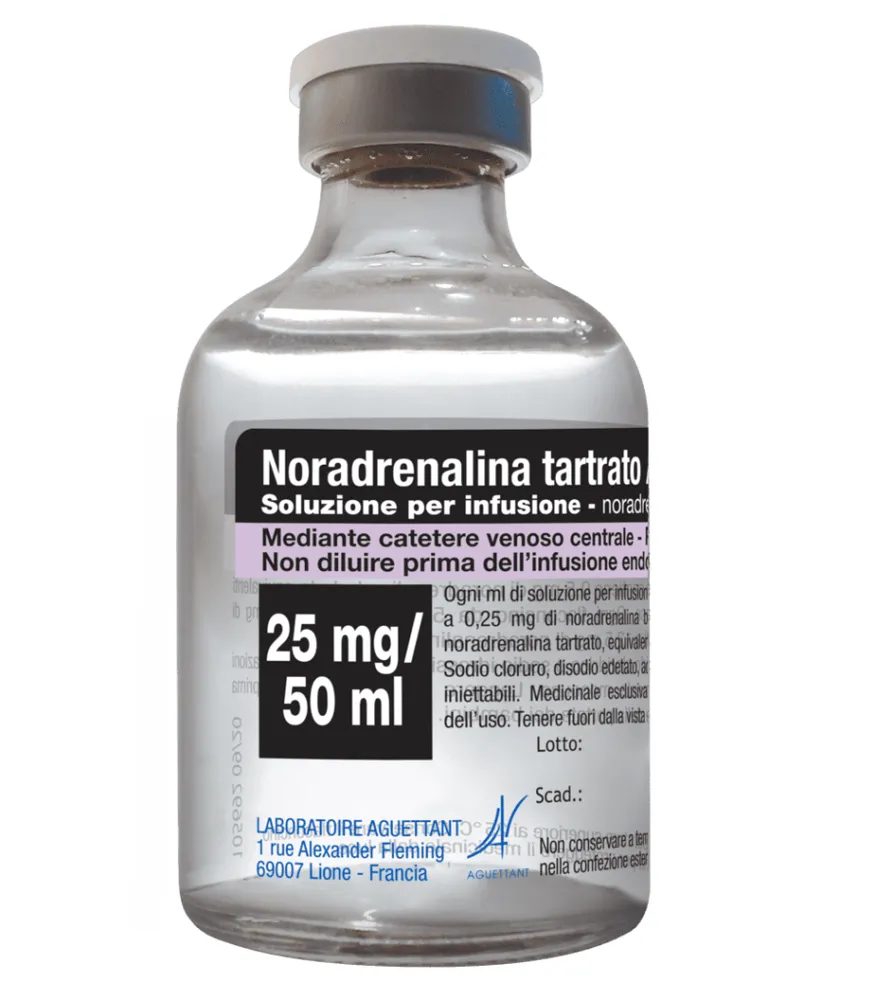
Table of Contents
- Patient Information Leaflet: Information for the User
- Noradrenalina tartrato Aguettant 0.16 mg/ml, solution for infusion
- 1. What Noradrenalina tartrato Aguettant solution for infusion is and what it is used for
- 3. How to use Noradrenaline tartrate Aguettant for infusion
- 4. Possible side effects
- 5. How to store Noradrenalina tartrato Aguettant solution for infusion
- 6. Package Contents and Other Information
Patient Information Leaflet: Information for the User
Noradrenalina tartrato Aguettant 0.16 mg/ml, solution for infusion
noradrenaline (norepinephrine)
Please read this leaflet carefully before using this medicine as it contains
important information for you.
- Keep this leaflet. You may need to read it again.
- If you have any questions, ask your doctor or nurse.
- This medicine has been prescribed for you only. Do not give it to others, even if their symptoms are the same as yours, as it could be harmful.
- If you experience any side effects, including those not listed in this leaflet, tell your doctor or nurse. See section 4.
Contents of this leaflet
- What Noradrenalina tartrato Aguettant solution for infusion is and what it is used for
- What you need to know before using Noradrenalina tartrato Aguettant solution for infusion
- How to use Noradrenalina tartrato Aguettant solution for infusion
- Possible side effects
- How to store Noradrenalina tartrato Aguettant solution for infusion
- Contents of the pack and other information
1. What Noradrenalina tartrato Aguettant solution for infusion is and what it is used for
This medicinal product contains the active substance noradrenaline and acts as a vasoconstrictor.
This medicine is indicated only in adults. It is used in adults weighing more than 50 kg for the treatment of hypotensive emergencies requiring a rapid increase in blood pressure to normal levels.
- What you need to know before using Noradrenalina tartrato Aguettant solution for infusion
Do not use Noradrenalina tartrato Aguettant solution for infusion:
- administered via peripheral cannula and/or peripheral vein.
- if you are allergic to noradrenaline or to any of the other components of this medicinal product (listed in section 6).
Warnings and precautions
Talk to your doctor or nurse before using Noradrenalina tartrato Aguettant solution for infusion:
- if you have severe dysfunction of the left ventricle (a heart condition),
- if you have recently had a myocardial infarction (a heart attack),
- if you have cardiac arrhythmias (your heartbeat is too fast, too slow, or irregular),
- if you suffer from hyperthyroidism (your thyroid gland is overactive),
- if you have diabetes mellitus,
- if you have hypotension (low blood pressure) caused by hypovolemia (low blood volume),
- if you have angina pectoris, or any vascular occlusion in the limbs or abdomen (acute difficulty for blood to circulate normally).
During the infusion of noradrenaline, your doctor will continuously monitor your blood pressure, heart rate (heartbeat), and the infusion site.
When it is necessary to administer Noradrenaline simultaneously with a blood or plasma transfusion, the latter must be administered through a separate intravenous line.
For athletes: the use of this medicine without therapeutic need constitutes doping and may result in a positive anti-doping test.
Children and adolescents
This medicine is indicated only in adults.
Other medicines and Noradrenalina tartrato Aguettant solution for infusion
Tell your doctor or pharmacist if you are taking, have recently taken, or might take any other medicines, such as:
- certain anaesthetic gases (halogenated agents),
- certain antidepressants (imipramine, serotonergic-adrenergic agents such as venlafaxine or duloxetine, monoamine oxidase inhibitors such as moclobemide or phenelzine),
- linezolid (an antibiotic),
- methylene blue (an antidote for the treatment of methaemoglobinaemia).
Pregnancy and breastfeeding
If you are pregnant or breastfeeding, ask your doctor or nurse for advice before using this medicine.
If you are pregnant, your doctor will decide whether you should take this medicine, as noradrenaline may harm the fetus.
There is no available information on the use of noradrenaline during breastfeeding.
Noradrenalina tartrato Aguettant solution for infusion contains sodium
This medicine contains 177.3 mg of sodium (the main component of table salt) per 50 ml vial. This corresponds to 8.9% of the maximum recommended daily dietary intake for an adult.
3. How to use Noradrenaline tartrate Aguettant for infusion
This medicine will be administered to you in hospital by a doctor or nurse.
This medicine will be given by intravenous infusion (into a vein) and only via a central venous catheter.
The dose of this medicine will depend on your condition. Your doctor will determine the appropriate dosage.
If you are given more Noradrenaline tartrate Aguettant infusion solution than you should
In case of overdose, the following symptoms may occur: cutaneous vasoconstriction (narrowing of blood vessels in the skin), pressure ulcers (skin ulcers), circulatory collapse (circulatory dysfunction), and hypertension (high blood pressure).
If adverse reactions related to excessive dosing occur, contact your doctor immediately. It is recommended to reduce the dose, if possible.
If you have any doubts about the use of this medicine, consult your doctor or nurse.
4. Possible side effects
Like all medicines, this medicine can cause side effects, although not everybody gets them.
The following side effects have been reported:
- Anxiety,
- Headache, tremor,
- Acute glaucoma,
- Tachycardia (rapid heartbeat), bradycardia (slow heartbeat), arrhythmia (irregular heartbeat), palpitations, increased myocardial contractility, acute heart failure (heart failure),
- Arterial hypertension (high blood pressure) and tissue hypoxia (reduced oxygen supply to organs), cold sensation and pallor of limbs and face, coldness and pain in extremities (gangrene), respiratory failure or breathing difficulty, dyspnea (difficulty breathing),
- Vomiting,
- Urinary retention,
- Local reactions: possible irritation and necrosis (cellular damage leading to cell death in tissue) at the injection site.
Continuous administration of a vasoconstrictor to maintain blood pressure in the absence of blood volume restoration may lead to the following symptoms:
- Severe peripheral and visceral vasoconstriction,
- Decreased renal blood flow,
- Reduced urine output,
- Hypoxia,
- Increased serum lactate levels.
In case of hypersensitivity or overdose, the following effects may occur more frequently:
arterial hypertension (high blood pressure), photophobia (abnormal intolerance to light), retrosternal pain (chest pain), pharyngeal pain (sore throat), pallor, profuse sweating, and vomiting.
Reporting of side effects
If you experience any side effect, including those not listed in this leaflet, please inform your doctor or nurse. You can also report side effects directly via the national reporting system at
https://www.aifa.gov.it/content/segnalazioni-reazioni-avverse . By reporting side effects, you can help provide more information on the safety of this medicine.
5. How to store Noradrenalina tartrato Aguettant solution for infusion
Keep this medicine out of the sight and reach of children.
Do not use this medicine after the expiry date stated on the vial label and on the carton after Exp. The expiry date refers to the last day of that month.
After first opening, the medicine must be used immediately.
Do not store above 25 °C. Keep the vial in the outer packaging to protect the medicine from light.
Do not use this medicine if you notice that the solution has turned dark yellow or pale pink, or if it contains precipitates.
Do not dispose of any medicine via wastewater or household waste. Ask your pharmacist how to dispose of medicines no longer in use. This will help protect the environment.
6. Package Contents and Other Information
What Noradrenaline Tartrate Aguettant for Infusion Solution Contains:
- The active substance is noradrenaline (norepinephrine). Each ml of solution contains 0.16 mg of noradrenaline (norepinephrine) tartrate, equivalent to 0.08 mg of noradrenaline (norepinephrine) base. Each 50 ml vial contains 8 mg of noradrenaline (norepinephrine) tartrate, equivalent to 4 mg of noradrenaline (norepinephrine) base.
- The other components are: sodium chloride, disodium edetate, hydrochloric acid or sodium hydroxide (to adjust pH), water for injections.
Description of the Appearance of Noradrenaline Tartrate Aguettant for Infusion Solution and Contents of the Package
Clear, colorless or pale yellow solution for infusion, contained in a 50 ml transparent glass vial.
Pack sizes: 1, 10, and 25 vials.
Not all pack sizes may be marketed.
Marketing Authorization Holder and Manufacturer
Laboratoire AGUETTANT
1, rue Alexander Fleming
69007 LYON
FRANCE
The following information is intended for medical or healthcare professionals only
This document is an extract of the Summary of Product Characteristics and is intended to facilitate the administration of Noradrenaline Tartrate Aguettant 0.16 mg/ml, solution for infusion. For assessing suitability for use in a specific patient, the prescribing physician should refer to the full Summary of Product Characteristics of the product.
Therapeutic Indications
This medicinal product is indicated in adults weighing more than 50 kg for the treatment of hypotensive emergencies.
Dosage and Method of Administration
Noradrenaline must be administered only by intravenous infusion via a central venous catheter. It must be infused at a controlled rate using an infusion pump or syringe pump, without dilution: it is supplied ready for use.
Arterial pressure must be carefully monitored throughout the duration of therapy.
Dosage
Initial dose:
The usual initial dose of noradrenaline tartrate is between 0.1–0.3 micrograms/kg/min (equivalent to 0.05–0.15 micrograms/kg/min of noradrenaline base).
Maintenance
The recommended maintenance range of noradrenaline tartrate is between 0.1–3 micrograms/kg/min (equivalent to 0.05–1.5 micrograms/kg/min of noradrenaline base).
Dose Titration:
Once noradrenaline infusion has been initiated, the dose should be titrated in increments of 0.1–0.2 micrograms/kg/min of noradrenaline tartrate (equivalent to 0.05–0.1 micrograms/kg/min of noradrenaline base), according to the observed pressor effect.
The goal should be to achieve a low-normal systolic blood pressure (100–120 mmHg) or to reach an adequate mean arterial pressure (greater than 65 mmHg – depending on the patient's condition).
Duration of Treatment:
Treatment should continue until high-dose vasoactive support is no longer required. At that point, the infusion should be gradually tapered and transitioned to a lower concentration infusion. Sudden discontinuation may cause acute hypotension.
Overdose
In case of overdose, the following symptoms may occur: cutaneous vasoconstriction, pressure ulcers, circulatory collapse, and hypertension.
In the event of adverse reactions related to excessive dosage, it is advisable to reduce the dose if possible.
Instructions for Handling and Disposal
Do not use this medicinal product if the solution is dark yellow or pale pink, or if it contains precipitates. Do not use the sterile solution if it is not clear, if it contains particulate matter, or if the anti-tampering seal on the vial is not intact.
This medicinal product must not be mixed with other medicinal products.
For single use only.
This medicinal product is already diluted and ready for use. It must be administered without prior dilution, using a suitable infusion pump or syringe pump capable of delivering the specified minimum volume at a controlled infusion rate, in accordance with dose titration instructions.
Unused medicinal product and waste materials derived from its use must be disposed of in accordance with local regulations.