Norchol
Italy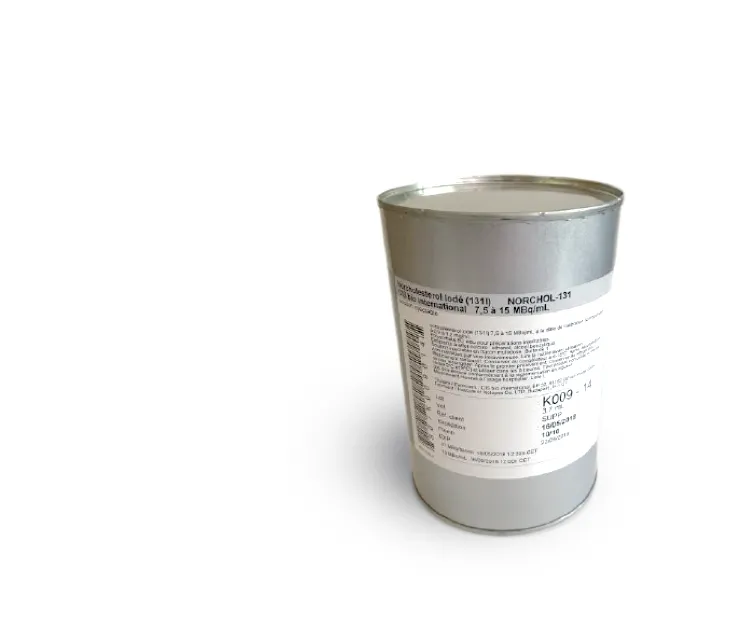
Table of Contents
*
Package leaflet: Information for the patient
NORCHOL 10 MBq/ml injectable solution
Iodomethylnorcholesterol (I)
Please read this leaflet carefully before you are administered
this medicine, as it contains important information for you.
- Keep this leaflet. You may need to read it again.
- If you have any questions, consult the nuclear medicine physician who will supervise your examination.
- If you experience any side effects, including those not listed in this leaflet, contact the nuclear medicine physician. See section 4.
Contents of this leaflet:
- What NORCHOL is and what it is used for
- What you need to know before you are administered NORCHOL
- How to use NORCHOL
- Possible side effects
- How to store NORCHOL
- Package contents and other information
1. What NORCHOL is and what it is used for
This medicinal product is a radiopharmaceutical (radioactive medicinal product) for diagnostic use only. NORCHOL contains Iodometilnorcholesterol (I).
After a small dose of NORCHOL is injected intravenously, the scintigraphic examination will allow the physician to obtain images of your adrenal glands, necessary to determine the location or progression of your disease.
Administration of NORCHOL involves exposure to small amounts of radioactivity. Your doctor and the nuclear medicine physician have determined that the clinical benefit obtained from the radiopharmaceutical procedure outweighs the risk due to radiation exposure.
2. What you need to know before you are given NORCHOL
Do not use NORCHOL:
- If you are allergic to iodomethyl-norcholesterol (I) or to any of the other ingredients of this medicine (listed in section 6).
- If you are pregnant or suspect you may be pregnant.
- If you are breast-feeding. If administration is considered necessary, breast-feeding must be discontinued.
- In newborns and premature infants.
Warnings and precautions
Exercise particular caution with NORCHOL
Talk to the nuclear medicine physician before you are given NORCHOL.
Inform the nuclear medicine specialist if:
- You suffer from allergies, as allergic reactions have been observed in some cases after administration of the NORCHOL solution.
- You suffer from excessive aldosterone secretion (hyperaldosteronism) or masculinizing hormones (hyperandrogenism), as you may be given a pre-treatment with dexamethasone starting 2 days before the examination and continuing for at least 4 days after NORCHOL administration.
- You have kidney and/or liver problems.
Children and adolescents
Inform the nuclear medicine physician if you are under 18 years of age.
Before administration of NORCHOL:
- To protect the thyroid gland, you will be prescribed potassium iodide or Lugol's solution, which must be taken the day before the scheduled administration of the product and for at least 7 days thereafter.
- To improve image quality, you may be prescribed an oral laxative to eliminate residual drug products, which could cause interfering activity during image acquisition and compromise image quality. This laxative should be taken starting two days after the first appointment (day of product injection) until the last imaging session (final appointment).
- Alternatively, you may be instructed to perform an enema the evening before each imaging session.
- You must drink plenty of water before the start of administration in order to urinate as frequently as possible during the first hours after the examination, to help eliminate radioactivity from the body.
Other medicines and NORCHOL
Inform the nuclear medicine physician if you are taking, have recently taken, or might take any other medicines, as they could interfere with this medicine.
In particular, before undergoing the diagnostic procedure, inform the nuclear medicine specialist if you are taking any of the following medicines, as they may alter the images obtained:
- oral contraceptives ("pill")
- medicines that inhibit corticosteroid synthesis: mitotane, aminoglutethimide (medicines used in the treatment of Cushing's syndrome), metyrapone (medicine used in the diagnosis of Cushing's syndrome)
- corticosteroids (medicines used to reduce inflammation)
- diuretics (medicines that increase urinary flow) such as spironolactone
- calcium channel blockers and angiotensin-converting enzyme (ACE) inhibitors (medicines used in the treatment of arterial hypertension)
- hypolipidemic agents (medicines that lower blood cholesterol levels)
Pregnancy, breast-feeding and fertility
If you are pregnant, suspect you may be pregnant, are planning a pregnancy, or are breast-feeding, consult your nuclear medicine physician before receiving this medicine.
You must inform the nuclear medicine physician before administration of NORCHOL if there is any possibility that you may be pregnant, if you have missed a menstrual period, or if you are breast-feeding.
If you have any doubts, it is important that you consult the nuclear medicine physician who will supervise the examination.
If you are pregnant
You must not take NORCHOL if you are pregnant or think you may be pregnant, as it could be harmful to your unborn child.
If you are breast-feeding
Inform the nuclear medicine physician if you are breast-feeding, as you must completely discontinue breast-feeding before treatment. If you are a breastfeeding mother, the examination should be postponed until after the end of breast-feeding. If the examination must be performed, breast milk must be replaced with alternative feeding.
Driving and using machines
No effects on the ability to drive or operate machinery are known.
NORCHOL contains ethanol
This medicine contains 80 mg of alcohol (ethanol) per ml (equivalent to a maximum of 320 mg ethanol per administered dose unit of 4 ml of product). The amount in 4 ml of this medicine is equivalent to less than 8 ml of beer or 3 ml of wine.
The small amount of alcohol in this medicine will not produce significant effects.
NORCHOL contains benzyl alcohol
This medicine contains 9.4 mg of benzyl alcohol per ml, equivalent to a maximum of 38 mg per administered dose unit. Benzyl alcohol has been associated with a risk of serious adverse reactions, including respiratory problems (gasping syndrome), in young children.
3. How to use NORCHOL
There are strict laws regulating the use, handling, and disposal of radiopharmaceuticals. NORCHOL must be used only in designated controlled areas. This product must be handled and administered only by trained and qualified personnel who are experienced in its safe use. These individuals will pay particular attention to the safe use of this product and will keep you informed about their actions.
The nuclear medicine physician supervising the examination will determine the amount of NORCHOL to be used in your case. This will be the smallest quantity necessary to achieve the desired effect.
The normally recommended administered amount for an adult ranges from 20 MBq to 40 MBq (the megabecquerel, MBq, is the unit used to express radioactivity).
If you have liver or kidney problems, the specialist physician will need to carefully evaluate the appropriate dose to administer.
Administration of NORCHOL and performance of the examination
The product will be injected slowly, over at least 30 seconds, to reduce the risk of adverse effects.
NORCHOL is administered only by intravenous injection.
A single injection of the product is sufficient for your doctor to perform the required examination.
Scintigraphic imaging will be performed at least 4 days after injection.
For certain diagnoses (hyperaldosteronism or hyperandrogenism), administration of dexamethasone will be required starting 2 days before injection of the radiopharmaceutical and will continue until image acquisition, which will take place at least 4 days after administration.
The nuclear medicine physician will inform you about any special precautions you need to follow after receiving this medicinal product.
If you have any doubts about how to use this medicine, consult your nuclear medicine physician.
After administration of NORCHOL:
- you should urinate frequently to eliminate the product from your body,
- you may be prescribed a laxative,
- you should avoid close contact with pregnant women or young children during the 24 hours following the examination.
If you have been given more NORCHOL than you should have received
An overdose is unlikely, as you will receive only a single, precisely determined dose of NORCHOL, administered under the supervision of the nuclear medicine physician.
However, in the event of an overdose, you will receive appropriate treatment. The supervising nuclear medicine physician may advise you to drink plenty of fluids and may prescribe a laxative to help eliminate residual radioactivity from your body.
If you have any doubts about the use of this medicine, consult your nuclear medicine physician.
4. Possible side effects
Like all medicines, this medicine can cause side effects,
although not everybody will experience them.
Administration of NORCHOL may cause anaphylactic-type
adverse reactions, with frequency not known.
Symptoms (frequency not known) are generally mild in intensity and
include:
- flushing,
- feeling of warmth,
- urticaria,
- nausea,
- lumbar pain,
- hypertension,
- hypotension,
- chest tightness.
However, sometimes more serious signs may occur, such as
bronchoconstriction or collapse (frequency not known). These reactions
may occur either immediately or later (within 15 minutes
after administration).
In such cases, your doctor will administer antihistamines,
corticosteroids, or possibly adrenaline.
Administration of the radiopharmaceutical may occasionally
cause local tissue reactions.
This radiopharmaceutical emits ionizing radiation, which is associated with a very low risk of cancer and congenital abnormalities.
Reporting of adverse reactions
If you experience any adverse reaction, including those not
listed in this leaflet, contact your Nuclear Medicine physician. You
may also report adverse reactions directly via the Agency’s website: https://www.aifa.gov.it/content/segnalazioni-reazioni-avverse.
By reporting adverse reactions, you can help provide more information on the safety of this medicine.
5. How to store NORCHOL
You must not store this medicinal product. This medicine is stored under the responsibility of a specialist in suitable premises. Radiopharmaceuticals must be stored in accordance with national regulations concerning radioactive products.
6. Package contents and other information
What NORCHOL contains
- The active substance is iodomethylnorcholesterol (I)
- The other components are ethanol, polysorbate 80, benzyl alcohol, water for injectable preparations.
Description of the appearance of NORCHOL and package contents
The medicinal product is a solution for injection supplied in a multiple-dose vial.
Pack size: 1 vial.
Marketing Authorization Holder and Manufacturer
Marketing Authorization Holder
CURIUM Italy S.r.l.
Via Nicola Piccinni 2,
I-20131 Milano, Italy
Manufacturer
INSTITUTE OF ISOTOPES CO. LTD.
Konkoly Thege Miklos ut 29-33
H-1121 BUDAPEST, Hungary
Other sources of information
More detailed information on this medicinal product is available on the AIFA website.
<-------------------------------------------------------------------------------------------------->
The following information is intended exclusively for physicians or healthcare professionals:
The complete NORCHOL product information, including the Summary of Product Characteristics, is provided as a separate document, intended to supply healthcare professionals with additional scientific and practical information regarding the administration and use of this radiopharmaceutical.
Refer to the Summary of Product Characteristics.