NiquitinMint
Italy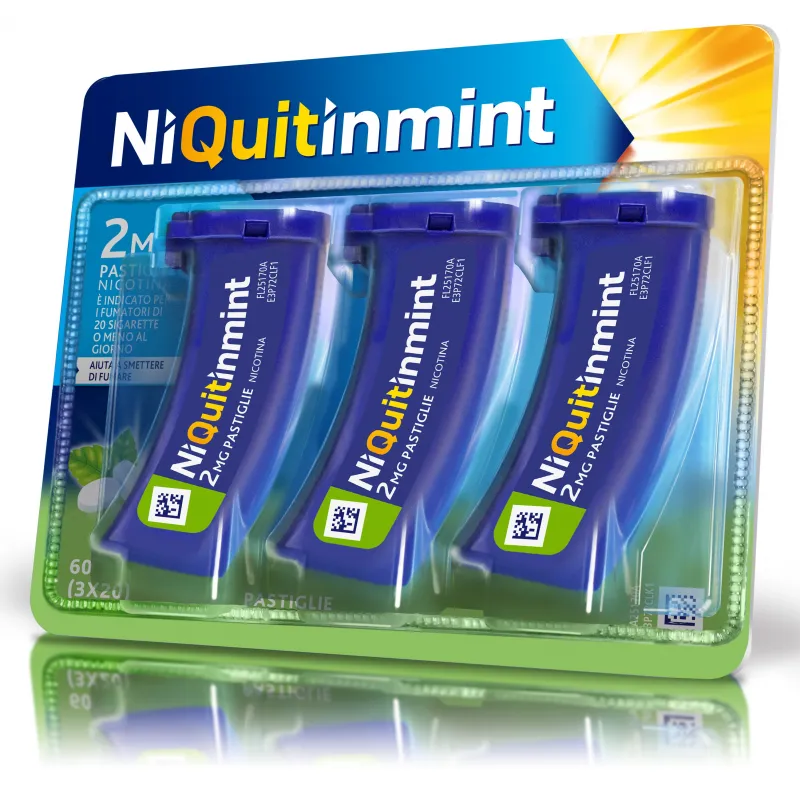
Table of Contents
Patient Information Leaflet
Niquitinmint 2 mg tablets
nicotine
Please read all of this leaflet carefully before you start using this medicine because it contains important information for you.
Always use this medicine exactly as described in this leaflet or as your doctor or pharmacist has told you to.
- Keep this leaflet. You may need to read it again.
- If you need more information or advice, consult healthcare professionals such as your doctor, a smoking cessation clinic, or a pharmacist.
- If you experience any of the side effects, including those not listed in this leaflet, talk to your doctor or pharmacist. See section 4.
- In this leaflet, "Niquitinmint" refers to Niquitinmint 2 mg tablets.
Contents of this leaflet
- What Niquitinmint is and what it is used for
- What you need to know before using Niquitinmint
- How to use Niquitinmint
- Possible side effects
- How to store Niquitinmint
- Contents of the pack and other information
1. What Niquitinmint is and what it is used for
Niquitinmint is used to help people stop smoking. This type of treatment is known as Nicotine Replacement Therapy (NRT).
Niquitinmint 2 mg is indicated for smokers of 20 cigarettes or fewer per day.
Niquitinmint can help you to stop smoking either abruptly or gradually. If you think you can stop smoking abruptly, you should do so, as this is the best approach. However, if you feel this would be too difficult, you should first reduce the number of cigarettes you smoke, before stopping completely. See section 3 “How to use Niquitinmint” for further details.
It is the nicotine in cigarettes that causes physical dependence on smoking.
- Niquitinmint helps you stop smoking by replacing part of the nicotine you normally absorb from cigarettes.
- Nicotine relieves some of the unpleasant symptoms that smokers may experience when trying to quit, such as discomfort or irritability.
- Nicotine can also reduce cigarette cravings and help you resist the urge to smoke.
Niquitinmint does not carry the health risks associated with tobacco, as it does not contain tar, carbon monoxide, or other toxins present in cigarette smoke. Some people are concerned that after quitting smoking they might become dependent on nicotine tablets instead. This is very rare, and even if it were to occur, it would still be much less harmful than continuing to smoke. Moreover, such dependence is easier to overcome.
Your chances of successfully quitting smoking are increased if you take part in a support programme. These “smoking cessation programmes” are known as behavioural support. For information about smoking cessation programmes, please consult your doctor or pharmacist.
Smoking provides no health benefits. It is always better to stop smoking. Using Nicotine Replacement Therapy (NRT), such as Niquitinmint, can help you. In general, any potential side effects associated with NRT are far less serious than the well-known risks linked to smoking.
2. What you need to know before using Niquitinmint
Do not use Niquitinmint:
- if you are allergic (hypersensitive) to nicotine or to any of the other ingredients of this medicine (listed in section 6).
- if you are a non-smoker.
- if you are under 12 years of age.
Warnings and precautions
Consult your doctor or pharmacist before using Niquitinmint if you have recently had a heart attack or stroke, or if you suffer from severe heart rhythm problems, unstable or worsening angina (chest pain), or angina at rest. In such cases, you should try to stop smoking without using nicotine replacement therapy (NRT), unless your doctor specifically recommends it.
- If you have diabetes, monitor your blood sugar levels more frequently than usual when starting Niquitinmint. You may need to adjust your insulin dose or other medications.
- If you have a history of epilepsy (seizures).
- If you have experienced allergic reactions with swelling of the lips, face, and throat (angioedema) or itchy skin rash (urticaria). NRT use may occasionally trigger such reactions.
Do not alternate Niquitinmint with nicotine-containing chewing gum during a single attempt to quit smoking.
If you are pregnant or breastfeeding, it is preferable to stop smoking without using NRT. However, quitting smoking with NRT is better than continuing to smoke (see the section on pregnancy and breastfeeding for more information).
Seek advice and support from your doctor in the following cases:
- If you have heart or circulation problems, or blood pressure issues, including heart failure, stable angina, hypertension, or occlusive peripheral arterial disease.
- If you have moderate to severe liver problems or severe kidney problems, as you may be more susceptible to side effects.
- If you have uncontrolled hyperactive thyroid or pheochromocytoma (a tumor of the adrenal gland that can affect blood pressure) – your doctor will have already discussed this with you – as nicotine may worsen symptoms.
- If you have gastric or duodenal ulcer or inflammation of the esophagus (the passage between mouth and stomach), because ingesting nicotine may worsen symptoms. It may also cause mouth ulceration. If symptoms worsen, consult your doctor. It may be preferable to use a non-oral form of NRT, such as patches.
- If you have had seizures (fits).
- If you have concerns about becoming dependent on, or think you have become dependent on, this product.
Children and adolescents
This medicine must not be used by children under 12 years of age, as it may cause severe poisoning or be fatal to children. It is therefore essential to always keep Niquitinmint out of the sight and reach of children.
Other medicines and Niquitinmint
Inform your doctor or pharmacist if you are taking, have recently taken, or might take any other medicines.
Stopping smoking may alter the effects of other medicines you are taking. If you have any doubts about using this medicine, consult your doctor or pharmacist.
Pregnancy and breastfeeding
If you are pregnant, think you may be pregnant, are planning to become pregnant, or are breastfeeding, consult your doctor or pharmacist before taking this medicine.
Smoking during pregnancy poses risks to the baby, such as poor growth before birth, premature delivery, and stillbirth. Stopping smoking is the best thing you can do for your health and your baby's. The earlier you stop, the better.
Ideally, if you are pregnant, you should stop smoking without using NRT. However, if you have tried and failed, your doctor may recommend NRT as an aid to quitting, since it is better for the developing fetus than continuing to smoke. The decision to use NRT should be made as early as possible in pregnancy, and gradual smoking reduction is not recommended. You should aim to use NRT for only 2–3 months. Remember, the most important goal is to stop smoking.
Products such as lozenges may be preferable to nicotine patches, as lozenges do not deliver nicotine continuously. However, patches may be preferable if you suffer from nausea or vomiting.
If you are breastfeeding, tobacco smoke causes breathing difficulties and other health problems in newborns and children. Ideally, you should stop smoking without using NRT. However, if you have tried and failed, your doctor may advise you to use NRT to help you quit. If you need to use NRT to stop smoking, the amount of nicotine passed to the infant is low and much less harmful than passive smoke exposure. It is better to use NRT products taken several times a day (such as chewing gum or lozenges) rather than patches. Additionally, it is best to breastfeed shortly before taking the product, to minimize the infant's exposure to nicotine.
Driving and using machines
Niquitinmint has no known effects on the ability to drive or operate machinery. However, you should be aware that quitting smoking may cause behavioral disturbances that could affect your ability to drive or use machinery.
Niquitinmint contains:
Sodium: this medicine contains less than 1 mmol (23 mg) of sodium per lozenge, i.e., essentially 'sodium-free'.
Mannitol: may have a mild laxative effect.
3. How to use Niquitinmint
The instructions on how to use Niquitinmint differ depending on whether you intend to:
a) stop smoking abruptly
b) stop smoking gradually
During any attempt to quit smoking with Niquitinmint, it is important to make every effort to
stop completely.
Niquitinmint must always be used exactly as described in this leaflet. If you have any doubts, consult your
doctor or pharmacist.
Medicinal product for oral mucosa. This means that the nicotine contained in the tablets is released
slowly into the mouth and then absorbed into the body.
In any case, the tablet must be kept in the mouth, moving it occasionally from one side of the mouth to the other, until it has completely dissolved (approximately 10 minutes). The tablet must not be chewed or swallowed whole. Do not take more than 15 tablets per day. If you feel the need to use Niquitinmint for more than 9 months in total, ask your doctor or pharmacist for advice.
a) Abrupt smoking cessation
Adults (from 18 years of age onwards)
- Start by taking 8 to 12 tablets per day. Take one tablet whenever you feel the urge to smoke.
- Use the tablets in this way for up to a maximum of 6 weeks, then gradually reduce the number of tablets you take daily.
- When you reach the point of taking only 1 or 2 tablets per day, stop completely. To help you remain smoke-free after treatment, you may take one tablet whenever you feel a strong urge to smoke.
Weeks 1 to 6:
Start by taking 1 tablet every 1-2 hours; at least 8 tablets per day.
Weeks 7 to 9:
Gradually reduce the number of tablets to 1 every 2-4 hours.
Weeks 10 to 12:
Gradually reduce the number of tablets to 1 every 4-8 hours.
Do not take more than 15 tablets per day. To help you remain smoke-free after treatment, during the
following 12 weeks, you may take 1-2 tablets per day only on occasions when you feel a strong urge to smoke.
b) Gradual smoking cessation
Adults (from 18 years of age onwards)
When you feel a strong urge to smoke, take a Niquitinmint tablet instead of smoking a
cigarette to manage your craving. Reduce as much as possible the number of cigarettes smoked per
day. If after 6 weeks you have not managed to reduce the number of daily cigarettes, consult your doctor
or pharmacist.
As soon as you feel ready, you should give up cigarettes completely. You should follow the
instructions above for abrupt smoking cessation. This should be done as soon as possible. If you are unable
to start a complete smoking cessation attempt within 6 months of beginning
Niquitinmint therapy, consult your doctor or pharmacist.
This method of gradual smoking cessation is not recommended during pregnancy (see the section on
pregnancy and breastfeeding for further information).
Use in adolescents
Adolescents (from 12 to 17 years inclusive)
Use Niquitinmint only on the advice of a doctor.
Do not exceed the recommended doses. Follow the instructions carefully and do not take more than 15 tablets per day
(24 hours).
Children under 12 years of age must not use Niquitinmint.
Ask your doctor or pharmacist if:
- you are concerned about starting to smoke again
- you find it difficult to stop taking the tablets completely
If you start smoking again, they will be able to advise you on how to achieve the best results with further cycles
of Nicotine Replacement Therapy (NRT).
If you take more Niquitinmint than recommended
If you take too many Niquitinmint tablets, you may begin to feel nausea, dizziness and general discomfort. Stop using
the tablets and contact a doctor or hospital emergency department immediately. If possible, show the
pack or this leaflet.
The tablets are not intended for children under 12 years of age or for non-smokers. If taken by
children or non-smokers, the tablets may cause symptoms of nicotine overdose. These include
headache, discomfort, stomach pain and diarrhoea. If a child has sucked or eaten one or more tablets, contact
a doctor and the nearest hospital emergency department immediately. If possible, show the
pack or this leaflet.
If you have any further questions about this product, consult your doctor or pharmacist.
If symptoms persist, consult a doctor.
4. Possible side effects
Like all medicines, Niquitinmint may cause side effects, although not everyone experiences them.
At the recommended doses, Niquitinmint has not caused serious side effects.
Stop using this medicine and consult a doctor immediately if you experience any of the following symptoms:
- Allergic reactions, tremor, angioedema (swelling of the skin or mucous membranes, face, tongue and throat causing breathing difficulties), dyspnoea (shortness of breath).
Stopping smoking itself may cause certain symptoms such as dizziness, headache, sleep disturbances, cough and cold-like symptoms.
Symptoms such as depression, irritability, anxiety, restlessness, increased appetite and insomnia may be associated with withdrawal symptoms following smoking cessation.
Other side effects are listed below, grouped according to how likely they are to occur.
Very common (may affect more than 1 in 10 people)
- Nausea
Common (may affect up to 1 in 10 people)
- Sore throat
- Dry mouth
- Pain or irritation and ulceration of the mouth or tongue
- Vomiting
- Stomach discomfort
- Diarrhoea
- Constipation
- Digestive difficulties / heartburn
- Belching
- Flatulence
- Hiccups
- Pharyngitis
- Increased appetite
- Difficulty sleeping, abnormal dreams
- Anxiety
- Irritability
- Restlessness
- Headache
- Dizziness
- Cough
Uncommon (may affect up to 1 in 100 people)
- Nervousness
- Depression
- Sleep disturbances
- Nocturia (frequent urination during the night)
- Mood changes
- Appetite disturbances
- Taste disturbances (dysgeusia)
- Palpitations (awareness of heartbeat)
- Increased heart rate
- Chest pain
- Skin rash
- Pain, leg pain
- Swelling of the legs
- Vascular disorders
- Itching or skin rash, swelling of the skin or mucous membranes, skin redness, increased sweating
- Tightness of the throat
- Worsening of asthma
- Irritation of nose and throat
- Nasal congestion
- Respiratory infections
- Nosebleeds
- Dry lips, dry throat
- Toothache and jaw pain
- Oral paraesthesia (numbness or tingling of the mouth)
- Bleeding gums
- Indigestion
- Dysphagia (difficulty swallowing)
- Stomach ulcer
- Hiatus hernia
- Acid regurgitation
- Gastric and oesophageal irritation
- Abnormal gastrointestinal noises
- Symptoms of overdose
Very rare (may affect up to 1 in 10,000 people)
- Symptoms of severe allergic reaction including sudden breathlessness or chest tightness, skin rash and feeling faint.
Not known (frequency cannot be estimated from available data)
- Convulsions (seizures)
- Increased salivation
- Fatigue and general malaise
- Flu-like illness (flu-like symptoms)
- Hypersensitivity
- Angioedema (swelling of the skin or mucous membranes, face, tongue and throat causing breathing difficulties)
- Tremor
- Dyspnoea (shortness of breath)
- A fast and irregular heartbeat (Atrial fibrillation)
Reporting of side effects
If you experience any side effect, including those not listed in this leaflet, talk to your doctor or pharmacist.
You can also report side effects directly via the national reporting system at www.aifa.gov.it/content/segnalazioni-reazioni-avverse.
By reporting side effects, you can help provide more information on the safety of this medicine.
5. How to store Niquitinmint
Keep this medicine out of the sight and reach of children.
Do not use the tablets after the expiry date stated on the container and outer packaging.
The expiry date refers to the last day of that month.
Do not store above 25°C.
Keep in the original container to protect the medicine from moisture.
Do not reuse the packaging for other purposes, as a fine layer of tablet powder may remain in the container.
Do not dispose of any medicine via wastewater. Ask your pharmacist how to dispose of medicines no longer in use. This will help protect the environment.
6. Package contents and other information
What Niquitinmint contains
The active substance is nicotine. Each tablet contains 2 mg of nicotine (in the form of a complexed resin known as
nicotine resinate).
The excipients are mannitol (E421), sodium alginate (E401), xanthan gum (E415), potassium bicarbonate
(E501), calcium polycarbophil, anhydrous sodium carbonate (E500), potassium acesulfame (E950), peppermint flavour,
magnesium stearate (E470b), sucralose.
Description of the appearance of Niquitinmint and pack contents
Tablets, oval, white to off-white, with convex surfaces.
The tablet is marked with the inscription “NIQ2” on one side.
Each container contains 20 tablets. Packs may contain 1, 3 or 5 containers.
Not all pack sizes may be marketed.
Marketing Authorisation Holder
PERRIGO ITALIA S.r.l.
Viale Dell’Arte 25 – 00144 Rome, Italy
Responsible producer for batch release
Perrigo Supply Chain
International DAC
The Sharp Building
Hogan Place,
Dublin 2
Dublin, D02 TY74
Ireland
This summary of product characteristics has been approved on