Nipent
Italy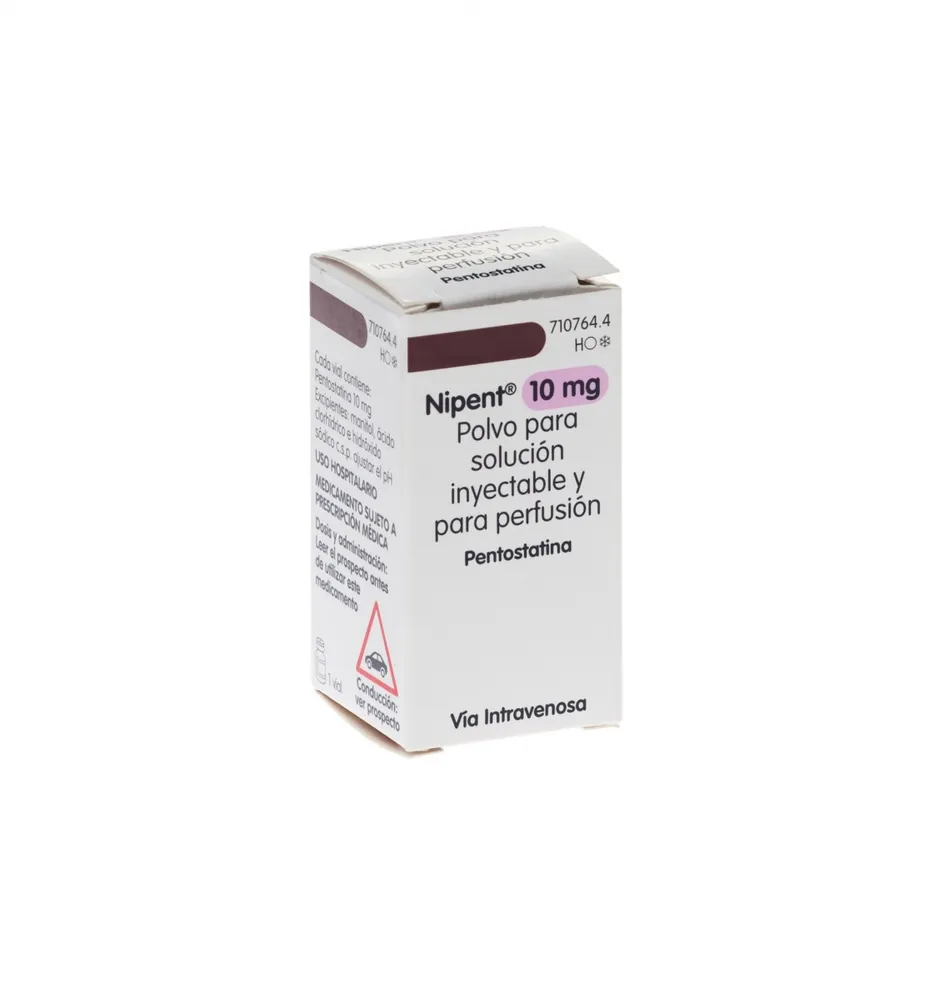
Table of Contents
PACKAGE LEAFLET: INFORMATION FOR THE USER
Nipent 10 mg
Powder for injectable solution, powder for infusion solution
(Pentostatin)
Read this leaflet carefully before starting to take this medicine
- Keep this leaflet. You may need to read it again.
- If you have any questions, ask your doctor.
- If any of the side effects worsens, or if you notice any side effect not listed in this leaflet, inform your doctor.
Contents of this leaflet:
- What Nipent is and what it is used for
- Before you use Nipent
- How to use Nipent
- Possible side effects
- How to store Nipent
- Further information
1. WHAT NIPENT IS AND WHAT IT IS USED FOR
Nipent is an antitumour medicinal product used to treat adult patients with
hairy cell leukaemia, a type of lymphocyte cancer (white blood cells important for fighting viruses and bacteria invading the body).
2. BEFORE USING NIPENT
Do not take Nipent:
- if you are allergic to Nipent (pentostatin) or to mannitol
- if you have severely impaired renal function (creatinine clearance < 60 ml/min)
- if you have an infection (elevated temperature or fever, chills or feeling unwell)
Before using this medicine, inform your doctor if any of the above apply to you.
The use of Nipent is not recommended in children.
Take special care with Nipent
- If you have liver problems
Before using this medicine, inform your doctor if the above applies to you.
Examinations
Before receiving Nipent for the first time, tests will be carried out to check your kidney function. Your blood will also be checked. This blood test will be repeated regularly during treatment with Nipent.
Inform your doctor if, after treatment with Nipent, you experience symptoms such as: confusion, dizziness, insomnia, tingling sensations (pins and needles), memory problems, unsteady gait, muscle spasms, tremors, fainting, headache, seizures, or other neurological symptoms.
Taking Nipent with other medicines
Inform your doctor if you are taking or have recently taken any other medicines, including those obtained without a prescription.
Nipent must not be used together with:
- fludarabine (another anti-tumour medicine)
Inform your doctor if you are taking the following medicines:
- vidarabine (an antiviral drug)
- cyclophosphamide, etoposide, carmustine (other anti-tumour medicines)
- allopurinol (a medicine used to treat gout, high levels of uric acid in the body caused by certain anti-tumour drugs, and kidney stones)
Pregnancy and breastfeeding
Nipent is not recommended if you are pregnant. Inform your doctor if you are pregnant, trying to become pregnant, or breastfeeding.
If you are of childbearing age, you must use adequate contraceptive methods. If you become pregnant, inform your doctor immediately.
Men must not father a child during treatment and for six months after the end of treatment with Nipent.
Driving and using machines
After taking this medicine, you may feel unwell and may experience dizziness or vision problems. Do not drive or operate machinery if you experience these adverse effects.
3. HOW TO USE NIPENT
This medicine will always be administered under the supervision of a doctor.
Dosage
Your doctor will determine and precisely calculate the dose required for you based on your
height, weight, and health condition. The usual dose in adults, including the elderly, is 4
mg/m² administered every 15 days. This medicine is given as a single short injection or by
infusion over 20–30 minutes into a vein (by drip).
Before and after treatment with Nipent, you will be given an intravenous infusion of a
solution (dextrose or dextrose and saline) to ensure that the fluids in your body are sufficient
to allow the medicine to reach its intended site of action and to reduce side effects.
Duration of treatment
You will be treated with Nipent until the tumor cells are destroyed. Your doctor will check
after 6 and 12 months from the start of Nipent therapy whether you are responding to
treatment.
If you receive a higher dose of Nipent
If you receive a dose of Nipent higher than recommended, vital organs (brain, liver, kidneys,
lungs) may be affected, which could potentially cause a serious medical condition. If you
experience any of the symptoms listed below, inform your doctor immediately, as they may
indicate a medical emergency that could be life-threatening: confusion; drowsiness; seizures;
loss of consciousness for a period of time; pain, burning, numbness, tingling in hands and
feet; weakness in arms or legs, loss of ability to move arms or legs, or disturbances in vision
and hearing (difficulty focusing and tinnitus).
You may also notice: yellowing of the skin and whites of the eyes (jaundice); itching; pain in
the upper right part of the abdomen; skin rash, unexplained fatigue and weakness, or loss of
appetite. Other symptoms may include: need to urinate frequently, especially at night
(nocturia); swelling of the legs and puffiness of the skin around the eyes (fluid retention);
shortness of breath, dry cough and general discomfort when breathing, or worsening of
symptoms when lying on your back.
4. POSSIBLE ADVERSE EFFECTS
Like all medicines, Nipent can cause adverse effects, although not everybody gets them.
Nipent works by killing tumour cells, but sometimes it also kills normal blood cells, resulting in an increased risk of developing infections. It may also reduce the number of platelets (which are necessary for blood clotting). Your doctor will monitor you and inform you if these events occur. There are specific precautions you should take to reduce the risk of infections or bleeding. If possible, avoid contact with people who have infections.
- Contact your doctor immediately if you feel you are becoming unwell due to an infection, or if you have fever, sweating or chills, cough, hoarseness, difficulty swallowing, mouth or lip ulcers, swollen nose with discharge (rhinorrhea), painful sinusitis, back or flank pain, pain, inability or difficulty urinating (urinating), severe headache and confusion (encephalitis).
- Contact your doctor immediately if you experience unusual bleeding, nosebleeds or bruising, black stools, blood in urine or stools, red pin-sized spots on the skin, sore throat, jaundice (yellowing of the eye whites or skin, pale stools or dark urine), allergic reactions (e.g. severe rash, difficulty breathing, rhinorrhea, facial swelling, painful mouth ulcers), tremors, muscle spasms, severe chest pain that may extend to the arm and neck (myocardial infarction).
Consult your doctor or nurse as soon as possible if any of the following side effects occur:
Very common (occur in more than 1 in 10 patients)
- Stomach pain or feeling unwell
- Loss of appetite
- Diarrhoea or blood in stools
- Headache
- Cough, rhinorrhea, cold, sore throat or breathing difficulties
- Skin rash, skin itching or skin problems
- Muscle pain, joint or bone problems
- Tiredness, weakness or pain
- Fever, sweating or chills
- Jaundice
Common (occur in less than 1 in 10 patients)
- Abdominal pain, indigestion, bloating or gas, constipation, change in body weight
- Inflammation of the gums (gingivitis), mouth or lips, throat swelling
- Dental problems, taste changes, dry mouth
- Dehydration
- Mood changes, aggression, anxiety, nervousness, depression, strange dreams or thoughts, hallucinations, neurosis
- Confusion, memory loss
- Dizziness, body or limb tremors, muscle spasms, seizures, fainting
- Difficulty falling asleep or drowsiness
- Unsteady gait, difficulty speaking, paralysis, inflammation of the lining of the brain, nerve damage
- Skin rash, peeling, swelling, redness, skin infection or itching
- Dry skin, acne, oily skin, skin discolouration, skin sensitivity to light
- Hair loss
- Dry eyes or altered tear production, eye pain, eye infections, light sensitivity, vision changes, damage to the back of the eye (retina)
- Ringing in the ears (tinnitus), ear pain, deafness, balance problems, vertigo
- Shortness of breath, asthma, blood clots or fluid in the lungs, nosebleeds
- Irregular, slow or fast heartbeat, changes in ECG, high or low blood pressure, shock
- Chest pain, angina, fluid around the heart, heart failure, cardiac arrest
- Blood clots in veins or vein inflammation, bleeding
- Infections such as sinusitis, pneumonia or bronchitis, abscesses, bone infections, skin infections, kidney or urinary tract infections, fungal infections (e.g. candidiasis), herpes zoster
- Skin cancer or other tumours, leukaemia
- Problems after transplantation
- Enlarged spleen, bruising, swollen lymph nodes
- Gout, changes in blood electrolytes (e.g. sodium, potassium and calcium)
- Arthritis, joint problems
- Kidney disorders, difficulty or pain when urinating, kidney failure, kidney stones, inability to empty the bladder
- Amenorrhoea, breast cysts, impotence
Uncommon (occur in less than 1 in 100 patients)
* Gastroenteritis, intestinal infection due to Clostridium difficile
* Infections, for example of the bladder (cystitis), CMV (Cytomegalovirus), pulmonary fungal infections
* Tumour lysis syndrome (includes breakdown products from dying tumour cells)
* Specific red blood cell disorders (Pure Red Cell Aplasia and certain types of anaemia), red or purple skin spots due to low platelet count
* Transplant failure
* Heart attack, heart muscle problems, low blood oxygen levels
* Organ failure
* Severe breathing problems
Rare (occur in less than 1 in 1,000 patients)
* Alzheimer's disease (memory loss, difficulty thinking and speaking)
* Epileptic seizures
* Migraine
* Parkinson's disease (lack of coordination, body and limb tremors)
* Eyelid swelling
* Inflammation of the heart lining, reduced heart function
* Fungal infection of the oesophagus
Very rare (occur in less than 1 in 10,000 patients)
* Severe eye pain with loss of vision
This medicine may cause the following side effects, which will be monitored by your doctor:
Very common (occur in more than 1 in 10 patients)
* Blood disorders affecting red blood cells, white blood cells and platelets (clotting factors)
* Changes in blood test results indicating liver or kidney function
Common (occur in less than 1 in 10 patients)
* Kidney stones
* Swelling of glands
* Heart and circulation problems
* Enlarged spleen
Sometimes the effects of Nipent may occur months or even years after the drug has been used, and in some cases, serious adverse effects have been fatal. Among these delayed adverse effects are commonly the development of certain types of tumours (e.g. skin cancer and acute leukaemia). Discuss these possible effects with your doctor.
Reporting of adverse effects
If you experience any adverse effect, including those not listed in this leaflet, talk to your doctor, pharmacist or nurse. You can also report adverse effects directly via the national reporting system at www.agenziafarmaco.gov.it/content/come-segnalare-una-sospetta-reazione-avversa.
By reporting adverse effects, you can help provide more information on the safety of this medicine.
5. HOW TO STORE NIPENT
Keep this medicine out of the sight and reach of children.
Do not use Nipent after the expiry date stated on the carton and vial (after Exp.:).
Where the month and year are indicated, the expiry date refers to the last day of the stated month.
Store in a refrigerator (2°C – 8°C).
Reconstituted solutions for injection or infusion must be used immediately; however, if this is not possible, they may be stored at a temperature below 25°C for a maximum of 8 hours.
6. OTHER INFORMATION
What Nipent contains:
The active substance is pentostatin. Each glass vial contains 10 mg of the active substance.
The other components are mannitol, sodium hydroxide, or hydrochloric acid.
Description of the appearance of Nipent and contents of the pack:
Nipent is a white powder which must be reconstituted with water for injections to form a solution prior to administration as an injectable solution or infusion.
Nipent is available in single-dose packs, in 10 ml vials individually packaged in cardboard cartons (pack containing 1 vial).
Marketing Authorization Holder:
Pfizer Italia S.r.l., via Isonzo, 71 – 04100 Latina
Manufacturer:
Hospira UK Limited, Horizon, Honey Lane, Hurley, Maidenhead, SL6 6RJ, United Kingdom.
Pfizer Service Company BVBA, Hoge Wei 10, 1930 Zaventem, Belgium.
This patient information leaflet was last revised in: 11/2018
Nipent® 10 mg powder for solution for injection, powder for solution for infusion
The following information is intended exclusively for physicians or healthcare professionals:
To be administered as an intravenous bolus injection or intravenous infusion. Do not administer the medicinal product in any other way than described above.
Instructions for use and dilution:
Any unused product or waste material must be disposed of in accordance with local requirements.
The physician must consult national or accepted guidelines on the handling of cytotoxic agents.
Procedures for the safe handling and disposal of anticancer drugs must be followed:
- Reconstitution of Nipent must be performed only by appropriately trained personnel in designated areas for cytotoxic drugs.
- Wear suitable protective gloves.
- Cytotoxic preparations must not be handled by pregnant personnel.
- Exercise caution and care in the disposal of waste materials such as syringes, needles, and other items used during reconstitution of the cytotoxic drug.
- Contaminated surfaces must be washed thoroughly with abundant water.
- Any remaining solution must be discarded. Transfer 5 ml of water for injections into the Nipent vial and mix thoroughly until complete dissolution. The resulting solution should be colorless to pale yellow, and the resulting concentration of pentostatin is 2 mg/ml. Parenteral medicinal products should be inspected visually for particulate matter and discoloration prior to administration.
Nipent may be administered as an intravenous bolus or diluted in a large volume (25 to 50 ml) of 5% Dextrose Injection (5% glucose solution) or 0.9% Sodium Chloride Injection (0.9% physiological saline). Diluting the entire contents of one reconstituted vial in 25 ml or 50 ml results in a final diluted concentration of pentostatin of 0.33 mg/ml or 0.18 mg/ml, respectively.
When diluted for infusion with 5% Dextrose Injection (5% glucose solution) or 0.9% Sodium Chloride Injection (0.9% physiological saline), Nipent solution shows no interaction with containers or administration sets made of PVC at concentrations ranging from 0.18 mg/ml to 0.33 mg/ml.
Avoid acidic solutions (the pH of the reconstituted powder ranges between 7.0 and 8.2).
Storage and stability:
The reconstituted injectable solution, or the solution further diluted for infusion, must be used within 8 hours and stored at a temperature not exceeding 25°C. Immediate use is recommended after reconstitution.