Nexium Control
Italy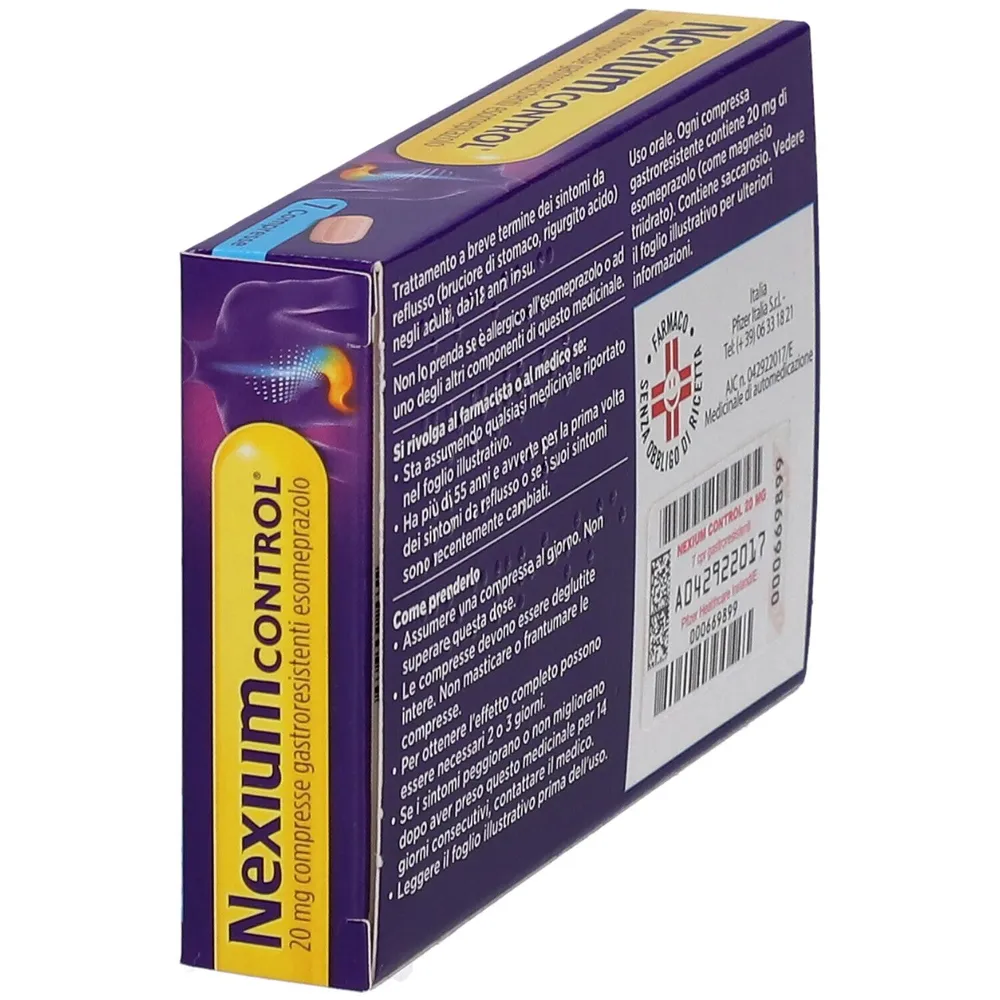
Table of Contents
- Package leaflet: Information for the user
- Nexium Control 20 mg gastro-resistant tablets
- 1. What Nexium Control is and what it is used for
- 2. What you need to know before taking Nexium Control
- 3. How to take Nexium Control
- 4. Possible side effects
- 5. How to store Nexium Control
- 6. Package contents and other information
- Package leaflet: Information for the user
- Nexium Control 20 mg gastro-resistant hard capsules
- 1. What Nexium Control is and what it is used for
- 2. What you need to know before taking Nexium Control
- 3. How to take Nexium Control
- 4. Possible side effects
- 5. How to store Nexium Control
- 6. Package contents and other information
Package leaflet: Information for the user
Nexium Control 20 mg gastro-resistant tablets
esomeprazole
Please read this leaflet carefully before taking this medicine because it contains important information for you.
Always take this medicine exactly as described in this leaflet or as your pharmacist has instructed you.
- Keep this leaflet. You may need to read it again.
- If you need more information or advice, consult your pharmacist.
- If you experience any side effects, including those not listed in this leaflet, contact your doctor or pharmacist. See section 4.
- Contact your doctor if you do not notice any improvement or if your symptoms worsen after 14 days.
Contents of this leaflet:
- What Nexium Control is and what it is used for
- What you need to know before taking Nexium Control
- How to take Nexium Control
- Possible side effects
- How to store Nexium Control
- Contents of the pack and other information
- Additional useful information
1. What Nexium Control is and what it is used for
Nexium Control contains the active substance esomeprazole. It belongs to a group of medicines known as 'proton pump inhibitors'. These work by reducing the amount of acid produced by the stomach.
This medicine is used in adults for the short-term treatment of reflux symptoms (for example, heartburn and acid regurgitation).
Reflux is the backflow of acid from the stomach into the oesophagus ("food pipe"), which can become inflamed and painful. This can cause symptoms such as a painful burning sensation in the chest rising towards the throat (heartburn) and a sour or bitter taste in the mouth (acid regurgitation).
Nexium Control is not intended to provide immediate relief. It may be necessary to take the tablets for 2-3 consecutive days before feeling better. Consult your doctor if you do not feel better or if you feel worse after 14 days.
2. What you need to know before taking Nexium Control
Do not take Nexium Control
- If you are allergic to esomeprazole or to any of the other ingredients of this medicine (listed in section 6).
- If you are allergic to medicines containing other proton pump inhibitors (e.g. pantoprazole, lansoprazole, rabeprazole or omeprazole).
- If you are taking a medicine containing nelfinavir or rilpivirine (used to treat HIV infection).
- If you have ever had a severe skin rash or skin peeling, skin rash with blisters and/or mouth ulcers after taking Nexium Control or other related medicines.
Do not take this medicine if any of the above apply to you. If in doubt,
consult your doctor or pharmacist before taking this medicine.
Warnings and precautions
Talk to your doctor before taking Nexium Control if:
- You have previously had a stomach ulcer or undergone stomach surgery.
- You have been continuously treated for 4 or more weeks for reflux or heartburn. This could be a sign of a more serious condition.
- You have frequent wheezing, particularly in association with heartburn.
- You have jaundice (yellowing of the skin and eyes) or severe liver problems.
- You have severe kidney problems.
- You are over 55 years old and have had new or recently changed reflux symptoms, or need to take daily over-the-counter remedies for indigestion or heartburn.
- You have ever had a skin reaction after treatment with a medicine similar to Nexium Control that reduces stomach acid. Serious skin reactions, including Stevens-Johnson syndrome, toxic epidermal necrolysis, drug reaction with eosinophilia and systemic symptoms (DRESS), have been reported in association with treatment with Nexium Control. Stop using Nexium Control and seek immediate medical advice if you notice any of the symptoms related to these serious skin reactions described in section 4.
- You are scheduled for endoscopy or urea breath test.
- You need to undergo a specific blood test (Chromogranin A).
Contact your doctor immediately before taking or after taking this medicine if you notice
any of the following symptoms, which could be signs of a more serious underlying illness:
- You lose a lot of weight without reason.
- You have problems or pain when swallowing.
- You experience stomach pain or signs of indigestion such as nausea, feeling of fullness, bloating, especially after eating.
- You start vomiting food or blood, which may appear dark like coffee grounds in your vomit.
- Your stools are black (stools with blood spots).
- You have severe or persistent diarrhoea; esomeprazole has been associated with a slight increase in the risk of infectious diarrhoea.
- If you notice the appearance of a skin rash, especially in areas exposed to sunlight, contact your doctor as soon as possible, as it may be necessary to discontinue treatment with Nexium Control. Remember to also report any other adverse effects such as joint pain.
Seek urgent medical advice if you experience chest pain accompanied by mental confusion, sweating, dizziness, or shoulder pain and shortness of breath. These could be symptoms of a serious heart problem.
If any of the above apply to you (or if you have any doubts), contact your doctor immediately.
Children and adolescents
This medicine must not be used in children and adolescents under 18 years of age.
Other medicines and Nexium Control
Inform your doctor or pharmacist if you are taking, have recently taken, or might take
any other medicines. This is because this medicine may affect how some medicines work, and some medicines may affect it.
Do not take this medicine if you are also taking a medicine containing nelfinavir or
rilpivirine (used to treat HIV infection).
You must specifically inform your doctor or pharmacist if you are taking clopidogrel (used to
prevent blood clots).
Do not take this medicine with other medicines that reduce the amount of acid produced
in the stomach, such as proton pump inhibitors (e.g. pantoprazole, lansoprazole, rabeprazole or
omeprazole) or H\textsubscript{2} antagonists (e.g. ranitidine or famotidine).
If needed, you may take this medicine with antacids (e.g. magaldrate, alginic acid,
sodium bicarbonate, aluminium hydroxide, magnesium carbonate or their combinations).
Inform your doctor or pharmacist if you are taking any of the following medicines:
- Ketoconazole and itraconazole (used to treat fungal infections).
- Voriconazole (used to treat fungal infections) and clarithromycin (used to treat infections). Your doctor may adjust the dose of Nexium Control if you also have severe liver problems and are on long-term treatment.
- Erlotinib (used to treat cancer).
- Levothyroxine (used to treat hypothyroidism).
- Methotrexate (used to treat cancer and rheumatic diseases).
- Digoxin (used for heart problems).
- Atazanavir, saquinavir (used to treat HIV infection).
- Citalopram, imipramine or clomipramine (used to treat depression).
- Diazepam (used to treat anxiety, for muscle relaxation or in epilepsy).
- Phenytoin (used to treat epilepsy).
- Medicines used to thin the blood, such as warfarin. Your doctor may need to monitor you when starting or stopping treatment with Nexium Control.
- Cilostazol (used to treat intermittent claudication — a condition in which poor blood supply to leg muscles causes pain and difficulty walking).
- Cisapride (used for indigestion and heartburn).
- Rifampicin (used to treat tuberculosis).
- Tacrolimus (used in organ transplantation).
- St John’s wort (Hypericum perforatum) (used to treat depression).
Pregnancy and breastfeeding
As a precautionary measure, you should preferably avoid using Nexium Control during
pregnancy. You must not use this medicine during breastfeeding.
If you are pregnant, suspect you may be pregnant, planning a pregnancy, or are breastfeeding, consult your doctor or pharmacist before taking this medicine.
Driving and using machines
Nexium Control is unlikely to affect your ability to drive or use machines.
However, side effects such as dizziness and visual disturbances are not uncommon (see section 4).
If these occur, do not drive or operate machinery.
Nexium Control contains sucrose and sodium
Nexium Control contains sugar spheres containing sucrose, a type of sugar. If your doctor has informed you that you have an intolerance to certain sugars, consult him before taking this medicine.
Nexium Control contains less than 1 mmol (23 mg) of sodium per tablet, i.e. essentially ‘sodium-free’.
3. How to take Nexium Control
Take this medicine exactly as described in this leaflet or as directed by your doctor or pharmacist. If you are in doubt, consult your doctor or pharmacist.
Dosage
- The recommended dose is one tablet daily.
- Do not exceed the recommended dose of one tablet (20 mg) per day, even if you do not experience immediate improvement.
- You may need to take the tablets for two or three consecutive days before symptoms of reflux (for example, heartburn and acid regurgitation) improve.
- The treatment duration is up to 14 days.
- When your reflux symptoms have completely disappeared, you must stop taking this medicine.
- If your reflux symptoms worsen or do not improve after taking this medicine for 14 consecutive days, consult your doctor.
If you frequently experience persistent or long-lasting recurring symptoms, even after treatment with this medicine, contact your doctor.
How to take the medicine
- You may take the tablet at any time of day, with or without food.
- Swallow the tablet whole with half a glass of water. Do not chew or crush the tablet. This is because the tablet contains coated granules that protect the medicine from the acidity of the stomach. It is therefore important not to damage the granules.
Alternative method of administration
- Place the tablet in a glass of plain (non-carbonated) water. Do not use any other liquid.
- Stir until the tablet dissolves (the mixture will not be clear), then drink the mixture immediately or within 30 minutes. Always stir the mixture again just before drinking.
- To ensure you have taken all the medicine, rinse the glass thoroughly with half a glass of water and drink it. The solid particles contain the medicine – do not chew or crush them.
If you take more Nexium Control than you should
If you take more Nexium Control than recommended, inform your doctor or pharmacist immediately.
Symptoms such as diarrhoea, stomach pain, constipation, feeling unwell and fatigue may occur.
If you forget to take Nexium Control
If you forget to take a dose, take it as soon as you remember on the same day. Do not take a double dose to make up for the missed dose.
If you have any doubts about how to use this medicine, consult your doctor or pharmacist.
4. Possible side effects
Like all medicines, this medicine can cause side effects, although not everybody gets them.
If you notice any of the following serious side effects, stop taking Nexium Control and contact your doctor immediately:
- Sudden wheezing, swelling of the lips, tongue and throat, skin rash, feeling faint or difficulty swallowing (severe allergic reaction, rarely observed).
- Reddening of the skin with blistering or peeling. Severe blisters and bleeding may also occur in the lips, eyes, mouth, nose and genitals. This may be ‘Stevens-Johnson syndrome’ or ‘toxic epidermal necrolysis’, very rarely observed.
- Yellowing of the skin, dark urine and tiredness, which may be symptoms of liver problems, rarely observed.
- Widespread rash, high body temperature and swollen lymph nodes (DRESS syndrome or drug hypersensitivity syndrome), very rarely observed.
Contact your doctor as soon as possible if you experience any of the following signs of infection:
This medicine very rarely affects white blood cells, leading to immunodeficiency. If you develop an infection with symptoms such as fever with severe deterioration in your general health, or fever with signs of local infection such as neck pain, sore throat or mouth, or difficulty urinating, you must consult your doctor as soon as possible to rule out a lack of white blood cells (agranulocytosis) by means of a blood test. In this case, it is important that you inform your doctor about the medicine you are taking.
Other side effects include:
Common (may affect up to 1 in 10 people)
- Headache.
- Stomach or intestinal problems: diarrhoea, stomach pain, constipation, gas (flatulence).
- Feeling unwell (nausea) or illness (vomiting).
- Benign growths (polyps) in the stomach.
Uncommon (may affect up to 1 in 100 people)
- Swelling of the feet and ankles.
- Disturbed sleep (insomnia), drowsiness.
- Dizziness, tingling sensation like “pins and needles”.
- Feeling of dizziness (vertigo).
- Dry mouth.
- Increased liver enzymes shown in blood tests that monitor liver function.
- Skin rash, hives (urticaria) and itchy skin.
Rare (may affect up to 1 in 1,000 people)
- Blood disorders such as a reduced number of white blood cells or platelets. This may cause weakness, bruising or increased susceptibility to infections.
- Low levels of sodium in the blood. This may cause weakness, illness (vomiting) and cramps.
- Feeling agitated, confused or depressed.
- Taste disturbances.
- Vision problems such as blurred vision.
- Sudden sensation of wheezing or breathlessness (bronchospasm).
- Inflammation inside the mouth.
- An infection called “candidiasis” that may affect the intestine and is caused by a fungus.
- Hair loss (alopecia).
- Skin rash after exposure to sunlight.
- Joint pain (arthralgia) or muscle pain (myalgia).
- General feeling of illness and lack of strength.
- Increased sweating.
Very rare (may affect up to 1 in 10,000 people)
- Low numbers of red blood cells, white blood cells, and platelets (a condition called pancytopenia).
- Aggression.
- Seeing, sensing or hearing things that are not there (hallucinations).
- Severe liver problems leading to liver failure and brain inflammation.
- Muscle weakness.
- Severe kidney problems.
- Breast enlargement in men.
Not known (frequency cannot be estimated from the available data)
- Low levels of magnesium in the blood. This may cause fatigue, illness (vomiting), involuntary muscle contractions, tremors and changes in heart rhythm (arrhythmia). If you have very low magnesium levels, you may also develop low blood levels of calcium and/or potassium.
- Inflammation of the intestine (which may lead to diarrhoea).
- Erythema, possible joint pain.
Reporting of side effects
If you experience any side effect, including those not listed in this leaflet, talk to your doctor or pharmacist. You can also report side effects directly via the national reporting system listed in Annex V. By reporting side effects, you can help provide more information on the safety of this medicine.
5. How to store Nexium Control
Keep this medicine out of the sight and reach of children.
Do not use this medicine after the expiry date which is stated on the carton and blister after
EXP. The expiry date refers to the last day of that month.
Do not store above 30°C.
Keep this medicine in the original packaging to protect it from moisture.
Do not dispose of any medicine via wastewater or household waste. Ask your pharmacist how to dispose of medicines you no longer use. This will help protect the environment.
6. Package contents and other information
What Nexium Control contains
- The active substance is esomeprazole. Each gastro-resistant tablet contains 20 mg of esomeprazole (as magnesium trihydrate).
- The other components are: glycerol monostearate 40-55, hydroxypropylcellulose, hypromellose, red-brown iron oxide (E172), yellow iron oxide (E172), magnesium stearate, methacrylic acid-ethyl acrylate copolymer (1:1) 30% dispersion, microcrystalline cellulose, synthetic paraffin, macrogol 6000, polysorbate 80, crospovidone (type A), sodium stearyl fumarate, sugar spheres (sucrose and maize starch), talc, titanium dioxide (E171) and triethyl citrate (see section 2, "Nexium Control contains sucrose and sodium").
Description of the appearance of Nexium Control and package contents
Nexium Control 20 mg gastro-resistant tablets are light pink, oblong, biconvex, 14 mm x 7 mm, film-coated, marked with '20 mG' on one side and A/EH on the other.
Nexium Control is available in blister packs containing 7, 14 and 28 gastro-resistant tablets.
Not all pack sizes may be marketed.
Marketing Authorization Holder
Haleon Ireland Dungarvan Limited, Knockbrack, Dungarvan, Co. Waterford, Ireland
Manufacturer
Haleon Italy Manufacturing S.r.l., Via Nettunense, 90, 04011, Aprilia (LT), Italy.
More detailed information on this medicinal product is available on the European Medicines Agency website: http://www.ema.europa.eu .
ADDITIONAL USEFUL INFORMATION
What are the symptoms of heartburn?
Typical reflux symptoms are a painful burning sensation in the chest rising towards the throat (heartburn) and a sour taste in the mouth (acid regurgitation).
Why do these symptoms occur?
Heartburn may result from overeating, consuming fatty foods, eating too quickly, or excessive alcohol consumption. You may also notice that heartburn worsens when lying down. Overweight individuals and smokers are more likely to suffer from heartburn.
What can you do to relieve symptoms?
- Eat healthier foods and try to avoid spicy or fatty foods and large meals shortly before bedtime.
- Avoid carbonated drinks, coffee, chocolate and alcohol.
- Eat slowly and reduce portion sizes.
- Try to lose weight.
- Stop smoking.
When should you seek advice or help?
- You should urgently consult a doctor if you experience chest pain accompanied by mental confusion, sweating, dizziness, shoulder pain or shortness of breath.
- If you experience the symptoms listed in section 2 of this package leaflet, for which you are advised to consult a doctor or pharmacist.
- If you experience the adverse effects listed in section 4 that require medical intervention.
Package leaflet: Information for the user
Nexium Control 20 mg gastro-resistant hard capsules
esomeprazole
Please read this leaflet carefully before taking this medicine because it contains
important information for you.
Always take this medicine exactly as described in this leaflet or as your pharmacist has instructed you to do.
- Keep this leaflet. You may need to read it again.
- If you need more information or advice, consult your pharmacist.
- If you experience any side effects, including those not listed in this leaflet, consult your doctor or pharmacist. See section 4.
- Consult your doctor if you do not notice any improvement or if your symptoms worsen after 14 days.
Contents of this leaflet:
- What Nexium Control is and what it is used for
- What you need to know before taking Nexium Control
- How to take Nexium Control
- Possible side effects
- How to store Nexium Control
- Package contents and other information
- Additional useful information
1. What Nexium Control is and what it is used for
Nexium Control contains the active substance esomeprazole. It belongs to a group of medicines called 'proton pump inhibitors'. These work by reducing the amount of acid produced by the stomach.
This medicine is used in adults for short-term treatment of reflux symptoms (for example, heartburn and acid regurgitation).
Reflux is the backflow of acid from the stomach into the oesophagus ("food pipe"), which can become inflamed and painful. This may cause symptoms such as a painful sensation in the chest rising towards the throat (heartburn) and a sour taste in the mouth (acid regurgitation).
Nexium Control is not intended to provide immediate relief. It may be necessary to take the capsules for 2-3 consecutive days before feeling better. Consult your doctor if you do not feel better or if you feel worse after 14 days.
2. What you need to know before taking Nexium Control
Do not take Nexium Control
- If you are allergic to esomeprazole or to any of the other ingredients of this medicine (listed in section 6).
- If you are allergic to medicines containing other proton pump inhibitors (e.g. pantoprazole, lansoprazole, rabeprazole or omeprazole).
- If you are taking a medicine containing nelfinavir or rilpivirine (used to treat HIV infections).
- If you have ever had a severe skin rash or skin peeling, or a rash with blisters and/or mouth ulcers after taking Nexium Control or other related medicines.
Do not take this medicine if any of the above apply to you. If in doubt,
consult your doctor or pharmacist before taking this medicine.
Warnings and precautions
Talk to your doctor before taking Nexium Control if:
- You have previously had a gastric ulcer or undergone stomach surgery.
- You have been continuously treating reflux or heartburn for 4 or more weeks. This could be a sign of a more serious condition.
- You have frequent wheezing, especially in the presence of heartburn.
- You have jaundice (yellowing of the skin and eyes) or severe liver problems.
- You have severe kidney problems.
- You are over 55 years old and have recently developed new or changed reflux symptoms, or need to take over-the-counter remedies for indigestion or heartburn daily.
- You have ever had a skin reaction after treatment with a medicine similar to Nexium Control that reduces stomach acid. Serious skin reactions, including Stevens-Johnson syndrome, toxic epidermal necrolysis, and drug reaction with eosinophilia and systemic symptoms (DRESS), have been reported in association with Nexium Control therapy. Stop using Nexium Control and seek immediate medical advice if you notice any of the symptoms related to these serious skin reactions described in section 4.
- You are scheduled for endoscopy or urea breath test.
- You need to undergo a specific blood test (chromogranin A).
Seek immediate medical advice before taking or after taking this medicine if you notice
any of the following symptoms, which could be signs of a more serious underlying illness:
- You lose a lot of weight without reason.
- You have difficulty or pain when swallowing.
- You experience stomach pain or signs of indigestion such as nausea, feeling of fullness, bloating, especially after eating.
- You start vomiting food or blood, which may appear dark like coffee grounds in your vomit.
- Your stools are black (indicating blood in the stool).
- You have severe or persistent diarrhoea; esomeprazole has been associated with a slight increase in the risk of infectious diarrhoea.
- If you notice a skin rash, particularly in sun-exposed areas, consult your doctor as soon as possible, as treatment with Nexium Control may need to be discontinued. Remember to also report any other side effects such as joint pain.
Seek urgent medical advice if you experience chest pain accompanied by mental confusion,
sweating, dizziness, or shoulder pain and shortness of breath. These could be symptoms
of a serious heart problem.
If any of the above situations apply to you (or if you have any doubts), consult your doctor immediately.
Children and adolescents
This medicine must not be used in children and adolescents under 18 years of age.
Other medicines and Nexium Control
Tell your doctor or pharmacist if you are taking, have recently taken, or might take
any other medicines. This is because this medicine may affect how some medicines work, and some medicines may affect it.
Do not take this medicine if you are also taking a medicine containing nelfinavir or
rilpivirine (used to treat HIV infection).
You must specifically inform your doctor or pharmacist if you are taking clopidogrel (used to
prevent blood clots).
Do not take this medicine with other medicines that reduce stomach acid production, such as proton pump inhibitors (e.g. pantoprazole, lansoprazole, rabeprazole or
omeprazole) or H₂-receptor antagonists (e.g. ranitidine or famotidine).
If necessary, you may take this medicine with antacids (e.g. magaldrate, alginic acid,
sodium bicarbonate, aluminium hydroxide, magnesium carbonate or their combinations).
Inform your doctor or pharmacist if you are taking any of the following medicines:
- Ketoconazole and itraconazole (used to treat fungal infections).
- Voriconazole (used to treat fungal infections) and clarithromycin (used to treat infections). Your doctor may adjust the dose of Nexium Control if you also have severe liver problems and are undergoing long-term treatment.
- Erlotinib (used to treat cancer).
- Levothyroxine (used to treat hypothyroidism).
- Methotrexate (used to treat cancer and rheumatic diseases).
- Digoxin (used for heart problems).
- Atazanavir, saquinavir (used to treat HIV infection).
- Citalopram, imipramine or clomipramine (used to treat depression).
- Diazepam (used to treat anxiety, for muscle relaxation, or in epilepsy).
- Phenytoin (used to treat epilepsy).
- Medicines used to thin the blood, such as warfarin. Your doctor may need to monitor you when starting or stopping treatment with Nexium Control.
- Cilostazol (used to treat intermittent claudication — a condition where poor blood supply to leg muscles causes pain and difficulty walking).
- Cisapride (used for indigestion and heartburn).
- Rifampicin (used to treat tuberculosis).
- Tacrolimus (used in organ transplantation).
- St John's Wort (Hypericum perforatum) (used to treat depression).
Pregnancy and breastfeeding
As a precautionary measure, you should preferably avoid using Nexium Control during
pregnancy. You must not use this medicine during breastfeeding.
If you are pregnant, think you may be pregnant, planning to become pregnant, or are breastfeeding, consult your doctor or pharmacist before taking this medicine.
Driving and using machines
Nexium Control is unlikely to affect your ability to drive or use machines.
However, side effects such as dizziness and visual disturbances are not uncommon (see section 4).
If these occur, do not drive or operate machinery.
Nexium Control contains sucrose, sodium and Allura Red AC (E129)
Nexium Control contains sugar spheres containing sucrose, a type of sugar. If your doctor has told you that you have an intolerance to certain sugars, consult him before taking this medicine.
Nexium Control contains less than 1 mmol of sodium (23 mg) per capsule, i.e. essentially 'sodium-free'.
Nexium Control contains the azo dye Allura Red AC (E129), which may cause allergic reactions.
3. How to take Nexium Control
Take this medicine exactly as stated in this leaflet or as directed by your doctor or pharmacist. If you have any doubts, consult your doctor or pharmacist.
Dosage
- The recommended dose is one capsule daily.
- Do not exceed the recommended dose of one capsule (20 mg) per day, even if you do not experience immediate improvement.
- You may need to take the capsules for two or three consecutive days before reflux symptoms (for example, heartburn and acid regurgitation) improve.
- The treatment duration is up to 14 days.
- When your reflux symptoms have completely disappeared, you should stop taking this medicine.
- If your reflux symptoms worsen or do not improve after taking this medicine for 14 consecutive days, consult your doctor.
If you frequently experience persistent or long-lasting symptoms, even after treatment with this medicine, contact your doctor.
How to take the medicine
- You may take the capsule at any time of day, with or without food.
- Swallow the capsule whole with half a glass of water. Do not chew, crush, or open the capsule. This is because the capsule contains coated granules that protect the medicine from the acidity of the stomach. It is therefore important not to damage the granules.
If you take more Nexium Control than you should
If you take more Nexium Control than recommended, inform your doctor or pharmacist immediately.
Symptoms such as diarrhoea, stomach pain, constipation, feeling unwell, and fatigue may occur.
If you forget to take Nexium Control
If you forget to take a dose, take it as soon as you remember on the same day. Do not take a double dose to make up for the missed dose.
If you have any doubts about how to use this medicine, consult your doctor or pharmacist.
4. Possible side effects
Like all medicines, this medicine can cause side effects, although not everyone will experience them.
If you notice any of the following serious side effects, stop taking Nexium Control and contact your doctor immediately:
- Sudden wheezing, swelling of the lips, tongue and throat, rash, feeling faint or difficulty swallowing (severe allergic reaction, rarely observed).
- Skin redness with blistering or peeling. Severe blisters and bleeding may also occur in the lips, eyes, mouth, nose and genitals. This may be 'Stevens-Johnson syndrome' or 'toxic epidermal necrolysis', very rarely observed.
- Yellowing of the skin, dark urine and fatigue, which may be symptoms of liver problems, rarely observed.
- Widespread rash, high body temperature and swollen lymph nodes (DRESS syndrome or drug hypersensitivity syndrome), very rarely observed.
Contact your doctor as soon as possible if you develop any of the following signs of infection:
This medicine very rarely affects white blood cells, leading to immunodeficiency. If you develop an infection with symptoms such as fever accompanied by severe deterioration in general health, or fever with signs of local infection such as neck, throat or mouth pain, or difficulty urinating, you must consult your doctor as soon as possible to rule out a lack of white blood cells (agranulocytosis) through a blood test. In this case, it is important that you inform your doctor about the medicine you are taking.
Other side effects include:
Common (may affect up to 1 in 10 people)
- Headache.
- Stomach or intestinal problems: diarrhoea, stomach pain, constipation, gas (flatulence).
- Feeling unwell (nausea) or illness (vomiting).
- Benign growths (polyps) in the stomach.
Uncommon (may affect up to 1 in 100 people)
- Swelling of the feet and ankles.
- Disturbed sleep (insomnia), drowsiness.
- Dizziness, sensation of tingling like "pins and needles".
- Feeling of dizziness (vertigo).
- Dry mouth.
- Increased liver enzymes shown in blood tests monitoring liver function.
- Skin rash, skin bumps (urticaria) and skin itching.
Rare (may affect up to 1 in 1,000 people)
- Blood disorders such as reduced number of white blood cells or platelets. This may cause weakness, bruising or increased susceptibility to infections.
- Low levels of sodium in the blood. This may cause weakness, feeling unwell (vomiting) and cramps.
- Feeling restless, confused or depressed.
- Taste disturbances.
- Vision problems such as blurred vision.
- Sudden sensation of wheezing or breathlessness (bronchospasm).
- Inflammation inside the mouth.
- Infection called "candidiasis" that may affect the intestine and is caused by a fungus.
- Hair loss (alopecia).
- Skin rash after exposure to sunlight.
- Joint pain (arthralgia) or muscle pain (myalgia).
- General feeling of malaise and lack of strength.
- Increased sweating.
Very rare (may affect up to 1 in 10,000 people)
- Low number of red blood cells, white blood cells and platelets (a condition called pancytopenia).
- Aggression.
- Seeing, sensing or hearing things that are not real (hallucinations).
- Severe liver problems leading to liver failure and brain inflammation.
- Muscle weakness.
- Severe kidney problems.
- Breast enlargement in men.
Not known (frequency cannot be estimated from the available data)
- Low levels of magnesium in the blood. This may cause fatigue, feeling unwell (vomiting), involuntary muscle contractions, tremors and changes in heart rhythm (arrhythmia). If you have very low magnesium levels, you may also develop low blood levels of calcium and/or potassium.
- Inflammation of the intestine (which may lead to diarrhoea).
- Erythema, possible joint pain.
Reporting of side effects
If you experience any side effect, including those not listed in this leaflet, talk to your doctor or pharmacist. You can also report side effects directly through the national reporting system listed in Annex V. By reporting side effects, you can help provide more information on the safety of this medicine.
5. How to store Nexium Control
Keep this medicine out of the sight and reach of children.
Do not use this medicine after the expiry date stated on the carton and bottle after EXP. The expiry date refers to the last day of that month.
Do not store above 30°C.
Keep this medicine in the original packaging to protect it from moisture.
Do not dispose of any medicine via wastewater or household waste. Ask your pharmacist how to dispose of medicines you no longer use. This will help protect the environment.
6. Package contents and other information
What Nexium Control contains
- The active substance is esomeprazole. Each gastro-resistant hard capsule contains 20 mg of esomeprazole (as magnesium trihydrate).
- The other components are: glyceryl monostearate 40-55, hydroxypropylcellulose, hypromellose, magnesium stearate, methacrylic acid-ethyl acrylate copolymer (1:1) 30% dispersion, polysorbate 80, sugar spheres (sucrose and maize starch), talc, triethyl citrate, carmine (E120), indigo carmine (E132),
titanium dioxide (E171), yellow iron oxide (E172), erythrosine (E127), Allura red AC (E129),
povidone K-17, propylene glycol, shellac, sodium hydroxide and gelatin (see section
2, “Nexium Control contains sucrose, sodium and Allura red AC (E129)”).
Description of the appearance of Nexium Control and contents of the pack
Nexium Control 20 mg gastro-resistant hard capsules are capsules of approximately 11 x 5 mm with a transparent body and an amethyst-coloured cap printed with “NEXIUM 20 MG” in white. The capsule has a yellow central band and contains yellow and purple enteric-coated pellet granules.
Nexium Control is available in high-density polyethylene (HDPE) bottles with an induction seal and child-resistant closure. Each bottle also contains a sealed container with silica gel desiccant.
Each pack contains 1 or 2 bottles, each with 14 gastro-resistant hard capsules.
Not all pack sizes may be marketed.
Marketing Authorization Holder
Haleon Ireland Dungarvan Limited, Knockbrack, Dungarvan, Co. Waterford, Ireland
Manufacturer
Haleon Italy Manufacturing S.r.l., Via Nettunense, 90, 04011, Aprilia (LT), Italy.
More detailed information on this medicinal product is available on the European Medicines Agency website: http://www.ema.europa.eu .
ADDITIONAL USEFUL INFORMATION
What are the symptoms of heartburn?
The typical symptoms of reflux are a painful burning sensation in the chest rising towards the throat (heartburn) and a sour taste in the mouth (acid regurgitation).
Why do these symptoms occur?
Heartburn may result from overeating, consuming fatty foods, eating too quickly, or excessive alcohol consumption. You may also notice that heartburn worsens when lying down. Overweight individuals and smokers are more likely to experience heartburn.
What can you do to relieve the symptoms?
- Eat healthier foods and try to avoid spicy or fatty foods and large meals shortly before bedtime.
- Avoid carbonated drinks, coffee, chocolate and alcohol.
- Eat slowly and reduce portion sizes.
- Try to lose weight.
- Quit smoking.
When should you seek advice or help?
- You should urgently consult a doctor if you experience chest pain accompanied by mental confusion, sweating, dizziness, shoulder pain or shortness of breath.
- If you experience the symptoms listed in section 2 of this leaflet, for which you are advised to consult a doctor or pharmacist.
- If you experience the adverse effects listed in section 4 that require medical attention.