Nerixia
Italy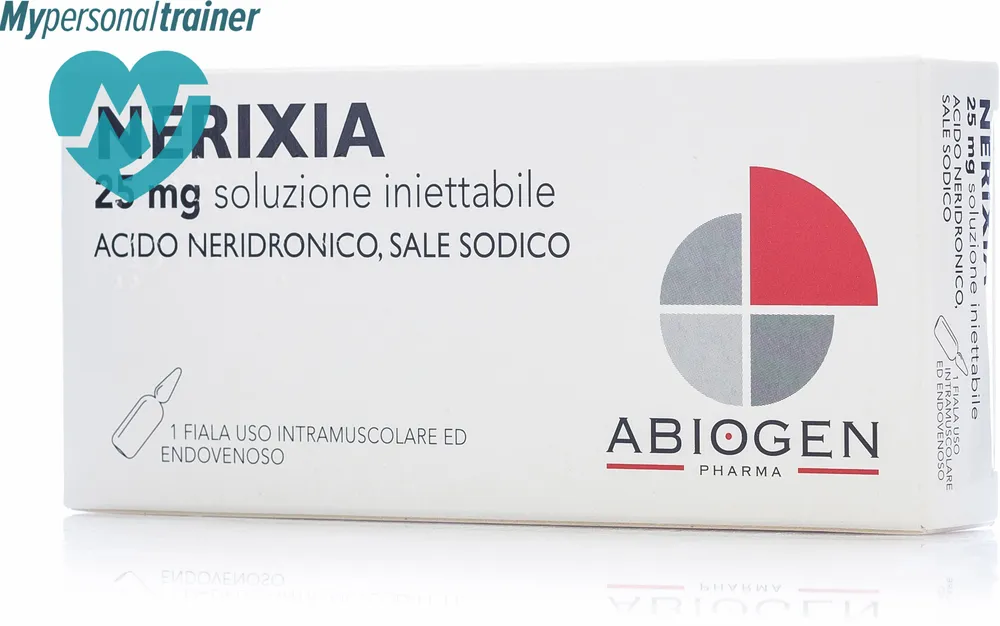
Table of Contents
- Package leaflet: Information for the patient
- NERIXIA 25 mg injectable solution, 100 mg concentrate for infusion solution
- 1. What NERIXIA is and what it is used for
- 2. What you need to know before using NERIXIA
- 3. How to use NERIXIA
- 4. Possible side effects
- 5. How to store NERIXIA
- 6. Package contents and other information
Package leaflet: Information for the patient
NERIXIA 25 mg injectable solution, 100 mg concentrate for infusion solution
Neridronic acid
Please read this leaflet carefully before using this medicine because it contains important information for you.
- Keep this leaflet. You may need to read it again.
- If you have any questions, ask your doctor or pharmacist.
- This medicine has been prescribed for you only. Do not give it to others, even if their symptoms are the same as yours, as it may be harmful.
- If you experience any side effects, including those not listed in this leaflet, contact your doctor or pharmacist. See section 4.
Contents of this leaflet:
- What NERIXIA is and what it is used for
- What you need to know before using NERIXIA
- How to use NERIXIA
- Possible side effects
- How to store NERIXIA
- Contents of the pack and other information
1. What NERIXIA is and what it is used for
NERIXIA is a medicine containing neridronic acid, an active substance that belongs to a group of
drugs used to treat bone diseases, called bisphosphonates.
NERIXIA is used in adults and in children under 18 years of age for the treatment:
- of a hereditary disease characterized by skeletal fragility, reduced bone mass, and a tendency to fractures (osteogenesis imperfecta or "brittle bone disease"). NERIXIA is furthermore used only in adults for:
- the treatment of a bone disease causing enlargement and deformation of bones (Paget's disease of bone)
- the symptomatic treatment of a bone disorder characterized by pain and swelling, increased sensitivity to pain (hyperalgesia), pain in response to a stimulus that is normally not painful (allodynia), movement disorders, joint stiffness, abnormal constriction or dilation of blood vessels, and degeneration of soft tissues (algodystrophy), with symptoms having appeared less than 4 months ago.
2. What you need to know before using NERIXIA
Do not use NERIXIA
- If you/your child are allergic to neridronic acid, to other medicines similar to NERIXIA (bisphosphonates), or to any of the other ingredients of this medicine (listed in section 6).
- If you/your child have severe kidney disease (severe renal insufficiency).
- If you are pregnant and/or breastfeeding (see section 2. "Pregnancy and breastfeeding").
Warnings and precautions
Talk to your doctor before using NERIXIA.
During treatment, your doctor will ask you to undergo blood tests to monitor kidney function and blood levels of calcium and phosphate (see section 4. "Possible side effects").
In particular, inform your doctor:
- if you/your child have been diagnosed with a tumour and are taking bisphosphonates, medicines used to treat bone diseases
- if you/your child are undergoing chemotherapy or radiotherapy sessions for treating tumours
- if you/your child are taking medicines to treat inflammation (corticosteroids)
- if you suffer from fragile bones (osteoporosis)
- if you/your child have poor dental health, gum disease, are scheduled for a tooth extraction, or do not regularly visit the dentist. In these cases, you might develop a condition known as osteonecrosis of the jaw (see section 4. Possible side effects). In such cases, during treatment with NERIXIA, avoid, if possible, invasive dental procedures. You may also need to undergo preventive dental treatment before starting treatment with NERIXIA (see section 4. Possible side effects).
Other medicines and NERIXIA
Tell your doctor or pharmacist if you/your child are taking, have recently taken, or might take any other medicines.
This is particularly important if you/your child are taking aminoglycosides, medicines used to treat infections.
Pregnancy, breastfeeding and fertility
Do not use NERIXIA during pregnancy and breastfeeding, as it is contraindicated (see section 2 " Do not use NERIXIA").
Driving and use of machines
There are no data suggesting that NERIXIA has effects on the ability to drive vehicles or use machinery.
NERIXIA contains sodium
NERIXIA 25 mg injectable solution contains 9.6 mg of sodium per dose. This medicine contains less than 1 mmol (23 mg) of sodium per vial, i.e. essentially 'sodium-free'.
NERIXIA 100 mg concentrate for solution for infusion contains 38.42 mg of sodium (main component of table salt) per dose. This corresponds to 1.9% of the maximum recommended daily dietary intake of sodium for an adult.
This should be taken into consideration if you/your child have kidney disease or are on a low-sodium diet.
3. How to use NERIXIA
Use this medicine exactly as instructed by your doctor or pharmacist. If you have any doubts, consult your doctor or pharmacist.
This medicine may be administered to adults either by intramuscular or intravenous injection, while in children it should only be given by intravenous injection.
Osteogenesis imperfecta
Adults
The recommended dose ranges from 25 mg to 100 mg intravenously, depending on body weight, administered as a single slow infusion after dilution in 250–500 mL of 0.9% sodium chloride solution.
The recommended dosage is 2 mg/kg body weight every 3 months.
The total dose may alternatively be divided into 25 mg intramuscular doses given daily for up to 4 consecutive days every 3 months.
Children (under 18 years of age)
The recommended dose is 2 mg/kg body weight (up to a maximum of 100 mg) administered every 3 months as a slow intravenous infusion (at least 2 hours), after dilution in 250–500 mL of 0.9% sodium chloride solution.
Paget's bone disease
The most commonly recommended dose is 100 mg daily by intravenous route for 2 consecutive days, given as a slow infusion (at least 2 hours) after dilution in 250–500 mL of physiological saline solution. Lower doses may be sufficient for milder forms of the disease. The total dose may also be divided into 25 mg intramuscular doses administered on consecutive days, up to a maximum of 8 days. Your doctor will assess whether repeating the treatment cycle is appropriate, no sooner than 6 months after the initial cycle, once the full therapeutic effect on bone turnover (serum alkaline phosphatase) has been observed.
Complex regional pain syndrome (algodystrophy)
The recommended dose is 100 mg daily by intravenous route every 3 days, for a total of 400 mg of neridronate, administered as a slow intravenous infusion (at least 2 hours) after dilution in 250–500 mL of physiological saline solution.
In cases where intravenous administration of NERIXIA 100 mg concentrate for infusion solution is not feasible and if the doctor considers home treatment appropriate, the recommended dose of NERIXIA 25 mg injectable solution is 25 mg (1 vial) by intramuscular injection daily for 16 consecutive days, for a total of 400 mg of neridronate.
Repeating the treatment is not recommended due to lack of clinical data.
Children and adolescents (under 18 years of age)
The use of NERIXIA is not recommended due to insufficient clinical data.
If you use more NERIXIA than you should
In case of accidental overdose, contact your doctor or go to the nearest hospital immediately.
Symptoms of overdose may include:
- Lowering of calcium levels in the blood
Treatment: A significant decrease in blood calcium levels can be corrected by intravenous administration of calcium gluconate.
If you forget to use NERIXIA
Do not take a double dose to make up for the missed dose.
If you stop using NERIXIA
If you have any doubts about using this medicine, consult your doctor or pharmacist.
4. Possible side effects
Like all medicines, this medicine can cause side effects, although not everyone experiences them.
The possible side effects are listed below, classified by frequency.
Uncommon (may affect up to 1 in 100 people)
- Pain at the injection site, which decreases after a few minutes (in case of administration into a muscle).
Rare (may affect up to 1 in 1,000 people)
- Atypical fracture of the femur (thigh bone), particularly in patients receiving long-term treatment for osteoporosis. Contact your doctor if you experience pain, weakness, or discomfort in the thigh, hip, or groin, as this could be an early sign of a possible femoral fracture.
- Influenza-like syndrome with fever, malaise, chills, and bone and/or muscle pain. In most cases, no specific treatment is required and symptoms resolve within a few hours or days.
Very rare (may affect up to 1 in 10,000 people)
- Osteonecrosis of the jaw (see section 4. Warnings and precautions)
- Consult your doctor if you experience ear pain, ear discharge, and/or ear infection. These events could be signs of bone damage in the ear (osteonecrosis of the external auditory canal)
- Skin rash
- Urticaria
- Dizziness
- Pain at the injection site, which decreases after a few minutes (in case of intravenous administration)
Not known (frequency cannot be estimated from the available data)
- Eye inflammation, which may present, for example, as eye pain, redness, light sensitivity, tearing, blurred vision, or discharge (conjunctivitis, anterior uveitis, episcleritis)
- Decreased levels of calcium in the blood (hypocalcemia)
- Decreased levels of phosphate in the blood (hypophosphatemia)
Reporting of side effects
If you experience any side effect, including those not listed in this leaflet, consult your doctor or pharmacist. You can also report side effects directly via the national reporting system at the website: "https://www.aifa.gov.it/content/segnalazioni-reazioni-avverse".
Reporting side effects can help provide more information on the safety of this medicine.
5. How to store NERIXIA
This medicinal product does not require any special storage conditions.
Keep this medicinal product out of the sight and reach of children.
Do not use this medicinal product after the expiry date stated on the packaging after "Exp".
The expiry date refers to the last day of that month.
Do not dispose of any medicinal product via wastewater or household waste. Ask your pharmacist how to dispose of medicines you no longer use. This will help protect the environment.
6. Package contents and other information
What NERIXIA contains
NERIXIA 25 mg injection solution
- The active substance in a 2 ml vial is Sodium neridronate 27 mg, equivalent to 25 mg of neridronic acid.
- The other components are Sodium chloride; disodium citrate dihydrate (see section 2. NERIXIA contains sodium), citric acid monohydrate; water for injection.
NERIXIA 100 mg concentrate for solution for infusion
- The active substance in an 8 ml vial is Sodium neridronate 108 mg, equivalent to 100 mg of neridronic acid.
- The other components are Sodium chloride; disodium citrate dihydrate (see section 2. NERIXIA contains sodium), citric acid monohydrate; water for injection.
Description of the appearance of NERIXIA and contents of the pack
NERIXIA 25 mg injection solution is a clear, colourless injectable solution in 2 ml vials for intramuscular and intravenous use.
It is available in packs containing 1 vial, 4 vials or 8 vials.
NERIXIA 100 mg concentrate for solution for infusion is a clear, colourless solution in a pack containing 2 vials of 8 ml for intravenous use.
It is possible that not all pack sizes are marketed.
Marketing Authorization Holder and Manufacturer
ABIOGEN PHARMA S.p.A. - Via Meucci 36 – Loc. Ospedaletto – Pisa, Italy