Neotigason
Italy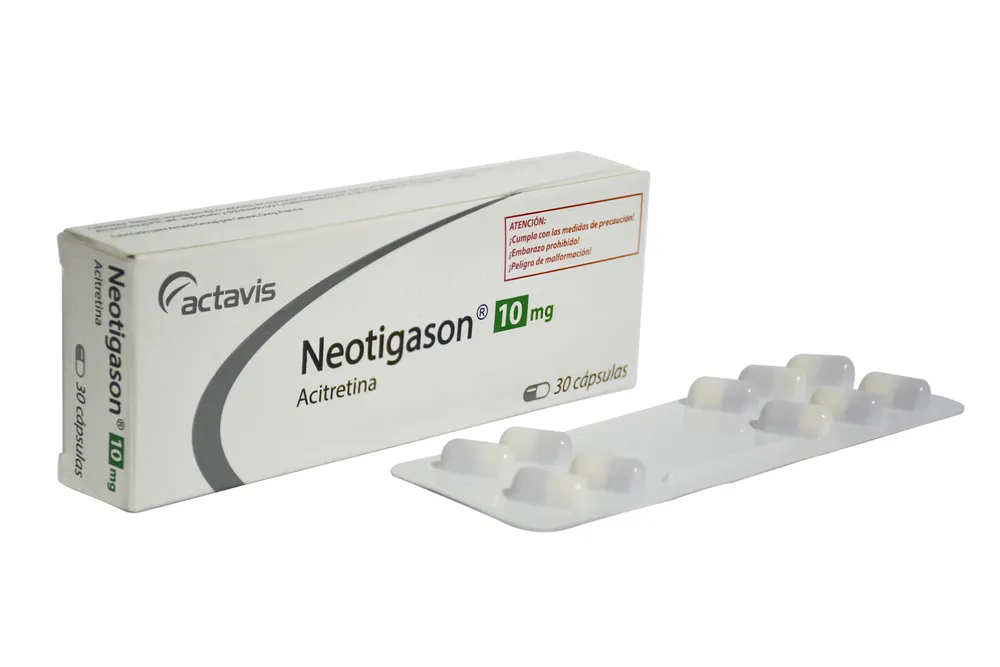
Neotigason 10 mg hard capsules
Neotigason 25 mg hard capsules
acitretin
WARNING
CAN SERIOUSLY HARM THE FETUS
Women must use effective contraceptive methods
Do not use if you are or think you may be pregnant
This medicine is under additional monitoring. This allows for rapid identification of new safety information. You can help by reporting any side effects you experience while taking this medicine. See the end of section 4 for information on how to report side effects.
PHARMACOTHERAPEUTIC CATEGORY
Retinoids for the treatment of psoriasis
THERAPEUTIC INDICATIONS
Severe forms of psoriasis, including those associated with arthropathy.
Keratinization disorders such as ichthyosis-like conditions, palmoplantar keratoderma, Darier’s disease, and lichen planus.
Other dermatoses responsive to Neotigason therapy.
CONTRAINDICATIONS
Do not use NEOTIGASON
- If you are pregnant or breastfeeding.
- If there is any possibility of becoming pregnant, you must follow the precautions outlined in the “Pregnancy Prevention Programme” in the “Precautions for Use” section.
- If you are allergic to the active substance, to other retinoids, or to any of the excipients or other components of this medicine.
- Severely impaired liver function.
- Severely impaired kidney function.
- Persistently elevated serum lipid levels.
- Since both acitretin and tetracyclines may increase intracranial pressure, their concomitant use is contraindicated (see “Interactions”).
- An increased risk of hepatitis has been reported with concomitant therapy using methotrexate and etretinate; therefore, the simultaneous use of methotrexate and acitretin is also contraindicated (see “Interactions”).
- Concomitant administration of acitretin with vitamin A or other retinoids is contraindicated due to the risk of developing hypervitaminosis A (see “Interactions”).
PRECAUTIONS FOR USE
NEOTIGASON should be prescribed only by or under the supervision of physicians experienced in the use of systemic retinoids for the treatment of severe acne and who fully understand the risks of acitretin therapy and the need for monitoring.
The physician must provide detailed information to all patients, both women and men, regarding the risk of teratogenicity and the strict contraceptive measures required. Clinical data have shown that etretinate may be formed following concomitant intake of acitretin and ethanol. Etretinate is highly teratogenic and has a longer half-life (approximately 120 days) than acitretin. Therefore, women of childbearing potential must not consume alcohol (in beverages, food, or medicines) during acitretin therapy and for two months after the end of treatment. Contraceptive measures and pregnancy testing must be continued for 3 years after completion of acitretin treatment (see “Pregnancy and Lactation”).
Pregnancy Prevention Programme
Pregnant women must not use NEOTIGASON
This medicine can seriously harm the fetus (it is said to be “teratogenic”) – it may cause
malformations in the newborn affecting the brain, face, ear, eye, heart, and certain glands (thymus and
parathyroid glands). It may also likely induce abortion. This may occur even if NEOTIGASON is used only briefly during pregnancy.
- Do not use NEOTIGASON if you are pregnant or think you may be pregnant.
- Do not use NEOTIGASON if you are breastfeeding. The medicine may pass into breast milk and harm the newborn.
- Do not use NEOTIGASON if you could become pregnant during treatment.
- Do not become pregnant for 3 years after completing this treatment, as some medicines may remain in your body.
Prescription based on diagnosis and therapeutic plan by a dermatology specialist. Based on a therapeutic plan with a maximum duration of 6 months, prescriptions may also be issued by the general practitioner. Prescribing NEOTIGASON to women of childbearing potential is limited to 30 days of therapy, and continuation of treatment requires a new prescription. Pregnancy testing, prescription issuance, and dispensing of NEOTIGASON should preferably occur on the same day. NEOTIGASON will be dispensed by the pharmacist within a maximum of seven days from the date of prescription. After this period, the pharmacist will dispense NEOTIGASON only upon presentation of a new prescription.
NEOTIGASON IS PRESCRIBED TO WOMEN OF CHILDBEARING POTENTIAL UNDER VERY STRICT RULES. THIS IS DUE TO THE RISK OF HARM TO THE FETUS.
These are the rules:
- The doctor must explain the risk of fetal harm – you must understand that you must not become pregnant and what is needed to prevent pregnancy.
- The doctor must discuss contraception (birth control) with you. The doctor will provide information on how to avoid pregnancy. The doctor may refer you to a specialist for contraceptive counseling.
- Before starting treatment, the doctor will instruct you to undergo a pregnancy test. The test must confirm that you are not pregnant when starting NEOTIGASON treatment. Women must use an effective contraceptive method before, during, and after using NEOTIGASON.
- You must agree to use at least one highly reliable contraceptive method (e.g., an intrauterine device or contraceptive implant) or two effective methods that work in different ways (e.g., hormonal oral contraceptive and condom). Discuss with your doctor which method may be suitable for you.
- You must use contraception for one month before starting NEOTIGASON, during treatment, and for 3 years after treatment ends.
- You must use contraception even if you are not menstruating or are not sexually active (unless your doctor advises otherwise). Women must agree to undergo pregnancy testing before, during, and after using NEOTIGASON.
- You must agree to regular follow-up visits, preferably monthly.
- You must agree to undergo regular pregnancy tests, preferably monthly during treatment and, since some medicines may remain in your body, every 1 to 3 months for 3 years after stopping NEOTIGASON (unless your doctor decides otherwise).
- You must agree to additional pregnancy tests if requested by your doctor.
- You must not become pregnant during treatment or within 3 years after stopping treatment, as some medicines may remain in your body.
- Your doctor will discuss all these points with you using a checklist and will ask you (or a relative/guardian) to sign it. This document confirms that the risks have been communicated to you and that you agree to follow the above rules.
If you become pregnant while taking NEOTIGASON, stop taking this medicine immediately and consult your doctor. Your doctor may refer you to a specialist for consultation.
Additionally, if you become pregnant within 3 years after stopping NEOTIGASON, you must contact your doctor. Your doctor may refer you to a specialist for consultation.
Advice for men
Levels of oral retinoids in the semen of men using NEOTIGASON are too low to harm their partner’s fetus. However, you must never share your medicines with anyone.
Additional precautions
Never give this medicine to anyone else. At the end of treatment, return any unused capsules to the pharmacist.
Do not donate blood during treatment with this medicine and for 3 years after stopping NEOTIGASON, as if a pregnant patient were to receive your blood, it could harm her fetus.
Women of childbearing age must not receive blood transfusions from patients being treated with acitretin.
Liver function should be monitored before starting acitretin treatment, every 1–2 weeks during the first two months, and subsequently every three months during treatment. If liver function is found to be impaired, monitoring should be repeated weekly. If abnormal values persist or worsen, acitretin therapy must be discontinued. It is advisable to continue monitoring liver function for at least three additional months (see “Undesirable Effects”).
Serum cholesterol and fasting serum triglyceride levels must be checked before starting treatment, one month after starting treatment, and every three months during treatment.
A reduction in night vision has been observed during acitretin treatment. Patients should be informed of this possible side effect and advised to be cautious when driving or operating machinery at night. Visual problems should be closely monitored (see “Undesirable Effects”).
Rare cases of benign intracranial hypertension have been reported. Patients with severe headache, nausea, vomiting, and visual disturbances must immediately discontinue acitretin treatment and undergo neurological evaluation and treatment (see “Undesirable Effects”).
In adults, particularly elderly patients, undergoing long-term acitretin therapy, appropriate periodic monitoring should be performed for possible alterations in ossification processes (see “Undesirable Effects”). If ossification problems occur, the doctor must discuss with the patient the possibility of continuing treatment based on a risk/benefit assessment.
Occasional reports of bone changes in children, including premature epiphyseal closure, hyperostosis, and extraosseous skeletal calcification, have been reported after long-term treatment with etretinate; these effects may be expected with acitretin use. Therefore, in children, growth parameters and skeletal development must be carefully monitored.
It should be emphasized that not all possible consequences of long-term acitretin treatment are currently known.
The effects of UV radiation are enhanced by retinoid therapy; therefore, patients should avoid excessive sun exposure and uncontrolled use of sunlamps. If necessary, a sunscreen with a high protection factor of at least 15 should be used.
Very rarely, a serious condition causing rupture of small blood vessels (capillaries), capillary leak syndrome/retinoic acid syndrome, has been reported. This may lead to severe hypotension (low blood pressure), edema (fluid retention causing swelling), and shock (collapse).
Very rarely, a severe skin reaction with symptoms such as rash, blisters, or skin peeling (exfoliative dermatitis) has been reported.
Treatment with high doses of retinoids may cause mood changes, including irritability, aggression, and depression.
Talk to your doctor before taking NEOTIGASON:
- If you have had mental health problems, including depression, aggressive tendencies, or mood changes. This is because NEOTIGASON may affect your mood.
Mental health problems
You may not notice some changes in your mood and behavior, and it is very important that you inform your friends and family that this medicine may affect your mood and behavior. They may notice these changes and help you identify problems that need to be discussed with your doctor.
High-risk patients:
In patients with diabetes, alcoholism, obesity, cardiovascular risk factors, or lipid metabolism disorders undergoing acitretin treatment, more frequent monitoring of serum lipid levels, blood glucose, and other cardiovascular risk indices (e.g., blood pressure) is required.
Retinoids may improve or worsen glucose tolerance in diabetic patients; therefore, blood glucose should be monitored more frequently than usual during the initial stages of treatment.
In all high-risk patients where cardiovascular risk indices fail to normalize or worsen further, dose reduction or discontinuation of acitretin therapy should be considered.
INTERACTIONS
Inform your doctor or pharmacist if you have recently taken any other medicines, including those without a prescription.
Concomitant administration of methotrexate, tetracyclines, vitamin A, or other retinoids with acitretin is contraindicated; see “Contraindications”.
Low-dose progestin-only preparations (minipills) may be an inadequate contraceptive method during acitretin treatment; see “Pregnancy and Lactation”. No interactions have been observed with combined estrogen/progestin oral contraceptives.
In a study conducted on healthy volunteers, concomitant intake of a single dose of acitretin and alcohol resulted in the formation of etretinate, which is highly teratogenic. The mechanism of this metabolic process has not been clarified, and therefore it is unknown whether interaction with other substances is possible. Therefore, women of childbearing potential must not consume alcohol (in beverages, food, or medicines) during acitretin therapy and for two months after the end of treatment (see “Precautions for Use”).
When acitretin is used concomitantly with phenytoin, it should be noted that acitretin reduces the protein binding of phenytoin. The clinical relevance of this is not yet known.
No further interactions between acitretin and other substances (e.g., digoxin, cimetidine) have been observed so far.
Studies on the effect of acitretin on the protein binding of coumarin anticoagulants (warfarin) have not shown any interaction.
SPECIAL WARNINGS
Consult your doctor or pharmacist before taking any medicine.
Pregnancy and Lactation
Women of childbearing potential / Contraception in males and females
Acitretin is highly teratogenic. Its use is contraindicated in women who may become pregnant during treatment or within three years after its completion. The risk of giving birth to a malformed child is extremely high if acitretin is administered before or during pregnancy, regardless of treatment duration or dosage.
Acitretin is contraindicated in any woman of childbearing potential unless all the following conditions are met:
- The patient has a severe keratinization disorder resistant to standard therapies.
- She is able to understand and follow the doctor’s instructions.
- She is able to reliably and consistently use the agreed contraceptive method without error.
- It is absolutely necessary that every woman of childbearing potential undergoing acitretin therapy consistently uses an effective contraceptive (preferably two complementary methods), starting 4 weeks before treatment, continuing throughout treatment, and for three years after its discontinuation. The patient must contact a doctor immediately if pregnancy is suspected.
- Treatment must not begin until the second or third day of the next menstrual period.
- A negative pregnancy test (minimum sensitivity 25 mIU/ml) must be obtained up to three days before the first dose. During treatment, pregnancy tests should be scheduled every 28 days. A negative pregnancy test no more than three days old is mandatory at these visits before prescribing. After treatment discontinuation, pregnancy tests must be performed every 1–3 months for a period of 3 years after the last dose.
- Before starting treatment, the doctor must provide detailed information to women of childbearing age about the precautionary measures, the risks of very severe fetal malformations, and the potential consequences of pregnancy during acitretin treatment and within three years after its discontinuation.
- Continued use of effective contraception must be implemented every time treatment is repeated, regardless of treatment duration, and continued for three years after treatment ends.
- In case of pregnancy despite these precautions, there is a high risk of severe fetal malformations (e.g., craniofacial defects, cardiac and vascular malformations or CNS, skeletal and thymic defects) and an increased incidence of spontaneous abortions. This risk is particularly high during acitretin treatment and in the 2 months following treatment. Up to 3 years after discontinuation of acitretin treatment, the risk is lower (especially in women who have not consumed alcohol), but cannot be entirely excluded due to the possible formation of etretinate. Therefore, women of childbearing potential must not consume alcohol (in beverages, food, or medicines) during acitretin therapy and for two months after the end of treatment (see “Precautions for Use” and “Interactions”).
The primary contraceptive method should be a combined hormonal contraceptive or an intrauterine device, and use of a condom or diaphragm is recommended. Low-dose progestin-only preparations (minipills) are not recommended due to possible interference with their contraceptive effect.
For male patients treated with acitretin, available data based on maternal exposure to sperm and seminal fluid indicate minimal, if any, risk of teratogenic effects.
Pregnancy
Acitretin is contraindicated in pregnant women (see “Contraindications”).
For further information on pregnancy and contraception, see the “Pregnancy Prevention Programme” section.
Lactation
Acitretin must not be administered to women who are breastfeeding (see “Contraindications”).
Effects on ability to drive and use machines
Neotigason may slightly impair the ability to drive or operate machinery.
A reduction in night vision has been observed during Neotigason treatment (see “Undesirable Effects”). Patients must be informed of this possible problem and advised to be cautious when driving or operating machinery at night.
Important information about some excipients in Neotigason
Neotigason contains glucose. If your doctor has diagnosed you with intolerance to certain sugars, contact him before taking this medicine.
Neotigason contains less than 1 mmol (23 mg) of sodium per capsule, i.e., it is essentially “sodium-free”.
DOSAGE, METHOD AND DURATION OF ADMINISTRATION
Neotigason must be prescribed only by physicians experienced in the use of systemic retinoids and aware of the teratogenicity risk associated with acitretin treatment.
Dosage
Due to differences in acitretin absorption and degree of metabolism, the dosage regimen should be individually adjusted. The following are general guidelines.
Adults
Initial therapy:
25–30 mg/day for two to four weeks (1 capsule of 25 mg or 3 capsules of 10 mg).
Maintenance therapy:
The maintenance dose should be based on clinical efficacy and tolerability. Generally, 25–50 mg/day administered for an additional six to eight weeks achieves optimal therapeutic results.
It may sometimes be necessary to increase the dose up to a maximum of 75 mg/day (3 capsules of 25 mg). In patients showing sufficient regression of psoriatic lesions, therapy may be discontinued. Any relapses should be treated as described above.
In the treatment of keratinization disorders, maintenance therapy is often required, even at very low doses (even below 20 mg/day and not exceeding 50 mg/day).
Children
For long-term treatments, the risk/benefit ratio must be carefully evaluated due to the possible occurrence of serious adverse effects. Acitretin should be used only when alternative therapies have proven ineffective.
Dosage should be based on body weight. A daily dose of 0.5 mg/kg is recommended. Doses up to 1 mg/kg/day may occasionally be required for limited periods. Total daily doses should not exceed 35 mg. Maintenance therapy should be conducted at the lowest effective dose due to the possible occurrence of adverse effects with long-term treatment.
Combination therapy:
Combining Neotigason with other therapies and individual response may justify a reduction in drug dosage.
The concurrent use of standard topical therapies does not interfere with Neotigason and may therefore continue.
Method of administration
Capsules should preferably be taken once daily with food or a glass of milk.
OVERDOSE
In case of accidental ingestion/overdose of Neotigason, contact your doctor immediately or go to the nearest hospital.
In case of acute overdose, acitretin therapy must be immediately discontinued.
Symptoms of overdose are identical to those of acute hypervitaminosis A, i.e., headache, dizziness, nausea or vomiting, drowsiness, irritability, and itching. Due to the low acute toxicity of the preparation, no specific treatment is required.
If you have any doubts about the use of Neotigason, consult your doctor or pharmacist.
UNDESIRABLE EFFECTS
Like all medicines, Neotigason can cause side effects, although not everyone experiences them.
Adverse effects have been observed in most patients starting acitretin therapy. However, these effects tend to disappear with dose reduction or treatment discontinuation. Sometimes, an initial worsening of psoriasis symptoms has been observed at the beginning of treatment.
The most frequently observed adverse effects are symptoms of hypervitaminosis A, such as dry lips, which can be relieved with ointment application.
Adverse effects reported for acitretin in clinical studies or as post-marketing events are listed below by system organ class and frequency. Frequencies are defined as:
Very common (≥1/10)
Common (≥1/100, <1/10)
Uncommon (≥1/1,000, <1/100)
Rare (≥1/10,000, <1/1,000)
Very rare (<1/10,000)
Not known (frequency cannot be estimated from available data)
| Infections and infestations Frequency not known | Vulvovaginal candidiasis caused by Candida albicans |
| Immune system disorders Frequency not known | Type I hypersensitivity (immediate allergic reaction with symptoms such as skin rash, swelling or itching of the skin, swollen and red eyes, severe nasal congestion, asthma or wheezing. The reaction may not be life-threatening). |
| Nervous system disorders Common Uncommon Rare Very rare Not known | Headache Dizziness Peripheral neuropathy Benign intracranial hypertension (see "Precautions for use") Dysgeusia |
| Eye disorders Very common Uncommon Very rare | Dryness and inflammation of mucous membranes (e.g., conjunctivitis, xerophthalmia), which may lead to intolerance of contact lenses Blurred vision Night blindness (see "Precautions for use"), ulcerative keratitis |
| Ear and labyrinth disorders Frequency not known | Hearing impairment, tinnitus |
| Vascular disorders Frequency not known | Flushing, capillary leak syndrome / retinoic acid syndrome* |
| Respiratory, thoracic and mediastinal disorders Very common Frequency not known | Dryness and inflammation of mucous membranes (e.g., epistaxis and rhinitis) Voice alteration (dysphonia) |
| Gastrointestinal disorders Very common Common Uncommon Not known | Dry mouth, thirst Stomatitis, gastrointestinal disorders (e.g., abdominal pain, diarrhea, nausea, vomiting) Gingivitis Rectal bleeding |
| Hepatobiliary disorders Uncommon Very rare | Hepatitis Jaundice |
| Skin and subcutaneous tissue disorders Very common | Cheilitis, pruritus, alopecia, skin peeling |
| Common Uncommon Not known | (affecting the whole body, particularly palms and soles) Skin fragility, sticky skin, dermatitis, abnormal hair texture, brittle nails, paronychia, erythema Fissures, bullous dermatitis, photosensitivity reactions Pyogenic granuloma, loss of eyelashes and eyebrows (madarosis), angioedema, urticaria, skin thinning, exfoliative dermatitis** |
| Musculoskeletal and connective tissue disorders Common Very rare | Arthralgia, myalgia Bone pain, exostoses (maintenance treatment may lead to progression of pre-existing spinal hyperostosis, development of new hyperostotic lesions and extraskeletal calcifications, as observed during long-term systemic treatment with retinoids) (see "Precautions for use") |
| General disorders and administration site conditions Common | Peripheral edema |
| Investigations Very common | Abnormal liver function tests (transient, usually reversible increase in transaminases and alkaline phosphatase) (see "Precautions for use") Lipid abnormalities (during treatment with high doses of acitretin, reversible increases in serum triglycerides and cholesterol have occurred, especially in high-risk patients and during long-term treatment (see "Precautions for use"). An associated atherogenic risk cannot be excluded when these conditions persist). |
*a serious condition causing breakdown of the small blood vessels (capillaries) (Capillary Leak Syndrome / Retinoic Acid Syndrome). This may lead to severe hypotension (low blood pressure), edema (fluid retention causing swelling), and shock (circulatory collapse).
** a severe skin reaction with symptoms such as rash, blisters, or peeling of the skin (Exfoliative Dermatitis).
Children
There have been occasional reports of bone changes in children, including premature epiphyseal closure, hyperostosis, and extraskeletal calcification following long-term treatment with etretinate; these effects may also be expected with acitretin use.
In children, growth parameters and bone development must be closely monitored.
Diabetics
Retinoids may improve or worsen glucose tolerance (see “Precautions for use”).
Following the instructions provided in this leaflet reduces the risk of adverse effects.
Reporting of adverse reactions
If you experience any adverse reaction, including those not listed in this leaflet, contact your doctor or pharmacist. Adverse reactions can also be reported directly via the national reporting system at the following website:
https://www.aifa.gov.it/content/segnalazioni-reazioni-avverse
Reporting adverse reactions helps provide more information on the safety of this medicine.
EXPIRY DATE AND STORAGE
Expiry date: see the date printed on the packaging.
The expiry date refers to the product kept in its original sealed packaging and stored correctly.
Warning: do not use the medicine after the expiry date stated on the packaging.
Storage instructions:
Store below 25°C. Keep in the original container.
Medicines should not be disposed of via wastewater or household waste. Ask your pharmacist how to dispose of medicines no longer required. This will help protect the environment.
KEEP THIS MEDICINE OUT OF THE SIGHT AND REACH OF CHILDREN
COMPOSITION
Neotigason 10 mg hard capsules
One capsule contains:
Active substance: acitretin 10 mg.
Excipients: microcrystalline cellulose, spray-dried liquid glucose, gelatin, and sodium ascorbate.
The capsule shell contains gelatin, titanium dioxide (E 171), red iron oxide (E 172), black iron oxide (E 172), and yellow iron oxide (E 172).
The printing ink contains shellac, black iron oxide (E172), propylene glycol, and ammonium hydroxide.
Neotigason 25 mg hard capsules
One capsule contains:
Active substance: acitretin 25 mg.
Excipients: microcrystalline cellulose, spray-dried liquid glucose, gelatin, and sodium ascorbate.
The capsule shell contains gelatin, titanium dioxide (E 171), red iron oxide (E 172), yellow iron oxide (E 172), and black iron oxide (E 172).
The printing ink contains shellac, black iron oxide (E172), propylene glycol, and ammonium hydroxide.
PHARMACEUTICAL FORM AND CONTENT
Hard capsules.
10 mg: capsules with brown cap and white body, with "10" printed in black on the body; size 4 capsules.
25 mg: capsules with brown cap and yellow body, with "25" printed in black on the body; size 1 capsules.
Neotigason 10 mg hard capsules: 30 capsules.
Neotigason 25 mg hard capsules: 20 capsules.
MARKETING AUTHORISATION HOLDER
Aurobindo Pharma (Italia) s.r.l. – Via San Giuseppe, 102 – 21047 Saronno (Varese)
MANUFACTURER
Cenexi – 52, Rue Marcel et Jacques Gaucher – 94120 Fontenay-Sous-Bois (France)
Cenexi-17, Rue de Pontoise-95520 Osny (France)