Neodidro
Italy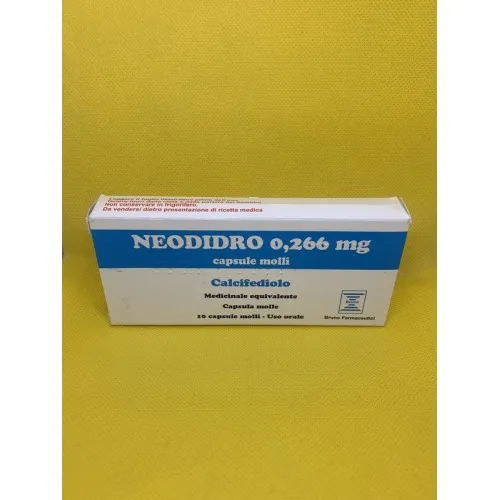
Table of Contents
Package leaflet: information for the patient
NEODIDRO 0.266 mg soft capsules
Calcifediol
Equivalent medicine
Read this leaflet carefully before taking this medicine because it contains important information for you.
- Keep this leaflet. You may need to read it again.
- If you have any questions, ask your doctor, pharmacist or nurse.
- This medicine has been prescribed for you only. Do not give it to others, even if their symptoms are the same as yours, as it could be harmful.
- If you experience any side effect, including those not listed in this leaflet, talk to your doctor, pharmacist or nurse. See section 4.
Contents of this leaflet
- What NEODIDRO is and what it is used for
- What you need to know before taking NEODIDRO
- How to take NEODIDRO
- Possible side effects
- How to store NEODIDRO
1. What NEODIDRO is and what it is used for
The medicine contains calcifediol, a form of vitamin D used for the treatment of vitamin D deficiency and related conditions, particularly when there is a need to initiate treatment with high doses or to space out administration over time. Among the functions of vitamin D in the human body is the enhancement of calcium absorption.
NEODIDRO is used:
In adults:
For the treatment of vitamin D deficiency, in cases where initial administration of high doses is required or when spaced administration over time is preferred, such as in the following situations:
- Adjunctive treatment in the management of osteoporosis
- In patients with malabsorption syndrome (difficulty absorbing nutrients)
- Osteodystrophy (bone disease) or calcium deficiency in patients with renal insufficiency
- Bone problems caused by corticosteroids (anti-inflammatory agents used in the treatment of various conditions).
2. What you should know before taking NEODIDRO
Do not take NEODIDRO:
- if you are allergic to calcifediol or to any of the other ingredients of this medicine (listed in section 6)
- if you have hypercalcemia (calcium levels in the blood >10.5 mg/dl) or hypercalciuria (high levels of calcium in the urine)
- if you have kidney stones
- if you have been diagnosed with hypervitaminosis D (excess vitamin D in the body).
Warnings and precautions
Talk to your doctor or pharmacist before taking NEODIDRO.
- Do not exceed the recommended daily intake of vitamin D supplements, such as this medicine; taking excessive doses of vitamin D may lead to poisoning (see section 3, paragraph If you take more NEODIDRO than you should).
- During or before starting treatment with this medicine, your doctor may recommend blood and urine tests to monitor calcium, phosphorus, and other parameters.
- The medicine may have reduced effectiveness in some patients with liver disease.
- Patients with kidney disease require special attention and must be closely monitored by a physician and undergo regular testing.
- Patients with heart disease require special attention and must be frequently monitored by a physician to check calcium levels, especially those receiving treatment with cardiac glycosides (see within this section, paragraph Other medicines and NEODIDRO).
- If you have hypoparathyroidism (insufficient synthesis and secretion of parathyroid hormone), this medicine may be less effective.
- If you are prone to developing calcium-containing kidney stones, your doctor should monitor your blood calcium levels.
- In patients requiring prolonged immobilization, a reduced dosage of this medicine may be necessary.
- Certain intestinal disorders may reduce the ability to absorb vitamin D (for example, diseases characterized by frequent diarrhea).
- Patients with sarcoidosis (a disease causing nodule formation, particularly in the skin), tuberculosis, or other conditions characterized by nodule formation should take this medicine with particular caution, as they have an increased risk of developing adverse effects at doses lower than recommended. Periodic blood and urine tests to monitor calcium levels are advised.
- To avoid potential overdose, your doctor should inform you and your family and/or caregivers about the importance of strictly following the recommended dosages and dietary recommendations, as well as concomitant calcium supplementation.
- Interference with laboratory tests: if you need to undergo diagnostic tests (including blood and urine tests, skin tests involving allergens, etc.), inform your doctor that you are taking this medicine; it may affect test results, for example, cholesterol tests.
Children and adolescents
For use in children and adolescents, administration of other formulations with lower dosage is recommended.
Elderly patients
Elderly patients generally require increased vitamin D intake due to, among other factors, reduced skin capacity to convert vitamin D into its active forms or reduced sun exposure. Elderly patients should take this medicine under medical supervision.
Other medicines and NEODIDRO
Inform your doctor or pharmacist if you are taking, have recently taken, or might take any other medicines.
Some medicines may alter the mechanism of action of this medicine. Conversely, NEODIDRO or calcifediol, the active ingredient of this medicine, may affect the efficacy of other medicines taken concomitantly, including:
- Medicines used to treat epilepsy (such as phenytoin, phenobarbital, and primidone) and other enzyme inducers (which may reduce the effects of NEODIDRO).
- Cardiac and/or antihypertensive medicines and cardiac glycosides, thiazide diuretics, or verapamil.
- Cholestyramine, colestipol (for cholesterol), orlistat (for obesity). Administration of these medicines and calcifediol should be spaced at least 2 hours apart.
- Mineral oil or paraffin (laxatives): use of an alternative laxative or administration of the two medicines at a suitable interval is recommended.
- Certain antibiotics (such as penicillin, neomycin, and chloramphenicol).
- Magnesium salts.
- Other products containing vitamin D.
- Calcium supplements.
- Corticosteroids (anti-inflammatory agents).
NEODIDRO with food and drinks
Some foods and drinks are fortified with vitamin D. This should be taken into account, as their effects may add up to those of this medicine and thus become excessive.
Pregnancy, breastfeeding, and fertility
If you are pregnant or suspect you may be pregnant, planning a pregnancy, or breastfeeding, consult your doctor or pharmacist before taking this medicine.
Do not take this medicine during pregnancy.
Do not take this medicine while breastfeeding.
Driving and using machines
NEODIDRO does not affect or affects negligibly the ability to drive or use machines.
NEODIDRO contains ethanol, sorbitol (E-420), and sunset yellow (E-110).
This medicine contains 1% ethanol (alcohol); this small amount corresponds to 4.98 mg/capsule.
This medicine contains sorbitol. If your doctor has diagnosed you with intolerance to certain sugars, consult him/her before taking this medicine.
The medicine contains sunset yellow (E-110) and may therefore cause allergic reactions. It may cause asthma, particularly in patients allergic to acetylsalicylic acid.
3. How to take NEODIDRO
Take this medicine exactly as directed by your doctor or pharmacist. If you have any doubts, consult your doctor or pharmacist.
Do not take this medicine in higher doses or more frequently than prescribed by your doctor (weekly, bi-weekly, or monthly). Otherwise, the risk of overdose increases.
Dosages vary depending on the individual and the indication. Your doctor should monitor your calcium and vitamin D levels periodically, usually before starting treatment and again 3 months after starting treatment.
Depending on the indication, doses are normally reduced or spaced further apart over time once symptoms have improved or vitamin D deficiency has been corrected.
The recommended doses are as follows:
Adults
The recommended dose is one capsule (0.266 mg of calcifediol) once a month.
- Vitamin D insufficiency: administration of one capsule (0.266 mg of calcifediol) per month is recommended for 2 months.
- Vitamin D deficiency: initial administration of one capsule (0.266 mg of calcifediol) per month is recommended for 4 months.
- As an adjunct to the treatment of osteoporosis in patients with vitamin D deficiency: administration of one capsule (0.266 mg of calcifediol) per month is recommended for 3–4 months.
In high-risk populations for vitamin D deficiency, higher doses or longer treatment durations may be necessary, if deemed appropriate by the doctor, based on blood test results and subsequent regular monitoring of corresponding levels:
- Renal osteodystrophy: administration of one capsule (0.266 mg of calcifediol) once a week or every two weeks is recommended.
- Corticosteroid-induced bone disorders: administration of one capsule (0.266 mg of calcifediol) once a month is recommended.
- In patients with more severe vitamin D deficiency or malabsorption syndrome, it is recommended to repeat the initial dose one week after starting treatment, followed by administration of one capsule once a month for four months, with regular monitoring of plasma 25-OH-cholecalciferol concentration. Depending on the serum levels detected, it may be necessary to increase the dose or frequency of administration. Once the concentration value has stabilized within the expected range, treatment should be discontinued or the administration frequency reduced. For oral use.
If you feel that the effect of this medicine is too strong or too weak, consult your doctor or pharmacist.
If you take more NEODIDRO than you should
If you take a dose of this medicine higher than prescribed by your doctor (overdose) and/or take it for prolonged periods, hypercalcemia (elevated calcium levels in the blood) and increased phosphate levels in urine and blood may occur, potentially leading to renal failure. Some symptoms of toxicity may appear soon after starting the medicine, while others may appear later. Initial symptoms include: weakness, fatigue, headache, loss of appetite, dry mouth, digestive disturbances such as vomiting, abdominal cramps, constipation or diarrhea, increased thirst, increased frequency of urination, muscle pain. Later symptoms may include: itching, weight loss, growth retardation in children, kidney disorders, sunlight intolerance, conjunctivitis, increased cholesterol and transaminase levels, pancreatitis, calcification (formation of calcium deposits) in blood vessels and other tissues such as tendons and muscles, increased blood pressure, mental disturbances, irregular heartbeat. Symptoms of overdose usually improve or disappear once treatment is discontinued; however, in cases of severe intoxication, renal or cardiac failure may occur.
If you forget to take NEODIDRO
Do not take a double dose to make up for the missed dose.
Take the missed dose as soon as possible, then continue with your regular dosing schedule.
If you stop taking NEODIDRO
If you have any doubts about using this medicine, consult your doctor, pharmacist, or nurse.
4. Possible side effects
Like all medicines, this medicine can cause side effects, although not everyone experiences them.
In general, side effects are not common (they may affect up to 1 in 100 people) when doses are adjusted according to recommendations. However, serious adverse reactions may occur if treatment involves excessive doses or is continued for longer than prescribed by the doctor, which may lead to hypercalcemia (increased levels of calcium in the blood).
The following side effects may occur:
Nausea, vomiting, dry mouth, constipation, taste disturbances with a metallic taste, abdominal cramps, anorexia (loss of appetite).
In cases of moderate hypercalcemia (increased calcium levels), weakness, fatigue, drowsiness, headache, and irritability may occur.
In cases of hypercalcemia, arrhythmias (disturbances in heart rhythm) may occur.
In cases of hypercalcemia, bone and muscle pain may occur, and calcifications (calcium deposits) in soft tissues may develop. Furthermore, nephrocalcinosis (formation of calcium deposits in the kidneys), kidney impairment with polyuria (increased frequency of urination), polydipsia (increased thirst), nocturia (repeated need to urinate during the night), and proteinuria (presence of protein in the urine) may occur.
In rare cases (affecting up to 1 in 1,000 people), at very high doses, photophobia (intolerance of the eyes to light) and conjunctivitis with corneal calcifications (calcium deposits in the cornea) may occur.
Other possible side effects include: rhinorrhea (runny nose), pruritus (itching), hyperthermia (fever), decreased libido (reduced sexual desire), pancreatitis (inflammation of the pancreas), increased blood urea nitrogen, albuminuria (presence of albumin in the urine), hypercholesterolemia (increased cholesterol in the blood), and hypercalcemia (increased calcium in the blood).
When blood calcium levels are high, an increase in transaminases (SGOT and SGPT) may occur.
Reporting of side effects
If you experience any side effect, including those not listed in this leaflet, talk to your doctor, pharmacist, or nurse. You may also report side effects directly via the national reporting system at www.agenziafarmaco.gov.it/it/responsabili.
By reporting side effects, you can help provide more information on the safety of this medicine.
5. How to store NEODIDRO
Keep this medicine out of the sight and reach of children.
Do not use this medicine after the expiry date stated on the packaging after EXP. The expiry date refers to the last day of that month.
This medicine requires no special storage conditions.
Do not store in the refrigerator.
Do not dispose of medicines via wastewater or household waste. Ask your pharmacist how to dispose of medicines you no longer use. This will help protect the environment.
6. Package contents and other information
What NEODIDRO contains
- The active substance is calcifediol. Each capsule contains 0.266 mg of calcifediol (equivalent to 15,960 IU of vitamin D).
- The other ingredients are: anhydrous ethanol, medium-chain triglycerides; capsule components are: gelatin, glycerol, sorbitol (E-420), titanium dioxide (E171), and sunset yellow (E-110).
Description of the appearance of NEODIDRO and package contents
NEODIDRO is presented as soft gelatin capsules, orange in colour and oval-shaped,
containing a clear, low-viscosity liquid free from particles, packed in PVC/PVDC-Al blisters
containing 5 or 10 capsules.
Marketing Authorisation Holder and Manufacturer
Marketing Authorisation Holder
Bruno Farmaceutici S.p.A.
Via delle Ande 15, 00144 Rome
Italy
Manufacturer responsible for batch release
Faes Farma, S.A.
Maximo Agirre Kalea, 14
48940 Leioa (Bizkaia)
Spain
Faes Farma, S.A.
Parque Científico y Tecnológico de Bizkaia
Ibaizabal Bidea, Edificio 901
48160 Derio (Bizkaia)
Spain
This medicinal product is authorised in the EEA Member States under the following names:
Belgium: Defediol
Bulgaria: Hidroferol 0,266 mg мека капсула
Estonia: Defevix
Italy: Neodidro
Lithuania: Defevix 0,266 mg minkštoji kapsulė
Latvia: Defevix 0,266 mg mīkstās kapsulas
Luxembourg: Defediol
Netherlands: Hidroferol 0,266 mg zachte capsules
Poland: Calfos
Portugal: Vitodê 0,266 mg cápsula mole
Romania: Hidroferol 0,266 mg capsulă moale
This patient information leaflet was last reviewed on