Natpar
Italy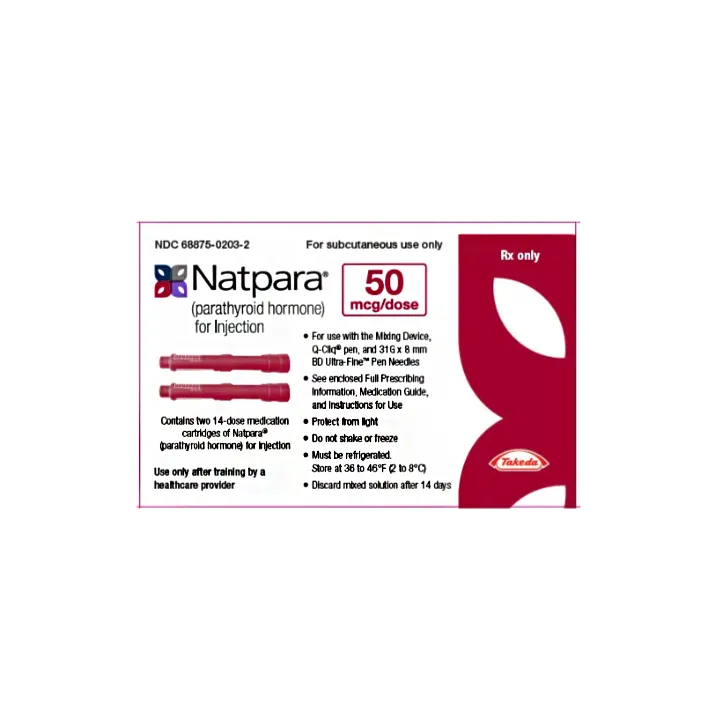
Table of Contents
- Package leaflet: Information for the patient
- Natpar 25 micrograms/dose powder and solvent for injectable solution, 50 micrograms/dose powder and solvent for injectable solution, 75 micrograms/dose powder and solvent for injectable solution, 100 micrograms/dose powder and solvent for injectable solution
- 1. What Natpar is and what it is used for
- 2. What you need to know before using Natpar
- 3. How to use Natpar
- 4. Possible side effects
- 5. How to store Natpar
- 6. Package contents and other information
- 7. Instructions for Use
Package leaflet: Information for the patient
Natpar 25 micrograms/dose powder and solvent for injectable solution, 50 micrograms/dose powder and solvent for injectable solution, 75 micrograms/dose powder and solvent for injectable solution, 100 micrograms/dose powder and solvent for injectable solution
Parathyroid hormone
This medicinal product is subject to additional monitoring. This will allow for rapid identification of
new safety information. You can help by reporting any side effects you experience while taking
this medicine. See the end of section 4 for information on how to report side effects.
Please read this leaflet carefully before using this medicine because it contains important
information for you.
- Keep this leaflet. You may need to read it again.
- If you have any questions, ask your doctor or pharmacist.
- This medicine has been prescribed for you only. Do not give it to others, even if they have the same symptoms as you, because it could be harmful.
- If you experience any side effect, including those not listed in this leaflet, contact your doctor or pharmacist. See section 4.
Contents of this leaflet
- What Natpar is and what it is used for
- What you need to know before using Natpar
- How to use Natpar
- Possible side effects
- How to store Natpar
- Contents of the pack and other information
- Instructions for use
1. What Natpar is and what it is used for
What is Natpar?
Natpar is a hormone replacement therapy for adults with reduced parathyroid gland activity, a condition known as 'hypoparathyroidism'.
Hypoparathyroidism is a disease caused by low levels of parathyroid hormone, a hormone produced by the parathyroid glands located in the neck. This hormone regulates the levels of calcium and phosphate in the blood and urine.
If parathyroid hormone levels are too low, you may develop low levels of calcium in the blood, which can cause symptoms affecting many parts of the body, including the bones, heart, skin, muscles, kidneys, brain, and nerves. For a list of symptoms caused by low calcium levels, see section 4.
Natpar is a synthetic form of parathyroid hormone that helps maintain calcium and phosphate levels in the blood and urine within normal ranges.
2. What you need to know before using Natpar
Do not use Natpar
- if you are allergic to parathyroid hormone or to any of the other ingredients of this medicine (listed in section 6)
- if you are currently undergoing or have previously undergone radiotherapy to the skeleton
- if you have bone cancer or other types of cancer that have spread to the bones
- if you are at increased risk of developing a type of bone cancer called osteosarcoma (for example, Paget’s disease or other bone diseases)
- if blood tests show unexplained increases in bone alkaline phosphatase
- if you have pseudohypoparathyroidism, a rare condition in which the body does not respond properly to the parathyroid hormone it produces.
Warnings and precautions
Talk to your doctor, pharmacist, or nurse before using Natpar.
Treatment with Natpar may cause side effects due to low or high levels of calcium in the blood (for these side effects, see section 4).
These side effects are more likely to occur:
- at the beginning of treatment with Natpar,
- if the dose of Natpar is changed,
- if you miss one of the daily injections,
- if you temporarily or permanently stop administering Natpar.
You may be prescribed medications to treat or prevent these side effects, or you may be advised to stop taking some of your current medications, including calcium or vitamin D.
If symptoms are severe, your doctor may prescribe additional medical treatment.
Your doctor will monitor your calcium levels. It may be necessary to adjust the dose of Natpar or temporarily stop the injections.
Examinations and monitoring
Your doctor will monitor your response to treatment:
- within the first 7 days after starting treatment and
- whenever the dose is adjusted, through tests measuring calcium levels in blood or urine. Your doctor may adjust the amount of calcium or vitamin D you take (in any form, including calcium-rich foods).
Talk to your doctor or pharmacist before using Natpar if you have kidney stones.
Children and adolescents
Natpar must not be used in children or adolescents under 18 years of age.
Other medicines and Natpar
Inform your doctor or pharmacist if you are taking, have recently taken, or might take any other medicines, including:
- digoxin, also known as digitalis, a medicine for the heart
- medicines used to treat osteoporosis, called bisphosphonates, such as alendronic acid
- medicines that can alter calcium levels in the blood, such as lithium or other medicines used to increase urine output (diuretics).
Pregnancy, breastfeeding, and fertility
If you are pregnant, think you may be pregnant, are planning a pregnancy, or are breastfeeding, consult your doctor or pharmacist before taking this medicine. Data on the safety of Natpar in pregnant women are limited. Excretion of Natpar in rat milk has been demonstrated, but it is not known whether Natpar is excreted in human breast milk.
Your doctor will decide whether to start treatment with Natpar. Your doctor will also decide whether you should continue taking Natpar during pregnancy or if you may begin breastfeeding while on treatment.
It is not known whether Natpar has effects on fertility.
Driving and using machines
Natpar has no effect on the ability to drive vehicles or use machinery. However, hypoparathyroidism may impair concentration. In such a case, you must not drive or operate machinery until your concentration improves.
Natpar contains sodium
This medicine contains less than 1 mmol (23 mg) of sodium per dose, i.e., essentially “sodium-free”.
3. How to use Natpar
Use this medicine exactly as instructed by your doctor or pharmacist. If you have
any doubts, consult your doctor or pharmacist. Your doctor or nurse will show you how to use the
Natpar pen.
Natpar is administered daily by subcutaneous injection (under the skin) using a pen.
In this patient information leaflet, the 'reusable Natpar pen' is referred to as the 'Natpar pen' or 'pen'.
Dose
The recommended starting dose of Natpar is 50 micrograms per day.
- However, depending on the results of a blood test, your doctor may prescribe you an initial dose of 25 micrograms per day.
- After 2-4 weeks, your doctor may adjust the dose.
The dose of Natpar varies from person to person. Some people may require a dose between 25 and 100 micrograms per day.
During treatment with Natpar, your doctor may prescribe other medicines such as calcium or vitamin D supplements, and will inform you of the daily doses required.
How to use the pen
Before using the pen, read “Section 7. Instructions for use” in this patient information leaflet.
Do not use the pen if the solution appears cloudy or discolored, or contains visible particles.
Before first use, the medicine must be mixed.
After mixing, the Natpar pen is ready for use and the medicine can be injected under the skin in one thigh. The following day, inject the medicine in the other thigh, continuing to alternate between the right and left thigh.
It is strongly recommended that each time you receive a dose of Natpar, the name and batch number of the product are recorded, to keep track of the batches used.
How long to use Natpar
Continue using Natpar for the duration prescribed by your doctor.
If you use more Natpar than you should
If you accidentally inject more than one dose of Natpar in a day, contact your doctor or pharmacist immediately.
If you forget to use Natpar
If you forget to use Natpar (or cannot use it at the usual time), administer the injection as soon as possible, but do not inject more than one dose on the same day.
Inject the next dose of Natpar the following day at the usual time. If you experience signs indicating low calcium levels in the blood, you may need to take a higher amount of calcium supplements; for symptoms, see section 4.
Do not inject a double dose to make up for a forgotten dose.
If you stop using Natpar
Talk to your doctor if you wish to stop treatment with Natpar.
If you have any questions about how to use this medicine, consult your doctor or pharmacist.
4. Possible side effects
Like all medicines, this medicine can cause side effects, although not everybody gets them.
Serious side effects
The use of Natpar may cause the following potentially serious side effects:
- Very common: high levels of calcium in the blood, which may occur more frequently at the beginning of treatment with Natpar.
- Very common: low levels of calcium in the blood; this event may occur more frequently if Natpar is suddenly stopped.
Symptoms related to high or low levels of calcium in the blood are listed below. If you experience any of these side effects, contact your doctor immediately.
Other side effects include:
Very common (may affect more than 1 in 10 people)
- headaches*
- tingling and numbness of the skin
- diarrhoea*
- nausea and vomiting*
- joint pain*
- muscle spasms
Common (may affect up to 1 in 10 people)
- nervousness or anxiety
- sleep problems (daytime drowsiness or difficulty sleeping at night)*
- fast or irregular heartbeat*
- hypertension*
- cough
- stomach ache*
- muscle contractions or cramps
- muscle pain
- neck pain
- pain in arms and legs
- increased levels of calcium in the urine*
- frequent need to urinate
- fatigue and lack of energy*
- chest pain
- redness and pain at the injection site
- thirst*
- antibodies (produced by the immune system) against Natpar
- reduced levels of vitamin D and magnesium in blood tests
Not known (frequency cannot be estimated from the available data):
- allergic reactions (hypersensitivity), such as: swelling of the face, lips, mouth or tongue; shortness of breath; itching; rash; hives
- seizures (convulsions) due to low levels of calcium in the blood
*These side effects may be related to high levels of calcium in the blood.
These side effects may be related to low levels of calcium in the blood.
Reporting of side effects
If you get any side effect, including ones not listed in this leaflet, talk to your doctor or pharmacist. You can also report side effects directly via the national reporting system listed in Annex V. By reporting side effects, you can help provide more information on the safety of this medicine.
5. How to store Natpar
Keep this medicine out of the sight and reach of children.
Do not use this medicine after the expiry date stated on the cartridge and the outer carton after
Exp. The expiry date refers to the last day of that month.
Before mixing
- Store in a refrigerator (2°C - 8°C).
- Do not freeze.
- Keep the cartridge in the cartridge holder inside the outer packaging to protect the medicine from light.
After mixing
- Store in a refrigerator (2°C - 8°C).
- Do not freeze.
- Keep the pen containing the mixed cartridge tightly closed to protect the medicine from light.
- Do not use the medicine for more than 14 days after mixing.
- Do not use the medicine if it has not been stored correctly.
- Before attaching a new needle to the Natpar pen, check that the solution is clear and colourless. It is normal to see small bubbles. Do not use this medicine if it appears cloudy, coloured, or contains visible particles.
Do not dispose of any medicine via household waste. Ask your pharmacist how to dispose of medicines no longer required. This will help protect the environment.
6. Package contents and other information
What Natpar contains
The active substance is parathyroid hormone (rDNA).
Natpar is available in cartridges of 4 different strengths (each cartridge contains 14 doses):
Natpar 25 micrograms
After reconstitution, each dose contains 25 micrograms of parathyroid hormone in 71.4 microlitres of
solution.
Natpar 50 micrograms
After reconstitution, each dose contains 50 micrograms of parathyroid hormone in 71.4 microlitres of
solution.
Natpar 75 micrograms
After reconstitution, each dose contains 75 micrograms of parathyroid hormone in 71.4 microlitres of
solution.
Natpar 100 micrograms
After reconstitution, each dose contains 100 micrograms of parathyroid hormone in 71.4 microlitres of
solution.
The other components present in the cartridge (for all strengths) are:
In the powder:
- Sodium chloride
- Mannitol
- Citric acid monohydrate
- Sodium hydroxide (for pH adjustment)
In the solvent:
- Metacresol
- Water for injections
Description of the appearance of Natpar and contents of the pack
Each Natpar cartridge contains the medicine as a powder with solvent for the preparation of an injectable solution. The cartridge is made of glass and sealed with a rubber stopper. It is contained in a plastic cartridge holder.
Natpar is available in packs of 2 cartridges, each contained in their respective cartridge holders.
The colour of the box/cartridge indicates the strength of Natpar:
Natpar 25 micrograms/dose
Violet cartridge.
Natpar 50 micrograms/dose
Red cartridge.
Natpar 75 micrograms/dose
Grey cartridge.
Natpar 100 micrograms/dose
Blue cartridge.
Marketing Authorisation Holder and Manufacturer
Takeda Pharmaceuticals International AG Ireland Branch
Block 2 Miesian Plaza
50 – 58 Baggot Street Lower
Dublin 2
D02 HW68
Ireland
For further information about this medicine, contact the local representative of the Marketing Authorisation Holder:
België/Belgique/Belgien Lietuva
Takeda Belgium NV Takeda, UAB
Tél/Tel: +32 2 464 06 11 Tel: +370 521 09 070
[email protected] [email protected]
България Luxembourg/Luxemburg
Такеда България ЕООД Takeda Belgium NV
Тел.: +359 2 958 27 36 Tél/Tel: +32 2 464 06 11
[email protected] [email protected]
Česká republika Magyarország
Takeda Pharmaceuticals Czech Republic s.r.o. Takeda Pharma Kft.
Tel: +420 234 722 722 Tel.: +36 1 270 7030
[email protected] [email protected]
Danmark Malta
Takeda Pharma A/S Drugsales Ltd
Tlf: +45 46 77 10 10 Tel: +356 21419070
[email protected] [email protected]
Deutschland Nederland
Takeda GmbH Takeda Nederland B.V.
Tel: +49 (0)800 825 3325 Tel: +31 20 203 5492
[email protected] [email protected]
Eesti Norge
Takeda Pharma OÜ Takeda AS
Tel: +372 6177 669 Tlf: +47 800 800 30
[email protected] [email protected]
Ελλάδα Österreich
Takeda ΕΛΛΑΣ Α.Ε. Takeda Pharma Ges.m.b.H.
Tηλ: +30 210 6387800 Tel: +43 (0) 800-20 80 50
[email protected] [email protected]
España Polska
Takeda Farmacéutica España, S.A. Takeda Pharma Sp. z o.o.
Tel: +34 917 90 42 22 Tel.: +48223062447
[email protected] [email protected]
France Portugal
Takeda France SAS Takeda Farmacêuticos Portugal, Lda.
Tél: + 33 1 40 67 33 00 Tel: + 351 21 120 1457
[email protected] [email protected]
Hrvatska România
Takeda Pharmaceuticals Croatia d.o.o. Takeda Pharmaceuticals SRL
Tel: +385 1 377 88 96 Tel: +40 21 335 03 91
[email protected] [email protected]
Ireland Slovenija
Takeda Products Ireland Ltd Takeda Pharmaceuticals farmacevtska družba d.o.o.
Tel: 1800 937 970 Tel: + 386 (0) 59 082 480
[email protected] [email protected]
Ísland Slovenská republika
Vistor hf. Takeda Pharmaceuticals Slovakia s.r.o.
Sími: +354 535 7000 Tel: +421 (2) 20 602 600
[email protected] [email protected]
Italia Suomi/Finland
Takeda Italia S.p.A. Takeda Oy
Tel: +39 06 502601 Puh/Tel: 0800 774 051
[email protected] [email protected]
Κύπρος Sverige
A.POTAMITIS MEDICARE LTD Takeda Pharma AB
Τηλ: +357 22583333 Tel: 020 795 079
[email protected] [email protected]
Latvija United Kingdom (Northern Ireland)
Takeda Latvia SIA Takeda UK Ltd
Tel: +371 67840082 Tel: +44 (0) 3333 000 181
[email protected] [email protected]
This medicine has been granted a marketing authorisation “under conditional approval”. This means that
additional data on this medicine are required.
The European Medicines Agency will review new information on this medicine at least annually, and this
package leaflet will be updated if necessary.
More detailed information on this medicine is available on the website of the European Medicines Agency: http://www.ema.europa.eu .
7. Instructions for Use
This guide explains how to prepare, inject, and store the Natpar pen.
These instructions are divided into 5 sections:
Familiarize yourself with the components of the Natpar pen and the medicine
Prepare and mix Natpar
Prepare the Natpar pen
Administer your daily dose
How to store the medicine
If you need assistance at any time, contact your doctor, pharmacist, or nurse.
You may also contact Takeda at [email protected].
What you should know before starting
- DO NOT use the Natpar pen until your doctor or nurse has shown you how to do so.
- Use these instructions for use every time you mix the medicine, prepare the pen, or administer an injection to avoid missing a step.
- Apply a new needle to the pen each day.
- Prepare a new cartridge every 14 days.
- DO NOT use this medicine if you notice it has become cloudy, discolored, or contains visible particles.
- Always store the cartridge in the refrigerator (2°C – 8°C).
- DO NOT freeze the cartridge.
- DO NOT use a cartridge that has been frozen.
- Dispose of all mixed cartridges after 14 days.
- Take only one dose per day.
- To clean the Natpar pen, wipe the outside of the pen with a damp cloth. DO NOT immerse the pen in water or wash or clean it with liquids.
- Dispose of used Natpar cartridges and used needles according to instructions from your doctor, pharmacist, or nurse.
- The Natpar pen can be reused for up to 2 years.
Familiarize yourself with the components of the Natpar pen and the medicine
Familiarize yourself with the components of the Natpar pen
Components of the Natpar pen
Note: The pin protector (empty cartridge) protects the pin during shipping from the factory.
Discard the pin protector when you are ready to use the pen.

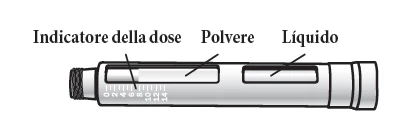
The Natpar cartridge
The Natpar cartridge contains a powder and a solvent to be mixed with the powder. The powder and
solvent must be mixed within the cartridge before using the Natpar pen.
- Each cartridge contains 14 doses.
- The dose indicator shows the number of doses remaining in the cartridge.
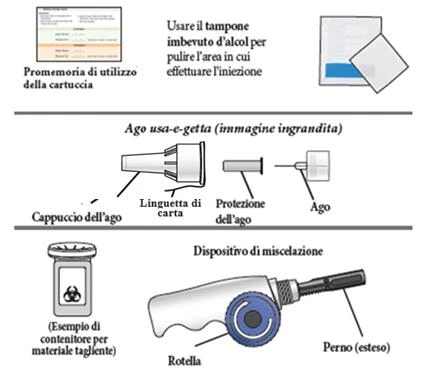
Other materials needed:
Note: Alcohol swabs, injection needles, and sharps container are not included in the package.
The cartridge usage reminder is included in these instructions for use.
Prepare and mix Natpar
Natpar must be mixed before use. Once the medicine is mixed, it can be used to administer up to 14 injections (14 doses).
If this is the first time you are using Natpar on your own, your doctor or nurse will guide you through the cartridge mixing procedure.
- Before preparing to inject a dose, ensure you have taken the Natpar cartridge out of the refrigerator.
Note: Always store the cartridge in the refrigerator, except
when the medicine is being prepared and injected.
- Wash and dry your hands.
- Gather the necessary materials, including:
o The mixing device
o The new Natpar cartridge taken from the refrigerator
o A new disposable pen needle
o A sharps container
o A pencil or pen to record cartridge mixing dates
o The cartridge usage reminder (included in these instructions for use)
o The Natpar pen for injecting the medicine
o These instructions for use
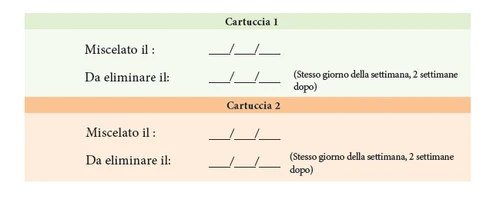
- Fill in the cartridge usage reminder by entering the required dates.
Cartridge Usage Reminder
Instructions:
- In the space next to “Mixed on”, enter today’s date.
- In the space next to “To be discarded on”, enter the date 14 days from today (same day of the week, 2 weeks later).
- Discard the cartridge on the date shown next to “To be discarded on”, even if it still contains medicine. Do not use the cartridge on the date shown next to “To be discarded on”.
- To mix a new cartridge, you must attach the pen needle.
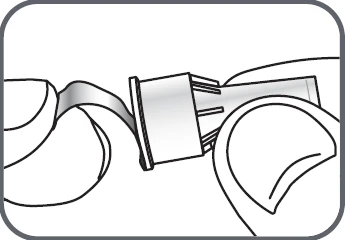
- Remove the paper tab from the needle cap.
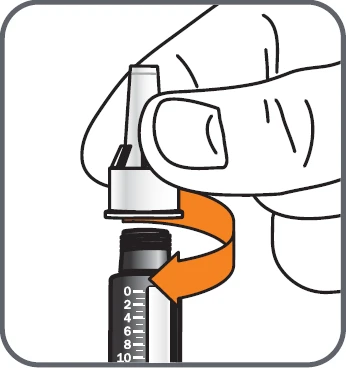
- Screw the pen needle onto the cartridge clockwise.
- Ensure the pen needle is straight and securely tightened on the cartridge (the wider edge of the needle cap should touch the cartridge flange).
- Do not remove the needle cap or protector until you are ready to administer the medicine.
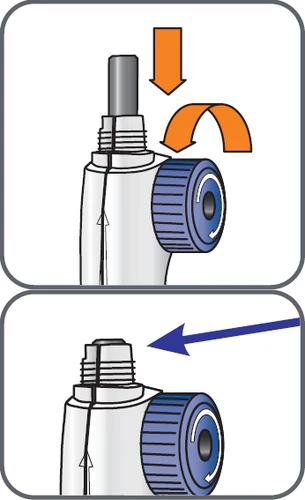
- Turn the mixing device wheel counterclockwise to lower the pin, if it is not already in this position.
- Ensure the mixing device pin appears as shown in the figure (fully retracted).
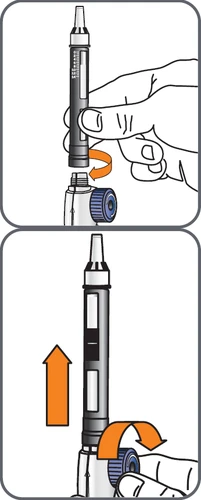
- Screw the Natpar cartridge onto the mixing device clockwise.
- The pen needle must be firmly attached.
- With the needle cap facing upward, slowly turn the wheel clockwise until the locking devices inside the cartridge no longer move and the wheel turns freely.
- Keep the needle facing upward.
- DO NOT hold the mixing device at an angle.
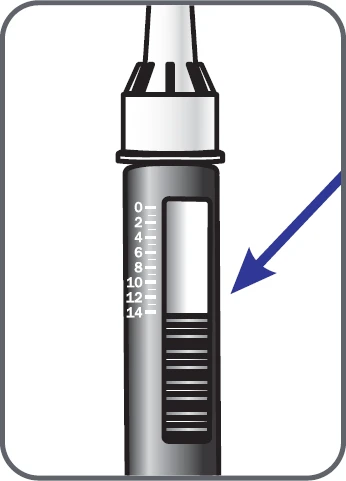
- Ensure the locking devices appear as shown in the figure and remain together.
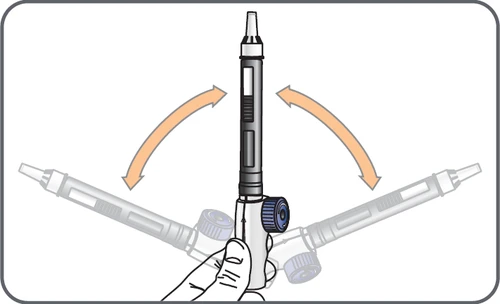
- Holding the mixing device with the cartridge attached, with the needle facing upward, gently move the cartridge from side to side (from 9 o’clock to 3 o’clock) about 10 times to dissolve the powder inside.
- DO NOT shake the cartridge.
- Ensure the needle remains facing upward.
- Place the mixing device with the attached cartridge on a flat surface and wait 5 minutes for the powder to fully dissolve.
Check the solution before
administering each daily dose. If
after 5 minutes the solution appears cloudy,
contains visible particles, or is not colorless,
do not use the medicine. Contact your
doctor, pharmacist, or nurse. It is normal to see small bubbles.
Prepare the Natpar pen
The Natpar pen should be prepared once
every 14 days.
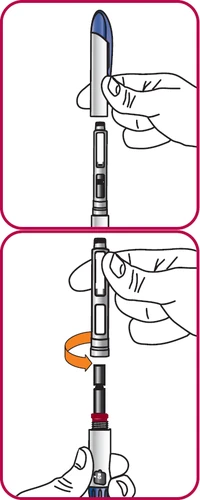
- Take the pen and remove the cap. Keep the cap for future use.
- Unscrew the pin protector (empty cartridge) or used cartridge by turning it counterclockwise and dispose of it in the sharps container.
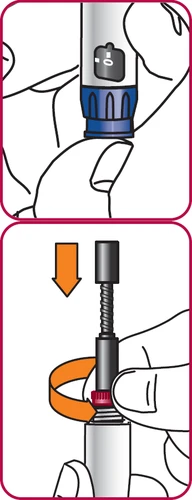
- Press the injection button. In the dose window, “0” must align with the mark. If it does not align, press the injection button until “0” aligns.
- Lower the pin. If the pin is extended, turn the dark red ring counterclockwise to lower the pin. Do not overtighten the ring.
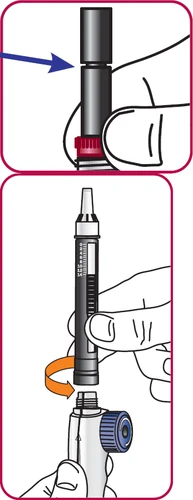
- Check the pin. If properly screwed in, a small gap should be visible.
- Unscrew the cartridge from the mixing device by turning it counterclockwise and set the mixing device aside.
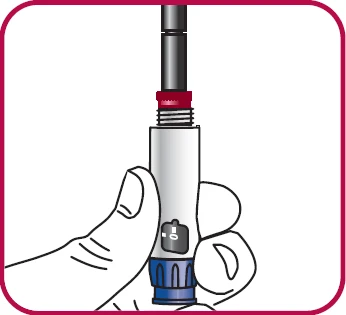
- Attach the cartridge to the pen. Take the pen base and hold it with the pin facing upward.
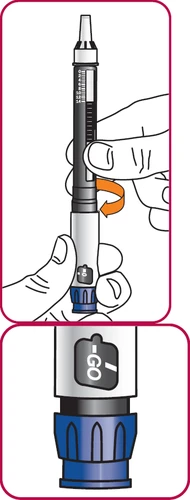
- With the needle cap facing upward, screw the cartridge onto the pen clockwise until the space between the cartridge and pen is completely eliminated.
- Load the Natpar pen
Turn the dosage knob clockwise
until “GO” aligns with the visible mark in the
dose window.
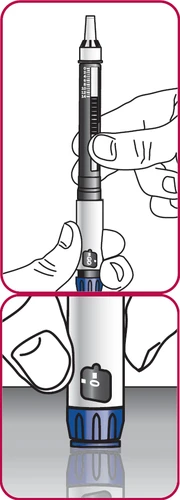
- Hold the pen with the needle cap facing upward.
- Press the injection button against a flat surface, such as a table, until “0” aligns with the visible mark in the dose window.
- It is normal at this step to see 1 or 2 drops of liquid at the needle tip.
- Do not remove the medicine cartridge from the pen until you reach the date shown next to “To be discarded on” or the cartridge is empty.
- Load the pen only once for each new cartridge.
Administer your daily dose
NOTE: If mixing of the medicine has just been completed and you are preparing
the pen with the needle attached, go to “Before injecting your daily dose”
(step 6 of this section) for instructions on how to inject Natpar with the pen.
If you need assistance at any time, contact your doctor or nurse.
- Wash and dry your hands.
- Gather the necessary materials, including:
- The Natpar pen, taken from the refrigerator
- A new disposable pen needle
- A sharps container
- An alcohol swab
Note: Always store the mixed cartridge
inside the pen and in the refrigerator, except
when the medicine is being prepared and injected.
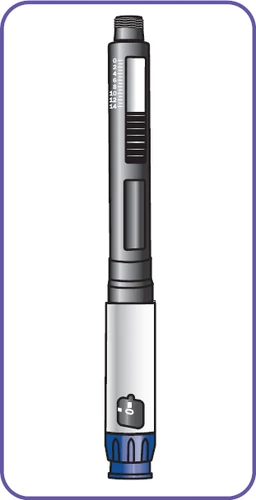
- Check the cartridge.
Remove the cap from the Natpar pen. The mixed cartridge
should be visible inside.
- Before attaching a new needle to the pen, check that:
- The solution is clear, colorless, and free of visible particles. It is normal to see small bubbles. Do not use the medicine if the liquid is not clear, colorless, or free of visible particles. Contact your doctor, pharmacist, or nurse.
You must prepare a new Natpar cartridge if:
- There are no more doses left in the pen (the counter is aligned on “0”) or
- The date shown next to “To be discarded on” has been reached (see the cartridge usage reminder).
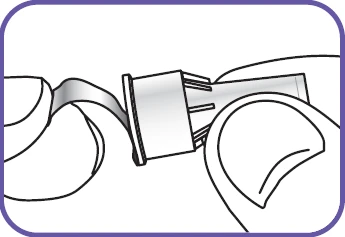
- Attaching a new needle.
- Remove the paper tab from the needle cap.
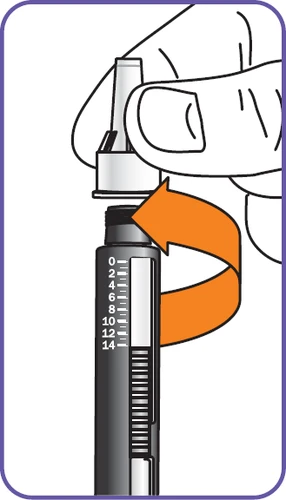
Firmly hold the Natpar pen in an
upright position.
- While keeping the needle cap straight, screw it firmly onto the cartridge clockwise (the wider edge of the needle cap must touch the cartridge “flange”)
- Leave the needle cap in place.
- Before injecting your daily dose
- DO NOT use a cartridge that has been frozen.
- Dispose of all mixed cartridges when the date shown next to “To be discarded on” has been reached (see the cartridge usage reminder).
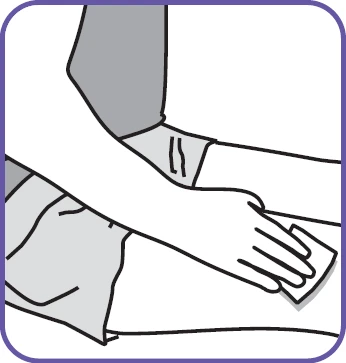
- Use an alcohol swab to clean the area of the thigh where the injection will be given. Alternate the thigh used each day.
Ensure the needle cap is always pointing downward during steps 8 to 17.
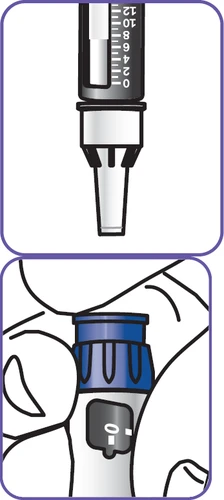
- Hold the Natpar pen with the needle in a vertical position pointing downward.
- Keep the needle pointing downward until the end of the injection procedure.
- Hold the pen so you can see the dose window.
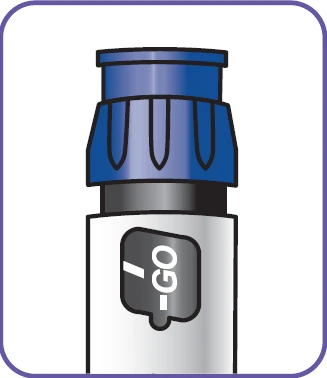
- Turn the dosage knob until “GO” aligns with the visible mark in the dose window. DO NOT turn the dosage knob beyond “GO”.
- If turning the knob is difficult, there may not be enough liquid remaining. Check the dose indicator on the cartridge to verify that doses remain, or check the date next to “To be discarded on” on the cartridge usage reminder to ensure it has not been more than 14 days.
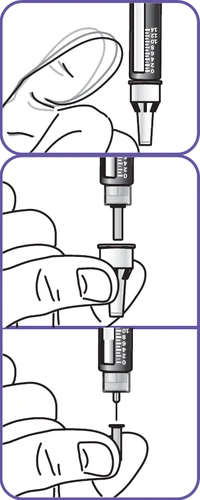
- Gently tap the cartridge 3 to 5 times to move any bubbles away from the needle.
- Prepare the pen needle for injection.
Without unscrewing the needle,
- Remove the needle cap and set it aside.
- Then remove and discard the needle protector.
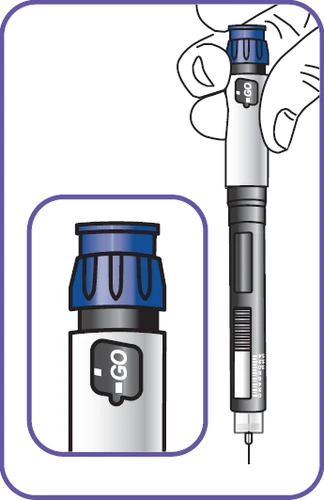
- Hold the pen so you can see “GO” in the dose window, with the needle pointing downward.
- Read steps 15, 16, and 17 carefully before injecting the medicine.
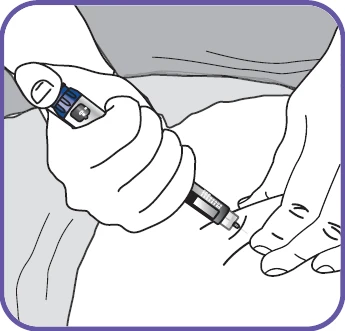
- Insert the needle completely into the thigh (you may pinch a skin fold if advised by your doctor or nurse). Ensure “GO” is visible in the dose window.
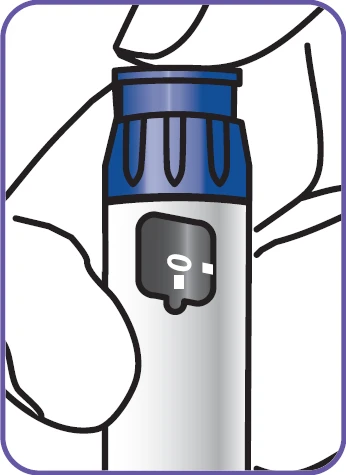
- Press the injection button until “0” aligns with the visible mark in the dose window. You should see and hear the dosage knob return to the “0” position. Count slowly to 10.
Important note regarding injection
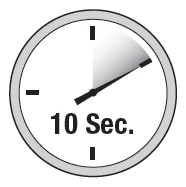
To avoid administering an insufficient amount of medicine,
it is important to keep the needle in the skin
for 10 seconds AFTER pressing the injection button.
- Remove the needle from the thigh without tilting it.
It is normal at this step to see 1 or 2 drops of liquid at the needle tip.
If you think you did not inject a full dose of medicine, do not administer another dose. Contact your doctor. You may need to take calcium and vitamin D.
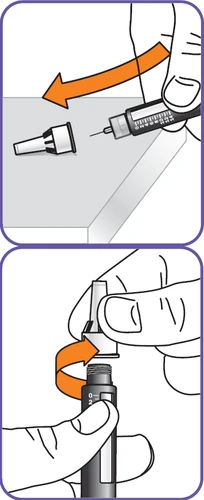
- Reattach the large cap over the exposed needle without touching the cap or the needle.
Ensure the cap is fully inserted.
- While holding the cartridge, unscrew the needle cap (with the needle inside) by turning it counterclockwise.
To avoid contracting or transmitting infections, do not
share the pen or needles with other people.
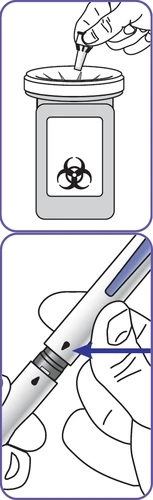
- Dispose of the used needle in a sharps container.
Ask your doctor, pharmacist, or nurse how to
properly dispose of a full sharps container.
- Replace the outer cap on the pen.
To perform this step, a cartridge must be attached to the pen.
Align the two symbols on the cap and the pen.
Press the cap and pen together until you hear a “click.”
- Return the Natpar pen to the refrigerator.
How to store the medicine
Natpar cartridges and pens containing a mixed cartridge must always be
stored in the refrigerator (2°C – 8°C).
- DO NOT freeze the cartridge.
- DO NOT use a cartridge that has been frozen.
- Dispose of all mixed cartridges after 14 days.