Nalcrom
Italy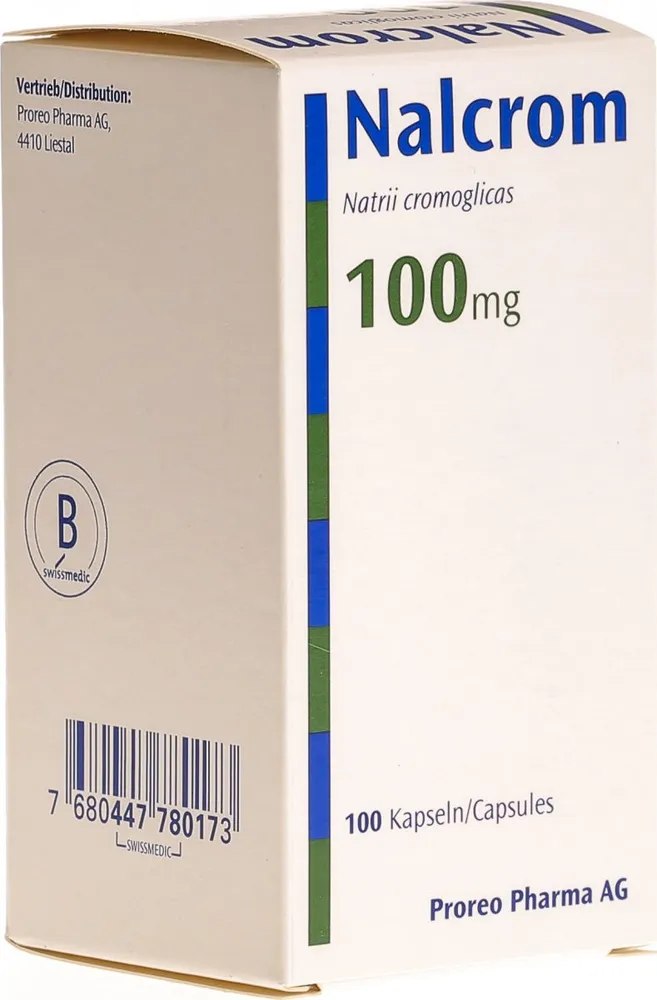
Table of Contents
PACKAGE LEAFLET
NAME OF THE MEDICINAL PRODUCT
Nalcrom 100 mg hard capsules
Nalcrom 250 mg oral solution granules
Nalcrom 500 mg oral solution granules
PHARMACO-THERAPEUTIC CATEGORY
Antiallergic.
THERAPEUTIC INDICATIONS
Prevention of food allergy.
CONTRAINDICATIONS
Hypersensitivity to the active substance or to any of the excipients.
PRECAUTIONS FOR USE
No special precautions for use.
INTERACTIONS
Not known.
Inform your doctor or pharmacist if you have recently taken any other medicinal products, including those
not requiring a prescription.
SPECIAL WARNINGS
Patients with a personal history of anaphylactic shock or potentially life-threatening similar reactions to
food ingestion must not rely on protection with Nalcrom.
The safety of Nalcrom use in children under two years of age has not been established.
Pregnancy and breastfeeding
The use of this medicinal product during pregnancy and breastfeeding should only be considered in cases of actual
necessity.
Ask your doctor or pharmacist for advice before taking any medicinal product.
Driving and operating machinery
The use of Nalcrom does not impair the ability to drive vehicles or operate machinery.
Important information about some excipients in Nalcrom
The sachet formulation contains sucrose. This should be taken into account in diabetic patients and
in those on a low-calorie diet.
If you have been diagnosed with an intolerance to certain sugars, contact your doctor before taking
this medicinal product.
DOSAGE, METHOD AND DURATION OF ADMINISTRATION
Nalcrom should be used after appropriate testing to determine sensitivity to one or more ingested
allergens, together with a diet restricting major causative allergens.
Initial dose:
Children aged 2 to 14 years: 100 mg four times daily before main meals
Adults: 200–250 mg four times daily before main meals.
If satisfactory symptom control is not achieved within 2–3 weeks, the dose may be doubled (200 mg four times daily in children up to 14 years of age and 500 mg four times daily in adults and adolescents over 14 years of age), without exceeding 40 mg/kg/day.
Maintenance dose:
Once therapeutic response has been achieved, the dose may be reduced to the lowest necessary to
maintain the patient symptom-free.
Patients with food allergy who are unable to avoid allergenic foods in certain circumstances (e.g. school meals, restaurants, etc.) may protect themselves against the effects of these foods by taking a single dose of Nalcrom 15–30 minutes before the meal. The optimal dose should be determined for each patient, starting with 200/250 mg in adults and 100 mg in children.
ADMINISTRATION
The capsules may be swallowed whole, or the powder content may be dissolved in a small amount of hot water and then diluted with cold water before drinking. Administration as an aqueous solution appears to be the preferred method in food allergy.
The sachets should be opened and their contents dissolved in half a glass of cold water, stirred gently with a spoon.
It is advisable to swirl the solution in the mouth for a few seconds before swallowing. This procedure helps protect the oral mucosa, which is sometimes involved in the absorption of food allergens.
Diabetic patients and patients on a low-calorie diet should pay attention to the information provided in the section “Special warnings”.
OVERDOSE
Nalcrom is absorbed only in small amounts. Furthermore, animal studies have demonstrated that sodium cromoglicate has low local or systemic toxicity; extensive human studies have not revealed safety risks with the product. Therefore, overdose is unlikely to cause problems, but if suspected, treatment should be supportive and aimed at controlling symptoms.
In case of accidental ingestion/overdose of a large amount of Nalcrom, contact your doctor immediately or go to the nearest hospital.
C
Continue therapy as per recommended dosage.
S ’ N , .
UNDESIRABLE EFFECTS
Like all medicinal products, Nalcrom can cause adverse effects, although not everybody experiences them.
The most frequently reported adverse effects (≤ 1/100) usually involve the gastrointestinal
system, such as nausea, vomiting, diarrhoea, abdominal discomfort. Less common (≤ 1/1000) are skin-related effects such as skin rash or musculoskeletal effects such as joint pain.
Even rarer (≤ 1/10,000) are hypersensitivity reactions.
Following the instructions contained in this leaflet reduces the risk of adverse effects.
If any of the adverse effects worsens, or if you notice any adverse effect not listed in this leaflet, inform your doctor or pharmacist.
EXPIRY DATE AND STORAGE
Expiry date: see the date printed on the packaging.
Keep the blister pack in the outer packaging to protect the medicinal product from light.
Keep the sachets in the outer packaging to protect the medicinal product from light.
The date refers to the product in intact packaging and correctly stored.
WARNING: do not use the medicinal product after the expiry date stated on the packaging.
KEEP THE MEDICINAL PRODUCT OUT OF THE SIGHT AND REACH OF CHILDREN.
Medicinal products must not be disposed of via wastewater or household waste. Ask your
pharmacist how to dispose of medicines no longer required. This will help protect
the environment.
COMPOSITION
Each hard capsule contains:
Active substance: sodium cromoglicate 100 mg (pure, without excipients).
Each 250 mg sachet contains:
Active substance: sodium cromoglicate 250 mg.
Excipients: sucrose.
Each 500 mg sachet contains:
Active substance: sodium cromoglicate 500 mg
Excipients: sucrose.
PHARMACEUTICAL FORMS AND CONTENTS
Hard capsules 20 capsules 100 mg.
Oral solution granules 12 sachets of 250 mg.
24 sachets of 250 mg
Oral solution granules 6 sachets of 500 mg.
24 sachets of 500 mg
MARKETING AUTHORISATION HOLDER
Italchimici S.p.A. - Via Pontina 5, Km 29
00040 Pomezia (Rome)
MANUFACTURER AND FINAL CONTROLLER
ITC FARMA Srl - Via Pontina 5, Km 29
00040 Pomezia (Rome)