Nalador
Italy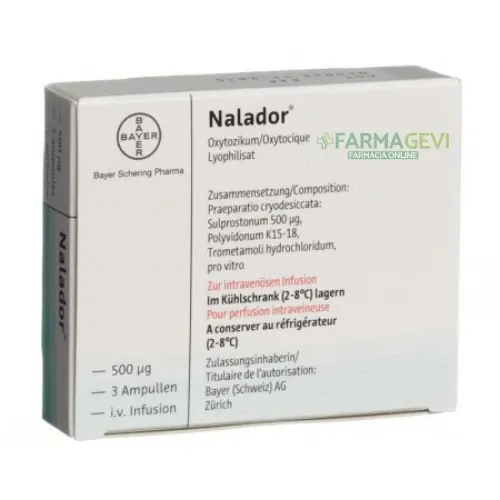
Table of Contents
- Package leaflet: Information for the patient
- Nalador 0.5 mg powder for solution for infusion
- 1. What Nalador is and what it is used for
- 2. What you should know before receiving Nalador
- 3. How Nalador will be administered
- The following information is intended exclusively for healthcare professionals" and/or by means of
- 4. Possible side effects
- 5. How to store Nalador
- 6. Package contents and other information
- The following information is intended for healthcare professionals only:
Package leaflet: Information for the patient
Nalador 0.5 mg powder for solution for infusion
sulprostone
Please read this leaflet carefully before receiving this medicine because it contains
important information for you.
- Keep this leaflet. You may need to read it again.
- If you have any questions, ask your doctor or nurse.
- This medicine has been prescribed for you only. Do not give it to other people, even if
- their symptoms are the same as yours, because it could be harmful.
- If you experience any side effect, including those not listed in this leaflet,
- contact your doctor. See section 4.
Contents of this leaflet:
- What Nalador is and what it is used for
- What you need to know before receiving Nalador
- How Nalador will be administered
- Possible side effects
- How to store Nalador
- Contents of the pack and other information
1. What Nalador is and what it is used for
Nalador is a medicine belonging to the therapeutic category of prostaglandins (substances that induce uterine activity and cervical ripening).
This medicine is used for:
induction of abortion (maternal or fetal indications);
induction of labour in cases of intrauterine fetal death;
treatment of postpartum haemorrhage due to lack of uterine muscular tone (uterine atony) (PPH).
2. What you should know before receiving Nalador
Do not receive Nalador
- If you are allergic to the active substance or to any of the other ingredients of this medicine (listed in section 6);
- if you suffer from bronchial asthma or spasmodic bronchitis (inflammation of the bronchial mucosa characterized by spasms of the bronchi);
- if you have heart failure (even without signs of decompensation);
- if you have a history (even familial) of vascular diseases (especially of the blood vessels of the heart (coronary));
- if you suffer from severe arterial hypertension (high blood pressure);
- if you have hepatic or renal insufficiency (reduced liver or kidney function);
- if you have decompensated diabetes mellitus (characterized by high blood glucose concentration);
- if you have convulsive cerebral disorders;
- if you have glaucoma (increased pressure inside the eye);
- if you suffer from thyrotoxicosis (excess thyroid hormones in circulation);
- if you have acute gynecological infections;
- if you have acute ulcerative colitis or gastric ulcer;
- if you suffer from sickle cell anemia (a blood disorder also known as sickle cell anemia in which red blood cells assume an irregularly cylindrical shape) or thalassemia (a type of anemia causing red blood cell breakdown);
- if you generally suffer from severe diseases;
- if you have had surgical interventions on the uterus;
- if you are being treated with methylergometrine (see "Other medicines and Nalador"). Induction of labor in the presence of a viable fetus is contraindicated, as adverse effects on the fetus cannot be excluded when using a synthetic prostaglandin such as sulprostone.
Warnings and precautions
Talk to your doctor before receiving Nalador.
The use of this medicine is restricted to hospitals, nursing homes, and specialized clinics and must
be administered under direct medical supervision.
Your doctor will exercise particular caution if you suffer from cardiovascular diseases or have cardiovascular risk factors (age, tobacco use, hyperlipidemia, diabetes with vasculopathy).
Since Nalador, like natural prostaglandins, may cause pulmonary hypertension (high blood pressure in the lungs) (of variable severity up to pulmonary edema) and dyspnea (difficulty breathing), your doctor may subject you to more frequent monitoring of respiratory function and cardiocirculatory parameters (as episodes of bradycardia and/or arterial hypotension may occur).
Any treatment with Nalador for the induction of abortion must result in termination of pregnancy, as fetal harm cannot be excluded.
Even after an apparently complete abortion, a curettage must always be performed (see also "Pregnancy and breastfeeding").
Other medicines and Nalador
Inform your doctor or nurse if you are taking, have recently taken, or might take any other medicine.
Nalador must not be used in combination with:
- methylergometrine (a medicine used, for example, to promote placental detachment and reduce bleeding)
- oxytocin (a medicine used, for example, to induce labor)
- non-steroidal anti-inflammatory drugs (NSAIDs) (medicines used to treat pain, reduce fever, and/or treat inflammation)
There are no clinical data on the use of topical prostaglandins before or in combination with Nalador.
Pre-treatment or concomitant use with other prostaglandins is discouraged, as theoretically there may be a risk of combined effects of unknown magnitude, potentially leading to serious adverse events.
Pregnancy and breastfeeding
If you are pregnant, suspect you may be pregnant, are planning a pregnancy, or are breastfeeding, consult your doctor or nurse before receiving this medicine.
Any treatment with Nalador for the induction of abortion must result in termination of pregnancy, as fetal harm cannot be excluded. Therefore, once Nalador treatment has been administered, it must be confirmed that the pregnancy has been terminated. Even after an apparently complete abortion, a curettage must always be performed. Since the incidence of perinatal mortality is increased after administration of Nalador, the medicine must not be used for labor induction with a live fetus.
It is not known whether sulprostone is excreted in breast milk. Breastfeeding is allowed 2–3 hours after the end of the infusion.
Driving and use of machines
Not applicable.
3. How Nalador will be administered
Nalador is a medicine that will be administered exclusively by an experienced gynaecologist, in a clinic equipped with modern equipment for continuous monitoring of cardiovascular functions (for example, blood pressure and heart rate) and provided with the necessary resuscitation equipment.
The information regarding the correct use of Nalador is reported in section “Le
The following information is intended exclusively for healthcare professionals" and/or by means of
information made available to the physician by the marketing authorization holder.
If you take more Nalador than you should
In case of accidental ingestion/overdose of Nalador, contact your doctor immediately or go to the nearest hospital.
Symptoms of poisoning include: bronchospasm (constriction of the airways), bradycardia (slowed heart rate), changes in blood pressure, myocardial ischemia (inadequate blood supply to the heart muscle), uterine hyperstimulation (puerperal tetany). Cyanosis (bluish discoloration of the skin and mucous membranes due to low oxygen levels in the blood) and dyspnea (difficulty breathing) may precede pulmonary edema (fluid accumulation in the lungs).
If you have any doubts about the use of this medicine, consult your doctor.
4. Possible side effects
Like all medicines, this medicine can cause side effects, although not everyone experiences them.
Very common (may affect more than 1 in 10 people)
- nausea,
- vomiting.
Common (may affect up to 1 in 10 people)
- decrease in blood pressure,
- gastric spasm,
- diarrhoea,
- fever,
- increase in body temperature.
Uncommon (may affect up to 1 in 100 people)
- uterine rupture.
Rare (may affect up to 1 in 1,000 people)
- somnolence,
- headache,
- slowed heart rate,
- pulmonary edema (accumulation of fluid in the lungs),
- increased blood pressure in the pulmonary arteries,
- narrowing of the airways (bronchi).
Very rare (may affect up to 1 in 10,000 people)
- temporary, unexpected and focal contractions of the heart artery wall muscles (coronary spasm),
- insufficient blood supply to the heart muscle (myocardial ischemia),
- transient imbalance of fluids and electrolytes (mineral salts).
Not known (frequency cannot be estimated from the available data)
- hypersensitivity reactions (urticaria, anaphylactic shock),
- increase in blood pressure.
Following the instructions provided in the package leaflet reduces the risk of side effects.
Reporting of side effects
If you experience any side effect, including those not listed in this leaflet, tell your doctor or pharmacist. You can also report side effects directly via the national reporting system at https://www.aifa.gov.it/content/segnalazioni-reazioni-avverse.
By reporting side effects, you can help provide more information on the safety of this medicine.
5. How to store Nalador
Keep this medicine out of the sight and reach of children.
Do not use this medicine after the expiry date stated on the label and the carton after "Exp.".
The expiry date refers to the last day of that month.
The expiry date refers to the product when kept in its original, unopened packaging and stored correctly.
Lyophilized vials of Nalador must be stored in a refrigerator at a temperature between 2°C and 8°C.
The medicine may be stored at higher temperatures, provided they do not exceed 25°C, for a maximum
period of 8 days.
The reconstituted solution must be diluted immediately.
Administration of the ready-to-use solution must be carried out immediately.
Do not dispose of any medicine via wastewater or household waste. Ask your pharmacist how to
dispose of medicines no longer in use. This will help protect the environment.
6. Package contents and other information
What Nalador contains
- The active substance is sulprostone. Each vial or bottle contains 0.5 mg of sulprostone.
- The other components are: povidone (PVP, K <18), tromethamine hydrochloride.
How to prepare Nalador infusion solution
Vial:
After reconstitution with physiological saline solution, the solution in the vial must be clear and
free from particles.
The contents of one Nalador vial must be diluted immediately in 250 ml or 500 ml of physiological saline solution for intravenous infusion.
Bottle:
After reconstitution with physiological saline solution, the solution in the bottle must be clear and
free from particles.
The contents of one Nalador bottle must be diluted immediately in 250 ml or 500 ml of physiological saline solution for intravenous infusion.
Description of the appearance of Nalador and package contents
Nalador is a powder for infusion solution.
1 glass vial containing 0.5 mg of sulprostone.
1 amber glass bottle containing 0.5 mg of sulprostone.
Marketing Authorization Holder
Teofarma S.r.l.
Via F.lli Cervi, 8
27010 Valle Salimbene (PV)
Manufacturer
Bayer AG, Muellerstrasse 170-178, D-13353 Berlin (Germany).
The following information is intended for healthcare professionals only:
Therapeutic indications
Induction of abortion (maternal or fetal indications).
Induction of labour in case of intrauterine fetal death.
Treatment of postpartum haemorrhage due to uterine atony (PPH).
Posology and method of administration
Nalador must be used exclusively by experienced gynaecologists in clinics equipped with modern equipment for continuous monitoring of cardiovascular functions and provided with appropriate resuscitation facilities.
To avoid high plasma peaks and to ensure proper monitoring and control during administration, it is strongly recommended to administer the medicinal product using an automated infusion system.
Induction of abortion, induction of labour in case of intrauterine fetal death
The contents of one vial of Nalador should be dissolved in 250 ml or 500 ml of physiological solution and administered by intravenous infusion.
Nalador must not be administered for longer than 10 hours. Begin therapy at the initial dose (A, Table 1). If the desired effect is not achieved, the dose may be increased up to the maximum dose (B, Table 1). The maximum infusion rate must never be exceeded, as high serum concentrations increase the likelihood of adverse reactions.
Infusion must be performed under constant supervision.
Table 1
| Infusion volume | 500 µg of Nalador in 250 ml or 500 ml | |||||
| Infusion rate | µg/min | ml/min | drops/min | ml/min | drops/min | µg/hour |
| A: initial dose | 1.7 | 0.9 | about 17 | 1.7 | about 34 | 100 |
| B: maximum dose | 8.3 | 4.2 | about 83 | 8.3 | about 166 | 500 |
Maximum total dose: 1500 μg of Nalador within 24 hours.
If the treatment objective is not achieved, the infusion may be repeated 12–24 hours after the end of the first administration.
Treatment of postpartum haemorrhage due to uterine atony (PPH)
Causes of postpartum haemorrhage other than uterine atony must be excluded. During the gynaecological examination, administer oxytocin as first-line treatment to confirm the diagnosis.
If the effect of oxytocin treatment is insufficient, Nalador must be administered immediately (second-line treatment).
The contents of one Nalador vial must be dissolved in 250 ml or 500 ml of physiological solution for intravenous infusion.
If, during treatment with the initial dose (A, Table 2), bleeding does not stop or does not clearly reduce within a few minutes, the dose may be increased up to the maximum dose (B, Table 2).
Once the therapeutic effect appears, the intravenous infusion rate must be reduced to the maintenance dose (C, Table 2).
Table 2
| Infusion volume | 500 g of Nalador in 250 ml or 500 ml | |||||
| Infusion rate | g/min | ml/min | drops/min | ml/min | drops/min | g/hour |
| A: initial dose | 1.7 | 0.9 | about 17 | 1.7 | about 34 | 100 |
| B: maximum dose | 8.3 | 4.2 | about 83 | 8.3 | about 166 | 500 |
| C: maintenance dose | 1.7 | 0.9 | about 17 | 1.7 | about 34 | 100 |
| or | ||||||
Maximum total dose: 1500 μg of Nalador within 24 hours.
If bleeding cannot be controlled, other therapeutic measures must be taken.
How to prepare Nalador infusion solution
Vial:
After reconstitution with physiological saline solution, the solution in the vial must be clear and free from particles.
The contents of one Nalador vial must be diluted immediately in 250 ml or 500 ml of physiological saline solution for intravenous infusion.
Vial:
After reconstitution with physiological saline solution, the solution in the vial must be clear and free from particles.
The contents of one Nalador vial must be diluted immediately in 250 ml or 500 ml of physiological saline solution for intravenous infusion.
Contraindications
Hypersensitivity to the active substance or to any of the excipients.
Bronchial asthma, spasmodic bronchitis.
Pre-existing heart failure (even without signs of decompensation).
History of vascular diseases (especially coronary).
Severe arterial hypertension.
Severe impairment of hepatic or renal function.
Decompensated diabetes mellitus.
Convulsive cerebral disorders.
Glaucoma.
Thyrotoxicosis.
Acute gynecological infections.
Acute ulcerative colitis and acute gastric ulcer.
Sickle cell anemia, thalassemia.
Severe diseases in general.
Previous surgical interventions on the uterus.
Induction of labor is contraindicated in the presence of a viable fetus, since adverse effects on the fetus cannot be excluded when using a synthetic prostaglandin such as sulprostone.
The use of sulprostone is contraindicated in combination with methylergometrine.
Interactions with other medicinal products and other forms of interaction
The use of Nalador in combination with methylergometrine may increase the risk of coronary vasoconstriction and consequent myocardial ischemia, potentially life-threatening or fatal.
Oxytocin must not be administered simultaneously with sulprostone due to the risk of overstimulation of an unevacuated uterus (exception: postpartum hemorrhage due to uterine atony).
Concomitant administration of analgesics belonging to the non-steroidal anti-inflammatory drug (NSAID) class should be avoided, as the efficacy of Nalador may be reduced.
There are no clinical experiences regarding the use of topical prostaglandins prior to or in combination with Nalador.
Pre-treatment or concomitant use with other prostaglandins is discouraged, since theoretically there may be a risk of combined effects of unknown magnitude, potentially leading to serious adverse events.
Special warnings and precautions for use
Any treatment with Nalador for abortion induction must result in termination of pregnancy, since fetal harm cannot be excluded.
Even after an apparently complete abortion, curettage must always be performed.
Since the incidence of perinatal mortality is increased after administration of Nalador, the medicinal product must not be used for labor induction with a live fetus.
It is not known whether sulprostone is excreted in breast milk. Considering the half-life of sulprostone, breastfeeding is allowed 2–3 hours after the end of the infusion.
Particular caution is required in patients with cardiovascular diseases or cardiovascular risk factors (tobacco use, hyperlipidemia, diabetes with vasculopathy). Patient age must also be considered when evaluating risk factors.
Accidental intra-arterial administration must be avoided, as it may cause local arteritis with subsequent necrosis.
Do not administer as a bolus injection (sudden increase in plasma levels may cause pulmonary hypertensive crises).
Nalador must not be administered by intracervical/intramyometrial injection. Depending on local conditions, intracervical/intramyometrial injection may lead to an undesirable rapid increase in plasma levels of sulprostone or its accumulation, possibly resulting in prolonged drug action, which, especially in combination with infusion therapy, could induce adverse reactions.
Since bradycardia and/or changes in blood pressure may occur, appropriate monitoring of cardiac and circulatory parameters is indicated.
During post-marketing experience with sulprostone, cases of hypertension have been reported, sometimes associated with serious cardiovascular reactions, particularly when the recommended initial flow rate was not respected (exceeding 100 μg/h) or when the flow rate was not increased gradually in case of insufficient therapeutic response.
If it is necessary to increase the flow rate due to insufficient treatment effect, this should be done gradually to prevent cardiovascular complications. Hypertension generally resolved within 30 minutes after dose reduction or discontinuation of sulprostone.
Myocardial ischemia may occur, probably secondary to coronary spasm associated with the use of Nalador. Such reactions may lead to myocardial infarction, life-threatening cardiac arrhythmia, shock, and cardiac arrest, possibly with fatal outcome.
Bronchospasm may occur in predisposed individuals. As with natural prostaglandins, increases in pulmonary circulation pressure (of variable severity up to pulmonary edema) may occur.
Since Nalador, like natural prostaglandins, may cause pulmonary hypertension (of variable severity up to pulmonary edema) and dyspnea, its use requires frequent monitoring of respiratory function and cardiocirculatory parameters (since episodes of bradycardia and/or arterial hypotension may occur). In case of marked reduction in heart rate, treatment with beta-mimetics should be initiated. In cases of hypotension (without reduction in blood volume), adrenaline may be used. Any reduction in blood volume should be corrected as soon as possible.
As a consequence of reversible effects on renal function, transient water and electrolyte imbalances (disturbances in electrolyte excretion) may occur.
Myometrial sensitivity to prostaglandins increases with advancing gestation. Uterine rupture has been observed.
Undesirable effects
Table of adverse reactions
The table below lists adverse reactions classified by system organ class according to MedDRA (MedDRA SOC). Frequencies are based on post-marketing data and overall experience with Nalador (e.g., literature).
| System Organ Class | Very common ≥1/10 | Common ≥1/100, <1/10 | Uncommon ≥1/1,000, <1/100 | Rare ≥1/10,000, <1/1,000 | Very rare <1/10,000 | Not known (frequency cannot be estimated from the available data) |
| Nervous system disorders | drowsiness, headache | |||||
| Cardiac disorders | bradycardia | coronary spasm, myocardial ischemia | ||||
| Vascular disorders | hypotension | hypertension | ||||
| Respiratory, thoracic and mediastinal disorders | pulmonary edema, increased arterial pressure | |||||
| pulmonary, bronchospasm | ||||||
| Gastrointestinal disorders | nausea, vomiting | gastric spasm (epi- and mesogastric), diarrhea | ||||
| Renal and urinary disorders | transient electrolyte imbalance (excretion of electrolytes) | |||||
| Pregnancy, puerperium and perinatal conditions | uterine rupture | |||||
| Systemic and administration site conditions | fever, increased body temperature | |||||
| Immune system disorders | hypersensitivity reactions (urticaria, allergic shock) |
The most appropriate MedDRA term has been used to describe a specific reaction, its synonyms and related conditions. The description of ADR terms is based on MedDRA version 8.0.
Overdose
Symptoms of intoxication
Bronchospasm, bradycardia, alterations in blood pressure, myocardial ischemia. Cyanosis and dyspnea may herald impending pulmonary edema. Uterine hyperstimulation (postpartum tetany).
Treatment of intoxication
If necessary, intensive therapy should be administered in the presence of bronchospasm, bradycardia, hypotension, and signs of impending pulmonary edema. The use, although appropriate in itself, of β-adrenergic sympathomimetics in the presence of bronchospasm, bradycardia, and postpartum tetany carries the potential risk of pulmonary edema in the pregnant woman. Therefore, the risk/benefit ratio of such treatment must be evaluated on a case-by-case basis.
Special precautions for storage
Store in a refrigerator (2°–8°C).
The reconstituted solution must be diluted immediately.
After dilution, the chemical, physical, and microbiological stability of the ready-to-use solution has been demonstrated for 12 hours at 2–8°C.
The ready-to-use solution should be administered immediately.
The product may be stored at higher temperatures, provided that the temperature does not exceed 25°C for a maximum period of 8 days.