Myoview
Italy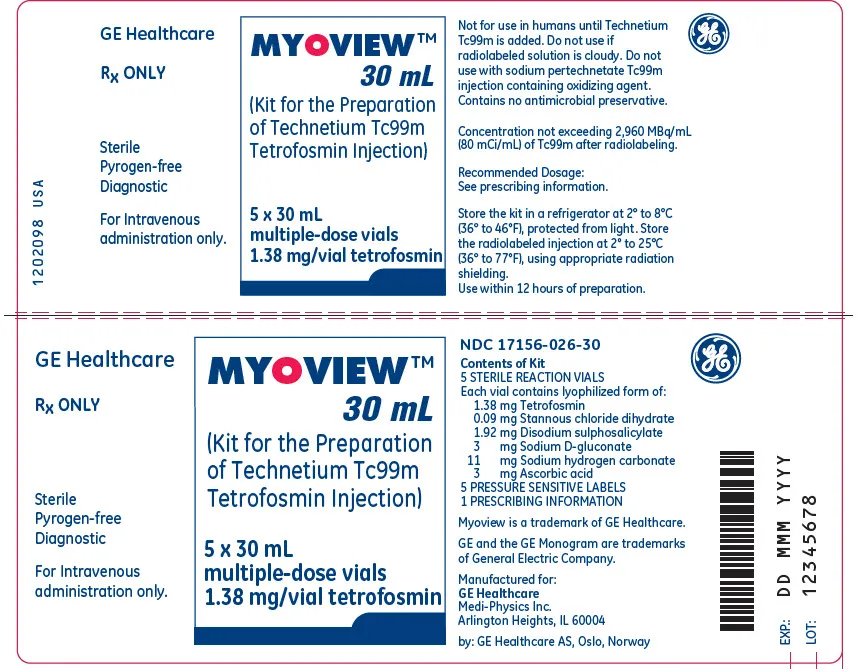
Table of Contents
PATIENT LEAFLET: INFORMATION FOR THE PATIENT
Myoview 230 micrograms
radiopharmaceutical preparation kit
Tetrofosmin
Please read this leaflet carefully before you are administered Myoview, as it contains
important information for you.
- Keep this leaflet. You may need to read it again.
- If you have any questions, ask your nuclear medicine physician.
- If you experience any adverse reactions, including those not listed in this leaflet, contact your nuclear medicine physician. See section 4.
Contents of this leaflet:
- What Myoview is and what it is used for
- What you need to know before you are administered Myoview
- How Myoview is used
- Possible side effects
- How Myoview is stored
- Contents of the pack and other information
1. What Myoview is and what it is used for
This medicinal product is for diagnostic use only. It is used solely to detect the possible presence
of diseases.
Myoview is a 'radiopharmaceutical' medicinal product. It is administered before a diagnostic imaging procedure and helps the imaging device to visualize the inside of a part of your body.
- It contains an active substance called “tetrofosmin”. This is mixed with a radioactive substance called “technetium 99m” before use.
- Once injected, your body can be viewed from the outside using an imaging device employed in the diagnostic procedure.
- The diagnostic imaging can help the nuclear medicine physician to assess heart function, or to identify and quantify heart damage following a myocardial infarction.
- This medicinal product is also used in other cases before a diagnostic imaging procedure to examine suspected masses in the breast. Your nuclear medicine physician will inform you which part of your body will be examined.
Use of Myoview involves exposure to small amounts of radiation. Your doctor and the nuclear medicine physician have determined that the clinical benefit of this procedure performed with a radiopharmaceutical outweighs the radiation-related risk. Please consult your nuclear medicine physician if you have any questions.
2. What you need to know before you are given Myoview
Myoview must not be used
- if you are allergic (hypersensitive) to Myoview or to any of the other ingredients of Myoview (listed in section 6).
- If you are pregnant or think you might be pregnant. Myoview must not be administered to you if any of the above apply. If you are unsure, discuss this with your nuclear medicine physician.
Warnings and precautions
Talk to your nuclear medicine physician before using Myoview
- if the person to be given this medicine is a child or adolescent
- if you have missed your last menstrual period. This may indicate that you are pregnant and therefore Myoview must not be administered (see section Pregnancy and Breast-feeding)
- if you are on a low-sodium diet
- if you are breastfeeding
Before Myoview is administered, you must:
Drink plenty of fluids before undergoing the examination, so that you urinate as frequently as possible during the first few hours after the examination.
Children and adolescents
The efficacy and safety of Myoview have not been established in patients under 18 years of age.
Other medicines and Myoview
Inform the nuclear medicine physician performing the examination if you are taking or have recently taken any other medicines, including those obtained without a prescription. This includes herbal medicines. Some medicines may affect how Myoview works.
If you are about to undergo a cardiac diagnostic examination, inform your nuclear medicine physician if you are taking any of the following types of medicines, as they may alter the diagnostic test results:
- Beta-blockers such as atenolol, bisoprolol, or propranolol
- Calcium antagonists such as nifedipine, diltiazem, or felodipine
- Nitrates such as glyceryl trinitrate, isosorbide mononitrate, or isosorbide dinitrate
- Any medication prescribed for blood pressure, heart treatment, or heart failure.
If you are unsure whether you are taking any of the medicines listed above, speak with your nuclear medicine physician before Myoview is administered.
Myoview with food and drinks
If you are about to undergo:
- a diagnostic examination of the heart – you may be asked not to eat the night before, or you may be allowed only a light breakfast on the morning of the diagnostic examination
- a diagnostic examination of the breast – you may eat and drink fluids normally.
Pregnancy and breast-feeding
Myoview must not be administered if you are pregnant or think you might be pregnant, as it could affect the unborn child.
You must not breastfeed after receiving Myoview, because a small amount of radioactivity may pass into breast milk. If you are breastfeeding, your nuclear medicine physician may decide to wait until you have finished breastfeeding before administering Myoview.
If waiting is not possible, your nuclear medicine physician may ask you to:
- stop breastfeeding for 3–6 hours,
- use infant formula for your baby, and
- express (remove) breast milk and discard it.
Your nuclear medicine physician will tell you when you can resume breastfeeding.
Driving and using machines
It is considered unlikely that Myoview will affect your ability to drive or operate machinery. Ask your nuclear medicine physician if you may drive or use machinery after receiving Myoview.
Myoview contains sodium
This medicine contains 15–29 mg of sodium (the main component of table salt) per reconstituted vial. This corresponds to 0.7–1.4% of the maximum daily recommended dietary sodium intake for an adult.
When you are given Myoview, you are exposed to radioactivity.
- Your nuclear medicine physician must always evaluate the potential risks and benefits before administering the medicine. Ask your nuclear medicine physician for clarification if you have any doubts.
3 How Myoview is used
There are strict regulations regarding the use, handling, and disposal of radiopharmaceuticals.
This product will be handled and administered exclusively by trained and qualified personnel.
- Myoview will always be used in a hospital or clinic.
- Qualified staff will provide you with any necessary information to ensure the safe use of the medicine.
The dose to be administered depends on the type of examination you will undergo. Your nuclear medicine physician will determine the most appropriate dose for your case. The minimum necessary dose required to obtain the desired information will be used.
Administration of Myoview and procedure execution
For cardiac diagnostic examination, the typical dose is:
- A first injection at rest
- A second injection (after at least one hour), when your heart is under stress.
- During or immediately after physical exercise. The order of the two injections may be reversed for some individuals. Others may require only a single injection. In some cases, your nuclear medicine physician may decide it is preferable to administer the two injections on separate days.
For breast diagnostic examination, the typical dose is:
- A single injection
If you are given more Myoview than you should
Myoview is administered in hospitals or clinics by trained and specifically instructed personnel. It is unlikely that you will receive more than the intended dose. However, in the event of an overdose, appropriate treatment will be given.
If you have any concerns, ask your nuclear medicine physician.
Duration of the procedure
Your nuclear medicine physician will inform you about the duration of the procedure.
After Myoview administration, you must:
Urinate as frequently as possible to eliminate the product from your body.
Your nuclear medicine physician will inform you of any special precautions to follow after administration of this medicine. Ask your nuclear medicine physician if you have any questions or concerns.
4. Possible side effects
Like all medicines, this medicine can cause side effects, although not everyone gets them.
With this medicine, you will receive a small amount of ionizing radiation, carrying a very low risk of developing cancer or hereditary abnormalities.
Serious side effects
If you have an allergic reaction while in hospital or clinic during the diagnostic examination, inform the nuclear medicine doctor immediately to receive medical advice. Signs and symptoms may include:
Uncommon – may affect up to 1 in 100 people
- Hot flushes
Rare – may affect up to 1 in 1,000 people
- Rash
Not known – frequency cannot be estimated from the available data
- Itching, redness, or hives
- Facial swelling, local swelling
- Difficulty breathing, shortness of breath, tightness in the throat, coughing
In more severe cases (serious allergic reaction or anaphylaxis), reactions may include:
- Fainting (loss of consciousness), dizziness, or feeling faint
If any of the above-mentioned side effects occur after you have left the hospital or clinic, go immediately to the nearest emergency room or hospital.
Other side effects include
Uncommon – may affect up to 1 in 100 people
- Changes in taste perception, such as a metallic taste
- An unpleasant sensation of warmth at the injection site
- Vomiting
Rare – may affect up to 1 in 1,000 people
- Changes in sense of smell
- Visual disturbances
- Abdominal pain, feeling unwell (nausea), a burning sensation in the mouth
Not known – frequency cannot be estimated from the available data
- Headache, dizziness
- Fast heartbeat (palpitations), chest pain
- Fever
- Low blood pressure
- Increase in white blood cell count (detected in certain types of blood tests)
Reporting of side effects
If you experience any side effect, including those not listed in this leaflet, contact your nuclear medicine doctor. You can also report side effects directly via the national reporting system at the following website:
https://www.aifa.gov.it/content/segnalazioni-reazioni-avverse.
By reporting side effects, you can help provide more information on the safety of this medicine.
5. How Myoview is stored
Do not store this medicine. This medicine is stored under the responsibility of a specialist in suitable premises. Storage must comply with current regulations regarding radioactive materials.
Hospital staff must ensure that the product is properly stored and disposed of, and that it is not used after the expiry date stated on the label.
The following information is intended exclusively for doctors or healthcare professionals.
- Keep this medicine out of the sight and reach of children.
- Do not use this medicine after the expiry date stated on the label after EXP.
- Store the product in a refrigerator at 2°C–8°C. Keep it in the original packaging to protect the medicine from light.
- The chemical and physical in-use stability of the reconstituted injectable solution has been demonstrated for 12 hours at 2°C–25°C. Store the reconstituted product at a temperature below 25°C. Do not freeze.
6. Package Contents and Other Information
What Myoview Contains
- The active substance is tetrofosmin. Each Myoview vial contains 230 micrograms of tetrofosmin.
- The other components are tin(II) chloride dihydrate, disodium sulfosalicylate, sodium D-gluconate, and sodium bicarbonate.
Description of the Appearance of Myoview and Contents of the Pack
Myoview is a kit for the preparation of a radiopharmaceutical. It is supplied in a clear glass vial containing a powder for injectable solution. Packs containing 2 or 5 vials are available; it is possible that not all pack sizes are marketed.
Marketing Authorization Holder
GE Healthcare S.r.l.
Via Galeno, 36
20126 Milan
Italy
Manufacturer
GE Healthcare AS
Nycoveien 1
NO-0485 Oslo - Norway