Mydrane
Italy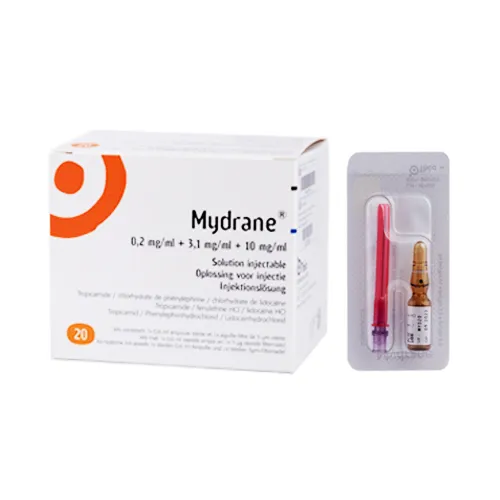
Table of Contents
- Package leaflet: Information for the user
- MYDRANE 0.2 mg/ml + 3.1 mg/ml + 10 mg/ml solution for injection
- 1. What MYDRANE is and what it is used for
- 2. What you should know before using MYDRANE
- 3. How MYDRANE is administered
- 4. Possible side effects
- 5. How to store MYDRANE
- 6. Package contents and other information
Package leaflet: Information for the user
MYDRANE 0.2 mg/ml + 3.1 mg/ml + 10 mg/ml solution for injection
tropicamide/phenylephrine hydrochloride/lidocaine hydrochloride
Please read all of this leaflet carefully before you start using this medicine because it contains important information for you.
- Keep this leaflet. You may need to read it again.
- If you have any questions, ask your doctor or pharmacist.
- If you get any side effects, talk to your doctor or pharmacist. This includes any possible side effects not listed in this leaflet. See section 4.
Contents of this leaflet:
- What MYDRANE is and what it is used for
- What you need to know before using MYDRANE
- How MYDRANE is administered
- Possible side effects
- How to store MYDRANE
- Contents of the pack and other information
1. What MYDRANE is and what it is used for
What MYDRANE is
This medicine is a solution that is injected into the eye.
It contains three active substances:
- tropicamide, which belongs to a group of medicines (known as anticholinergics) that block the transmission of impulses through certain nerves,
- phenylephrine (as phenylephrine hydrochloride), which belongs to a group of medicines (alpha-sympathomimetics) that mimic the effects of impulses transmitted through certain nerves,
- lidocaine (as lidocaine hydrochloride), which belongs to a class of medicines called amide-type local anesthetics.
What it is used for
This medicine is used only in adults.
It is administered by the ophthalmic surgeon as an injection into the eye at the start of cataract surgery (clouding of the lens), in order to dilate the pupil of the eye (mydriasis) and to achieve anesthesia in the eye during the surgical procedure.
2. What you should know before using MYDRANE
Do not use MYDRANE if:
- you are allergic to tropicamide, phenylephrine hydrochloride, and/or lidocaine hydrochloride or to any of the other ingredients of this medicine (listed in section 6),
- you are allergic to amide-type local anaesthetics (articaine, bupivacaine, mepivacaine, prilocaine, ropivacaine),
- you are allergic to atropine derivatives.
Warnings and precautions
MYDRANE is not recommended:
- during cataract surgery associated with another type of eye surgery (vitrectomy),
- if the anterior chamber of your eye is shallow,
- if you have a history of acute increase in intraocular pressure (acute angle-closure glaucoma).
In particular, inform your doctor if you have:
- high blood pressure (hypertension),
- arterial wall thickening (atherosclerosis),
- heart diseases, especially those affecting heart rate,
- contraindications to drugs that increase blood pressure (vasopressor amines: epinephrine, norepinephrine, dopamine, dobutamine) in general,
- overactive thyroid gland (hyperthyroidism),
- prostatic disorders,
- seizures (epilepsy),
- any liver or kidney problems,
- breathing difficulties,
- loss of muscle function and weakness (myasthenia gravis).
Other medicines and MYDRANE
Tell your doctor or pharmacist if you are taking, have recently taken, or might take any other medicines.
Fertility, pregnancy and breastfeeding
This medicine must not be used:
- during pregnancy,
- during breastfeeding.
If you are pregnant, think you might be pregnant, or are planning to become pregnant, consult your doctor or pharmacist before using this medicine.
Effects on ability to drive and use machines
MYDRANE has a moderate effect on the ability to drive vehicles or operate machinery. Therefore, do not drive and/or operate machinery until your vision has returned to normal.
MYDRANE contains sodium
This medicine contains less than 1 mmol of sodium (23 mg) per dose, i.e., essentially "sodium-free".
3. How MYDRANE is administered
This medicinal product may be administered to you only if satisfactory pupillary dilation has already been demonstrated with topical mydriatic therapy during a preoperative assessment.
Posology and method of administration
- MYDRANE injection is performed by the ophthalmic surgeon, under local anaesthesia, at the beginning of cataract surgery.
- The recommended dose is 0.2 ml of solution, administered as a single injection. No additional dose should be injected, as an additive effect cannot be demonstrated and an increased loss of endothelial cells (cells of the layer lining the posterior surface of the cornea) has been observed.
- The same dose is used for both adults and elderly patients.
If too much MYDRANE has been administered, or too little:
The medicine is administered by an ophthalmic surgeon. Overdose is unlikely. However, overdose may cause increased loss of corneal endothelial cells (cells of the layer covering the posterior surface of the cornea).
If you have any doubts about the use of this medicine, consult your doctor, pharmacist, or nurse.
4. Possible side effects
Like all medicines, this medicine can cause side effects, although not everybody gets them.
More serious well-known complications that may occur during and after cataract surgery:
Uncommon: may affect up to 1 in 100 people
- Posterior lens capsule damage (posterior capsule rupture),
- Thickening of the retina (cystoid macular edema). Please consult your doctor immediately in this case.
Other side effects:
Uncommon: may affect up to 1 in 100 people
- Headache,
- Corneal swelling (keratitis), increased eye pressure, eye redness (ocular hyperemia),
- High blood pressure (hypertension).
Reporting of side effects
If you experience any side effect, including those not listed in this leaflet, talk to your doctor or pharmacist. You can also report side effects directly through the national reporting system at the website https://www.aifa.gov.it/content/segnalazioni-reazioni-avverse.
By reporting side effects, you can help provide more information on the safety of this medicine.
5. How to store MYDRANE
Keep this medicine out of the sight and reach of children.
Do not use this medicine after the expiry date stated on the carton, blister, and vial. The expiry date refers to the last day of that month.
This medicine does not require any special storage conditions.
For single use only. This medicine must be used immediately after first opening of the vial.
Do not dispose of medicines via wastewater or household waste. Ask your pharmacist how to dispose of medicines you no longer use. This will help protect the environment.
6. Package contents and other information
What MYDRANE contains
- The active substances are tropicamide 0.04 mg, phenylephrine hydrochloride 0.62 mg and lidocaine hydrochloride 2 mg per 0.2 ml dose, equivalent to 0.2 mg tropicamide, 3.1 mg phenylephrine hydrochloride and 10 mg lidocaine hydrochloride per 1 ml.
- The other components are: sodium chloride, disodium phosphate dodecahydrate, disodium phosphate dihydrate, disodium edetate and water for injections.
Description of the appearance of MYDRANE and contents of the pack
MYDRANE is a clear, slightly yellowish-brown solution, practically free from visible particles, supplied in a 1 ml brown glass vial. Each sterile vial contains 0.6 ml of injectable solution and is presented individually or together with a sterile 5-micron filter needle in a sealed paper/PVC blister.
Each carton contains 1, 20 or 100 sterile vials with sterile 5-micron filter needles, either separately or in the same blister. The 5-micron filter needles are to be used only for withdrawing the contents of the vial. All components are for single use only.
It is possible that not all pack sizes are marketed.
Marketing Authorisation Holder and Manufacturer
Marketing Authorisation Holder
LABORATOIRES THEA
12, RUE LOUIS BLERIOT
63017 CLERMONT-FERRAND CEDEX 2
FRANCE
Manufacturer
DELPHARM TOURS
RUE PAUL LANGEVIN
37170 CHAMBRAY LES TOURS
FRANCE
or
LABORATOIRES THEA
12, RUE LOUIS BLERIOT
63017 CLERMONT-FERRAND CEDEX 2
FRANCE
This medicinal product is authorised in the Member States of the European Economic Area under the following names:
Austria, Belgium, Bulgaria, Cyprus, Czech Republic, Germany, Denmark, Greece, Finland, France, Croatia, Iceland, Italy, Luxembourg, Netherlands, Poland, Portugal, Romania, Sweden, Slovenia, Slovakia, United Kingdom........................................................................................... Mydrane
Ireland, Spain...........................................................................................................................Fydrane
Norway .................................................................................................................................... Mydane
More detailed information on this medicinal product is available on the website of the Italian Medicines Agency (AIFA)
The following information is intended exclusively for physicians or healthcare professionals:
Incompatibilities
No incompatibility of the active substances with products commonly used in cataract surgery has been reported in the literature or during clinical studies. For standard viscoelastic agents, this has also been confirmed by pharmaceutical interaction testing.
Warning
Do not use if the blister is damaged or broken. Open only under aseptic conditions. The contents of the blister are guaranteed sterile.
How to prepare and administer MYDRANE
Solution for use in one eye only, intended for intracameral use.
MYDRANE must be administered by intracameral injection into the anterior chamber of the eye by an ophthalmic surgeon under the aseptic conditions recommended for cataract surgery.
Prior to intracameral injection, the solution should be inspected visually and used only if it is clear, slightly yellowish-brown and practically free from visible particles.
The recommended dose is 0.2 ml of MYDRANE; an additional dose should not be injected as no significant additive effect has been demonstrated and an increased loss of endothelial cells has been observed.
The product must be used immediately after opening the vial and must not be used for the other eye or for any other patient.
For kit presentations only (blister containing one vial and one needle): attach the flag label from the blister to the patient's chart.
To prepare MYDRANE for intracameral administration, follow these instructions: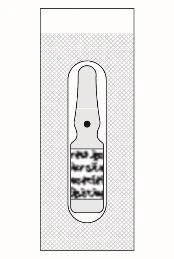 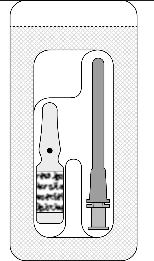 | |
or 5-µm Filter Needle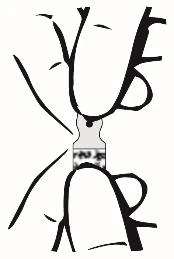 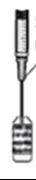 | 1. Inspect the sealed blister to ensure it is intact. Open the blister under aseptic conditions to maintain sterility of the contents. 2. Break the sterile vial containing the medicinal product. The One Point Cut (OPC) vial must be opened as follows: hold the lower part of the vial with the thumb facing the colored dot. Hold the upper part of the vial with the other hand, placing the thumb on the colored dot and bending it backward to break at the pre-scored line beneath the dot. 3. Attach the sterile 5-micron filter needle (supplied) to a sterile syringe. Remove the protective cap from the sterile 5-micron filter needle and withdraw at least 0.2 ml of injectable solution from the vial into the syringe. 4. Remove the filter needle from the syringe and attach to the syringe an appropriate anterior chamber cannula. 5. Carefully expel air from the syringe. Adjust the volume to 0.2 ml. The syringe is now ready for injection. 6. Slowly inject 0.2 ml of the syringe contents into the anterior chamber of the eye in a single injection, through either the side port or the main access route. |
After use, dispose of any remaining solution appropriately. Do not store for later use.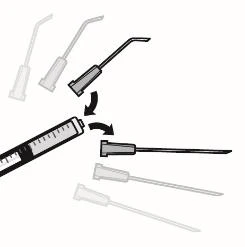 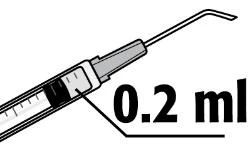 | |
Unused medicine and waste derived from this medicine must be disposed of in accordance with local applicable regulations.