Mycobutin
Italy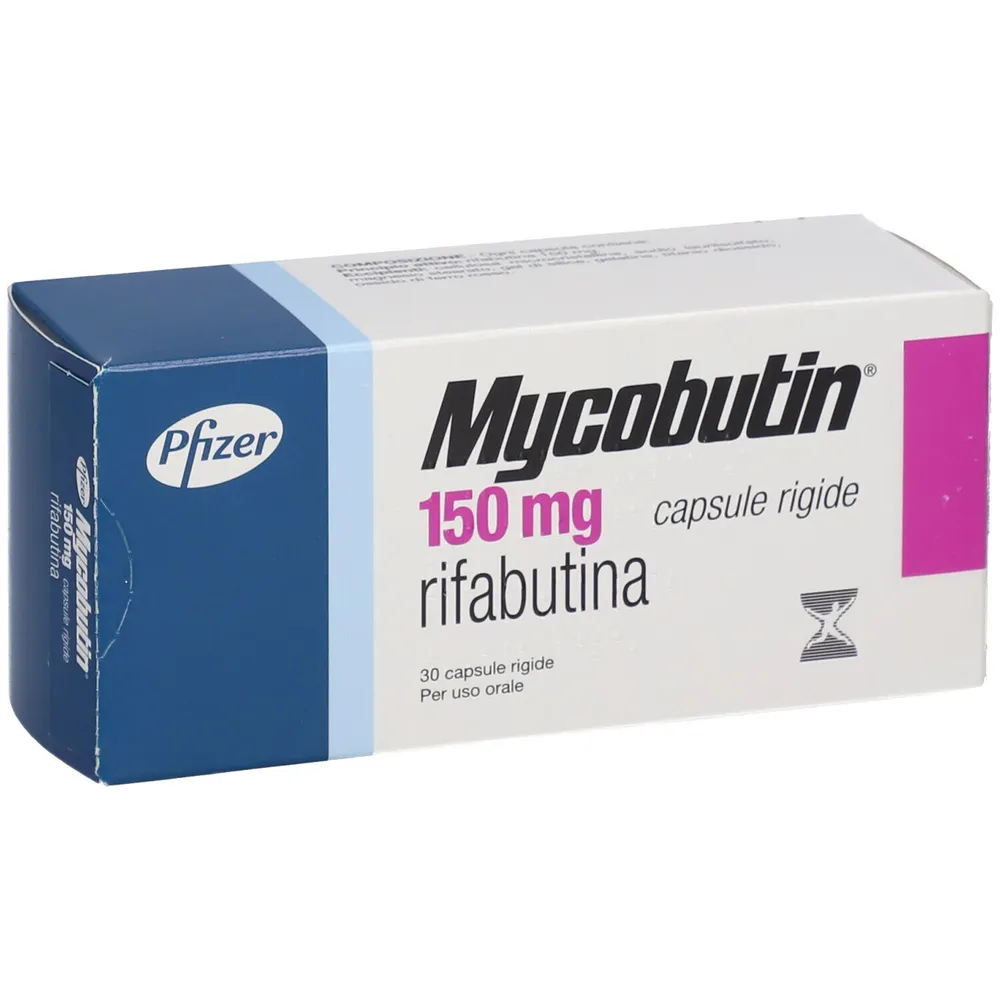
Table of Contents
Package leaflet: Information for the patient
Mycobutin 150 mg hard capsules
Rifabutin
Please read this leaflet carefully before you start taking this medicine because it contains important information for you.
- Keep this leaflet. You may need to read it again.
- If you have any questions, ask your doctor or pharmacist.
- This medicine has been prescribed for you only. Do not give it to other people, even if their symptoms are the same as yours, as it may be harmful.
- If you experience any side effects, including those not listed in this leaflet, tell your doctor or pharmacist. See section 4.
Contents of this leaflet
- What Mycobutin is and what it is used for
- What you need to know before taking Mycobutin
- How to take Mycobutin
- Possible side effects
- How to store Mycobutin
- Contents of the pack and other information
1. What Mycobutin is and what it is used for
Mycobutin contains the active substance rifabutin, an antibiotic. Rifabutin blocks the growth of mycobacteria, a type of bacteria that cannot be eliminated with common antibiotics.
Mycobutin is indicated in adults and elderly patients for:
- preventing infections caused by Mycobacterium avium complex (MAC) and other mycobacteria;
- treating infections caused by Mycobacterium tuberculosis, Mycobacterium avium complex (MAC), Mycobacterium xenopi, and other mycobacteria. Mycobutin must be used in combination with other antimycobacterial antibiotics not belonging to the rifamycin group.
2. What you need to know before taking Mycobutin
Do not take Mycobutin:
- if you are allergic to rifabutin, to other antibiotics of the rifamycin class (e.g. rifampicin), or to any of the other ingredients of this medicine (listed in section 6);
- if you are pregnant or breastfeeding.
Mycobutin must not be administered to children.
Warnings and precautions
Stop taking Mycobutin and contact your doctor immediately if you experience any of the following symptoms (drug reaction with eosinophilia and systemic symptoms (DRESS)):
- skin rash, fever
- swollen lymph nodes and blood count abnormalities
Talk to your doctor or pharmacist before taking Mycobutin if:
- you have tuberculosis or another infection caused by mycobacteria;
- you have severe liver or kidney problems.
Inform your doctor or pharmacist if any of the following conditions occur or worsen during treatment with Mycobutin:
- redness of the white part of the eye, especially if you are taking Mycobutin together with clarithromycin (an antibiotic) or fluconazole (an antifungal medicine). In such cases, you should have an ophthalmological examination;
- diarrhea, which may progress to inflammation of the intestine (colitis), even fatal. Inform your doctor immediately if you develop severe and persistent diarrhea, even if several months have passed since stopping Mycobutin treatment.
Mycobutin may cause a red/orange discoloration of urine, skin, and other body fluids. These effects are not a cause for concern as they have no harmful consequences for you. Avoid using soft contact lenses, as Mycobutin may alter the color of soft contact lenses.
Other medicines and Mycobutin
Inform your doctor or pharmacist if you are taking, have recently taken, or might take any other medicines.
The following medicines may affect the action of Mycobutin, or Mycobutin may reduce the effectiveness of the following medicines. Therefore, caution is required:
- amprenavir, bictegravir, delavirdine, didanosine, doravirine, fosamprenavir/ritonavir, indinavir, lopinavir/ritonavir, saquinavir, rilpivirine, ritonavir, and tipranavir/ritonavir (medicines used to treat HIV infection);
- fluconazole, itraconazole, posaconazole, voriconazole (medicines used to treat fungal infections);
- dapsone, sulfamethoxazole/trimethoprim, clarithromycin, ethambutol, isoniazid, pyrazinamide (antibiotics for various types of infections);
- methadone (a medicine for pain relief and for treating opioid dependence);
- oral contraceptives (medicines used to prevent pregnancy). It is recommended to use alternative contraceptive methods (e.g. condoms) to avoid pregnancy;
- tacrolimus (a medicine to prevent organ transplant rejection);
- theophylline (a medicine used in the treatment of asthma).
Pregnancy and breastfeeding
If you are pregnant, suspect you may be pregnant, are planning a pregnancy, or are breastfeeding, consult your doctor or pharmacist before taking this medicine.
Do not take Mycobutin if you are pregnant or think you may be pregnant, or if you are breastfeeding.
Driving and using machines
It is unknown whether this medicine affects the ability to drive or use machinery.
Mycobutin contains sodium
Mycobutin contains less than 1 mmol (23 mg) of sodium per hard capsule, i.e. it is essentially “sodium-free”.
3. How to take Mycobutin
Take this medicine exactly as directed by your doctor or pharmacist. If you have
any doubts, consult your doctor or pharmacist.
Swallow the capsules with half a glass of water. Take the capsules once daily, at any
time of day, regardless of meals.
Mycobutin is usually taken together with other antibiotics for the treatment of
mycobacterial infections.
- Prevention of Mycobacterium avium complex (MAC) infections
The recommended dose is 2 capsules once daily. - Treatment of mycobacterial infections (but not caused by Mycobacterium tuberculosis)
The recommended dose is 3–4 capsules once daily. Your doctor will determine the duration of treatment. - Treatment of pulmonary tuberculosis infections (caused by Mycobacterium tuberculosis)
The recommended dose for chronic tuberculosis infections is 2–3 capsules once daily. Your doctor will determine the duration of treatment.
The recommended dose for recent tuberculosis infections is 1 capsule daily for 6 months.
If you take more Mycobutin than you should
If you take too much of this medicine, contact your doctor or go to the nearest hospital emergency department immediately. Always bring the medicine pack with the label, even if no capsules are left.
If you forget to take Mycobutin
If you forget to take a dose, take it as soon as you remember, unless it is almost time for your next dose. Do not take a double dose to make up for a forgotten dose.
If you stop taking Mycobutin
Do not stop taking Mycobutin unless instructed by your doctor, as the infection may return.
If you have any questions about how to use this medicine, ask your doctor or pharmacist.
4. Possible side effects
Like all medicines, this medicine can cause side effects, although not everyone experiences them.
STOP treatment with Mycobutin immediately and contact your doctor urgently if you experience any of the following side effects:
- severe allergic reaction (anaphylactic shock). Symptoms may include confusion, drowsiness, cold and clammy skin, shallow or difficult breathing, rapid heartbeat;
- diarrhoea, stomach ache and blood in the stools, as these may be symptoms of a serious inflammation of the colon (the final part of the intestine) (see section 2 “Warnings and precautions”);
- sudden wheezing, difficulty breathing or swallowing, swelling of the eyelids, face or lips, skin rash or itching (particularly itching affecting the whole body). These may be signs of a severe hypersensitivity reaction (may occur in an unknown number of people) (Acute Generalized Exanthematous Pustulosis, AGEP);
- a drug reaction with symptoms such as fever, rash, abnormal blood counts, swollen lymph nodes and internal organ involvement (DRESS syndrome, occurs in an unknown number of people);
- a very severe allergic reaction with a rash, usually in the form of blisters or ulcers in the mouth and eyes, as well as other mucous membranes, for example the genitals (occurs in an unknown number of people) (Stevens-Johnson syndrome, SJS);
- inflamed and peeling skin, severely widespread skin damage (detachment of superficial epidermis and mucous membranes) (occurs in an unknown number of people) (toxic epidermal necrolysis, TEN).
Contact your doctor if you experience any of the following side effects:
Very common (may affect more than 1 in 10 people):
- decrease in the number of white blood cells (a type of white blood cell) in the blood
Common (may affect up to 1 in 10 people):
- anaemia (reduction in haemoglobin in the blood)
- skin rash
- nausea
- muscle pain
- fever
Uncommon (may affect up to 1 in 100 people):
- decrease or increase in the number of eosinophils (a type of white blood cell) in the blood
- decrease in the number of white blood cells, red blood cells and platelets in the blood
- allergies
- difficulty breathing
- eye pain and redness, corneal changes (the transparent front part of the eye) which may lead to loss of vision
- vomiting
- yellowish discoloration of the skin and the white part of the eye
- increased levels of liver enzymes
- skin discoloration
- joint pain
Reporting of side effects
If you experience any side effect, including those not listed in this leaflet, talk to your doctor or pharmacist. You can also report side effects directly via the national reporting system at: www.aifa.gov.it/content/segnalazioni-reazioni-avverse. By reporting side effects, you can help provide more information on the safety of this medicine.
5. How to store Mycobutin
Keep this medicine out of the sight and reach of children.
Do not use this medicine after the expiry date which is stated on the carton, blister pack, or bottle after "Exp". The expiry date refers to the last day of that month.
This medicine does not require any special storage conditions.
Do not dispose of medicines via wastewater or household waste. Ask your pharmacist how to dispose of medicines you no longer use. This will help protect the environment.
6. Package contents and other information
What Mycobutin contains
The active substance is rifabutin.
Each Mycobutin hard capsule contains 150 mg of rifabutin.
The other components are: microcrystalline cellulose, sodium lauryl sulfate (see section “Mycobutin
contains sodium”), magnesium stearate, gelatin, silica gel, titanium dioxide, iron oxide red.
Description of the appearance of Mycobutin and the contents of the pack
Mycobutin capsules are hard capsules available in PVC/aluminum blisters or in glass bottles containing 30 capsules.
Not all pack sizes may be marketed.
Marketing Authorization Holder and Manufacturer
Marketing Authorization Holder
Pfizer Italia S.r.l.
Via Isonzo 71,
04100 Latina (LT)
Manufacturer
Pfizer Italia S.r.l.
Località Marino del Tronto
63100 Ascoli Piceno (AP)