Monoferric
Italy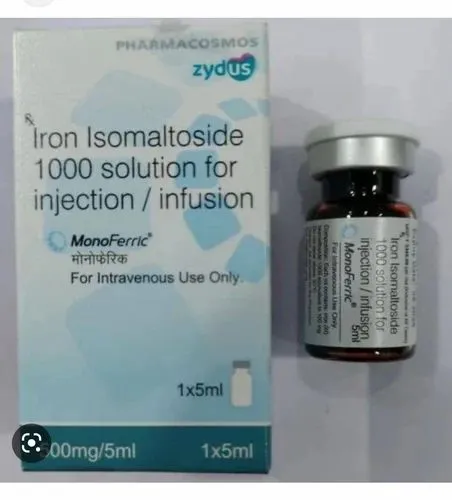
Instructions for Use
Package leaflet: Information for the user
Monoferric 100 mg/ml solution for injection/infusion
Ferric derisomaltose
Please read all of this leaflet carefully before you start using this medicine because it contains important information for you.
- Keep this leaflet. You may need to read it again.
- If you have any questions, ask your doctor or nurse.
- If you get any side effects, talk to your doctor or nurse. This includes any side effects not listed in this leaflet. See section 4.
Contents of this leaflet:
- What Monoferric is and what it is used for
- What you need to know before you use Monoferric
- How to use Monoferric
- Possible side effects
- How to store Monoferric
- Contents of the pack and other information
1. What Monoferric is and what it is used for
Monoferric contains a complex of iron and derisomaltose (a chain of sugar molecules).
The iron in Monoferric is of the same type as that naturally found in the body,
called "ferritin". This means that you can receive Monoferric by injection in high doses.
Monoferric is used for low iron levels (sometimes referred to as "iron deficiency" and "iron deficiency
anaemia") if:
- oral iron does not work or you are unable to tolerate it
- your doctor decides that you need iron quickly to restore your iron stores.
2. What you need to know before using Monoferric
Monoferric must not be administered to you if:
- you are allergic (hypersensitive) to the active substance or to any of the other ingredients of this medicine (listed in section 6);
- you have previously experienced severe allergic (hypersensitivity) reactions to other injectable iron preparations;
- you have an iron-deficiency-unrelated form of anaemia;
- you have too much iron (iron overload) or have a disorder in iron utilization;
- you have liver problems such as "cirrhosis".
Warnings and precautions
Please consult your doctor or nurse before receiving Monoferric:
- if you have previously had drug allergies;
- if you have systemic lupus erythematosus;
- if you have rheumatoid arthritis;
- if you have severe asthma, eczema, or other allergies;
- if you currently have a bacterial infection in the blood;
- if you have impaired liver function.
Incorrect administration of Monoferric may result in leakage of the product at the injection site, which could lead to skin irritation and potentially long-lasting brown discoloration at the injection site. If this occurs, administration must be stopped immediately.
Children and adolescents
Monoferric is intended for use in adults only. Children and adolescents should not be treated with this medicine.
Other medicines and Monoferric
Inform your doctor if you are currently taking, have recently taken, or might take any other medicines.
Concomitant administration of Monoferric with oral iron preparations may reduce the absorption of orally administered iron.
Pregnancy and breastfeeding
Data on the use of Monoferric in pregnant women are limited. It is important that you inform your doctor if you are pregnant or planning a pregnancy. If you become pregnant during treatment, you should seek medical advice. Your doctor will decide whether this medicine should be administered to you.
If you are breastfeeding, please consult your doctor before receiving Monoferric. It is unlikely that Monoferric poses a risk to the breastfed infant.
Driving and using machines
Ask your doctor whether you can drive or operate machinery after receiving Monoferric.
Monoferric contains sodium
This medicine contains up to 9.4 mg of sodium (a key component of table salt) per 100 mg iron dose. This corresponds to 0.47% of the maximum daily sodium intake recommended for an adult.
3. How Monoferric is given
Before administration, your doctor will carry out a blood test to determine the dose of
Monoferric you need.
Your doctor or nurse will give you Monoferric as an intravenous injection or infusion; Monoferric
can be administered as an intravenous injection of up to 500 mg up to three times a day.
- Monoferric can be administered during a dialysis session.
- Monoferric can be given as an intravenous infusion at a dose of up to 20 mg of iron/kg body weight or as weekly infusions until the total dose has been administered.
Monoferric will be given to you in a facility where immune-allergic reactions can be appropriately and promptly treated.
After each administration, you will be monitored by your doctor or nurse for at least 30 minutes.
If you are given more Monoferric than you should
Monoferric will be administered by a qualified healthcare professional. It is unlikely that you will be given an excessive amount. They will monitor the dose and your blood to prevent iron accumulation in your body.
4. Possible side effects
Like all medicines, this medicine can cause side effects, although not everyone gets them.
Allergic reactions
Contact your doctor immediately if you experience any of the following signs and symptoms, which may indicate a severe allergic reaction: swelling of the face, tongue or throat; difficulty swallowing; hives and breathing difficulties; and chest pain, which may be a sign of a potentially serious allergic reaction called Kounis syndrome.
Common (may affect up to 1 in 10 people):
- Nausea
- Skin reactions at or near the injection site, including skin redness, swelling, burning, pain, bruising, discoloration, leakage into surrounding tissue at the infusion site, irritation
- Rash.
Uncommon (may affect up to 1 in 100 people):
- Hypersensitivity reactions with potential shortness of breath (dyspnea) and bronchospasm
- Headache
- Numbness
- Distortion of taste sensation
- Blurred vision
- Loss of consciousness
- Dizziness
- Fatigue
- Increased heart rate
- Low or high blood pressure
- Chest pain, back pain, muscle or joint pain, muscle spasms
- Stomach pain, vomiting, indigestion, constipation, diarrhoea
- Itching, hives, skin inflammation
- Flushing, sweating, fever, chills, tremor
- Low blood phosphate levels
- Infection
- Increased liver enzymes
- Local inflammation of a vein
- Skin peeling.
Rare (may affect up to 1 in 1,000 people):
- Irregular heartbeat
- Hoarseness
- Seizures
- Tremor
- Altered mental state
- Malaise.
An influenza-like illness (may affect up to 1 in 1,000 people) may occur from several hours to several days after injection and is usually characterised by symptoms such as high temperature and muscle and joint pain.
Not known
Change in skin colour in areas of the body other than the injection site.
Reporting of side effects
If you get any side effects, including any not listed in this leaflet, talk to your doctor or nurse. You can also report side effects directly via the national reporting system at http://www.aifa.gov.it/content/segnalazioni-reazioni-avverse
By reporting side effects, you can help provide more information on the safety of this medicine.
5. How to store Monoferric
Keep this medicine out of the sight and reach of children.
Do not use this medicine after the expiry date stated on the vial or vial label after EXP. The expiry date refers to the last day of that month.
Before use, visually inspect the vials/vials for any precipitates or damage. Use only those vials containing a homogeneous solution free from precipitates.
The reconstituted injectable solution must be visually inspected before use. Use only clear solutions free from precipitates.
This medicine does not require any special storage conditions. Hospital staff will ensure that the product is properly stored and disposed of.
6. Package contents and other information
What Monoferric contains
- The active substance is iron (as ferric derisomaltose, an iron carbohydrate complex). The iron concentration in the product is 100 mg per millilitre.
- The other components are sodium hydroxide (for pH adjustment), hydrochloric acid (for pH adjustment), and water for injections.
Description of the appearance of Monoferric and contents of the pack
Monoferric is a dark brown, non-transparent solution for injection/infusion.
Monoferric is supplied in glass vials or glass ampoules containing:
- 1 ml of solution corresponding to 100 mg of iron as ferric derisomaltose
- 2 ml of solution corresponding to 200 mg of iron as ferric derisomaltose
- 5 ml of solution corresponding to 500 mg of iron as ferric derisomaltose
- 10 ml of solution corresponding to 1000 mg of iron as ferric derisomaltose.
Pack sizes are as follows:
Vial packs: 5 x 1 ml, 10 x 1 ml, 5 x 2 ml, 10 x 2 ml, 2 x 5 ml, 5 x 5 ml, 2 x 10 ml, 5 x 10 ml.
Ampoule packs: 1 x 1 ml, 5 x 1 ml, 10 x 1 ml, 5 x 2 ml, 10 x 2 ml, 1 x 5 ml, 2 x 5 ml,
5 x 5 ml, 1 x 10 ml, 2 x 10 ml, 5 x 10 ml.
Not all pack sizes may be marketed.
Marketing Authorisation Holder and Manufacturer
Pharmacosmos A/S
Roervangsvej 30
DK-4300 Holbaek
Denmark
Tel.: +45 59 48 59 59
Fax: +45 59 48 59 60
E-mail: [email protected]
Marketing Authorisation Holder in Italy
Kedrion S.p.A.
Loc. Ai Conti 55051, Castelvecchio Pascoli,
Barga (Lucca)
This medicinal product is authorised in the European Economic Area and in the United Kingdom (Northern Ireland) under the following names:
Austria, Bulgaria, Croatia, Denmark, Estonia, Finland, Germany, Iceland, Latvia, Lithuania,
Norway, Netherlands, United Kingdom (Northern Ireland), Romania, Slovenia, Sweden: Monofer
Belgium, Italy: Monoferric
Ireland, Luxembourg, Poland: Monover
Portugal: Monofar
The following information is intended exclusively for physicians or healthcare professionals:
Monitor patients closely for any signs and symptoms of hypersensitivity reactions during and
after each administration of Monoferric.
Monoferric must be administered only when trained personnel capable of assessing and managing
anaphylactic reactions are immediately available, and in a setting where full resuscitation equipment is accessible. The patient must be observed for adverse effects for at least 30 minutes after each injection of Monoferric.
Each single intravenous iron administration is associated with a risk of hypersensitivity reaction. Therefore, to minimise risks, the number of single intravenous iron administrations should be kept to a minimum.
Dosage
The dosage regimen for Monoferric follows a stepwise approach: [1] determination of iron requirement either or based on individual assessment, and [2] calculation and administration of the iron dose(s). These steps may be repeated after [3] post-depletion iron evaluations.
Step 1: Determination of iron requirement
The iron requirement can be determined using the Simplified Table (i) or the Ganzoni formula (ii) below.
The iron requirement is expressed in mg of elemental iron.
i. Simplified Table:
Table 1: Simplified Table
| Hb (g/dl) | Hb (mmol/l) | Patients with body weight <50 kg | Patients with body weight ≥50 kg to <70 kg | Patients with body weight ≥70 kg |
| ≥10 | ≥6.2 | 500 mg | 1000 mg | 1500 mg |
| <10 | <6.2 | 500 mg | 1500 mg | 2000 mg |
ii. Ganzoni's formula:
Table 2. Ganzoni's formula
Iron requirement = Body weight x (Target Hb – Current Hb) x 2.4 + Iron stores
[mg iron] [kg] [g/dL] [mg iron]
iii. Fixed iron requirement:
A fixed dose of 1000 mg is administered to the patient, and the patient is reassessed for further iron requirements according to "Phase 3: Post-iron depletion assessments". For calculating iron requirements in patients weighing less than 50 kg, use the simplified table or the Ganzoni formula.
Phase 2: Calculation and administration of the individual maximum dose(s) of iron
Based on the iron requirement determined above, the appropriate dose(s) of Monoferric should be administered, taking into account the following:
- The total weekly dose must not exceed 20 mg of iron/kg body weight.
- A single infusion of Monoferric must not exceed 20 mg of iron/kg body weight.
- A single intravenous bolus injection of Monoferric must not exceed 500 mg of iron.
Phase 3: Post-iron depletion assessments:
Re-evaluation, including blood tests, should be performed by the clinician based on the individual patient's condition. To assess the effect of IV iron treatment, Hb levels should be re-evaluated no sooner than 4 weeks after the last administration of Monoferric, to allow sufficient time for erythropoiesis and iron utilization. If the patient requires further iron replenishment, the iron requirement should be recalculated.
Children and adolescents:
The use of Monoferric is not recommended in children and adolescents under 18 years of age due to insufficient data on safety and efficacy.
Method of administration
Monoferric must be administered intravenously via injection or infusion.
Monoferric must not be administered concomitantly with oral iron preparations, as oral iron absorption may be reduced.
Intravenous bolus injection
Monoferric may be administered as an intravenous bolus injection at doses up to 500 mg, up to 3 times per week, at an administration rate of up to 250 mg of iron per minute. It may be administered undiluted or diluted in up to 20 mL of sterile 0.9% sodium chloride solution.
Table 3: Administration rate for intravenous bolus injection
| Monoferric Volume | Equivalent iron dose | Rate of administration/minimum infusion time | Frequency |
| ≤5 ml | ≤500 mg | 250 mg of iron/minute | 1-3 times per week |
Intravenous infusion:
The required iron dose should be administered as a single infusion of Monoferric up to 20 mg of iron/kg body weight, or as weekly infusions until the total cumulative iron requirement has been delivered.
If the iron requirement exceeds 20 mg of iron/kg body weight, the dose should be divided into two administrations, with an interval of at least one week between them. Where possible, it is recommended to administer 20 mg of iron/kg body weight during the first administration. Based on the physician's judgment, laboratory test results from follow-up assessments may be awaited before proceeding with the second administration.
Table 4: Administration rate for intravenous infusion
| Iron dose | Minimum administration time |
| ≤1000 mg >1000 mg | More than 15 minutes 30 minutes or more |
Monoferric must be administered as an undiluted infusion or diluted in 500 ml of sterile 0.9% sodium chloride.
For stability reasons, Monoferric must not be diluted to concentrations lower than 1 mg of iron/ml
(not including the volume of ferric derisomaltose solution) and must never be diluted in more than 500 ml.
Injection into the dialysate:
Monoferric may be administered during a hemodialysis session directly into the venous limb of the dialysate,
using the same procedures described for intravenous bolus injection.
Refer to the Summary of Product Characteristics (SmPC) for further information on Monoferric.
This page has been machine-translated and may contain inaccuracies. The original data is available in the manufacturing country's language.
Last data check: May 11, 2026 · Data source: Agenzia Italiana del Farmaco (AIFA)