Micoxolamina
Italy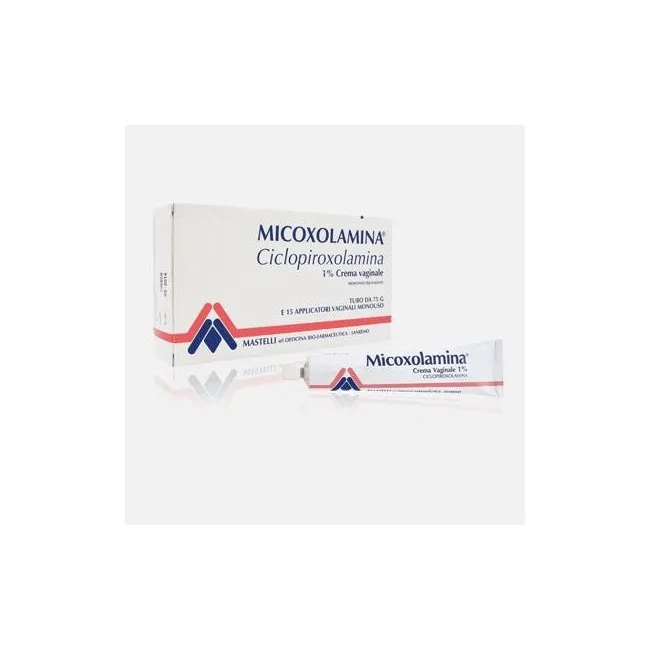
Table of Contents
- Package leaflet: Information for the user
- MICOXOLAMINA 1% cream, 1% cutaneous emulsion, 1% cutaneous solution
- 1. What MICOXOLAMINE is and what it is used for
- 2. What you need to know before using MICOXOLAMINE
- 3. How to use MICOXOLAMINE
- 4. Possible adverse reactions
- 5. How to store MICOXOLAMINA.
- 7. Package contents and other information
- Patient Information Leaflet: Information for the user
- MICOXOLAMINE 1% vaginal cream, 100 mg ovules, 1% gynecological foam
- 1. What MICOXOLAMINA is and what it is used for
- 2. What you should know before using MICOXOLAMINA
- 3. How to use MICOXOLAMINA
- 4. Possible adverse reactions
- 5. How to store MICOXOLAMINE
- 6. Package contents and other information
Package leaflet: Information for the user
MICOXOLAMINA 1% cream, 1% cutaneous emulsion, 1% cutaneous solution
Ciclopiroxolamine
Please read this leaflet carefully before using this medicine because it contains
important information for you.
Always use this medicine exactly as described in this leaflet or as your doctor or
pharmacist has instructed you.
Keep this leaflet. You may need to read it again.
If you have any questions, consult your doctor or pharmacist.
If you experience any side effects, including those not listed in this
leaflet, consult your doctor or pharmacist. See section 4.
Contact your doctor if you do not notice any improvement or if you notice a worsening of symptoms.
Contents of this leaflet:
- What MICOXOLAMINA is and what it is used for
- What you need to know before using MICOXOLAMINA
- How to use MICOXOLAMINA
- Possible side effects
- How to store MICOXOLAMINA
- Contents of the pack and other information
1. What MICOXOLAMINE is and what it is used for
MICOXOLAMINE contains the active substance ciclopiroxolamine, which belongs to a group of
medicines called antifungals, active against the growth of fungi. MICOXOLAMINE is indicated
for infections caused by susceptible fungi.
If you do not feel better or feel worse, consult your doctor.
2. What you need to know before using MICOXOLAMINE
Do not use MICOXOLAMINE
if you are allergic to ciclopirox olamine or to any of the other ingredients of this
medicinal product (listed in section 6).
Warnings and precautions
Talk to your doctor or pharmacist before using MICOXOLAMINE
Contact of the product with the eyes must be avoided. You should use MICOXOLAMINE with
caution and under medical supervision:
if you are simultaneously being treated with a systemic antifungal agent (medicines used against fungal growth);
if you have a history of reduced immune defenses (immunosuppression);
if your immune system is compromised, such as in transplant recipients or individuals with HIV infection;
if you have diabetes.
Prolonged use of MICOXOLAMINE may cause allergic reactions (hypersensitivity). If this occurs, treatment must be discontinued and you should contact your doctor. During treatment with MICOXOLAMINE, strictly follow the hygiene measures recommended by your doctor.
Other medicines and MICOXOLAMINE
Inform your doctor or pharmacist if you are currently taking, have recently taken, or might take any other medicines. No interactions with other medicines used concomitantly with MICOXOLAMINE have been reported.
Pregnancy and breastfeeding
If you are pregnant, suspect you may be pregnant, planning a pregnancy, or breastfeeding, consult your doctor or pharmacist before using this medicinal product. In pregnant women, breastfeeding women, and very young infants, this product should only be used when clearly necessary and under direct medical supervision.
Driving and using machines
MICOXOLAMINE does not affect the ability to drive or operate machinery.
MICOXOLAMINE cream contains benzoic acid and butylated hydroxyanisole
MICOXOLAMINE cream contains 200 mg of benzoic acid per 100 g.
Benzoic acid may cause local irritation. Benzoic acid may increase jaundice (yellowing of the skin and eyes) in newborns (up to 4 weeks of age).
This medicinal product contains butylated hydroxyanisole, which may cause localized skin reactions (e.g. contact dermatitis) or irritation of the eyes and mucous membranes.
MICOXOLAMINE emulsion contains benzoic acid and butylated hydroxyanisole
MICOXOLAMINE cutaneous emulsion contains 300 mg of benzoic acid per 100 g.
Benzoic acid may cause local irritation.
Benzoic acid may increase jaundice (yellowing of the skin and eyes) in newborns (up to 4 weeks of age).
This medicinal product contains butylated hydroxyanisole, which may cause localized skin reactions (e.g. contact dermatitis) or irritation of the eyes and mucous membranes.
MICOXOLAMINE cutaneous solution contains benzyl alcohol
MICOXOLAMINE cutaneous solution contains 500 mg of benzyl alcohol per 100 g. Benzyl alcohol
may cause mild local irritation. Benzyl alcohol may cause allergic reactions.
3. How to use MICOXOLAMINE
Use this medicine exactly as directed by your doctor or pharmacist. If you have
any doubts, consult your doctor or pharmacist.
The different formulations allow, at the doctor's discretion, selecting the most suitable one for each individual case.
Unless otherwise prescribed by your doctor, the usual dosage is as follows:
MICOXOLAMINE cream and MICOXOLAMINE cutaneous emulsion: apply two or three times a
day, depending on the severity of the condition, to the affected areas and immediately surrounding skin, with gentle massage.
The cream is particularly suitable for hairless (glabrous) surfaces and limited areas.
Repeat treatment until lesions disappear (usually 1–2 weeks). To prevent relapses, it is advisable to continue therapy for an additional 1–2 weeks.
For the treatment of onychomycosis (fungal infection affecting the nail), occlusive dressing is recommended.
MICOXOLAMINE cutaneous solution: apply the solution to the affected areas with gentle massage;
leave the medicine in contact with the skin for approximately 3–5 minutes before rinsing.
In Pityriasis versicolor (a type of skin infection), treatment is recommended once to three times daily for 1–2 weeks.
In Pityriasis capitis (dandruff) and seborrheic dermatitis (a type of skin inflammation) of the scalp, perform 2–3 treatments per week for 2–4 weeks.
At the doctor’s discretion, treatment with the cutaneous solution may be continued for an additional 1–2 weeks to reduce the risk of recurrence.
If you use more MICOXOLAMINE than you should
Cases of overdose have not been reported.
In case of accidental ingestion/overdose of MICOXOLAMINE, contact your doctor immediately or go to the nearest hospital.
If you forget to use MICOXOLAMINE
Do not use a double dose to make up for the missed dose.
If you have any questions about the use of this medicine, consult your doctor or pharmacist.
4. Possible adverse reactions
Like all medicines, this medicine may cause adverse reactions, although not everybody will experience them.
The following adverse reactions may occur:
Rarely, itching, burning or irritation of the skin may occur, usually temporary.
The use of topical products, especially if prolonged, may lead to sensitization phenomena. If hypersensitivity reactions occur, or if fungal infections develop that are not sensitive to the product, treatment should be discontinued and appropriate therapy initiated (see section "Warnings and precautions").
Following the instructions provided in this leaflet reduces the risk of adverse effects.
Reporting of adverse reactions
If you experience any adverse reaction, including those not listed in this leaflet, contact your doctor or pharmacist. You can also report adverse reactions directly via the national reporting system (reazioni-avverse). By reporting adverse reactions, you can help provide more information on the safety of this medicine.
5. How to store MICOXOLAMINA.
Keep this medicine out of the sight and reach of children.
Do not use this medicine after the expiry date stated on the packaging after "Expiry". The expiry date refers to the last day of that month. The expiry date applies to the product in unopened packaging and stored correctly.
MICOXOLAMINA cream and MICOXOLAMINA cutaneous emulsion require no special storage precautions.
MICOXOLAMINA cutaneous solution must be stored at a temperature not exceeding 25°C, and the product is valid for 30 days after first opening (please record the date of first opening in the designated space on the carton).
Do not dispose of any medicine via wastewater or household waste. Ask your pharmacist how to dispose of medicines you no longer use. This will help protect the environment.
7. Package contents and other information
What MICOXOLAMINA contains
MICOXOLAMINA 1% cream
The active substance is ciclopirox olamine. 100 g of cream contain 1 g of ciclopirox olamine.
The other components are: ethylene glycol and polyoxyethylene palmito-stearic glycols, polyoxyethylene saturated fatty acid glycerides, mineral oil, benzoic acid, butylhydroxyanisole, purified water.
MICOXOLAMINA 1% cutaneous emulsion
The active substance is ciclopirox olamine. 100 g of emulsion contain 1 g of ciclopirox olamine.
The other components are: ethylene glycol and polyoxyethylene palmito-stearic glycols, polyoxyethylene saturated fatty acid glycerides, mineral oil, benzoic acid, lactic acid, butylhydroxyanisole, purified water.
MICOXOLAMINA 1% cutaneous solution
The active substance is ciclopirox olamine. 100 g of solution contain 1 g of ciclopirox olamine.
The other components are: monoethanolamine lauryl sulfate, polyethylene glycol 150 stearate, polysorbate 20, lecithin diethanolamide, edetate sodium, benzyl alcohol, fragrance, lactic acid, purified water.
Description of the appearance of MICOXOLAMINA and contents of the pack
MICOXOLAMINA 1% cream – 30 g tube
MICOXOLAMINA 1% cutaneous emulsion – 30 g bottle
MICOXOLAMINA 1% cutaneous solution – 150 ml bottle
Marketing Authorization Holder and Manufacturer
Mastelli S.r.l. - Via Bussana Vecchia n° 32
18038 Sanremo (IM) Italy
Patient Information Leaflet: Information for the user
MICOXOLAMINE 1% vaginal cream, 100 mg ovules, 1% gynecological foam
Ciclopirox olamine
Please read this entire leaflet carefully before using this medicine, as it contains
important information for you.
Use this medicine exactly as described in this leaflet or as your doctor or pharmacist has instructed.
Keep this leaflet. You may need to read it again.
If you have any questions, consult your doctor or pharmacist.
If you experience any side effects, including those not listed in this leaflet, contact your doctor or pharmacist. See section 4.
Contact your doctor if you do not notice any improvement or if your symptoms worsen.
Contents of this leaflet:
- What MICOXOLAMINE is and what it is used for
- What you need to know before using MICOXOLAMINE
- How to use MICOXOLAMINE
- Possible side effects
- How to store MICOXOLAMINE
- Contents of the pack and other information
1. What MICOXOLAMINA is and what it is used for
MICOXOLAMINA contains the active substance ciclopiroxolamine, which belongs to a group of
medicines called antifungals, active against the growth of fungi.
MICOXOLAMINA is used to treat fungal infections caused by Candida species affecting the internal and external areas of the vagina.
If you do not feel better or feel worse, speak to your doctor.
2. What you should know before using MICOXOLAMINA
Do not use MICOXOLAMINA
if you are allergic to ciclopiroxolamine or to any of the other ingredients of this
medicinal product (listed in section 6).
Warnings and precautions
Talk to your doctor or pharmacist before using MICOXOLAMINA.
You may transmit or receive the infection (the so-called “ping-pong effect”) from your partner.
To prevent reinfection, even the “healthy” partner should undergo medical evaluation.
Prolonged use of MICOXOLAMINA may lead to sensitization reactions. In such cases, treatment
must be discontinued and the doctor should be contacted.
During treatment with MICOXOLAMINA, follow the hygiene measures recommended by your doctor.
Other medicines and MICOXOLAMINA
Inform your doctor or pharmacist if you are currently using, have recently used, or might use any other medicines.
No interactions with other medicinal products used concomitantly with MICOXOLAMINA have been reported.
Pregnancy and breastfeeding
If you are pregnant, suspect you may be pregnant, planning a pregnancy, or breastfeeding, consult your doctor or pharmacist before using this medicinal product.
In pregnant women, this medicinal product should be used only if clearly needed and under direct medical supervision.
Driving and operating machinery
MICOXOLAMINA does not affect the ability to drive vehicles or operate machinery.
MICOXOLAMINA vaginal cream contains benzoic acid and butylated hydroxyanisole
MICOXOLAMINA vaginal cream contains 200 mg of benzoic acid per 100 g of cream. Benzoic acid may cause local irritation.
MICOXOLAMINA vaginal cream contains butylated hydroxyanisole, which may cause localized skin reactions (e.g., contact dermatitis) or irritation of the eyes and mucous membranes.
MICOXOLAMINA ovules contain benzoic acid
MICOXOLAMINA vaginal ovules contain 50 mg of benzoic acid per ovule. Benzoic acid may cause local irritation.
MICOXOLAMINA 1% gynecological foam contains benzyl alcohol
MICOXOLAMINA 1% gynecological foam contains 500 mg of benzyl alcohol per 100 g of foam. Benzyl alcohol may cause allergic reactions and may cause mild local irritation.
3. How to use MICOXOLAMINA
Use this medicine exactly as instructed by your doctor or pharmacist. If you have
any doubts, consult your doctor or pharmacist.
Different formulations allow the most suitable one to be chosen according to the doctor's judgment for each individual
case. Unless otherwise prescribed by the doctor, the usual dosage is as follows:
MICOXOLAMINA 1% vaginal cream:
Insert once daily (before going to bed) or as prescribed by the doctor, 5 g of
vaginal cream (i.e. the contents of one filled applicator) deeply into the vagina
using the provided applicator.
Treatment should continue for at least 6–7 days, even if itching and white discharge
disappear during the first few days of treatment.
Depending on the severity of the infection or to prevent recurrence, it may be advisable
to continue treatment for an additional week.
MICOXOLAMINA 100 mg vaginal ovules:
Insert one ovule daily (in the evening before going to bed) deeply into the vagina for
at least three days.
Depending on the severity of the infection or to prevent recurrence, treatment may be
continued for another three days. To prevent reinfection, treat the external areas around the vagina (external genital organs up
to the anus) with MICOXOLAMINA cream. To do this, apply a small amount of cream to the affected area using a cotton ball.
MICOXOLAMINA 1% gynecological foam:
It is recommended to use once or twice daily during treatment with
MICOXOLAMINA ovules and/or MICOXOLAMINA cream. Wash the external areas of the vagina with
10 cc (1 dose = 1 measuring cap) of gynecological foam dissolved in water, without rinsing.
If you use more MICOXOLAMINA than you should
No cases of overdose have been reported. In case of accidental ingestion/overdose of MICOXOLAMINA, contact your doctor immediately or go to the nearest hospital.
If you forget to use MICOXOLAMINA
Do not use a double dose to make up for the forgotten dose. If you have any doubts about using this medicine, consult your doctor or pharmacist.
4. Possible adverse reactions
Like all medicines, this medicine can cause adverse reactions, although not everyone experiences them.
The following adverse reactions may occur rarely:
burning, itching, or local irritation.
Reporting of adverse reactions
If you experience any adverse reaction, including those not listed in this leaflet, please contact your doctor or pharmacist.
You can also report adverse reactions directly through the national reporting system at the following website: https://www.aifa.gov.it/content/segnalazioni-reazioni-avverse
By reporting adverse reactions, you can help provide more information on the safety of this medicine.
5. How to store MICOXOLAMINE
Keep this medicine out of the sight and reach of children.
Do not use this medicine after the expiry date stated on the packaging after "Expiry". The expiry date refers to the last day of that month.
The expiry date applies to the product in its original unopened packaging and properly stored.
This medicine does not require any special storage conditions.
Do not dispose of any medicine via wastewater or household waste. Ask your pharmacist how to dispose of medicines you no longer use. This will help protect the environment.
6. Package contents and other information
What MICOXOLAMINA contains
MICOXOLAMINA 1% vaginal cream
The active substance is ciclopirox olamine. 100 g of cream contain 1 g of ciclopirox olamine.
The other components are: ethylene glycol and polyoxyethylene glycol palmitostearates, polyoxyethylene saturated fatty acid glycerides, vaseline oil, benzoic acid, butylhydroxyanisole, purified water.
MICOXOLAMINA 100 mg ovules
The active substance is ciclopirox olamine. Each 3 g ovule contains 100 mg of ciclopirox olamine.
The other components are: ethoxylated solid semisynthetic glycerides, benzoic acid.
MICOXOLAMINA 1% gynecological foam
The active substance is ciclopirox olamine. 100 g of foam contain 1 g of ciclopirox olamine.
The other components are: monoethanolamine lauryl sulfate, polyethylene glycol 150 stearate, polysorbate 20, lecithin diethanolamide, edetate sodium, benzyl alcohol, fragrance, lactic acid, purified water.
Description of the appearance of MICOXOLAMINA and package contents
MICOXOLAMINA 1% vaginal cream – 75 g tube and 15 single-use applicators.
MICOXOLAMINA 100 mg ovules – 6 ovules of 3 g and 6 single-use applicators.
MICOXOLAMINA 1% gynecological foam – 60 ml bottle.
Marketing Authorization Holder and Manufacturer
Mastelli S.r.l.
Via Bussana Vecchia n° 32
18038 Sanremo (IM)
Italy