Miclast
Italy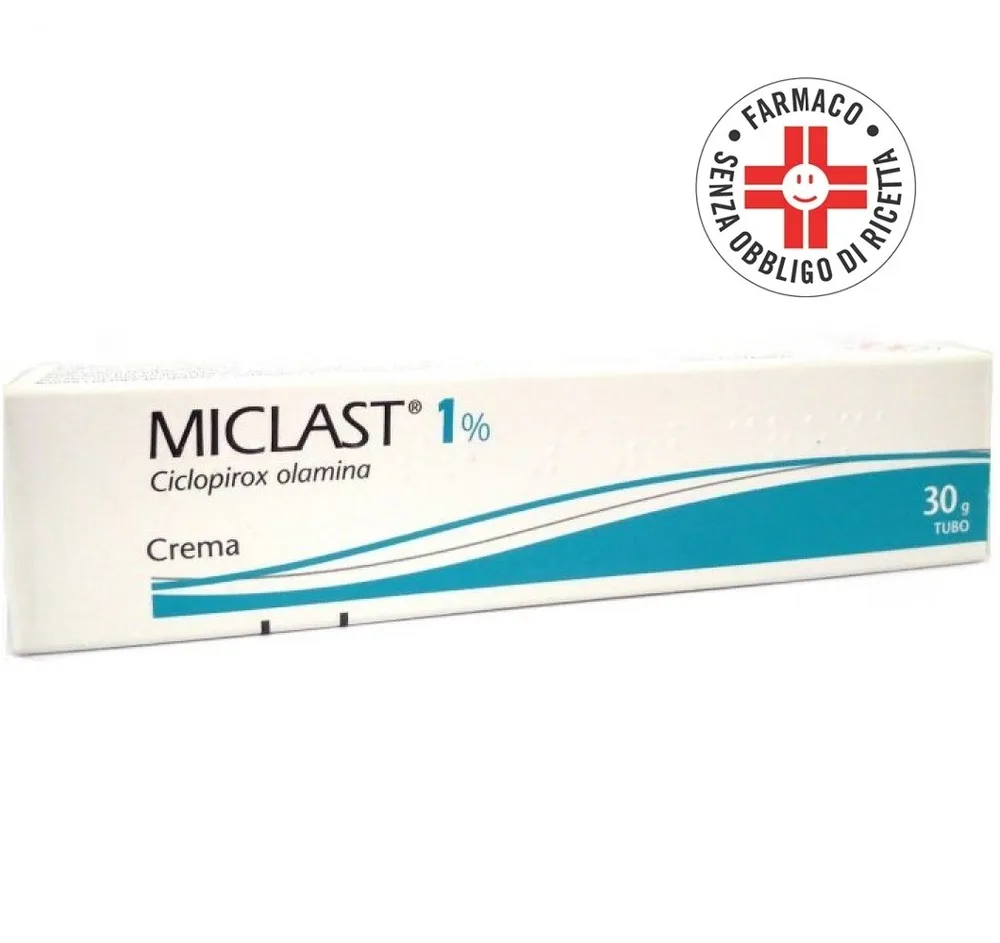
Table of Contents
- Package leaflet: Information for the user
- MICLAST 10 mg/g cream, 10 mg/g skin powder, 10 mg/ml skin solution
- 1. What MICLAST is and what it is used for
- 2. What you need to know before using MICLAST
- 3. How to use MICLAST
- 4. Possible side effects
- 5. How to store MICLAST
- 6. Package contents and other information
Package leaflet: Information for the user
MICLAST 10 mg/g cream, 10 mg/g skin powder, 10 mg/ml skin solution
Ciclopirox olamine
Please read this leaflet carefully before using this medicine because it contains
important information for you.
Always use this medicine exactly as described in this leaflet or as your doctor or
pharmacist has instructed you.
- Keep this leaflet. You may need to read it again.
- If you need more information or advice, consult your pharmacist.
- If you experience any side effects, including those not listed in this leaflet, contact your doctor or pharmacist. See section 4.
- Contact your doctor if you do not notice improvement or if you notice worsening of symptoms after a short period of treatment.
Contents of this leaflet:
- What MICLAST is and what it is used for
- What you need to know before using MICLAST
- How to use MICLAST
- Possible side effects
- How to store MICLAST
- Contents of the pack and other information
1. What MICLAST is and what it is used for
MICLAST contains the active substance ciclopirox olamine.
MICLAST belongs to a group of medicines called "antifungals".
MICLAST is used for certain fungal infections of the skin (cutaneous mycoses caused by
susceptible fungi).
2. What you need to know before using MICLAST
Do not use MICLAST
- if you are allergic to the active substance (ciclopirox olamine) or to any of the other ingredients of this medicinal product (listed in section 6);
- on wounds, in the case of MICLAST cutaneous powder.
Warnings and precautions
Talk to your doctor or pharmacist before using MICLAST.
Avoid contact with the eyes.
Use MICLAST with caution and under the direct supervision of your doctor:
- if you are currently being treated with other antifungal agents administered via routes other than the topical route (systemic antifungal treatment);
- if you have previously been diagnosed with severe immune system deficiencies (immunosuppression);
- if your immune system is compromised, as in the case of organ transplantation or HIV infection;
- if you are diabetic.
If you experience any allergic reaction, stop treatment immediately, carefully remove the product, and consult your doctor.
During treatment, carefully follow the hygiene measures recommended by your doctor and/or pharmacist.
If you have a Candida infection (a fungal infection), do not use acidic soap, as it may promote fungal growth.
Cream:
Avoid contact with mucous membranes.
Do not apply on wounds.
Other medicines and MICLAST
Inform your doctor or pharmacist if you are taking, have recently taken, or might take any other medicines.
Pregnancy and breastfeeding
If you are pregnant, think you may be pregnant, planning to become pregnant, or breastfeeding, consult your doctor or pharmacist before using this medicinal product.
Cream and cutaneous solution
Pregnancy
As a precautionary measure, it is preferable to avoid the use of MICLAST 10 mg/g cream and MICLAST 10 mg/ml cutaneous solution during pregnancy, as there are insufficient data on the use of ciclopirox olamine in pregnant women.
Breastfeeding
MICLAST 10 mg/g cream and MICLAST 10 mg/ml cutaneous solution should not be used during breastfeeding, as there is insufficient information on the excretion of ciclopirox olamine and its potential metabolites in breast milk. Therefore, a risk to newborns and infants cannot be excluded.
Cutaneous powder
MICLAST cutaneous powder may be used during pregnancy or breastfeeding.
Driving and using machines
MICLAST does not affect the ability to drive vehicles or operate machinery.
MICLAST cream contains cetyl alcohol, stearyl alcohol, benzyl alcohol, and polysorbate 60.
MICLAST cream contains:
- cetyl alcohol and stearyl alcohol, which may cause local skin reactions (e.g. contact dermatitis);
- 10 mg of benzyl alcohol per gram. Benzyl alcohol may cause allergic reactions and mild local irritation;
- polysorbates, which may cause allergic reactions.
3. How to use MICLAST
Use this medicine exactly as stated in this leaflet or as directed by your doctor or pharmacist. If you have any doubts, consult your doctor or pharmacist.
The different formulations allow the most suitable one to be chosen according to the judgment of the doctor and/or pharmacist, depending on the individual case.
Unless otherwise indicated by your doctor, the recommended dose is:
Cream:
Apply 2 or 3 times daily to the affected skin lesions and allow the preparation to dry.
Repeat treatment until the skin lesions have disappeared, which usually occurs within 2 weeks. To prevent recurrence, continue treatment for 1–2 weeks after the lesions have cleared.
The cream is particularly suitable for small, hairless areas.
Cutaneous powder:
Sprinkle once or twice daily on the affected areas and continue treatment until the skin lesions have disappeared. To prevent recurrence, continue treatment for 1–2 weeks after the lesions have cleared. Use the powder prophylactically and for disinfecting socks and shoes.
Cutaneous solution:
Apply 2–3 times daily, gently rubbing in, and repeat treatment until the skin lesions have disappeared, which usually occurs within 2 weeks. To prevent recurrence, continue treatment for 1–2 weeks after the lesions have cleared.
If you use more MICLAST than you should
Effects of overdose are not known.
If you forget to use MICLAST
Do not use a double dose to make up for the missed dose.
If you have any doubts about how to use this medicine, consult your doctor or pharmacist.
4. Possible side effects
Like all medicines, this medicine can cause side effects, although not everybody will experience them.
The following side effects may occur with the use of MICLAST:
Cream and topical solution
Common side effects (may affect up to 1 in 10 people)
- Transient worsening of symptoms at the application site
- Redness (erythema) or itching at the application site; these are mainly short-lived phenomena and treatment should not be discontinued
- Skin burning sensation
Uncommon side effects (may affect up to 1 in 100 people)
- Generalized allergic reactions (hypersensitivity) which may be severe, with symptoms including swelling (edema), itching, skin rash, itchy rash (urticaria), difficulty breathing (dyspnea)
- Blisters at the application site
If any of these side effects occur, treatment must be stopped immediately and you should contact your doctor as soon as possible.
Side effects with frequency not known (frequency cannot be estimated from the available data)
- Local skin inflammation, such as eczema and contact dermatitis
If you are undergoing prolonged treatment over large areas of skin, on wounds, on mucous membranes, or if using dressings that do not allow dispersion of the medicine (occlusive dressing), the risks related to the passage of the drug into the bloodstream should be taken into consideration: consult your doctor.
Topical powder
Side effects with frequency not known (frequency cannot be estimated from the available data)
- Skin inflammations, such as eczema and contact dermatitis; at the application site, local allergic skin reactions (hypersensitivity), redness (erythema), itching, irritation, and/or numbness (hypoesthesia) may occur.
Following the instructions provided in this leaflet reduces the risk of side effects.
Reporting of side effects
If you experience any side effect, including those not listed in this leaflet, talk to your doctor or pharmacist. You can also report side effects directly via the national reporting system at the following website:
https://www.aifa.gov.it/content/segnalazioni-reazioni-avverse
By reporting side effects, you can help provide more information on the safety of this medicine.
5. How to store MICLAST
Keep this medicine out of the sight and reach of children.
Do not use this medicine after the expiry date stated on the packaging.
The expiry date refers to the last day of that month.
Do not dispose of medicines via wastewater or household waste. Ask your pharmacist
how to dispose of medicines you no longer use. This will help protect the environment.
Cream:
Do not store above 30°C.
Do not use the medicine more than 3 months after first opening.
Cutaneous powder:
Do not store above 30°C.
Cutaneous solution:
No special storage conditions apply.
Do not use the medicine more than 1 month after first opening.
6. Package contents and other information
What MICLAST contains
MICLAST 10 mg/g cream
- The active substance is ciclopirox olamine. 1 g of cream contains 10 mg of ciclopirox olamine.
- The other components are: octyldodecanol, light liquid paraffin, stearyl alcohol, cetyl alcohol, myristyl alcohol, polysorbate 60 (E435), sorbitan stearate, benzyl alcohol (E1519), lactic acid (E270), purified water.
MICLAST 10 mg/g cutaneous powder
- The active substance is ciclopirox olamine. 1 g of cutaneous powder contains 10 mg of ciclopirox olamine.
- The other components are: anhydrous colloidal silica, pregelatinized corn starch.
MICLAST 10 mg/ml cutaneous solution
- The active substance is ciclopirox olamine. 1 ml of cutaneous solution contains 10 mg of ciclopirox olamine.
- The other components are: macrogol 400, isopropyl alcohol, purified water.
Description of the appearance of MICLAST and package contents
MICLAST is available in the following pharmaceutical forms:
Cream: tube containing 30 g of cream.
Homogeneous, odourless cream, whitish in colour.
Cutaneous powder: bottle containing 30 g (High-density polyethylene) of cutaneous powder with screw cap (High-density polyethylene).
Fine, homogeneous, practically white, free-flowing powder, free from lumps.
Cutaneous solution: bottle containing 30 ml (Low-density polyethylene) of cutaneous solution with spray pump and closed with a cap.
Clear liquid, colourless or slightly yellow.
Marketing Authorisation Holder and Manufacturer
Marketing Authorisation Holder
Pierre Fabre Italia S.p.A.
Via G. Washington, 70
20146 Milano - Italy
Manufacturer
Cream:
Pierre Fabre Médicament Production – Rue du Lycee Z.I. de Cuiry – 45500 Gien - France
Cutaneous powder:
Laboratoires M. Richard – Rue du Progrès ZI des Reys de Saulce – 26270 Saulce Sur Rhone -
France
Cutaneous solution:
Pierre Fabre Médicament Production – Rue du Lycee Z.I. de Cuiry – 45500 Gien - France