Mepivacaine Pierrel
Italy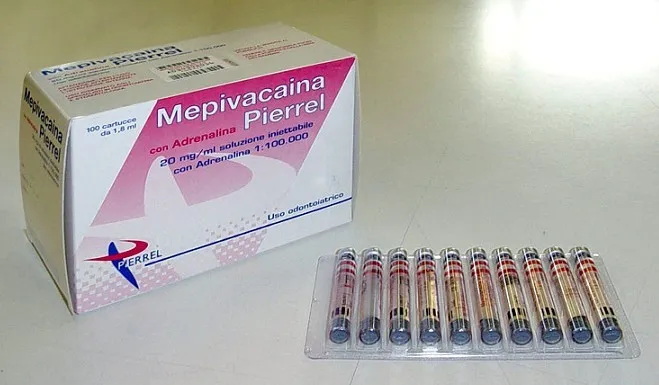
Table of Contents
PACKAGE LEAFLET
MEPIVACAINA PIERREL
30 mg/ml injectable solution, 100 cartridges of 1.8 ml
Composition
Mepivacaine 30 mg/ml injectable solution
Each ml of solution contains:
Active Substance:
Mepivacaine HCl 30.00 mg
Excipients:
Sodium chloride, water for injections.
Pharmaceutical form and packaging
Injectable solution.
The injectable solution is available in the following pack sizes:
Cardboard box containing 100 cartridges of 1.8 ml of mepivacaine 30 mg/ml.
Pharmacotherapeutic category
Injectable local anaesthetic for exclusive dental use.
Marketing Authorisation Holder
Pierrel S.p.A.
Strada Statale Appia 7 bis, 46/48 – 81043 Capua (CE)
Manufacturer
Pierrel S.p.A.
Strada Statale Appia 7 bis, 46/48 – 81043 Capua (CE)
Indications
Local and regional nerve block anaesthesia for stomatological and dental use.
Mepivacaine 30 mg/ml is useful in the anaesthetic treatment of patients in whom vasoconstrictors are contraindicated: severe hypertensives, coronary patients, diabetics.
Contraindications
Known hypersensitivity to the components.
It is contraindicated in cases where intolerance to other local anaesthetics of the same chemical group is known.
Administration of mepivacaine is contraindicated in: severe myasthenia gravis, low plasma cholinesterase levels, severe hepatic insufficiency.
Do not use in cases of confirmed or suspected pregnancy.
Appropriate precautions for use
Prior to use, the physician must verify the patient's health status and circulatory condition; he/she must also enquire about ongoing therapies and any previous allergic reactions. Any overdose of anaesthetic must be avoided, and two maximum doses must never be administered without an interval of at least 24 hours. In any case, the lowest doses and concentrations capable of achieving the desired effect should be used. The anaesthetic solution must be injected cautiously in small amounts, approximately 10 seconds after a preliminary aspiration. Especially when infiltrating highly vascularized areas, it is advisable to wait approximately 2 minutes before proceeding with the actual loco-regional block. The patient must be kept under close monitoring, and administration must be immediately suspended at the first sign of alarm (e.g. changes in consciousness).
Warning
It is essential to have immediate access to equipment, medications, and trained personnel for the management of emergencies, as rare but serious reactions, sometimes with fatal outcomes, have been reported following the use of local anaesthetics, even in the absence of individual hypersensitivity in the patient's history.
Local anaesthesia must be avoided in infected areas and in the presence of inflammation.
Interactions
No severe interactions with other drugs are known; however, the drug must be used with absolute caution in patients undergoing treatment with MAO inhibitors or tricyclic antidepressants.
Special warnings
Contraindicated in confirmed or suspected pregnancy.
Dosage, method and route of administration
Adults
1 to 3 cartridges of 1.8 ml per procedure, depending on the extent of the area to be anaesthetized and the injection technique used.
Disinfect the cartridge diaphragm before use with 70% ethyl alcohol or 90% pharmaceutical-grade isopropyl alcohol.
Cartridges must not be immersed in any type of solution.
It is advisable not to repeat administration in the same patient more than once a week.
Based on the above and considering the active substance concentration per cartridge, the maximum amount that may be administered in a single session should be calculated as follows:
Mepivacaine 30 mg/ml maximum dosage for administration of 3 cartridges of 1.8 ml.
Mepivacaine HCl: 3 x 54.00 mg = 162.00 mg
Equivalent to 2.7 mg/kg of anaesthetic for a 60 kg patient.
Under no circumstances should the dose exceed 300 mg of mepivacaine per session.
Children
Dosage will be determined according to age, extent of the procedure, and taking into account the child's weight.
The maximum recommended dose is 0.025 ml of anaesthetic solution per kg of body weight. The total dose must not exceed one cartridge per session.
The maximum dose of mepivacaine HCl in mg that can be administered to a child can be calculated as follows: child's weight (kg) x 1.33
Overdose
At the first sign of alarm, administration must be stopped immediately, the patient placed in a horizontal position, and airway patency ensured, administering oxygen in case of severe dyspnoea or performing artificial ventilation (Ambu bag). Respiratory stimulants should be avoided as they may worsen the condition by increasing oxygen consumption. Seizures, if they occur, may be controlled with intravenous diazepam at a dose of 10–20 mg; barbiturates are not recommended as they may exacerbate bulbar depression. Circulation may be supported by intravenous administration of appropriate doses of corticosteroids; diluted solutions of alpha-beta adrenergic agents with vasoconstrictor action (methoxamine, metaraminol, and others) or atropine sulphate may be added. Sodium bicarbonate, appropriately dosed, may be used intravenously as an anti-acidotic agent.
Undesirable effects
Undesirable effects may occur due to high plasma levels and hypersensitivity reactions.
Undesirable effects due to high plasma levels affecting both the CNS and the cardiovascular system have been described. CNS effects described include: excitation, tremors, disorientation, dizziness, mydriasis, increased metabolism and body temperature, and, at very high doses, trismus and convulsions; if the medulla oblongata is involved, there may be involvement of cardiovascular, respiratory, and emetic centres, with sweating, arrhythmias, hypertension, tachypnoea, bronchodilation, nausea, and vomiting. Peripheral cardiovascular effects include: bradycardia and vasodilation.
Allergic reactions mostly occur in hypersensitive individuals, but many cases have been reported even in the absence of known individual hypersensitivity in the patient's history. Local manifestations include various types of skin eruptions, urticaria, pruritus; general manifestations include bronchospasm, laryngeal oedema, and cardiorespiratory collapse due to anaphylactic shock.
If any other undesirable effects related to the use of this medicinal product occur, inform your doctor.
Expiry date
See the expiry date stated on the outer packaging.
This date refers to the product stored in its original, undamaged packaging under appropriate storage conditions.
Warning: do not use the product after this date.
KEEP OUT OF SIGHT AND REACH OF CHILDREN