Mepivacaine Guardant
Italy
Table of Contents
- PACKAGE LEAFLET
- MEPIVACAINA GUARDANT 20 mg/ml injectable solution
- 1. What Mepivacaina Guardant is and what it is used for
- 2. What you need to know before using Mepivacaine Guardant
- 3. How Mepivacaine Guardant will be administered to you
- 4. Possible side effects
- 5. How to store Mepivacaine Guardant
- 6. Package contents and other information
PACKAGE LEAFLET
MEPIVACAINA GUARDANT 20 mg/ml injectable solution
Mepivacaine hydrochloride
Please read all of this leaflet carefully before using this medicine because it contains important information for you.
- Keep this leaflet. You may need to read it again.
- If you have any questions, ask your doctor or pharmacist.
- This medicine has been prescribed for you only. Do not give it to other people, even if their symptoms are the same as yours, as it may be harmful.
- If you experience any side effects, including those not listed in this leaflet, tell your doctor or pharmacist. See section 4.
Contents of this leaflet:
- What Mepivacaina Guardant is and what it is used for
- What you need to know before using Mepivacaina Guardant
- How to use Mepivacaina Guardant
- Possible side effects
- How to store Mepivacaina Guardant
- Contents of the pack and other information
1. What Mepivacaina Guardant is and what it is used for
Mepivacaina Guardant contains the active substance mepivacaine hydrochloride, a medicine belonging to the group of local anaesthetic agents.
Mepivacaina Guardant is used to produce loss of sensation (anaesthetization) or numbness confined to a specific area of the body (local anaesthesia) in adults and children.
Mepivacaina Guardant is used in surgical procedures (general surgery, obstetrics and gynaecology, urology, ophthalmology, dermatology, otorhinolaryngology, and orthopaedics) or for pain relief (e.g. neuralgias) in general medicine and sports medicine (e.g. muscle strains).
2. What you need to know before using Mepivacaine Guardant
Do not use Mepivacaine Guardant:
- if you are allergic to the active substance or to any of the other ingredients of this medicine (listed in section 6); if you are allergic to other local anesthetics or similar substances;
- if you are pregnant or suspect you might be pregnant (see section Pregnancy and breastfeeding);
- if you suffer from porphyria, an inherited disease affecting red blood cell production;
- if you have heart rhythm disorders involving the electrical conduction from the atria to the ventricles (atrioventricular conduction);
- if you have uncontrolled epileptic seizures;
- if you have a history of malignant hyperthermia (dangerous, life-threatening increase in body temperature);
- in children under 4 years of age;
- by intravenous route.
Warnings and precautions
Talk to your doctor or pharmacist before receiving Mepivacaine Guardant.
Inform your doctor:
- if you are elderly or in generally poor health;
- if you suffer from heart diseases, especially if in shock, as local anesthetics may depress cardiac conduction;
- if you suffer from severe liver or kidney diseases;
- if you are taking class III antiarrhythmic drugs (e.g., amiodarone) for irregular heartbeat (see Other medicines and Mepivacaine Guardant). Your doctor may also perform ECG monitoring (electrocardiogram, a test to assess heart function);
- if you are taking antidepressant medications such as monoamine oxidase inhibitors (MAOIs) or tricyclic antidepressants like amitriptyline;
- if there is an infection at the injection site;
- in case of epidural, subarachnoid, or caudal anesthesia, especially if you suffer from neurological diseases, spinal deformities, sepsis, or hypertension.
Children
In children, Mepivacaine Guardant should be administered at appropriately reduced doses according to age and body weight.
Mepivacaine Guardant must not be administered to children under 4 years of age (see section 2. Do not use Mepivacaine Guardant).
Other medicines and Mepivacaine Guardant
Inform your doctor or pharmacist if you are taking, have recently taken, or might take any other medicines.
In particular, inform your doctor if you are taking:
- other local anesthetics or similar substances;
- medicines such as mexiletine, or class III antiarrhythmics (e.g., amiodarone), used to treat heart rhythm disorders;
- monoamine oxidase inhibitor (MAOI) drugs or tricyclic antidepressants, used to treat depression.
Pregnancy and breastfeeding
If you are pregnant, suspect you might be pregnant, planning a pregnancy, or breastfeeding, consult your doctor before receiving this medicine.
Pregnancy
Do not use Mepivacaine Guardant if you are pregnant or suspect you might be pregnant (see section 2. Do not use Mepivacaine Guardant).
Mepivacaine Guardant is not recommended during labor and delivery.
Breastfeeding
Like other local anesthetics, mepivacaine hydrochloride may pass into breast milk.
Driving and use of machinery
Local anesthetics may have a very slight effect on mental function and coordination and may temporarily impair movement and level of alertness.
Mepivacaine Guardant may impair your ability to drive vehicles and operate machinery.
Mepivacaine Guardant contains
This medicine contains 70.8 mg of sodium (the main component of table salt) per bag. This corresponds to 3.5% of the maximum daily recommended dietary intake for an adult.
3. How Mepivacaine Guardant will be administered to you
The dose will be determined by your doctor based on your body weight and your general health status.
Mepivacaine Guardant will be administered by a specialist doctor experienced in the use of this type of medicine, in appropriately equipped facilities, into the affected area of the body.
Mepivacaine Guardant must be administered as an injection.
Adult patients
The maximum dose in healthy adults (not pre-treated with sedatives), either as a single administration or as repeated administrations within less than 90 minutes, is 7 mg/kg, without ever exceeding 550 mg.
The total daily dose must never exceed 1000 mg.
Elderly patients
No adjustment of dose or frequency of administration is required.
Use in children
Mepivacaine Guardant must not be used in children under 4 years of age.
Dosage must be appropriately reduced in children (maximum dose 5–6 mg/kg).
If you are given more Mepivacaine Guardant than you should
It is highly unlikely that you will be given more solution than required, as your doctor will monitor you during treatment.
Accidental intravascular injection of local anaesthetics may cause immediate generalized adverse reactions (occurring within seconds to several minutes). In cases of excessive dosing, adverse effects appear later (15–60 minutes after injection) (see section 4 Possible side effects).
Symptoms of drug overdose are characterized by:
- tremors, double vision (diplopia), uncontrolled body movements (convulsions), followed by depression, respiratory failure and coma;
- cardiovascular disturbances with decreased blood pressure (hypotension) and reduced heart rate (bradycardia).
S,
4. Possible side effects
Like all medicines, this medicine can cause side effects, although not everyone experiences them.
The possible side effects after using Mepivacaine Guardant are largely similar to those of other local anaesthetics. If you experience any of the following serious side effects during administration of Mepivacaine Guardant, your doctor will immediately stop administering the medicine and provide appropriate treatment:
excitation, tremors, disorientation, dizziness, pupil dilation (mydriasis), increased metabolism and body temperature, and, at very high doses, prolonged contraction of the jaw muscles (trismus) and uncontrolled body movements (convulsions); sweating, disturbances in heart rhythm (arrhythmias), increased blood pressure (hypertension), increased respiratory rate (tachypnea), increased bronchial diameter (bronchodilation), nausea and vomiting, decreased heart rate (bradycardia) and increased diameter of blood vessels (vasodilation), various types of skin rashes, urticaria, pruritus, bronchospasm, swelling of the larynx, and cessation of blood circulation and breathing (cardiorespiratory collapse) caused by a severe allergic reaction (anaphylactic shock).
The following is a list of possible side effects according to the frequency below:
Common (may affect up to 1 in 10 people)
- increased diameter of blood vessels (vasodilation)
- reduction or increase in blood pressure (hypertension)
- nausea
- vomiting
- numbness (paraesthesia), dizziness
- decreased heart rate (bradycardia)
Uncommon (may affect up to 1 in 100 people)
reduction in central nervous system activity (with convulsions; excitement;
numbness around the mouth area (circumoral paraesthesia);
tongue numbness; increased sensitivity to sounds (hyperacusis); visual disturbances; loss of consciousness; drowsiness; tremor; prolonged contraction of the jaw muscles (trismus); ringing in the ears (tinnitus); difficulty speaking (dysarthria); depression
- anxiety, disorientation
Rare (may affect up to 1 in 1,000 people)
- nerve disease (neuropathy)
- nerve injury
- inflammation of a meninge, the lining of the brain (arachnoiditis)
- allergic reactions such as various types of skin rashes, urticaria, pruritus, transient
- narrowing of the bronchi preventing air passage into the lungs (bronchospasm)
- swelling of the larynx, the organ where voice is produced (laryngeal oedema)
- increased respiratory rate (tachypnea), increased bronchial diameter facilitating air passage into the lungs (bronchodilation)
- respiratory depression
- double vision (diplopia), pupil dilation (mydriasis)
- heart problems up to cardiac arrest, arrhythmia
- sweating
- increased metabolism and body temperature
Reporting of side effects
If you experience any side effect, including those not listed in this leaflet, talk to your doctor or pharmacist. You may also report side effects directly via the national reporting system at https://www.aifa.gov.it/content/segnalazioni-reazioni-avverse. By reporting side effects, you can help provide more information on the safety of this medicine.
5. How to store Mepivacaine Guardant
Keep this medicine out of the sight and reach of children.
Do not use this medicine after the expiry date stated on the carton after “Exp:”.
The expiry date refers to the last day of that month.
Store below 25°C.
MEPIVACAINA GUARDANT must be used immediately after opening the bag and for a single
administration only; after use, the container (and any remaining medicine) must be discarded, even if partially used.
Do not dispose of medicines via wastewater or household waste. Ask your pharmacist how to dispose of medicines no longer required. This will help protect the environment.
6. Package contents and other information
What Mepivacaine Hydrochloride contains
- The active substance is mepivacaine hydrochloride 20 mg.
- The other components are:
- Sodium chloride,
- Water for injections,
- Sodium bicarbonate
Description of the appearance of Mepivacaine Guardant and contents of the pack
Injectable solution.
Pack containing 50 bags of 20 ml of solution at 20 mg/ml.
MARKETING AUTHORISATION HOLDER AND MANUFACTURER
Marketing Authorisation Holder
Guardant S.r.l. Via Pietro Campana, 4 – 00044 Frascati (RM)
MANUFACTURER
Infomed Fluids Srl Bdul Theodor Pallady, 50 – Sector 3, Bucharest- 032266- Romania
The following information is intended exclusively for physicians or healthcare professionals:
The physician must have undergone complete and adequate training in the technique to be used and must be experienced in the diagnosis and treatment of adverse reactions, systemic toxicity, or other complications. In patients undergoing major nerve block or receiving high doses of the drug, an intravenous catheter should be inserted prior to administration of the local anesthetic.
Before use, the physician must assess the patient's physical condition.
The anesthetic solution should be injected slowly, after approximately 10 seconds of initial aspiration, with frequent aspirations throughout. Especially when infiltrating highly vascularized areas, it is advisable to wait approximately two minutes before proceeding with the actual locoregional block.
Any overdose of local anesthetic must be avoided, and two maximum doses must never be administered without an interval of at least 24 hours, for example, when a peripheral block fails for technical reasons.
It is good practice to use the lowest doses and concentrations capable of achieving the desired effect, taking into account the patient's age, weight, and physical condition.
Repeated administration of doses may lead to significant increases in plasma levels due to accumulation of mepivacaine or its metabolites.
Drowsiness is the first sign of elevated plasma levels and may occur even in cases of rapid absorption or accidental intravenous injection.
Some local anesthetic techniques may be associated with severe adverse effects, such as:
- Central nervous block: may cause cardiovascular depression, especially in the presence of hypovolemia;
- Retrobulbar and peribulbar injections: very rarely, may reach the cerebral subarachnoid space, causing temporary blindness, cardiovascular collapse, apnea, seizures, etc. Such reactions must be diagnosed and treated immediately. In addition, there is a risk of persistent ocular muscle dysfunction. Primary causes include trauma and/or local toxic effects on muscles and/or nerves. The severity of tissue reactions is related to the extent of trauma, the concentration of local anesthetic, and the duration of tissue exposure to the local anesthetic. As with all local anesthetics, it is therefore necessary to use the lowest doses and concentrations capable of achieving the desired effect. Vasoconstrictors may worsen tissue reactions and should only be used when indicated.
- Accidental intra-arterial injections in the cranial and cervical regions may cause severe symptoms even at low doses.
- Epidural anesthesia: may cause hypotension and bradycardia. The risk can be reduced by preloading the circulation with crystalloid or colloid solutions. Hypotension must be treated immediately with administration, possibly repeated, of a sympathomimetic agent such as ephedrine 5–10 mg intravenously.
DOSAGE, METHOD AND TIME OF ADMINISTRATION
The maximum dose in healthy adults (not pre-treated with sedatives), administered as a single dose or repeated doses within less than 90 minutes, is 7 mg/kg, without ever exceeding 550 mg.
The total daily dose must never exceed 1000 mg; in pediatric patients, do not exceed 5–6 mg/kg.
Dosage should be appropriately reduced in children and critically ill patients (maximum dose 5–6 mg/kg).
When prolonged block is used, for example through repeated administrations, the risk of reaching toxic plasma concentrations and inducing local neural injury must be evaluated.
To avoid intravascular administration, repeated aspiration before and during injection of the main dose is necessary. The dose should be injected slowly or in incremental doses, with careful monitoring of vital functions and maintenance of verbal contact with the patient.
Accidental intravascular administration may be recognized by a transient increase in heart rate, while accidental intrathecal administration may be identified by signs of spinal block.
If signs of toxicity occur, the injection must be immediately stopped.
Recommended doses:
Surgery
- Epidural and caudal block: up to 400 mg (equivalent to 20 ml of solution).
- Paravertebral block: up to 400 mg (equivalent to 20 ml of solution) for paravertebral block of somatic nerves. N.B. A 1% solution is recommended for stellate ganglion block and autonomic blocks: therefore, Mepivacaine Guardant is not suitable.
- Cervical, brachial, intercostal, paracervical, pubic, and nerve terminal peripheral nerve blocks: up to 400 mg (equivalent to 20 ml of solution), depending on the area and extent of the block.
- Intra-articular infiltration: up to 100 mg per joint to be anesthetized (equivalent to 5 ml of solution).
- Skin "barrier" infiltration: up to 300 mg (equivalent to 15 ml of solution). Obstetrics
- Paracervical block: up to 200 mg (equivalent to 10 ml of solution) per side. Analgesic therapy
- Trigger point block: up to 40 mg (equivalent to 2 ml of solution) per point, with a maximum total dose of 300 mg (equivalent to 15 ml of solution).
In the absence of specific compatibility data, MEPIVACAINA GUARDANT must not be mixed with other substances.
Instructions for use of the bag
The MEPIVACAINA GUARDANT bag has two access ports (Fig. 1) allowing withdrawal of the solution in two different ways:
a) a "luer-stick" type connector enabling withdrawal using a syringe with a needle (Fig. 2);
b) a "male luer-lock" type connector equipped with a manually breakable valve (Fig. 3), enabling withdrawal using a needle-free device (Fig. 4).
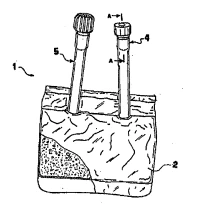
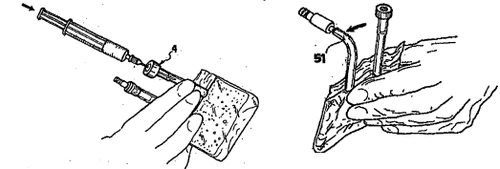
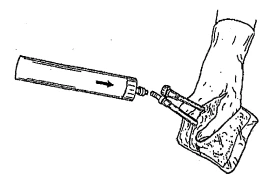
Fig. 1 Fig. 2 Fig. 3 Fig. 4