Menjugate
Italy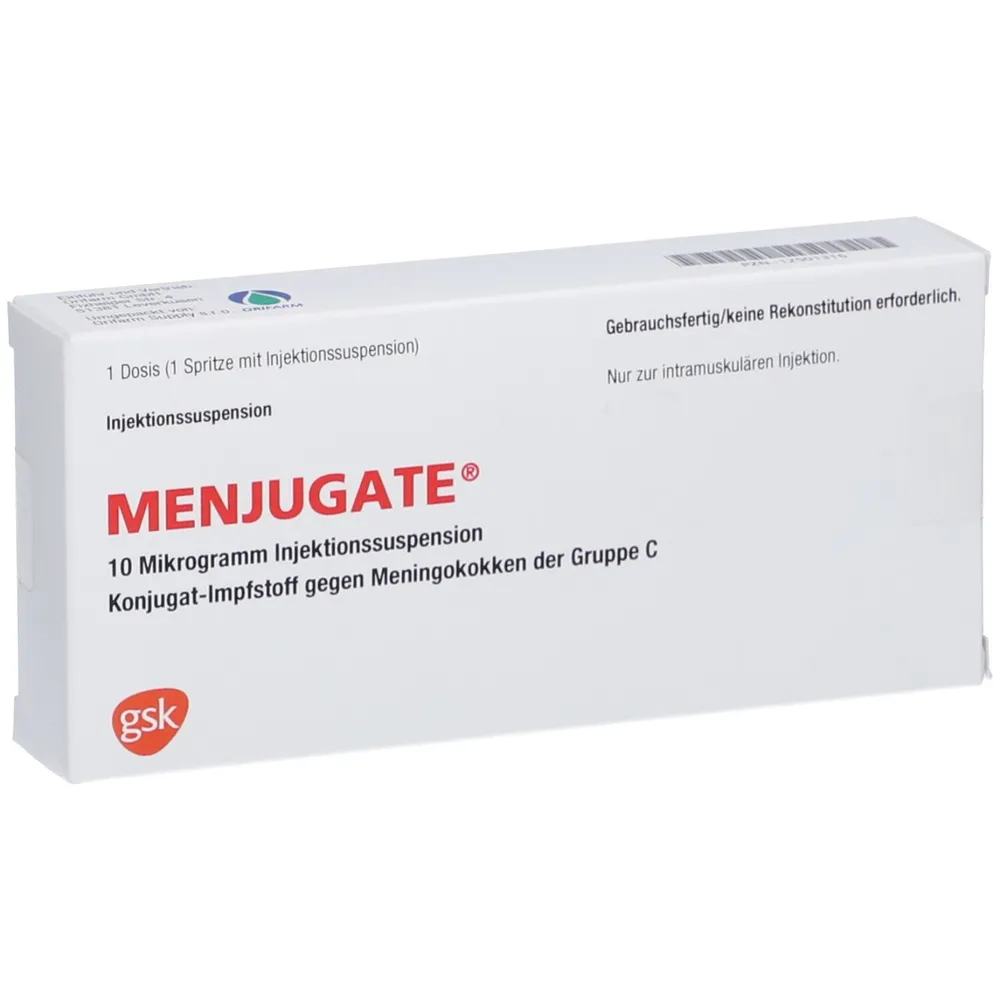
Table of Contents
- Package leaflet: Information for the user
- MENJUGATE 10 micrograms injectable suspension
- 1. What Menjugate is and what it is used for
- 2. What you should know before using Menjugate for yourself or your child
- 3. How to use Menjugate
- 4. Possible side effects
- 5. How to store Menjugate
- 6. Package contents and other information
- The following information is intended for healthcare professionals only:
Package leaflet: Information for the user
MENJUGATE 10 micrograms injectable suspension
Meningococcal group C conjugate vaccine
Please read all of this leaflet carefully before this medicine is administered to you or your child because it contains important information for you.
- Keep this leaflet. You may need to read it again.
- If you have any questions, ask your doctor or nurse.
- This vaccine has been prescribed only for you or your child. Do not give it to others.
- If you or your child experience any adverse reaction, including those not listed in this leaflet, tell your doctor or nurse. See section 4.
Contents of this leaflet:
- What Menjugate is and what it is used for
- What you need to know before receiving Menjugate for yourself or your child
- How to use Menjugate
- Possible side effects
- How to store Menjugate
- Contents of the pack and other information
1. What Menjugate is and what it is used for
Menjugate is a vaccine used to prevent disease caused by the bacterium Neisseria meningitidis
group C (also known as meningococcus group C). The vaccine works by stimulating the body to produce
its own protection (antibodies) against these group C meningococcal bacteria.
Neisseria meningitidis group C can cause serious infections that may sometimes be life-threatening, such as meningitis and septicaemia (blood infection).
This vaccine is used for active immunisation of infants from the age of 2 months, adolescents and
adults, and provides protection only against group C meningococcal bacteria. It does not protect against other groups (strains) of meningococcal bacteria or against other agents that may cause meningitis or septicaemia (blood infection). If at any time you or your child experiences neck pain or stiffness, discomfort caused by light (photophobia), drowsiness or confusion, or red or purple rash-like spots on the skin resembling bruises that do not fade when pressed, you must contact your doctor or the nearest Emergency Department immediately.
This vaccine cannot cause meningitis type C (disease caused by group C meningococcus).
This vaccine contains a protein (called CRM197) from the bacterium that causes diphtheria. Menjugate does not
protect against diphtheria. This means that you (or your child) must receive a different vaccine to be protected against diphtheria, as recommended by the vaccination schedule or advised by your doctor.
2. What you should know before using Menjugate for yourself or your child
Do not use Menjugate if you or your child:
- have previously had an allergic reaction to the active substances or to any of the other components of Menjugate (listed in section 6)
- have previously had an allergic reaction to diphtheria toxoid (a substance also present in other vaccines).
Warnings and precautions
Fainting, feeling faint, or other stress-related reactions may occur in response to needle injection. Inform your doctor or nurse if you (or your child) have previously experienced such reactions.
Consult your doctor or nurse before Menjugate is administered to you or your child if you or your child:
- have haemophilia or any other condition that impairs normal blood clotting (for example, a low platelet count known as thrombocytopenia), or are taking medications that may affect blood coagulation
- have a weakened immune system for any reason (for example, if you or your child do not produce antibodies effectively, or if you or your child are taking medicines that reduce the immune response to infections, such as anticancer drugs or high-dose corticosteroids)
- are receiving treatment that blocks the part of the immune system known as complement activation, such as eculizumab. Even after vaccination with Menjugate, you remain at increased risk of disease caused by Neisseria meningitidis group C bacteria
- have had their spleen removed or have been told that your spleen is not functioning properly
- have an infectious disease or high fever. In such cases, vaccination with Menjugate may need to be postponed. However, a minor infection (for example, a cold) is not a reason to delay vaccination
- are over 65 years of age
- have a kidney disease involving high levels of protein in the urine (called nephrotic syndrome). Cases of recurrence of this syndrome have been reported after vaccination. This vaccine provides protection only against Neisseria meningitidis group C bacteria. It does not protect against other types of meningococcal bacteria.
Latex-sensitive individuals and prefilled syringe presentation:
Although natural rubber latex has not been detected in the syringe cap, the safety of Menjugate in latex-sensitive individuals has not been established.
Other medicines and Menjugate
Inform your doctor or nurse if you (or your child) are taking, have recently taken, or might take any other medicines.
Menjugate may be administered simultaneously with other vaccines; however, in such cases, other injectable vaccines should be administered at a different injection site, preferably in a different arm or leg from the site used for Menjugate.
These vaccines include:
- oral or injectable Poliomyelitis vaccine
- Diphtheria and Tetanus vaccine, alone or combined with vaccines against Pertussis
- Haemophilus influenzae type b (Hib) vaccine
- Hepatitis B vaccine administered alone or in combination with combined vaccines against Diphtheria, Tetanus, Haemophilus influenzae type b, Poliomyelitis, and Pertussis
- combined Measles, Mumps, and Rubella (MMR) vaccine
- conjugate Pneumococcal vaccine
These other vaccines should be administered at the recommended ages as usual.
Pregnancy and breastfeeding
If you are pregnant, suspect you may be pregnant, planning to become pregnant, or are breastfeeding, ask your doctor or nurse for advice before receiving Menjugate. Your doctor or nurse may still recommend that you receive Menjugate if you are at high risk of contracting group C meningococcal infection.
Driving and using machines
You may experience dizziness or other adverse effects after the injection. This may impair your ability to drive or operate machinery. Do not drive or use machinery until you know how Menjugate affects you.
Menjugate contains:
This medicine contains less than 1 mmol (23 mg) of sodium per dose, i.e., essentially “sodium-free”.
3. How to use Menjugate
Menjugate will be administered by a doctor or nurse.
The vaccine is usually given into the muscle of the thigh in infants and young children, and into the muscle of the shoulder in older children, adolescents and adults.
The doctor or nurse will take care not to administer the vaccine into a blood vessel and will ensure that it is injected into the muscle and not into the skin tissue.
For children aged 12 months and older, adolescents and adults: a single dose (0.5 ml) of the vaccine is recommended.
For infants and young children aged between 2 and 12 months: two doses of Menjugate should be administered, with an interval of at least two months between them.
To maintain protection, children who have completed the primary vaccination course with two doses should subsequently receive a booster dose. Your doctor will inform you when this booster dose should be given to your child.
For information on handling the vaccine, see the section for doctors and healthcare professionals at the end of this leaflet.
If you use more Menjugate than you should
Since Menjugate will be administered by a doctor or nurse and each injection consists of a single dose of 0.5 ml, it is highly unlikely that you (or your child) will receive an excessive dose of the vaccine.
If you have any doubts about the amount of vaccine administered to you (or your child), speak with the doctor or nurse.
If you have any questions about the use of this medicine, consult your doctor or nurse.
4. Possible side effects
Like all medicines, Menjugate can cause side effects, although not everybody gets them.
If a severe allergic reaction occurs (usually in fewer than 1 in 10,000 people), report it immediately to your doctor or go immediately/take your child to the nearest Emergency Department, as urgent medical help may be needed.
Symptoms of a severe allergic reaction may include:
- swelling of the lips, mouth, or throat (which may cause difficulty swallowing)
- difficulty breathing with wheezing or coughing
- skin rash and swelling of hands, feet, and ankles
- loss of consciousness
- very low blood pressure.
These very rare reactions may occur immediately or shortly after injection and usually resolve rapidly if appropriate treatment is administered.
Other allergic-type reactions may begin several days after vaccination. These include:
- skin rashes, sometimes with itching, or purple spots or patches on the skin
- blistering skin rashes which may also cause mouth ulcers and sores around the genital area.
The most commonly reported side effects during clinical studies generally lasted one or two days and were generally not serious. These side effects were:
Very common (may affect more than 1 in 10 people)
- In all age groups: redness, swelling, and tenderness/pain at the injection site. These reactions generally did not require further medical treatment. Redness or swelling of at least 3 cm and tenderness severe enough to impair movement were rarely observed for longer than 48 hours.
- Infants and young children: feeling unwell (vomiting).
- Infants, young children, and children up to 2 years of age: irritability, drowsiness, sleep disturbances, loss of appetite, and diarrhoea.
- School-aged children: headache.
- Older children and adults: muscle and joint pain, general malaise.
- Adults: feeling unwell (nausea).
Common (may affect up to 1 in 10 people)
- In all age groups: fever (but rarely severe)
- Infants, young children, and children up to 2 years of age: crying
- Children up to 2 years of age: feeling unwell (vomiting)
- Primary school-aged children: headache
Other side effects reported during routine vaccination programmes include:
Very rare (may affect up to 1 in 10,000 people)
Various age groups:
- Enlargement of lymph nodes
- Dizziness
- Fainting
- Numbness
- Tingling or prickling sensation
- Temporary reduction in muscle tone
- Visual disturbances and light sensitivity. These events generally occurred together with headache and dizziness
- Extensive swelling of the vaccinated limb.
Although seizures have been very rarely reported after vaccination with Menjugate, in some cases occurring in adolescents and adults, these are believed to have been fainting episodes. In infants, young children, and younger children, seizures were generally associated with high fever. Most patients recovered rapidly.
Very rare cases of relapse of a kidney condition called nephrotic syndrome have been reported following administration of this type of vaccine.
In infants born very prematurely (at 28 weeks of gestation or earlier), episodes of prolonged breathing pauses (apnoea) may occur for two to three days after vaccination.
Reporting of side effects
If you or your child experience any side effect, including those not listed in this leaflet, talk to your doctor or nurse. You can also report side effects directly via the national reporting system.
By reporting side effects, you can help provide more information on the safety of this medicine.
5. How to store Menjugate
Keep this vaccine out of the sight and reach of children.
Do not use Menjugate after the expiry date stated on the carton.
The vaccine consists of a vial or a syringe.
Store in a refrigerator (2°C - 8°C). Do not freeze. Keep the vial or syringe in the outer packaging to protect the medicine from light.
Do not dispose of any medicine via wastewater or household waste. Ask your doctor or nurse how to dispose of medicines you no longer use. This will help protect the environment.
6. Package contents and other information
What Menjugate contains
Each 0.5 ml dose of vaccine contains the following amount of active substance:
10 micrograms of oligosaccharide from Neisseria meningitidis group C (strain C11) chemically
conjugated to 12.5 – 25 micrograms of CRM197 protein from Corynebacterium diphtheriae.
The active ingredient is adsorbed onto aluminium hydroxide (0.3 – 0.4 mg Al) in 0.5 ml (1 dose) of vaccine.
The other ingredients are: sodium chloride, histidine and water for injections (see also the end of
paragraph 2).
Description of the appearance of Menjugate and contents of the pack
Menjugate is an injectable suspension.
Each dose of Menjugate is available as:
- A vial containing a white, opalescent suspension, or
- A syringe containing a white, opalescent suspension
Packs: 1, 5 and 10 doses. Not all pack sizes may be marketed.
Marketing Authorisation Holder and Manufacturer
Marketing Authorisation Holder: GSK Vaccines S.r.l., Via Fiorentina 1, 53100
Siena, Italy
Manufacturer: GSK Vaccines S.r.l., Bellaria-Rosia, 53018 Sovicille (SI), Italy
The following information is intended for healthcare professionals only:
Syringe:
Gently shake the syringe containing the vaccine before administration. Remove the syringe cap and attach a suitable needle. Before administration, visually inspect the vaccine for the presence of particles or discoloration. Before injecting the vaccine, ensure that no air bubbles are present in the syringe. If foreign particles or changes in physical appearance are observed, discard the vaccine.
Vial:
Gently shake the vial containing the vaccine. Using a syringe and a suitable needle (21 G, 40 mm long), withdraw the entire contents of the vial. Before injection, replace the needle with one appropriate for administration. Before administration, visually inspect the vaccine for the presence of particles or discoloration. Before injecting the vaccine, ensure that no air bubbles are present in the syringe. If foreign particles or changes in physical appearance are observed, discard the vaccine.