Melphalan Tillomed
Italy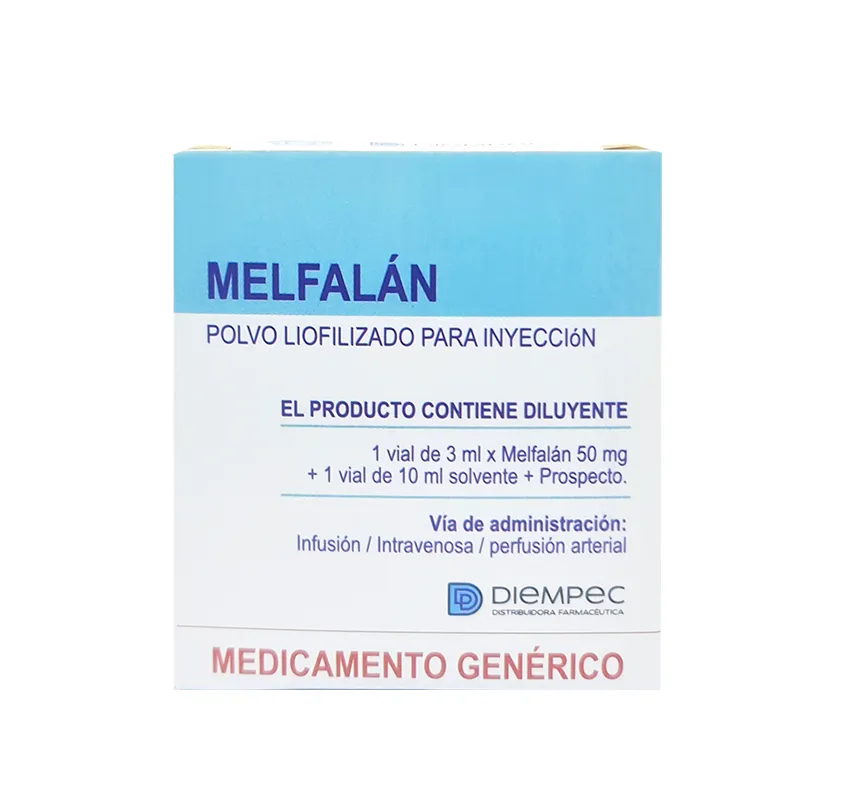
Table of Contents
- Package leaflet: information for the patient
- Melfalan Tillomed 50 mg powder and solvent for injectable solution/infusion
- 1. What Melfalan Tillomed is and what it is used for
- 2. What you should know before taking Melfalan Tillomed
- 3. How Melfalan Tillomed is administered
- 4. Possible side effects
- 5. How to store Melfalan Tillomed
- 6. Package contents and other information
PACKAGE LEAFLET
Package leaflet: information for the patient
Melfalan Tillomed 50 mg powder and solvent for injectable solution/infusion
Melfalan
Equivalent medicine
Please read this leaflet carefully before using this medicine because it contains important information for you.
- Keep this leaflet. You may need to read it again.
- If you have any questions, consult your doctor, pharmacist, or nurse.
- If you experience any side effects, including those not listed in this leaflet, contact your doctor or pharmacist. See section 4.
Contents of this leaflet
- What Melfalan Tillomed is and what it is used for
- What you need to know before being administered Melfalan Tillomed
- How Melfalan Tillomed is administered
- Possible side effects
- How to store Melfalan Tillomed
- Contents of the pack and other information
1. What Melfalan Tillomed is and what it is used for
Melfalan Tillomed contains a medicine called melphalan which belongs to a group of medicines
called alkylating agents (also known as chemotherapy). Melfalan Tillomed is used to treat
cancer. It works by reducing the number of abnormal cells produced by your body.
Melfalan Tillomed is used for:
- Multiple myeloma – a type of cancer that develops from cells in the bone marrow called plasma cells. Plasma cells help fight infections and diseases by producing antibodies
- Advanced ovarian cancer
- Neuroblastoma in childhood – a cancer of the nervous system
- Malignant melanoma – a type of skin cancer
- Soft tissue sarcoma – a cancer of the muscles, fat, fibrous tissue, blood vessels, and other connective tissues of the body.
2. What you should know before taking Melfalan Tillomed
Do not use Melfalan Tillomed
- If you are allergic (hypersensitive) to melphalan or to any of the other ingredients of this medicine listed in section 6.
- If you have severe reduction in blood cell formation in the bone marrow (severe bone marrow suppression [white blood cells <2000/mm³, platelets <50,000/mm³]).
- If you are pregnant, especially during the first 3 months.
- If you are breastfeeding.
If you have any doubts, consult your doctor or nurse before being treated with Melfalan Tillomed.
Warnings and precautions
Inform your doctor or nurse before taking Melfalan Tillomed:
- If you have undergone radiotherapy or chemotherapy, currently or recently
- If you have kidney problems
- If you are about to be vaccinated or have recently been vaccinated. Indeed, some vaccines (e.g., for polio, measles, mumps, rubella) may cause you an infection if administered during treatment with Melfalan Tillomed
Melfalan Tillomed will be prescribed by a specialist experienced in the treatment of blood disorders or cancer.
Local tissue damage may occur. Therefore, it must not be injected directly into a peripheral vein.
Since Melfalan Tillomed strongly suppresses blood cell formation in the bone marrow, your doctor will closely monitor your blood counts and, if necessary, interrupt treatment if blood cell counts are too low.
Like other alkylating agents, Melfalan Tillomed may also cause leukemia. The risk of leukemia should be weighed against the therapeutic benefit of melphalan treatment.
Melphalan has a mutagenic effect. Therefore, men treated with melphalan should be advised not to father children during treatment with melphalan and for up to 6 months afterwards, and to consult a sperm bank before starting treatment.
Other medicines and Melfalan Tillomed
Inform your doctor or pharmacist if you are taking, have recently taken, or might take any other medicines. In particular, inform your doctor or nurse if you are taking any of the following medicines:
- Vaccines containing live organisms (see "Warnings and precautions"), as this may lead to potentially dangerous vaccine-related reactions.
- Other cytotoxic medicines (chemotherapy)
- Nalidixic acid (an antibiotic used to treat urinary tract infections): when administered with high-dose intravenous melphalan, it may cause inflammation of the intestinal lining and lead to bleeding in children.
- Cyclosporine (used to prevent rejection of transplanted organs or tissues, or to treat certain skin conditions such as psoriasis and eczema, or to treat rheumatoid arthritis): may impair kidney function.
Pregnancy, breastfeeding and fertility
If you are pregnant, suspect you may be pregnant, are planning a pregnancy, or are breastfeeding, ask your doctor or pharmacist for advice before taking this medicine.
Pregnancy
Treatment with Melfalan Tillomed is not recommended during pregnancy as it may cause permanent harm to the fetus. This applies to both men and women. However, if treatment with Melfalan Tillomed is necessary, you should be informed about the risk of adverse effects in the child.
Breastfeeding
Do not breastfeed during treatment with Melfalan Tillomed. Consult your doctor or midwife.
Fertility
Melfalan Tillomed may damage sperm or eggs. Reliable contraceptive precautions must be taken while you or your partner are being treated with this injection and for at least six months afterwards to avoid pregnancy. Consult your doctor.
Driving and using machines
No studies have been conducted on the effects of Melfalan Tillomed on the ability to drive vehicles or operate machinery. Consult your doctor before driving or using tools or machines, as the amount of alcohol contained in the medicine may impair your ability to drive and use machinery.
Melfalan Tillomed contains sodium
This medicine contains 53.3 mg of sodium (the main component of table salt) per vial. This corresponds to 23% of the maximum daily dietary intake recommended for an adult.
Melfalan Tillomed contains ethanol
This medicine contains 5% ethanol by volume, i.e. up to 424.3 mg per dose, equivalent to 4.79 ml of beer or 1.99 ml of wine per dose. This amount may be harmful to the health of alcoholics. This should be taken into account in pregnant or breastfeeding women, children, and high-risk groups such as patients with liver disease or epilepsy.
Melfalan Tillomed contains propylene glycol
The propylene glycol contained in this medicine may produce effects similar to those of alcohol consumption and may increase the likelihood of side effects. Do not use this medicine in children under 5 years of age. Use this medicine only if recommended by your doctor. Your doctor may perform additional monitoring during treatment.
3. How Melfalan Tillomed is administered
Melfalan Tillomed must be prescribed only by specialists experienced in the treatment of
blood disorders or cancer.
Method of administration:
Melfalan Tillomed can be administered:
- as an injection/infusion into a vein
- as a perfusion into a specific part of the body through an artery
Melfalan Tillomed is administered after reconstitution with the solvent contained in the vial provided. Further dilution must be performed only with 0.9% m/v sodium chloride infusion solutions. Melfalan Tillomed is not compatible with infusion solutions containing dextrose.
Extravasation (leakage from blood vessels) must be avoided, as local tissue damage may occur.
Therefore, it must not be injected directly into a peripheral vein. If necessary, your doctor will
administer Melfalan Tillomed via a central venous access.
Your doctor will decide how much Melfalan Tillomed you will receive. The dose of Melfalan Tillomed depends on:
- your body weight or body surface area (a specific measure that takes into account your weight and height)
- other medicines you are taking
- your disease
- your age
- whether you have kidney problems
During treatment with Melfalan Tillomed, your doctor will perform regular blood tests. This
is necessary to monitor blood cell counts. Your doctor may occasionally adjust your dose based on the results of these tests.
Thromboembolic events
Thromboembolic events occur when a blood clot (thrombus) forms in a blood vessel, detaches, and is carried by the bloodstream until it blocks another vessel. The clot may obstruct a blood vessel in the lungs (pulmonary embolism), brain (stroke), gastrointestinal tract, or kidneys.
You will receive thromboprophylaxis (preventive treatment to reduce the risk of blood clot formation) for at least the first 5 months of treatment, especially if you have additional thrombogenic risk factors. Your doctor will decide, after careful assessment of risk factors, which actions to take.
Inform your doctor immediately if a thromboembolic event occurs, as treatment must be discontinued and standard anticoagulant therapy must be initiated. Your doctor will decide whether to restart treatment with the original dose of melphalan in combination with lenalidomide and prednisone or thalidomide and prednisone or dexamethasone once the thromboembolic event has been managed.
You must continue anticoagulant therapy during treatment with melphalan.
Use in children and adolescents
There is insufficient experience regarding use in children and adolescents. Dose recommendations cannot be provided.
Elderly patients
Melfalan Tillomed is frequently used at conventional dosages in elderly patients. However, specific experience in this patient group is limited.
Before receiving high-dose intravenous treatment, your doctor will ensure that you are in adequate general condition and have sufficient organ function.
High-dose therapy must not be performed with the maximum melphalan dose of 200 mg/m² in patients over 70 years of age, as unacceptably high mortality has been observed at this dose.
If you have renal impairment, blood urea levels may temporarily increase during melphalan treatment and may lead to spinal cord damage. Therefore, your doctor will closely monitor your blood urea levels.
Your doctor will determine the duration of treatment.
If you are given more Melfalan Tillomed than you should:
Your doctor will administer Melfalan Tillomed, so it is unlikely that you will receive an overdose. If you think you have been given too high a dose or have missed a dose, inform your doctor or nurse.
Contact your doctor if you feel that the effect of Melfalan Tillomed 50 mg injection is too strong or too weak.
If you have any questions about the use of this medicine, ask your doctor, pharmacist, or nurse.
4. Possible side effects
Like all medicines, this medicine can cause side effects, although not everyone experiences them.
Very common side effects (may affect more than 1 in 10 people):
- Reduced production of blood cells in the bone marrow, leading to lower numbers of circulating blood cells (red and white blood cells) and platelets, increasing the risk of infections. Gastrointestinal intolerance such as nausea or vomiting, diarrhoea, and inflammation of the oral mucosa at high doses. With high intravenous doses, vomiting, diarrhoea, and inflammation of the oral mucosa may become dose-limiting. Pre-treatment with cyclophosphamide may reduce gastrointestinal and intestinal symptoms. Hair loss at high doses.
- Muscle atrophy, proliferation of connective tissue in muscle tissue, muscle pain, increased blood levels of the enzyme creatine phosphokinase.
- Subjective and transient sensation of warmth and/or tingling after administration of high doses via a central venous catheter. Blood values must be closely monitored. If there are early signs of a sudden drop in blood counts, treatment with melphalan should be discontinued. However, blood values may continue to decline even after treatment has ended.
Common side effects (may affect less than 1 in 10 people):
- Acute leukaemia (a blood cancer) may occur, generally after a long period following the end of treatment, particularly in elderly patients after long-term use in combination therapy and following radiotherapy.
- Hair loss at conventional doses.
- Localized, painful accumulation of fluid in the muscles, leading to pain, tenderness, and sometimes numbness and muscle weakness (compartment syndrome).
- Increased blood urea levels at the beginning of melphalan treatment in patients with kidney problems.
- Temporary and permanent infertility, with reduced number and motility of sperm in semen (azoospermia).
- Loss of menstrual cycle (amenorrhoea).
Rare side effects (may affect less than 1 in 1,000 people):
- Changes in red blood cell count due to destruction of red blood cells (haemolytic anaemia), which may lead to fatigue, fever, dizziness, and increased susceptibility to infections.
- Allergic reactions such as tissue inflammation, skin rashes including mottled and itchy skin, and severe allergic reactions have rarely occurred at the beginning and during treatment, with symptoms such as swelling of the lips, tongue, and throat, chest pain or tightness, which may cause difficulty swallowing and breathing. Cases of cardiac arrest associated with severe allergic reactions have been reported.
- Lung infections (pneumonia) and lung damage caused by changes in lung tissue (pulmonary fibrosis, including fatal outcomes).
- Inflammation of the oral mucosa at normal doses.
- Liver disorders, such as liver inflammation and changes in liver enzymes and liver function (yellowing of the skin and eyes); blockages of the liver veins with high-dose treatment.
Side effects with unknown frequency (frequency cannot be estimated from the available data):
- Muscle tissue death (necrosis), muscle breakdown (rhabdomyolysis) leading to muscle weakness and numbness.
- Rapid-onset bone marrow cancer (acute myeloid leukaemia) and a group of disorders in which immature blood cells in the bone marrow fail to mature or develop into healthy blood cells (myelodysplastic syndrome).
- Deep vein thrombosis (formation of a blood clot (thrombus) in a deep vein, mainly in the legs) and pulmonary embolism (blockage of the pulmonary artery or one of its branches by a blood clot that has broken loose and migrated to the lungs).
Reporting of side effects
If you experience any side effect, including those not listed in this leaflet, talk to your doctor or pharmacist. You can also report side effects directly via the national reporting system at the following address:
By reporting side effects, you can help provide more information on the safety of this medicine.
5. How to store Melfalan Tillomed
Keep this medicine out of the sight and reach of children.
Do not use Melfalan Tillomed after the expiry date stated on the packaging after Exp. The expiry date refers to the last day of that month.
This medicine does not require any special storage conditions. Store the vial in the outer carton to protect the medicine from light.
Melfalan Tillomed is prepared for use by a healthcare professional. Once prepared, it must be used immediately. Unused medicine and waste material derived from this medicine must be disposed of in accordance with local regulations.
6. Package contents and other information
The active substance is melphalan. Each vial contains 50 mg of melphalan.
The other components are:
Vial with powder: povidone (K value: 10.2–13.8) and hydrochloric acid, diluted.
Vial with solvent: water for injections, disodium citrate dihydrate, propylene glycol and
ethanol.
Melfalan Tillomed is dissolved in a diluent before being injected.
Description of the appearance of Melfalan Tillomed and contents of the pack
Each pack contains one vial of Melfalan Tillomed and one vial of solvent.
The powder vial contains 50 mg of the active substance melphalan in powder form and the solvent vial contains 10 ml of solvent for reconstitution (dissolving) of the powder.
When one vial of melphalan powder is reconstituted with 10 ml of solvent, the resulting solution contains 5 mg/ml of anhydrous melphalan.
Powder: transparent, shaped type I glass vial, hermetically sealed with a bromobutyl rubber stopper coated with Omniflex G3 and an aluminium flip-off seal with an orange polypropylene button and satin finish. Pack: 1 vial containing 50 mg of melphalan.
Solvent: transparent, shaped type I glass vial, hermetically sealed with a bromobutyl rubber stopper and an aluminium flip-off seal with an orange polypropylene button and satin finish. Pack: 1 vial containing 10 ml.
Marketing Authorization Holder and Manufacturer
Marketing Authorization Holder
Tillomed Italia S.r.l., viale G. Richard 1, Torre A, 20143 Milano, Italy
Manufacturer
SGS Pharma Magyarorszag Kft.
Derkovits Gyula Utca 53,
Budapest XIX, 1193, Hungary
Tillomed Malta Limited
Malta Life Sciences Park,
LS2.01.06 Industrial Estate,
San Gwann, SGN 3000, Malta
This medicinal product is authorized in the Member States of the European Economic Area under the following names:
Country Product name
United Kingdom (Northern Ireland) Melphalan 50 mg Powder and Solvent for Solution for Injection/Infusion
Germany Melphalan Tillomed 50 mg Powder and solvent for solution for injection/infusion
Italy Melfalan Tillomed
Spain Melfalán Zentiva 50 mg powder and solvent for injectable and perfusion solution EFG
Cyprus Melphalan Tillomed 50 mg
Greece Melphalan Tillomed 50 mg
…………………………………………………………………………………………………………………..
The following information is intended for healthcare professionals only:
For further information, refer to the Summary of Product Characteristics
Note: Melfalan Tillomed injection is a cytotoxic agent. Therefore, caution must be exercised during handling and preparation. Use of gloves and other protective clothing is recommended to prevent skin contact.
Melfalan Tillomed injection must be administered exclusively by intravenous route.
Extravasation must be avoided, as local tissue damage may occur. Therefore, direct injection into a peripheral vein should not be performed. It is recommended to inject the reconstituted concentrate for injection or infusion slowly, directly as a rapid infusion. If this is not possible, the concentrate for the preparation of a solution for injection or infusion may be diluted in an infusion bag. In cases of difficult venous access, administration via central venous catheter is recommended.
If direct injection into a rapid infusion solution is not feasible, Melfalan Tillomed 50 mg IV may also be diluted in an infusion bag.
For high-dose therapy with or without autologous bone marrow transplantation, administration via central venous access is recommended.
Details regarding perfusion techniques are described in the scientific literature.
Melfalan Tillomed solution for injection/infusion must be prepared for use in a sterile unit of a pharmacy equipped with a suitable vertical laminar airflow cabinet.
Dosing in renal impairment
For conventional dosing and moderate to severe renal impairment, the initial dose should be reduced by 50%.
The physician will determine the dose based on blood counts.
At high doses (100–200 mg/m² body surface area), the need for dose reduction depends on the degree of renal function, therapeutic requirements, and whether autologous bone marrow transplantation has been performed. As a general guide, a 50% dose reduction may be considered appropriate in cases of moderate to severe renal impairment (creatinine clearance of 30–50 ml/min). Adequate fluid intake and increased urinary output are also required. The physician will not recommend treatment with high doses of melphalan if renal function is more severely impaired (creatinine clearance < 30 ml/min).
It is important that both the lyophilized substance and the solvent are at a temperature of approximately 25°C when the solution is prepared.
The concentrate for preparing the solution for injection or infusion must be produced at a temperature of approximately 25°C. For this purpose, 10 ml of solvent must be added at once to the vial containing the lyophilized substance immediately, using a sterile needle (a "21 gauge or higher gauge needle" must be used for piercing the vial stopper during reconstitution, to ensure smooth and effective penetration, not too fast or too hard, and perpendicular to the stopper without twisting the needle) and syringe. Immediately shake the vial vigorously (for about 5 minutes) until a clear solution free of visible particles is obtained. Rapid addition of diluent followed by immediate vigorous shaking is essential for proper dissolution. Each vial must be reconstituted individually in this manner. The resulting solution contains the equivalent of 5 mg per ml of anhydrous melphalan. Failure to follow the above preparation steps may result in incomplete dissolution of melphalan.
It should also be noted that vigorous shaking leads to the formation of a significant number of tiny air bubbles. These bubbles may persist and may require an additional 2–3 minutes to dissolve, as the resulting solution is quite viscous. This may make it difficult to assess the clarity of the solution.
The concentrate thus obtained for the preparation of the solution for injection or infusion has a pH of approximately 6.5 and contains 5 mg/ml of water-free melphalan in 1 ml.
Melphalan injection must be administered exclusively with sodium chloride infusion solutions.
It is not compatible with infusion solutions containing dextrose.
When diluted in an infusion solution, melphalan has limited stability, and the degradation rate increases rapidly with increasing temperature. Therefore, the solution must be prepared immediately before use. If melphalan is infused at room temperature of approximately 25°C, the total duration from preparation of the injection solution to completion of the infusion must not exceed one and a half hours.
Stability of the ready-to-use solution
For immediate use
The reconstituted solution must not be refrigerated, as the active substance may precipitate. Any excess solution must be discarded (see section on disposal).
If cloudiness or crystallization occurs in the concentrate for the preparation of the injection or infusion solution, or in the diluted infusion solution, the solution must be discarded.
Overdose
Nausea and vomiting may occur immediately after acute intravenous overdose. Intestinal and gastric mucous membranes may be damaged. Diarrhea, occasionally with bleeding, has been reported after overdose. A major toxic effect is bone marrow suppression, manifesting as leukopenia, thrombocytopenia and anemia.
Where appropriate, supportive measures including blood transfusions and platelet concentrate administration should be initiated. In addition, hospitalization, infection prophylaxis and administration of hematopoietic growth factors should be considered.
There is no specific antidote. However, blood counts should be monitored at short intervals for at least 4 weeks until recovery of blood levels is observed.
Special precautions for disposal and other handling
Procedures for safe handling and disposal of antineoplastic products must be observed:
- Personnel must be trained in the reconstitution of the medicinal product.
- Pregnant women must be excluded from handling this medicinal product.
- During reconstitution, personnel must wear appropriate protective clothing, including face masks, eye protection and gloves.
- Any medicinal product or waste material, including items used for administration or cleaning such as gloves, must be disposed of in accordance with local regulations for cytotoxic medicinal products.
In case of accidental contact of melphalan 50 mg injection with the eyes, immediately rinse the eyes with sodium chloride irrigation and consult a physician immediately. In case of skin contact, immediately wash the affected areas with soap and copious amounts of cold water and consult a physician immediately. Any spilled solution must be cleaned up immediately with a damp paper towel, which must then be safely disposed of. Contaminated surfaces must be washed with abundant water.