Luxturna
Italy
Instructions for Use
Table of Contents
- Luxturna 5 × 10 vector genomes/mL concentrate and solvent for injectable solution
- 1. What Luxturna is and what it is used for
- 2. What you should know before you are given Luxturna
- 3. How Luxturna is administered
- 4. Possible side effects
- 5. How to store Luxturna
- 6. Package contents and other information
- The following information is intended exclusively for healthcare professionals:
Package leaflet: Information for the patient
Luxturna 5 × 10 vector genomes/mL concentrate and solvent for injectable solution
voretigene neparvovec
This medicinal product is subject to additional monitoring. This will allow for rapid identification of new safety information. You can help by reporting any adverse reactions you experience while taking this medicine. See the end of section 4 for information on how to report adverse reactions.
Please read this leaflet carefully before you are given this medicine because it contains important information for you.
- Keep this leaflet. You may need to read it again.
- If you have any questions, ask your doctor or nurse.
- If you experience any adverse reactions, including those not listed in this leaflet, inform your doctor or nurse. See section 4.
Contents of this leaflet
- What Luxturna is and what it is used for
- What you need to know before you are given Luxturna
- How Luxturna is administered
- Possible adverse reactions
- How to store Luxturna
- Contents of the pack and other information
1. What Luxturna is and what it is used for
Luxturna is a gene therapy product containing the active substance voretigene neparvovec.
Luxturna is used to treat adults and children with vision loss due to inherited retinal dystrophy caused by mutations in the RPE65 gene. These mutations prevent the production of a protein essential for vision, leading to vision loss and eventual blindness.
The active substance in Luxturna, voretigene neparvovec, is a modified virus that carries a functional copy of the RPE65 gene. After injection, it delivers this gene into retinal cells, the light-sensitive layer at the back of the eye. This enables the retina to produce the proteins necessary for vision. The virus used to deliver the gene does not cause disease in humans.
Luxturna will only be given to you if genetic testing confirms that your vision loss is caused by mutations in the RPE65 gene.
2. What you should know before you are given Luxturna
You must not be given Luxturna
- if you are allergic to voretigene neparvovec or to any of the other ingredients of this medicine (listed in section 6)
- if you have an eye infection
- if you have inflammation of the eye
If any of the above conditions apply to you, or if you are unsure about any of the above,
please speak with your doctor before receiving Luxturna.
Warnings and precautions
Before receiving treatment with Luxturna:
- Inform your doctor if you have signs of an eye infection or eye inflammation, for example, if you have red eyes, sensitivity to light, eye swelling, or eye pain.
- Inform your doctor if you have an active infection of any kind. Your doctor may delay treatment until the infection has resolved, as this medicine may make it more difficult to clear an infection. See also section 3.
After receiving Luxturna:
- Contact your doctor immediately if your eye or eyes become red, painful, sensitive to light, if you see flashes or floating spots, or if you notice worsening or blurred vision.
- You must avoid air travel or other travel to high altitudes until advised otherwise by your doctor. During treatment with this medicine, your doctor introduces an air bubble into the eye, which is slowly absorbed by the body. Until the bubble is completely absorbed, air travel or other travel to high altitudes may cause the bubble to expand and lead to eye damage, including loss of vision. Please speak with your doctor before travelling.
- You must avoid swimming due to an increased risk of eye infection. Please speak with your doctor before swimming after receiving Luxturna treatment.
- You must avoid strenuous physical activity due to an increased risk of eye injury. Please speak with your doctor before starting strenuous physical activity after receiving Luxturna.
- You may experience temporary visual disturbances, such as sensitivity to light and blurred vision. Inform your doctor of any visual disturbances that occur. Your doctor may be able to help reduce any discomfort caused by these temporary disturbances.
- The active substance in Luxturna may be temporarily excreted through tears. You and your caregivers must dispose of used dressings and waste materials containing tears and nasal secretions in sealed bags before disposal. These precautions should be followed for 14 days.
- You may not be able to donate blood, organs, tissues, or cells for transplantation after treatment with Luxturna.
Children and adolescents
Luxturna has not been studied in children under four years of age. Data are limited.
Other medicines and Luxturna
Inform your doctor if you are taking, have recently taken, or might take any other medicines.
Pregnancy, breastfeeding and fertility
If you are pregnant, suspect you may be pregnant, planning a pregnancy, or breastfeeding,
please consult your doctor or nurse before you are given Luxturna.
The effects of this medicine on pregnancy and the unborn child are unknown. As a precaution,
you must not receive Luxturna while pregnant.
Luxturna has not been studied in women who are breastfeeding. It is not known whether it passes into
breast milk. Inform your doctor if you are breastfeeding or plan to breastfeed. Your doctor will then
help you decide whether to discontinue breastfeeding or not to receive Luxturna, taking into account
the benefits of breastfeeding for your child and the benefits of Luxturna for you.
Driving and using machines
After treatment with Luxturna, you may experience temporary visual disturbances. Do not drive or
operate heavy machinery until your vision has recovered. Speak with your doctor before resuming these activities.
Luxturna contains sodium
This medicine contains less than 1 mmol of sodium (23 mg) per dose, i.e. essentially ‘sodium-free’.
3. How Luxturna is administered
Luxturna will be administered to you in an operating room by experienced surgeons specializing in eye surgery.
Luxturna is administered under anesthesia. Your doctor will discuss anesthesia with you and explain how it will be administered.
Your doctor will perform an eye surgery to remove the clear gel inside the eye, and then inject Luxturna directly underneath the retina, the thin light-sensitive layer at the back of the eye. This procedure will be repeated in the other eye at least 6 days later. After each procedure, you will need to remain under post-operative observation for several hours so that your recovery can be monitored and any adverse effects related to the surgery or anesthesia can be detected.
Before starting treatment with Luxturna, your doctor may ask you to take a medicine that will suppress your immune system (the body's natural defenses), so that your body does not neutralize Luxturna when it is given. It is important to take this medicine exactly as instructed. Do not stop taking this medicine without first talking to your doctor.
If you are given more Luxturna than you should
Since this medicine is given to you by a doctor, it is unlikely that you will receive too much. If this does happen, your doctor will treat any symptoms as necessary. Inform your doctor or nurse if you experience any vision problems.
If you have any doubts about how to use this medicine, consult your doctor or nurse.
4. Possible side effects
Like all medicines, this medicine can cause side effects, although not everybody gets them.
The following side effects may occur with Luxturna:
Common (may affect up to 1 in 10 people)
- Deposits under the retina
Not known (frequency cannot be estimated from the available data)
- Atrophy of the (chori)retina
The following side effects may occur with the injection procedure:
Very common (may affect more than 1 in 10 people)
- Redness of the eye
- Cataract (clouding of the lens)
- Increased pressure inside the eye
Common (may affect up to 1 in 10 people)
- Tear in the retina
- Eye pain
- Swelling of the eye
- Detachment of the retina
- Bleeding in the back of the eye
- Pain or increased eye discomfort
- Blurred central vision due to a hole in the center of the retina
- Thinning of the eye surface (dellen)
- Eye irritation
- Eye inflammation
- Sensation of a foreign body in the eye
- Eye discomfort
- Abnormalities in the back of the eye
- Nausea (feeling unwell), vomiting, abdominal pain, lip pain
- Changes in the electrical activity of the heart
- Headache, dizziness
- Rash, swelling of the face
- Anxiety
- Problems associated with placement of a breathing tube into the trachea
- Surgical wound rupture
Not known (frequency cannot be estimated from the available data)
- Clouding of the gel-like substance inside the eye (vitreous opacities)
- Atrophy of the (chori)retina
Damage to eye tissues may be accompanied by bleeding and swelling, and may increase the risk of infection. Vision is reduced in the days following the procedure and usually improves; inform your doctor if vision does not return.
Reporting of side effects
If you experience any side effect, including those not listed in this leaflet, talk to your doctor or nurse. You can also report side effects directly via the national reporting system listed in Annex V. By reporting side effects, you can help provide more information on the safety of this medicine.
5. How to store Luxturna
Luxturna will be stored by healthcare professionals at your medical facility.
The concentrate and solvent must be stored and transported frozen at ≤-65 °C. Once thawed, the medicinal product must not be refrozen and should be kept at room temperature (below 25 °C).
Do not use this medicinal product after the expiry date stated on the label and the carton after EXP and Scad, respectively.
6. Package contents and other information
What Luxturna contains
- The active substance is voretigene neparvovec. Each mL of concentrate contains 5 × 10 vector genomes (vg). The concentrate (0.5 mL extractable volume in a single-dose 2 mL vial) must be diluted 1:10 before administration.
- Each dose of diluted solution contains 1.5 × 10 vector genomes of voretigene neparvovec in a deliverable volume of 0.3 mL.
- The other components of the concentrate are sodium chloride (see “Luxturna contains sodium” in section 2 of this leaflet), monosodium dihydrogen phosphate monohydrate (for pH adjustment), disodium hydrogen phosphate dihydrate (for pH adjustment), poloxamer 188, and water for injections.
- The diluent contains sodium chloride (see end of section 2), monosodium dihydrogen phosphate monohydrate (for pH adjustment), disodium hydrogen phosphate dihydrate (for pH adjustment), poloxamer 188, and water for injections.
This medicinal product contains genetically modified organisms.
Description of the appearance of Luxturna and contents of the pack
Luxturna is a clear, colourless concentrate for solution for subretinal injection, supplied in a transparent plastic vial. The diluent is a clear, colourless liquid supplied in a transparent plastic vial.
Each aluminium pack contains one container holding 1 vial of 0.5 mL concentrate and 2 vials of diluent (each containing 1.7 mL).
Marketing Authorization Holder
Novartis Europharm Limited
Vista Building
Elm Park, Merrion Road
Dublin 4
Ireland
Manufacturer
Novartis Pharma GmbH
Sophie-Germain-Strasse 10
90443 Nuremberg
Germany
For further information on this medicinal product, please contact the local representative of the Marketing Authorization Holder:
België/Belgique/Belgien Lietuva
Novartis Pharma N.V. SIA Novartis Baltics Lietuvos filialas
Tél/Tel: +32 2 246 16 11 Tel: +370 5 269 16 50
България Luxembourg/Luxemburg
Novartis Bulgaria EOOD Novartis Pharma N.V.
Тел: +359 2 489 98 28 Tél/Tel: +32 2 246 16 11
Česká republika Magyarország
Novartis s.r.o. Novartis Hungária Kft.
Tel: +420 225 775 111 Tel.: +36 1 457 65 00
Danmark Malta
Novartis Healthcare A/S Novartis Pharma Services Inc.
Tlf: +45 39 16 84 00 Tel: +356 2122 2872
Deutschland Nederland
Novartis Pharma GmbH Novartis Pharma B.V.
Tel: +49 911 273 0 Tel: +31 88 04 52 111
Eesti Norge
SIA Novartis Baltics Eesti filiaal Novartis Norge AS
Tel: +372 66 30 810 Tlf: +47 23 05 20 00
Ελλάδα Österreich
Novartis (Hellas) A.E.B.E. Novartis Pharma GmbH
Τηλ: +30 210 281 17 12 Tel: +43 1 86 6570
España Polska
Novartis Farmacéutica, S.A. Novartis Poland Sp. z o.o.
Tel: +34 93 306 42 00 Tel.: +48 22 375 4888
France Portugal
Novartis Pharma S.A.S. Novartis Farma - Produtos Farmacêuticos, S.A.
Tél: +33 1 55 47 66 00 Tel: +351 21 000 8600
Hrvatska România
Novartis Hrvatska d.o.o. Novartis Pharma Services Romania SRL
Tel. +385 1 6274 220 Tel: +40 21 31299 01
Ireland Slovenija
Novartis Ireland Limited Novartis Pharma Services Inc.
Tel: +353 1 260 12 55 Tel: +386 1 300 75 50
Ísland Slovenská republika
Vistor hf. Novartis Slovakia s.r.o.
Sími: +354 535 7000 Tel: +421 2 5542 5439
Italia Suomi/Finland
Novartis Farma S.p.A. Novartis Finland Oy
Tel: +39 02 96 54 1 Puh/Tel: +358 (0)10 6133 200
Κύπρος Sverige
Novartis Pharma Services Inc. Novartis Sverige AB
Τηλ: +357 22 690 690 Tel: +46 8 732 32 00
Latvija
SIA Novartis Baltics
Tel: +371 67 887 070
Other sources of information
This leaflet is available as an audio file and in large print from the website:
http://www.voretigeneneparvovec.support
More detailed information on this medicinal product is available on the European Medicines Agency website: http://www.ema.europa.eu.
The following information is intended exclusively for healthcare professionals:
Precautions to be taken before handling or administration of the medicinal product
This medicinal product contains genetically modified organisms. Personal protective equipment (including laboratory coat, safety goggles, and gloves) must be worn during handling or administration of voretigene neparvovec.
Intraocular pressure must be monitored before and after administration of the medicinal product and managed appropriately.
After administration, patients must be instructed to promptly report any symptoms suggestive of endophthalmitis or retinal detachment and must be managed appropriately.
Preparation prior to administration
Each package contains 1 vial of concentrate and 2 single-use vials of solvent.
Luxturna must be visually inspected before administration. If particulate matter, cloudiness, or discoloration is observed, the single-dose vial must not be used.
Preparation of Luxturna must be performed within 4 hours of initiating the administration procedure, in accordance with the following recommendations carried out under aseptic conditions.
Thaw one single-dose vial of concentrate and two vials of solvent at room temperature.
Once all three vials (1 vial of concentrate and 2 vials of diluent) are thawed, dilution must be initiated. Gently invert the vials five times to mix the contents.
Inspect for the presence of visible particles or abnormalities. Any abnormalities or visible particulate matter must be reported to the marketing authorization holder, and the product must not be used.
Transfer 2.7 mL of solvent extracted from the two thawed vials into a sterile empty 10 mL glass vial using a 3 mL syringe.
For dilution, draw up 0.3 mL of the thawed concentrate into a 1 mL syringe and add it to the sterile 10 mL vial containing the solvent. Gently invert the vial at least five times to ensure proper mixing. Inspect for the presence of visible particulate matter. The diluted solution should be clear to slightly opalescent. Label the 10 mL glass vial containing the diluted concentrate as follows: "Diluted Luxturna".
Do not prepare syringes if the vial is damaged or if visible particulate matter is observed. Prepare syringes for injection by withdrawing 0.8 mL of the diluted solution into a sterile 1 mL syringe.
Repeat the same procedure to prepare a backup syringe. The filled syringes must then be transferred to the operating room in a designated transport container.
Measures to be taken in case of accidental exposure
Accidental exposure must be avoided. Local biosafety guidelines must be followed for the preparation, administration, and handling of voretigene neparvovec.
- During handling or administration of voretigene neparvovec, personal protective equipment (including laboratory coat, protective goggles, and gloves) must be worn.
- Accidental exposure to voretigene neparvovec, including contact with skin, eyes, and mucous membranes, must be avoided. Any open wounds must be covered before handling.
- All spills of voretigene neparvovec must be treated with a virucidal agent such as 1% sodium hypochlorite and blotted with absorbent materials.
- All materials that may have come into contact with voretigene neparvovec (e.g., vial, syringe, needle, cotton gauze, gloves, masks, dressings) must be disposed of in accordance with local biosafety guidelines.
Accidental exposure
- In case of accidental occupational exposure (e.g., splash to eyes or mucous membranes), rinse with clean water for at least 5 minutes.
- In case of exposure to broken skin or needle-stick injury, thoroughly clean the affected area with soap and water and/or a disinfectant.
Precautions for disposal of the medicinal product
This medicinal product contains genetically modified organisms. Unused medicinal product or waste material must be disposed of in accordance with local guidelines for pharmaceutical waste.
Dosage
Treatment must be initiated and administered by a retinal surgeon experienced in macular surgery.
Patients will receive a single dose of 1.5 × 10¹¹ vector genomes of voretigene neparvovec in each eye. Each dose will be administered into the subretinal space in a total volume of 0.3 mL. The individual administration procedure for each eye is performed on separate days within a close interval, but not less than 6 days apart.
Immunomodulatory regimen
Prior to initiation of the immunomodulatory regimen and prior to administration of voretigene neparvovec, the patient must be evaluated for signs of active infection of any kind, and if present, initiation of treatment must be postponed until the patient has recovered.
Starting 3 days before administration of voretigene neparvovec in the first eye, initiation of an immunomodulatory regimen is recommended, following the schedule outlined below (Table 1). The initiation of the immunomodulatory regimen for the second eye should follow the same schedule and replace the completion of the immunomodulatory regimen for the first eye.
Table 1 Pre- and post-operative immunomodulatory regimen for each eye
| Preoperative | 3 days before administration of Luxturna | Prednisone (or equivalent) 1 mg/kg/day (maximum 40 mg/day) |
| Postoperative | 4 days (including day of administration) | Prednisone (or equivalent) 1 mg/kg/day (maximum 40 mg/day) |
| Followed by 5 days | Prednisone (or equivalent) 0.5 mg/kg/day (maximum 20 mg/day) | |
| Followed by 5 days of alternate-day dosing | Prednisone (or equivalent) 0.5 mg/kg on alternate days (maximum 20 mg/day) |
Special populations
Elderly
The safety and efficacy of voretigene neparvovec in patients aged ≥65 years have not been established.
Data are limited. However, no dose adjustment is required in elderly patients.
Hepatic and renal impairment
The safety and efficacy of voretigene neparvovec in patients with hepatic or renal impairment
have not been established. No dose adjustment is required in these patients (see
section 5.2).
Paediatric population
The safety and efficacy of voretigene neparvovec in children up to 4 years of age have not been
established. Data are limited. No dose adjustment is required in paediatric patients.
Method of administration
For subretinal use.
Luxturna is a sterile concentrated solution for subretinal injection which requires thawing and
dilution prior to administration.
This medicinal product must not be administered by intravitreal injection.
Luxturna is a single-use vial for a single administration in one eye. The product is administered via subretinal injection following vitrectomy in each eye. It must not be administered in the immediate vicinity of the fovea to preserve foveal integrity.
Administration of voretigene neparvovec must be performed in an operating room under controlled aseptic conditions. Prior to the procedure, the patient must receive adequate anaesthesia. The pupil of the eye to be injected must be dilated and a broad-spectrum antimicrobial agent must be administered topically prior to the procedure, in accordance with standard medical practice.
Administration
To administer voretigene neparvovec to patients, follow the steps below:
- After dilution, Luxturna must be visually inspected before administration. If particulate matter, cloudiness, or discoloration is observed, the product must not be used.
- Connect the syringe containing the diluted product to the extension tubing and the subretinal injection cannula. The product is slowly injected through the extension tubing and the subretinal injection cannula to remove any air bubbles from the system.
- The volume of product available for injection is confirmed in the syringe by aligning the end of the plunger with the 0.3 mL mark.
- Following completion of the vitrectomy, Luxturna is administered by subretinal injection using a subretinal injection cannula introduced via the pars plana.
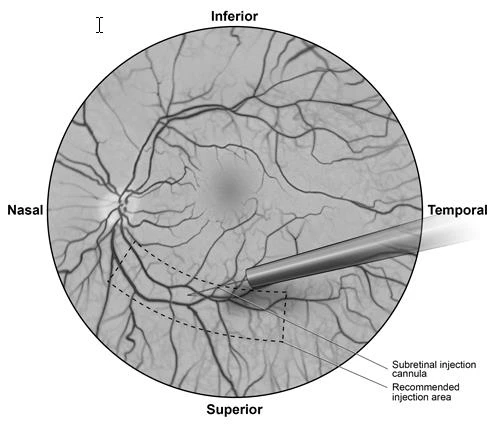
- Under direct visualization, the tip of the subretinal injection cannula is placed in contact with the retinal surface. The recommended injection site should be located along the superior vascular arcades, at least 2 mm away from the center of the fovea. A small amount of product is slowly injected until initial formation of a subretinal bleb is observed, after which the remaining volume is slowly injected to a total of 0.3 mL (Figure 1).
Figure 1 Tip of subretinal injection cannula positioned at the recommended injection site (surgeon’s view)
- At the end of the injection, the subretinal injection cannula is removed from the eye.
- After injection, any unused product must be discarded. The backup syringe cannot be stored.
- A fluid-air exchange is performed, carefully avoiding drainage of fluids near the retinotomy created for the subretinal injection. In the post-operative period, immediate supine head positioning is maintained, which the patient must continue for 24 hours after discharge.
This page has been machine-translated and may contain inaccuracies. The original data is available in the manufacturing country's language.
Last data check: May 11, 2026 · Data source: Agenzia Italiana del Farmaco (AIFA)