Luxazone
Italy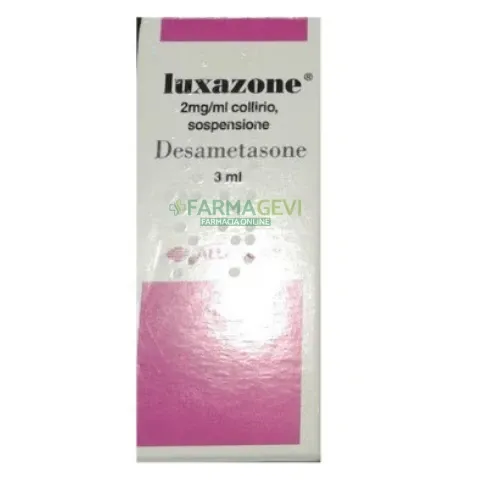
Table of Contents
Patient Information Leaflet
Luxazone 2 mg/ml eye drops, suspension, 2 mg/g eye ointment
Dexamethasone
Please read this leaflet carefully before using this medicine because it contains important information for you.
- Keep this leaflet. You may need to read it again.
- If you have any questions, ask your doctor or pharmacist.
- This medicine has been prescribed for you only. Do not give it to others, even if they have the same symptoms as yours, because it may be harmful.
- If you experience any adverse reaction, including those not listed in this leaflet, contact your doctor or pharmacist. See section 4.
Contents of this leaflet:
- What LUXAZONE is and what it is used for
- What you need to know before using LUXAZONE
- How to use LUXAZONE
- Possible side effects
- How to store LUXAZONE
- Contents of the pack and other information
1. What LUXAZONE is and what it is used for
LUXAZONE contains the active substance desametasone, which belongs to a group of medicines called corticosteroids that suppress inflammatory symptoms.
LUXAZONE is used to treat allergic, inflammatory, and congestive conditions affecting the front part of the eye, and in particular, inflammation of the posterior part of the eye (choroid) (acute and subacute iridocyclitis, anterior uveitis), increased fluid content within the cornea (corneal edema), swelling of the clear layer of the eye, and allergic inflammation of the conjunctiva (allergic conjunctivitis).
If you do not feel better or feel worse, consult your doctor.
2. What you need to know before using LUXAZONE
Do not use LUXAZONE
- if you are allergic to the active substance or to any of the other ingredients of this medicine (listed in section 6);
- if you have high pressure inside the eye (ocular hypertension);
- if you have had a viral eye infection (acute herpes simplex infections), or most viral diseases affecting the front part of the eye (cornea), except if you are being treated with specific antiviral drugs (chemotherapeutic agents), or if you have inflammation with superficial damage to the cornea, even in the early stage (conjunctivitis with ulcerative keratitis) (positive fluorescein test);
- if you have tuberculosis of the eye;
- if you have a fungal infection of the eye (fungal keratitis);
- if you have an eye inflammation with pus formation (acute purulent ophthalmia, purulent and herpetic conjunctivitis), which may be masked or worsened by corticosteroids;
- if you have a stye (hordeolum).
Warnings and precautions
Talk to your doctor or pharmacist before using LUXAZONE.
Prolonged use of eye products containing corticosteroids may lead to adverse events (see section “SIDE EFFECTS”). Continuous use for more than 1 month is not recommended.
Contact your doctor if you experience swelling and weight gain around the trunk and face, as these are usually the first signs of a condition called Cushing's syndrome. Suppression of adrenal gland function may develop after stopping prolonged or intensive treatment with Luxazone. Consult your doctor before stopping treatment on your own. These risks are particularly important in children and in patients taking a medicine called ritonavir or cobicistat.
Contact your doctor if you experience blurred vision or other visual disturbances.
Before using LUXAZONE, talk to your doctor if:
- you have a condition called glaucoma, as prolonged use of Luxazone may increase eye pressure. Your doctor will perform frequent checks of your intraocular pressure;
- you have any untreated eye infection, as Luxazone may mask or worsen it;
- you have any eye infection (including herpes simplex), as Luxazone may prolong the course and increase the severity of such infection;
- you have viral herpetic keratitis (an inflammation of the cornea); in this case, your doctor will prescribe Luxazone only if strictly necessary and under regular monitoring;
- you are scheduled for or have recently undergone any eye surgery (such as cataract surgery), as Luxazone may delay healing and increase the risk of blister formation;
- you suffer from diseases causing thinning of the ocular surface, as corticosteroid use could lead to perforation of the cornea or the white part of the eye (sclera).
If you use LUXAZONE for a long time:
- your doctor will monitor you regularly;
- the pressure in your eye may increase and damage the optic nerve, leading to vision problems;
- you may develop cataracts;
- your body, due to reduced immune defenses, may be less able to fight other types of eye infections, particularly viral or fungal infections.
To prevent eye injury or contamination, avoid letting the dropper bottle or tube cap touch the eye or any other surface. Sharing the bottle or tube among more than one person may spread infection.
Other medicines and LUXAZONE
Tell your doctor or pharmacist if you are currently using, have recently used, or might use any other medicines.
Contact your doctor if you are taking ritonavir or cobicistat, as they may increase the level of dexamethasone in the blood.
Pregnancy and breastfeeding
If you are pregnant, think you may be pregnant, planning pregnancy, or breastfeeding, consult your doctor or pharmacist before taking this medicine.
Pregnancy
If you are pregnant, your doctor will prescribe this product only if strictly necessary and under close supervision.
Breastfeeding
Breastfeeding is not recommended during treatment with Luxazone.
Driving and using machines
Luxazone does not affect or has negligible effect on the ability to drive or operate machinery.
However, as with any eye medication, if you experience temporary blurred vision while using it, wait until your vision clears before driving or operating machinery.
Luxazone eye drops, suspension contains:
- anhydrous sodium sulfite: may rarely cause severe hypersensitivity reactions and bronchospasm.
- benzalkonium chloride: this medicine contains 2.5 µg of benzalkonium chloride per drop, equivalent to 0.05 mg/ml. Benzalkonium chloride may be absorbed by soft contact lenses and may cause discoloration. Remove contact lenses before using this medicine and wait 15 minutes before reinserting them. Benzalkonium chloride may also cause eye irritation, especially if you have dry eye or corneal disorders (the outermost transparent layer of the eye). If you experience an unusual sensation, burning, or pain in the eye after using this medicine, speak with your doctor.
- phosphate buffer: this medicine contains 0.15 mg of phosphate buffer per drop, equivalent to 3 mg/ml. If you have severe damage to the outermost transparent layer of the eye (cornea), phosphates may very rarely cause opaque corneal deposits due to calcium accumulation during treatment.
3. How to use LUXAZONE
Use this medicine exactly as directed by your doctor or pharmacist. If you have any doubts, consult your doctor or pharmacist.
Luxazone eye drops, suspension:
The recommended dose is 3–4 drops every 2–3 hours, as prescribed by a physician, applied into the eye. Shake the bottle well before use.
Luxazone ophthalmic ointment:
The recommended dose is one application into the conjunctival sac every 2–3 hours, as prescribed by a physician.
Apply directly into the conjunctival sac.
Do not stop treatment prematurely.
Prolonged use may cause adverse effects; therefore, continuous use of the product for longer than one month is not recommended.
If the bottle or tube is shared between more than one person, infection may be spread.
Keep the bottle or tube tightly closed when not in use.
Use in children and adolescents
There are no adequate and well-controlled studies in pediatric patients.
If you use more Luxazone than you should
In case of overdose, temporarily and gradually discontinue use of Luxazone to avoid irritation, lesions, or sudden increase in intraocular pressure (acute glaucoma). Contact your doctor or pharmacist immediately.
If you accidentally ingest the product, inform your doctor immediately or go to the nearest hospital and drink fluids to dilute it.
If you forget to use Luxazone
Do not use a double dose to make up for the missed dose.
If you stop using Luxazone
Do not stop using Luxazone prematurely. Always consult your doctor if you decide to discontinue treatment.
If you have any doubts about how to use this medicine, consult your doctor or pharmacist.
4. Possible side effects
Like all medicines, this medicine can cause side effects, although not everybody gets them.
The following side effects may occur with the use of Luxazone:
Eye-related
- Eye irritation
- Eye burning
Effects on the body
- Allergic reactions (hypersensitivity)
The following side effects have been reported with medicines belonging to the same class as Luxazone:
Eye-related
- Clouding of the lens affecting vision (subcapsular cataract)
- Eye infection (including bacterial, fungal, and viral infections)
- Eye irritation
- Perforation of the eye (scleral or corneal perforation)
- Increased pressure inside the eye
- Eye disease due to increased intraocular pressure (glaucoma)
- Sensation of eye burning
- Blurred vision (frequency not known)
- Drooping of the eyelids
Hormonal problems:
Increased body hair growth (especially in women), muscle weakness and atrophy, purple stretch marks on the skin, increased blood pressure, irregular or absent menstrual cycle, changes in protein and calcium levels in the body, delayed growth in children and adolescents, and swelling with weight gain in the body and face (called “Cushing's syndrome”) (see section 2, “Warnings and precautions”).
Other side effects reported with eye drops containing phosphates
Very rarely, cases of corneal calcification have been reported with the use of eye drops containing phosphates in patients with significantly damaged corneas.
Reporting of side effects
If you experience any side effects, including those not listed in this leaflet, talk to your doctor or pharmacist. You can also report side effects directly via the national reporting system at
https://www.aifa.gov.it/content/segnalazioni-reazioni-avverse . By reporting side effects, you can help provide more information on the safety of this medicine.
5. How to store Luxazone
Keep this medicine out of the sight and reach of children.
Do not use this medicine after the expiry date stated on the carton after 'Exp.'. The expiry date refers to the last day of that month.
Store below 25°C.
Discard the container 28 days after first opening, even if some product remains.
Do not dispose of any medicine via wastewater or household waste. Ask your pharmacist how to dispose of medicines no longer required. This will help protect the environment.
6. Package contents and other information
What Luxazone eye drops, suspension contains
- The active substance is: desametasone 2 mg/mL
- The other components are: sodium chloride, monosodium phosphate, anhydrous sodium sulfite, benzalkonium chloride, hypromellose, polysorbate 80, purified water.
What Luxazone ophthalmic ointment contains
- The active substance is: desametasone 2 mg/g
- The other components are: liquid paraffin, anhydrous lanolin, chlorobutanol, white soft paraffin.
Description of the appearance of Luxazone and contents of the pack
Luxazone eye drops, suspension are supplied in a 3 mL plastic bottle.
Luxazone ophthalmic ointment is supplied in a 3 g aluminum tube.
Marketing Authorization Holder
AbbVie S.r.l.
S.R. 148 Pontina km 52 snc
04011 Campoverde di Aprilia (LT)
Italy
Manufacturer
Tubilux Pharma S.p.A.
Via Costarica 20/22
Pomezia (Rome)