Lupkynis
Italy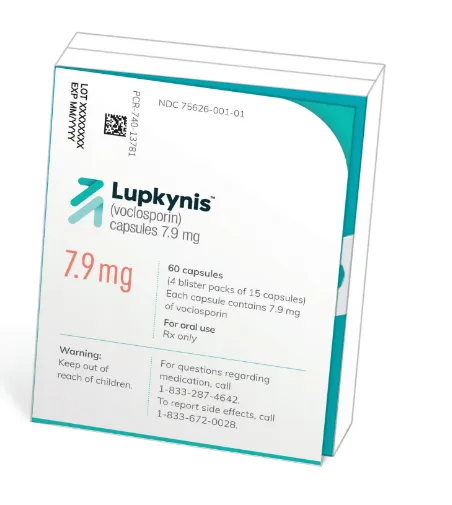
Table of Contents
Package leaflet: Information for the patient
Lupkynis 7.9 mg soft capsules
voclosporin (voclosporinum)
This medicinal product is under additional monitoring. This will allow for rapid identification of
new safety information. You can help by reporting any side effects you experience while taking
this medicine. See the end of section 4 for information on how to report side effects.
Please read this leaflet carefully before taking this medicine because it contains
important information for you.
- Keep this leaflet. You may need to read it again.
- If you have any questions, ask your doctor or pharmacist.
- This medicine has been prescribed for you only. Do not give it to others, even if they have the same symptoms as you, because it could be harmful.
- If you experience any side effect, including those not listed in this leaflet, contact your doctor or pharmacist. See section 4.
Contents of this leaflet:
- What Lupkynis is and what it is used for
- What you need to know before taking Lupkynis
- How to take Lupkynis
- Possible side effects
- How to store Lupkynis
- Contents of the pack and other information
1. What Lupkynis is and what it is used for
Lupkynis contains the active substance voclosporin. It is used to treat adults aged 18 years and older who have lupus nephritis (kidney inflammation caused by lupus).
The active substance in Lupkynis belongs to a group of medicines known as calcineurin inhibitors, which can be used to control the body's immune response (immunosuppressants). In lupus, the immune system (the body’s natural defence system) mistakenly attacks parts of the body itself, including the kidneys (lupus nephritis).
By reducing the immune system response, the medicine reduces kidney inflammation and alleviates symptoms such as swelling of the legs, ankles or feet, high blood pressure and fatigue, while also improving kidney function.
2. What you need to know before taking Lupkynis
Do not take Lupkynis
- If you are allergic to voclosporin or any of the other ingredients of this medicine (listed in section 6).
- If you are taking other medicines such as ketoconazole tablets (used to treat Cushing's syndrome, when the body produces an excess of cortisol), itraconazole, or clarithromycin (used to treat certain fungal and bacterial infections).
Warnings and precautions
Talk to your doctor or pharmacist before taking Lupkynis if any of the following apply to you:
- If your kidney disease worsens, it may be necessary to adjust the dose of this medicine. Your doctor will regularly monitor your kidney function.
- If you have risk factors for pure red cell aplasia (PRCA), a rare disorder in which the bone marrow does not produce enough red blood cells. Risk factors include previous infection with parvovirus B19 or prior treatments that may cause PRCA.
- If you have or develop high blood pressure. Your doctor will check your blood pressure every two weeks during the first month, then at regular intervals. Your doctor may prescribe a medicine to lower your blood pressure or may advise you to stop taking this medicine.
- This medicine may increase the risk of nervous system disorders, such as headache, tremors, vision changes, seizures, confusion, or weakness in one or more limbs. If you experience any of these new symptoms or worsening of existing symptoms, your doctor may consider stopping or reducing the dose of this medicine (see section 4).
- If you are planning to receive a vaccination or if you have been vaccinated within the last 30 days. This medicine may affect your response to vaccination, and vaccination may be less effective during treatment with this medicine.
- Do not take this medicine if you have previously had sudden, life-threatening allergic reactions (anaphylactic reactions) to soy or peanuts.
This medicine can increase potassium levels in the blood, which may be a serious condition requiring treatment. During treatment, your doctor will periodically monitor your potassium levels.
This medicine has not been studied in patients with severe liver problems and is therefore not recommended in these patients.
This medicine may affect the electrical activity of the heart (QT prolongation). This can lead to a serious heart rhythm disorder, the initial symptoms of which are dizziness and fainting.
Sunlight and UV radiation
This medicine may increase the risk of developing certain types of cancer, particularly of the skin. Avoid or limit exposure to sunlight and UV radiation by wearing appropriate protective clothing and frequently applying a high-protection sunscreen.
Infections
This medicine may increase the risk of developing infections, some of which may be serious or even fatal. Contact your doctor if you have signs of infection, such as fever, chills, or sore throat. Your doctor will decide whether you should stop taking this medicine (see section 4).
Children and adolescents
Do not take this medicine if you are under 18 years of age, as it has not been studied in this age group.
Elderly
This medicine is not recommended if you are over 75 years of age, as it has not been studied in this age group.
Other medicines and Lupkynis
Tell your doctor or pharmacist if you are taking, have recently taken, or might take any other medicines.
In particular, inform your doctor if you are taking:
- Medicines used to treat fungal infections, such as itraconazole and fluconazole.
- Medicines used to treat Cushing's syndrome (when the body produces an excess of cortisol), such as ketoconazole tablets.
- Medicines used to treat high blood pressure or heart problems, such as digoxin, diltiazem, and verapamil.
- Medicines that prevent blood clots, such as dabigatran etexilate.
- Medicines used to treat epilepsy, such as carbamazepine and phenobarbital.
- Herbal preparations containing St. John's wort, used to treat mild depression.
- Medicines used to relieve symptoms associated with seasonal allergic rhinitis, such as fexofenadine.
- Antibiotic medicines used to treat bacterial infections, such as rifampicin, clarithromycin, and erythromycin.
- Medicines that lower cholesterol, such as simvastatin, atorvastatin, rosuvastatin, and pravastatin.
- Medicines used to treat HIV infections, such as the antiretroviral efavirenz.
Lupkynis with food and drink
This medicine can be taken with or without food. During treatment with this medicine, avoid eating grapefruit or drinking grapefruit juice, as this may affect the medicine's action.
Pregnancy, breastfeeding, and fertility
If you are pregnant, think you may be pregnant, are planning to become pregnant, or are breastfeeding, consult your doctor before taking this medicine.
This medicine is not recommended during pregnancy and in women of childbearing potential who are not using contraceptive measures.
Inform your doctor if you are breastfeeding. The medicine may pass into breast milk, and it is not known whether it could affect the baby. Your doctor will discuss with you whether to discontinue treatment with this medicine during breastfeeding or to discontinue breastfeeding.
There are no data on the effect of this medicine on human fertility.
Driving and using machines
Lupkynis is not expected to have any effect on the ability to drive or use machinery.
Lupkynis contains alcohol
This medicine contains 21.6 mg of alcohol (ethanol) in each capsule. Therefore, a dose of 3 Lupkynis capsules contains 64.8 mg of ethanol, equivalent to less than 2 mL of beer or 1 mL of wine. The small amount of alcohol in this medicine will not produce significant effects.
Lupkynis contains sorbitol
This medicine contains 28.7 mg of sorbitol per capsule.
Lupkynis may contain soya lecithin
This medicine may contain traces of soya lecithin. If you have anaphylactic reactions to soy or peanuts, you must not use this medicine.
3. How to take Lupkynis
Take this medicine exactly as your doctor has told you. If you are unsure, consult your doctor or pharmacist.
The recommended dose of Lupkynis is three capsules twice daily, taken by mouth.
The capsules should be swallowed whole and may be taken with or without food.
Take the daily doses at approximately the same time each day, spaced at least 8 hours apart, and ideally as close as possible to 12 hours apart (for example, at 8:00 a.m. and 8:00 p.m.).
This medicine must be used in combination with another immunosuppressive medicine, mycophenolate mofetil.
If you take more Lupkynis than you should
If you accidentally take too many capsules, contact your doctor or the nearest hospital emergency department immediately. Symptoms of overdose may include rapid heartbeat and tremors (chills or uncontrollable shaking in one or more parts of the body).
If you forget to take Lupkynis
If you miss a dose, take it as soon as possible and within 4 hours of missing it. If more than 4 hours have passed since the time you usually take the medicine, skip that dose and take the next dose at your usual time. Do not take a double dose to make up for a missed dose.
If you stop taking Lupkynis
Do not stop treatment unless your doctor tells you to.
If you have any doubts about how to use this medicine, consult your doctor or pharmacist.
4. Possible side effects
Like all medicines, this medicine can cause side effects, although not everyone experiences them. The following side effects may occur with this medicine:
Serious side effects
If you experience any of these, consult your doctor immediately; they may advise you to stop taking this medicine or to reduce the dose.
Very common (may affect more than 1 in 10 people)
- Symptoms of infection (e.g. fever, generalised body pain, feeling tired, coughing or sneezing, nausea, vomiting or diarrhoea).
Common (may affect up to 1 in 10 people)
- Development of new symptoms related to nerve or brain problems, for example seizures.
Other side effects
Very common (may affect more than 1 in 10 people)
- Upper chest infection
- Reduction in red blood cells, which may make the skin pale and cause weakness or shortness of breath (anaemia)
- Headache
- Increased blood pressure
- Cough
- Diarrhoea
- Abdominal pain (stomach)
- Changes in kidney function that could reduce the amount of urine produced and cause new or worsening swelling in the legs or feet
Common (may affect up to 1 in 10 people)
- Fever, cough, difficult or painful breathing, wheezing, chest pain when breathing (possible symptoms of lung infection)
- Infections, which may be bacterial, such as urinary tract infections, or viral, such as herpes zoster
- Inflammation of the stomach and intestine
- Influenza
- Increased potassium levels observed in blood tests
- Decreased appetite
- Tremors
- Malaise
- Swelling, bleeding and/or inflammation of the gums
- Mouth ulcers
- Indigestion
- Hair loss
- Excessive and/or abnormal hair growth on any part of the body
- Fatigue
Not known (frequency cannot be estimated from the available data)
- Hypersensitivity
Reporting of side effects
If you experience any side effect, including those not listed in this leaflet, talk to your doctor or pharmacist. You can also report side effects directly via the national reporting system listed in Annex V. By reporting side effects, you can help provide more information on the safety of this medicine.
5. How to store Lupkynis
Keep this medicine out of sight and reach of children.
Do not use this medicine after the expiry date stated on the carton and blister after the word "Exp" or "EXP". The expiry date refers to the last day of that month.
Store in the original blister to protect the medicine from moisture.
Do not dispose of any medicine via wastewater or household waste. Ask your pharmacist how to dispose of medicines no longer in use. This will help protect the environment.
6. Package contents and other information
What Lupkynis contains
- The active substance is voclosporin. Each soft capsule of Lupkynis contains 7.9 mg of voclosporin.
- The other components are: Capsule contents: ethanol, vitamin E (E307) polyethylene glycol succinate (tocofersolan), polysorbate 40, and medium-chain triglycerides. Capsule shell: gelatin, sorbitol, glycerin, purified water, titanium dioxide (E171), red iron oxide (E172), yellow iron oxide (E172). Processing aid: soy lecithin.
Description of the appearance of Lupkynis and package contents
Lupkynis 7.9 mg, soft capsules, pink/orange in colour, approximately 13 mm × 6 mm, packed in blisters. Each blister contains 18 soft capsules. A carton contains either 180 or 576 soft capsules.
Not all pack sizes may be marketed.
Marketing Authorization Holder
Otsuka Pharmaceutical Netherlands B.V.
Herikerbergweg 292
1101 CT Amsterdam
The Netherlands
Manufacturer
Millmount Healthcare Limited
Block-7, City North Business Campus, Stamullen, Co. Meath, K32 YD60,
Ireland
For further information about this medicinal product, please contact the local representative of the Marketing Authorization Holder:
België/Belgique/Belgien Lietuva
Otsuka Pharma Scandinavia AB Otsuka Pharmaceutical Netherlands B.V.
Tél/Tel: +46 (0) 8 545 286 60 Tel: +31 (0) 20 85 46 555
България Luxembourg/Luxemburg
Otsuka Pharmaceutical Netherlands B.V. Otsuka Pharma Scandinavia AB
Teл: +31 (0) 20 85 46 555 Tél/Tel: +46 (0) 8 545 286 60
Česká republika Magyarország
Otsuka Pharmaceutical Netherlands B.V. Otsuka Pharmaceutical Netherlands B.V.
Tel: +31 (0) 20 85 46 555 Tel: +31 (0) 20 85 46 555
Danmark Malta
Otsuka Pharma Scandinavia AB Otsuka Pharmaceutical Netherlands B.V.
Tlf.: +46 (0) 8 545 286 60 Tel: +31 (0) 20 85 46 555
Deutschland Nederland
Otsuka Pharma GmbH Otsuka Pharmaceutical Netherlands B.V.
Tel: +49 (0) 69 1700 860 Tel: +31 (0) 20 85 46 555
Eesti Norge
Otsuka Pharmaceutical Netherlands B.V. Otsuka Pharma Scandinavia AB
Tel: +31 (0) 20 85 46 555 Tlf: +46 (0) 8 545 286 60
Ελλάδα Österreich
Otsuka Pharmaceutical Netherlands B.V. Otsuka Pharmaceutical Netherlands B.V.
Thλ: +31 (0) 20 85 46 555 Tel: +31 (0) 20 85 46 555
España Polska
Otsuka Pharmaceutical S.A Otsuka Pharmaceutical Netherlands B.V.
Tel: +34 (0) 93 208 1020 Tel: +31 (0) 20 85 46 555
France Portugal
Otsuka Pharmaceutical France SAS Otsuka Pharmaceutical Netherlands B.V.
Tél: +33 (0) 1 47 08 00 00 Tel: +31 (0) 20 85 46 555
Hrvatska România
Otsuka Pharmaceutical Netherlands B.V. Otsuka Pharmaceutical Netherlands B.V.
Tel: +31 (0) 20 85 46 555 Tel: +31 (0) 20 85 46 555
Ireland Slovenija
Otsuka Pharmaceutical Netherlands B.V. Otsuka Pharmaceutical Netherlands B.V.
Tel: +31 (0) 20 85 46 555 Tel: +31 (0) 20 85 46 555
Ísland Slovenská republika
Otsuka Pharma Scandinavia AB Otsuka Pharmaceutical Netherlands B.V.
Sími: +46 (0) 8 545 286 60 Tel: +31 (0) 20 85 46 555
Italia Suomi/Finland
Otsuka Pharmaceutical Italy S.r.l. Otsuka Pharma Scandinavia AB
Tel: +39 (0) 2 0063 2710 Puh/Tel: +46 (0) 8 545 286 60
Κύπρος Sverige
Otsuka Pharmaceutical Netherlands B.V. Otsuka Pharma Scandinavia AB
Thλ: +31 (0) 20 85 46 555 Tel: +46 (0) 8 545 286 60
Latvija
Otsuka Pharmaceutical Netherlands B.V.
Tel: +31 (0) 20 85 46 555
Other sources of information
More detailed information on this medicinal product is available on the website of the European Medicines Agency: https://www.ema.europa.eu. In addition, links to other websites on rare diseases and their therapeutic treatments are provided.
ANNEX IV
SCIENTIFIC CONCLUSIONS AND GROUNDS FOR THE VARIATION OF THE TERMS OF THE MARKETING AUTHORISATIONS
Scientific conclusions
Taking into account the assessment by the Pharmacovigilance Risk Assessment Committee (PRAC) of the Periodic Safety Update Reports (PSURs) for voclosporin, the PRAC's scientific conclusions are as follows:
Considering the available data on fatigue from clinical trials and spontaneous reports, including 237 cases with a clear temporal association and 10 cases showing a positive outcome upon de-challenge, the PRAC considers that there is at least a reasonable possibility of a causal relationship between voclosporin and fatigue. Therefore, the PRAC decided that the product information for medicinal products containing voclosporin should be updated accordingly.
Having reviewed the PRAC's recommendation, the Committee for Medicinal Products for Human Use (CHMP) agrees with the general conclusions and the rationale of the recommendation.
Grounds for the variation of the terms of the marketing authorisations
Based on the scientific conclusions on voclosporin, the CHMP considers that the benefit-risk balance of medicinal products containing voclosporin remains unchanged, subject to the proposed amendments to the product information.
The CHMP recommends a variation to the terms of the marketing authorisations.