Lumykras
Italy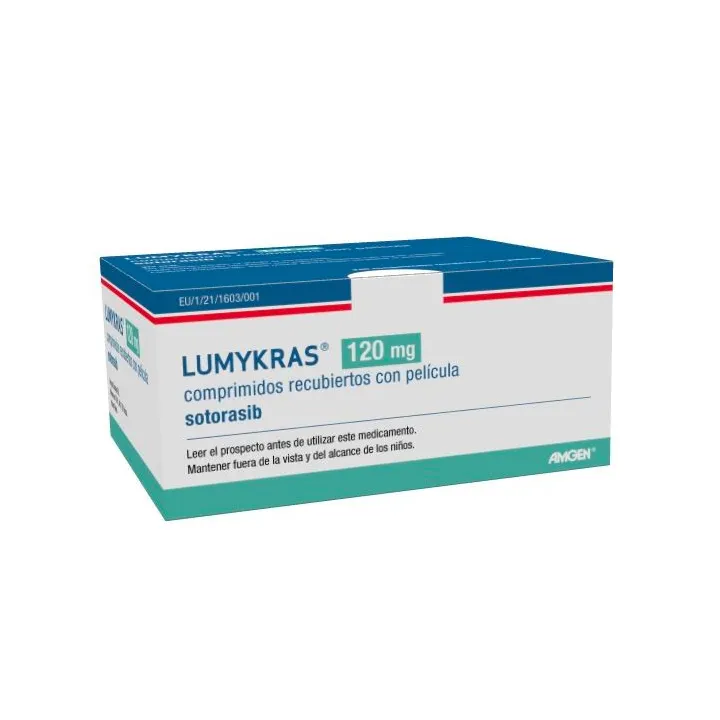
Table of Contents
- Package leaflet: Information for the patient
- LUMYKRAS 120 mg film-coated tablets, 240 mg film-coated tablets
- 1. What LUMYKRAS is and what it is used for
- 2. What you need to know before taking LUMYKRAS
- 3. How to take LUMYKRAS
- 4. Possible side effects
- 5. How to store LUMYKRAS
- 6. Package contents and other information
Package leaflet: Information for the patient
LUMYKRAS 120 mg film-coated tablets, 240 mg film-coated tablets
sotorasib
This medicinal product is subject to additional monitoring. This will allow for rapid identification of new safety information. You can help by reporting any side effects you experience while taking this medicine. See the end of section 4 for information on how to report side effects.
Please read this leaflet carefully before taking this medicine because it contains important information for you.
- Keep this leaflet. You may need to read it again.
- If you have any questions, ask your doctor, pharmacist, or nurse.
- This medicine has been prescribed for you only. Do not give it to others, even if their symptoms are the same as yours, as it may be harmful.
- If you experience any side effect, including those not listed in this leaflet, tell your doctor, pharmacist, or nurse. See section 4.
Contents of this leaflet
- What LUMYKRAS is and what it is used for
- What you need to know before taking LUMYKRAS
- How to take LUMYKRAS
- Possible side effects
- How to store LUMYKRAS
- Contents of the pack and other information
1. What LUMYKRAS is and what it is used for
LUMYKRAS contains the active substance sotorasib and belongs to a group of medicines called antineoplastic agents (medicines against cancer).
LUMYKRAS is used to treat adult patients with a type of lung tumour called non-small cell lung cancer, when it is in an advanced stage and has spread to other parts of the body.
LUMYKRAS is used when previous treatments have not been effective in stopping tumour growth, and when tumour cells have a genetic alteration that causes them to produce an abnormal form of a protein called KRAS G12C. Your doctor will first test for this alteration in the tumour cells to determine whether LUMYKRAS is an appropriate medicine for you.
How does LUMYKRAS work?
The abnormal KRAS G12C protein acts by promoting uncontrolled growth of tumour cells. LUMYKRAS binds to this protein and blocks its function, possibly slowing down or stopping tumour growth.
If you have any questions about how LUMYKRAS works or why this medicine has been prescribed for you, please consult your doctor, pharmacist, or nurse.
2. What you need to know before taking LUMYKRAS
Do not take LUMYKRAS
- if you are allergic to sotorasib or to any of the other ingredients of this medicine (listed in section 6).
Warnings and precautions
Talk to your doctor, pharmacist, or nurse before taking LUMYKRAS.
Tell your doctor, pharmacist, or nurse if you have a history of liver problems. Your doctor may order blood tests to monitor your liver function and may decide to reduce the dose of LUMYKRAS or stop treatment.
Tell your doctor if you have had any other lung problems. Some lung problems may worsen during treatment with LUMYKRAS, as LUMYKRAS can cause inflammation of the lungs during treatment. Symptoms may resemble those of lung cancer. Immediately inform your doctor if you develop new or worsening symptoms, including difficulty breathing, shortness of breath, or cough with or without mucus, or fever.
Children and adolescents
LUMYKRAS has not been studied in children or adolescents. Treatment with LUMYKRAS is not recommended for people under 18 years of age.
Other medicines and LUMYKRAS
Tell your doctor or pharmacist if you are taking, have recently taken, or might take any other medicines, including over-the-counter medicines, vitamins, and herbal supplements.
LUMYKRAS may affect the action of certain other medicines, and some other medicines may affect the action of LUMYKRAS.
The following medicines may reduce the effectiveness of LUMYKRAS:
- Medicines used to reduce gastric acidity and to treat gastric ulcers, indigestion, and heartburn (see section 3), such as:
- dexlansoprazole, esomeprazole, lansoprazole, omeprazole, sodium pantoprazole, or rabeprazole (medicines known as “proton pump inhibitors”)
- ranitidine, famotidine, cimetidine (medicines known as “H\₂ receptor antagonists”)
- Rifampicin (used to treat tuberculosis)
- Medicines used to treat epilepsy, such as phenytoin, phenobarbital, or carbamazepine (also used to treat nerve pain)
- St. John’s wort (a herbal medicine used to treat depression)
- Enzalutamide (used to treat prostate cancer)
LUMYKRAS may reduce the effectiveness of the following medicines:
- Medicines used to treat severe pain, such as alfentanil or fentanyl
- Medicines used in organ transplantation to prevent organ rejection, such as ciclosporin, sirolimus, everolimus, or tacrolimus
- Medicines used to lower high blood pressure, such as amlodipine and manidipine
- Medicines used to lower cholesterol levels, such as simvastatin, atorvastatin, or lovastatin
- Midazolam (used to treat acute seizures or as a sedative before or during surgical or medical procedures)
- Medicines used to treat heart rhythm problems, such as dronedarone or amiodarone
- Medicines known as anticoagulants that prevent blood clotting, such as rivaroxaban or apixaban
LUMYKRAS may increase the risk of side effects with the following medicines:
- Medicines used to treat certain cancers or inflammatory conditions, such as methotrexate, mitoxantrone, topotecan, or lapatinib
- Medicines used to treat heart failure, such as digoxin
- Medicines used to lower cholesterol, such as rosuvastatin
Contraception
If you take LUMYKRAS while using oral contraceptives, the oral contraceptives may become ineffective. In addition, you must use another reliable method of contraception, such as a barrier method (e.g., condom), to avoid becoming pregnant while taking this medicine. Talk to your doctor about appropriate contraceptive methods for you and your partner.
Pregnancy, breastfeeding, and fertility
Pregnancy
If you are pregnant, suspect you may be pregnant, planning to become pregnant, or breastfeeding, consult your doctor before taking this medicine.
You must not become pregnant while taking this medicine, as the effects of LUMYKRAS in pregnant women are unknown; it may harm the unborn baby. If there is any possibility you could become pregnant, you must use highly effective contraceptive measures during treatment and for at least 7 days after stopping treatment.
Breastfeeding
Do not breastfeed during treatment with this medicine and for 7 days after the last dose. It is not known whether the components of LUMYKRAS pass into breast milk and could therefore harm the baby.
Driving and using machines
LUMYKRAS has no or negligible influence on the ability to drive and use machines.
LUMYKRAS contains lactose
If your doctor has diagnosed you with an intolerance to certain sugars, contact them before taking this medicine.
LUMYKRAS contains sodium
This medicine contains less than 1 mmol (23 mg) of sodium per tablet, i.e., essentially ‘sodium-free’.
3. How to take LUMYKRAS
Take this medicine exactly as your doctor or pharmacist has told you. If you are unsure, consult your doctor or pharmacist.
Do not change the dose or stop taking LUMYKRAS unless instructed by your doctor or pharmacist. Your doctor or pharmacist may reduce the dose or stop the medicine depending on how well you tolerate it.
- The recommended dose is 960 mg (eight 120 mg tablets or four 240 mg tablets) once daily. Take the daily dose of LUMYKRAS by mouth once daily at approximately the same time each day.
- LUMYKRAS may be taken with or without food.
- Swallow the tablets whole. You may disperse the tablets in water, but do not chew, crush, or split the tablets.
- If you are unable to swallow the LUMYKRAS tablets whole:
- Place the daily dose of LUMYKRAS in half a glass (not less than 120 mL) of room temperature drinking water. Do not use other liquids, including acidic beverages (e.g., fruit juices).
- Gently swirl the glass in circular motions until the tablets break into small pieces (the tablets will not dissolve completely). The appearance of the mixture may range from pale yellow to bright yellow.
- Drink the mixture immediately.
- Rinse the glass with another half glass of water and drink immediately to ensure you have taken the entire dose of LUMYKRAS.
- If you do not drink the entire mixture immediately, swirl the glass again before drinking the remainder. Drink the entire mixture within two hours of preparation.
- If necessary, your doctor may advise you to take LUMYKRAS through a feeding tube.
If you need to take a medicine to reduce stomach acid, such as a proton pump inhibitor or an H\₂ receptor antagonist, take LUMYKRAS with an acidic beverage (such as cola). Alternatively, you may use a locally acting antacid (such as magnesium hydroxide or calcium carbonate); in this case, take LUMYKRAS 4 hours before or 10 hours after taking that medicine (see section 2).
If you take more LUMYKRAS than you should
If you take more tablets than you should, contact your doctor, pharmacist, or nurse immediately.
If you vomit after taking LUMYKRAS
If you vomit after taking a dose of LUMYKRAS, do not take an additional dose. Take the next dose at your usual scheduled time.
If you forget to take LUMYKRAS
If you forget to take a dose of LUMYKRAS at your usual scheduled time and less than 6 hours have passed, take the dose as usual. If more than 6 hours have passed since your usual scheduled time, do not take the missed dose. Take the next dose at your usual scheduled time the following day.
4. Possible side effects
Like all medicines, this medicine can cause side effects, although not everyone gets them.
The very common and serious possible side effects of LUMYKRAS are increases in levels of certain liver enzymes (AST/ALT) in the blood, which may indicate liver problems. Your doctor may carry out blood tests to monitor your liver function and may decide to reduce the dose of LUMYKRAS or to stop treatment (see section 2).
Other possible side effects of LUMYKRAS may include:
Very common (may affect more than 1 in 10 people)
- Diarrhoea
- Feeling unwell (nausea)
- Feeling tired
- Vomiting
- Constipation
- Stomach discomfort
- Joint pain
- Back pain
- Shortness of breath
- Cough
- Low red blood cell count (anaemia), which may cause tiredness and fatigue
- Reduced appetite
Common (may affect up to 1 in 10 people)
- Headache
- Fever
- Increased levels of certain enzymes, including those found in the blood, detected in laboratory tests (elevated alkaline phosphatase, bilirubin and gamma-glutamyltransferase)
- Liver injury
- Inflammation of the lungs called "interstitial lung disease"
- Changes in blood test results (low blood potassium levels)
Uncommon (may affect up to 1 in 100 people)
- Kidney problems, including impaired kidney function
- Inflammation of the liver (hepatitis)
Reporting of side effects
If you get any side effects, including ones not listed in this leaflet, talk to your doctor, pharmacist or nurse. You can also report side effects directly through the national reporting system listed in Annex V. By reporting side effects, you can help provide more information on the safety of this medicine.
5. How to store LUMYKRAS
Keep this medicine out of the sight and reach of children.
Do not use this medicine after the expiry date which is stated on the carton and on the blister after
Exp./EXP. The expiry date refers to the last day of that month.
Do not use this medicine after the expiry date which is stated on the carton and on the bottle after
Exp. The expiry date refers to the last day of that month.
This medicine does not require any special storage conditions.
Do not dispose of any medicine via wastewater or household waste. Ask your pharmacist how to
dispose of medicines no longer required. This will help protect the environment.
6. Package contents and other information
What LUMYKRAS contains
- The active substance is sotorasib. Each film-coated tablet contains 120 mg or 240 mg of sotorasib.
- The other components are:
- Microcrystalline cellulose (E460(i))
- Lactose monohydrate
- Cross-linked sodium carboxymethylcellulose (E468)
- Magnesium stearate (E470b)
- The tablets are coated with:
- Poly(vinyl alcohol) (E1203), titanium dioxide (E171), macrogol 4000 (E1521), talc (E553b) and yellow iron oxide (E172)
See LUMYKRAS contains lactose and LUMYKRAS contains sodium in section 2.
Description of the appearance of LUMYKRAS and contents of the pack
LUMYKRAS 120 mg film-coated tablets
Each film-coated tablet is a yellow, oblong tablet with “AMG” engraved on one side and “120” on the other side.
- LUMYKRAS is supplied in blisters containing 8 film-coated tablets in packs of 240 film-coated tablets (1 carton containing 30 blisters) and multiple pack of 720 (3 × 240) film-coated tablets.
- LUMYKRAS is supplied in bottles containing 120 film-coated tablets in a pack of 240 film-coated tablets (1 carton containing 2 bottles).
LUMYKRAS 240 mg film-coated tablets
Each film-coated tablet is a yellow, oval tablet with “AMG” engraved on one side and “240” on the other side.
- LUMYKRAS is supplied in perforated unit dose blisters containing 8 film-coated tablets in packs of 120 film-coated tablets (1 carton containing 15 blisters).
Not all pack sizes may be marketed.
Marketing Authorisation Holder and Manufacturer
Amgen Europe B.V.,
Minervum 7061,
4817 ZK Breda,
The Netherlands
Marketing Authorisation Holder
Amgen Europe B.V.,
Minervum 7061,
4817 ZK Breda,
The Netherlands
Manufacturer
Amgen NV,
Telecomlaan 5-7,
1831 Diegem,
Belgium
For further information about this medicinal product, please contact the local representative of the Marketing Authorisation Holder:
België/Belgique/Belgien Lietuva
s.a. Amgen n.v. Amgen Switzerland AG Vilniaus filialas
Tél/Tel: +32 (0)2 7752711 Tel: +370 5 219 7474
България Luxembourg/Luxemburg
Амджен България ЕООД s.a. Amgen
Тел.: +359 (0)2 424 7440 Belgique/Belgien
Tél/Tel: +32 (0)2 7752711
Česká republika Magyarország
Amgen s.r.o. Amgen Kft.
Tel: +420 221 773 500 Tel.: +36 1 35 44 700
Danmark Malta
Amgen, filial af Amgen AB, Sverige Amgen S.r.l.
Tlf.: +45 39617500 Italia
Tel: +39 02 6241121
Deutschland Nederland
Amgen GmbH Amgen B.V.
Tel: +49 89 1490960 Tel: +31 (0)76 5732500
Eesti Norge
Amgen Switzerland AG Vilniaus filialas Amgen AB
Tel: +372 586 09553 Tlf: +47 23308000
Ελλάδα Österreich
Amgen Ελλάς Φαρμακευτικά Ε.Π.Ε. Amgen GmbH
Τηλ: +30 210 3447000 Tel: +43 (0)1 50 217
España Polska
Amgen S.A. Amgen Biotechnologia Sp. z o.o.
Tel: +34 93 600 18 60 Tel.: +48 22 581 3000
France Portugal
Amgen S.A.S. Amgen Biofarmacêutica, Lda.
Tél: +33 (0)9 69 363 363 Tel: +351 21 4220606
Hrvatska România
Amgen d.o.o. Amgen România SRL
Tel: +385 (0)1 562 57 20 Tel: +4021 527 3000
Ireland Slovenija
Amgen Ireland Limited AMGEN zdravila d.o.o.
Tel: +353 1 8527400 Tel: +386 (0)1 585 1767
Ísland Slovenská republika
Vistor hf. Amgen Slovakia s.r.o.
Sími: +354 535 7000 Tel: +421 2 321 114 49
Italia Suomi/Finland
Amgen S.r.l. Amgen AB, sivuliike Suomessa/Amgen AB, filial
Tel: +39 02 6241121 i Finland
Puh/Tel: +358 (0)9 54900500
Kύπρος Sverige
C.A. Papaellinas Ltd Amgen AB
Τηλ: +357 22741 741 Tel: +46 (0)8 6951100
Latvija
Amgen Switzerland AG Rīgas filiāle
Tel: +371 257 25888
This medicinal product has been granted a conditional marketing authorisation. This means that additional data on this medicinal product are required.
The European Medicines Agency will review new information annually and this patient information leaflet will be updated as necessary.
Other sources of information
More detailed information about this medicinal product is available on the website of the European Medicines Agency: https://www.ema.europa.eu.
This leaflet is available in all languages of the European Union/European Economic Area on the website of the European Medicines Agency.