LumebLue
Italy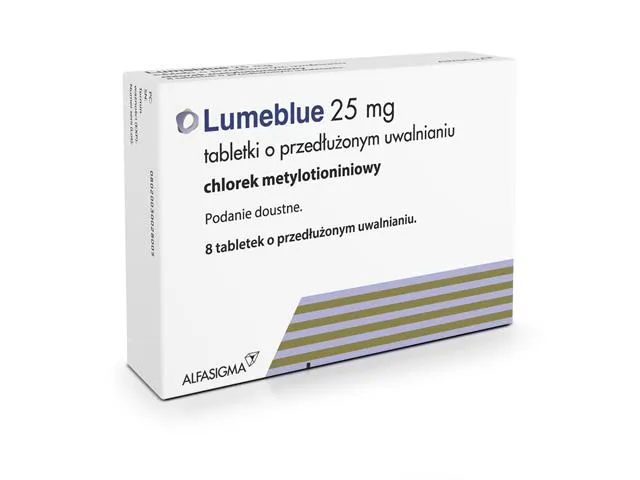
Table of Contents
Patient Information Leaflet
Lumeblue 25 mg prolonged-release tablets
methylthioninium chloride
Please read this leaflet carefully before taking this medicine because it contains important information for you.
- Keep this leaflet. You may need to read it again.
- If you have any questions, consult your doctor or pharmacist.
- This medicine has been prescribed for you only. Do not give it to others, even if their symptoms are the same as yours, as it could be harmful.
- If you experience any side effect, including those not listed in this leaflet, consult your doctor or pharmacist. See section 4.
Contents of this leaflet
- What Lumeblue is and what it is used for
- What you need to know before taking Lumeblue
- How to take Lumeblue
- Possible side effects
- How to store Lumeblue
- Contents of the pack and other information
1. What Lumeblue is and what it is used for
Lumeblue contains methylthioninium chloride (also known as methylene blue). This medicine is a
blue dye.
This medicine is used in adults to temporarily stain the colon (large intestine) before a colonoscopy,
during which a flexible instrument is inserted into the rectum to visually examine the intestine. The
staining allows the doctor to see the inner lining of the colon more clearly and improves the detection
of abnormalities.
2. What you should know before taking Lumeblue
Do not take Lumeblue
- if you are allergic to methylthioninium chloride, peanuts, soybeans, or any of the other ingredients of this medicine (listed in section 6);
- if you have been diagnosed with glucose-6-phosphate dehydrogenase (G6PD) deficiency;
- if you are pregnant, suspect you may be pregnant, are planning a pregnancy, or are breastfeeding, as your doctor may decide that you should not take this medicine before the procedure.
Warnings and precautions
Talk to your doctor or pharmacist before taking this medicine:
- if you are taking certain antidepressant medicines or medicines for psychiatric disorders. For example:
- selective serotonin reuptake inhibitors (SSRIs) such as fluoxetine, fluvoxamine, paroxetine, sertraline, citalopram, escitalopram, and zimelidine;
- bupropion, venlafaxine, mirtazapine, clomipramine, buspirone;
- medicines classified as monoamine oxidase inhibitors (often used to treat depression). Intravenous injection of methylthioninium chloride in patients taking these medicines has sometimes caused a potentially life-threatening condition called serotonin syndrome.
It is not known whether serotonin syndrome can occur when methylthioninium chloride is
administered in tablet form. Your doctor will decide how to proceed if you are taking an antidepressant or another medicine for psychiatric disorders.
This medicine may cause a skin reaction due to photosensitivity (a sunburn-like reaction) when the skin is exposed to strong light sources, such as phototherapy, operating room lights, or pulse oximeters. Protective measures against light exposure should be taken.
Your urine and faeces may turn blue-green; your skin may also turn blue during treatment with this medicine. This change in colour is expected and disappears at the end of treatment.
This medicine may affect the readings of monitoring devices used to measure blood oxygen levels or depth of anaesthesia.
Children and adolescents
This medicine must not be given to children and adolescents under 18 years of age,
as it is not known whether the medicine is safe and effective in this age group.
Other medicines and Lumeblue
Tell your doctor or pharmacist if you are taking, have recently taken, or might take
any other medicines.
Taking other medicines together with Lumeblue may negatively affect how each of them works or how they are metabolized and eliminated from the body.
In addition to the antidepressants and other psychiatric medicines mentioned in "Warnings and
precautions", before taking this medicine you must inform your doctor if you are also taking or have recently been given:
- medicines for irregular heartbeat, such as amiodarone, digoxin, and quinidine
- warfarin, to prevent blood clots
- medicines for cancer treatment, such as alectinib, everolimus, lapatinib, nilotinib, and topotecan
- medicines to prevent rejection of transplanted organs, such as cyclosporine, sirolimus, and tacrolimus
- medicines for HIV infection, such as ritonavir and saquinavir
- medicines for migraine treatment, such as dihydroergotamine and ergotamine
- medicines used to treat anxiety or insomnia, such as diazepam
- sedative medicines, such as midazolam and propofol
- antihistamine medicines for allergy treatment, such as diphenhydramine or promethazine
- probenecid for gout treatment
- phenytoin for epilepsy treatment
- pimozide for treatment of psychosis or schizophrenia
- medicines for severe pain, such as alfentanil, fentanyl, and meperidine (also known as pethidine)
- cimetidine for treatment of gastric ulcers and acid reflux
- metformin for treatment of type 2 diabetes
- aciclovir for treatment of herpes simplex virus infections (e.g. cold sores and genital warts) and varicella-zoster virus infections (e.g. chickenpox and shingles)
Pregnancy and breastfeeding
If you are pregnant, suspect you may be pregnant, or are planning a pregnancy, do not use this medicine
as it is not known whether it could be harmful to the unborn child.
If you are breastfeeding, consult your doctor or pharmacist before taking
this medicine.
Your doctor may decide that it is not necessary to take this medicine if you require a
colonoscopy during breastfeeding.
Driving and using machines
It is unlikely that taking Lumeblue will negatively affect your ability to drive or operate
machinery. However, if you experience side effects that could impair your ability to
drive or operate machinery safely, such as migraine, dizziness, or vision disturbances, you should avoid driving or operating machinery until you feel better.
Lumeblue contains soybean lecithin
If you are allergic to peanuts or soybeans, do not take this medicine.
3. How to take Lumeblue
Take this medicine exactly as instructed by your doctor or pharmacist. If
you have any doubts, consult your doctor or pharmacist.
The medicine is supplied in the form of tablets. These must be swallowed whole, as they have a special coating ensuring their passage through the stomach and release only in the intestine, where methylene blue is released to stain the colon blue. Do not crush or chew the tablets.
You will be given a pack containing 8 tablets (totaling 200 mg of methylene blue chloride). All tablets must be taken within a 2-hour period the night before the colonoscopy. Your doctor will explain how to take the tablets, which are generally taken together with a bowel cleansing preparation (a medicine to empty the colon).
Take the tablets according to your doctor's instructions.
Generally, the instructions are as follows:
- after drinking at least 1 liter of bowel cleansing preparation (or water), take the first dose of 3 tablets;
- wait 1 hour, then take a second dose of 3 tablets;
- wait another hour, then take the final dose of 2 tablets.
If you take more Lumeblue than you should
The pack contains a complete dose of Lumeblue. Therefore, you cannot take more Lumeblue than recommended. However, if you take more tablets than instructed, some of the side effects listed in section 4 may occur. If you think you have taken more medicine than you should, contact your doctor or nurse as soon as possible.
Seek immediate medical advice if you notice any of the following symptoms:
- nausea or vomiting, or stomach pain
- abnormally fast heartbeat or chest pain
- chest tightness or difficulty breathing (e.g., shortness of breath)
- confusion, dizziness or headache
- sweating, trembling, feeling weak, paler than usual skin, or blue-colored skin
- increased methemoglobin (an abnormal form of hemoglobin in the blood)
- high blood pressure.
If you forget to take one or more doses of Lumeblue
Do not take a double dose to make up for forgotten tablets; take the next dose according to the bowel cleansing schedule advised by your doctor. It may be helpful to set an alarm to remind you when to take the medicine.
If you stop taking Lumeblue
Inform the doctor performing the colonoscopy that you did not take all the tablets.
If you have any questions about the use of this medicine, consult your doctor, pharmacist, or
nurse.
4. Possible side effects
Like all medicines, this medicine can cause side effects, although not everybody gets them.
The following side effects are common, but you should contact your doctor or nurse if you experience any side effect that concerns you.
Very common (may affect more than 1 in 10 people)
- change in urine colour
- change in stool colour
- dizziness
- disturbances in taste sensation
- tingling sensation, pins and needles, numbness or prickling
- pain or discomfort in hands or feet
- blue discolouration of the skin
- sweating
Common (may affect up to 1 in 10 people)
- nausea
- vomiting
- stomach or chest pain
- headache
- anxiety
Uncommon (may affect up to 1 in 100 people)
- cold-like symptoms, including blocked or runny nose
- migraine
- low blood pressure
- cough
- vomiting blood
- skin discolouration resembling bruising
- night sweats
- itchy skin
- skin rash
- spider veins
- back or hip pain
- abnormally high amount of urine, or pain or difficulty passing urine
- general pain
- chills
Not known (frequency cannot be estimated from the available data)
- signs of serotonin syndrome, such as muscle spasms, lack of coordination, tremors, confusion or other mental changes
- signs of anaphylactic reaction, such as itchy rash, swelling of the throat or tongue, shortness of breath
- sensitivity to light
Reporting of side effects
If you experience any side effect, including those not listed in this leaflet, tell your doctor, pharmacist or nurse. You can also report side effects directly via the national reporting system referred to in Annex V. By reporting side effects, you can help provide more information on the safety of this medicine.
5. How to store Lumeblue
Keep this medicine out of the sight and reach of children.
Do not use this medicine after the expiry date stated on the carton and blister after
Exp. The expiry date refers to the last day of that month.
This medicine does not require any special storage conditions.
Do not use this medicine if you notice any damage to the packaging or signs of tampering.
Do not dispose of any medicine via wastewater or household waste. Ask your pharmacist how to dispose of medicines you no longer use. This will help protect the environment.
6. Package contents and other information
What Lumeblue contains
- The active substance is methylene blue chloride. Each prolonged-release tablet contains 25 mg of methylene blue chloride.
- The other components are: tablet core: stearic acid 50 (E570), soy lecithin (E322) – see section 2 "Lumeblue contains soy lecithin", microcrystalline cellulose (E460), hypromellose 2208 (E464), mannitol (E421), talc (E553b), anhydrous colloidal silica (E551), magnesium stearate (E470b); film coating: methacrylic acid - methyl methacrylate copolymer, talc (E553b), titanium dioxide (E171), triethyl citrate (E1505)
Description of the appearance of Lumeblue and package contents
Lumeblue prolonged-release tablets are off-white to blue, round, biconvex tablets with an enteric film coating. The prolonged-release tablets are supplied in blisters containing 8 tablets.
Marketing Authorization Holder
Cosmo Technologies Ltd
Riverside II
Sir John Rogerson’s Quay
Dublin 2
Ireland
Manufacturer
Cosmo S.p.A
Via C. Colombo, 1
20045, Lainate
Milan,
Italy
Other sources of information
More detailed information on this medicinal product is available on the website of the European Medicines Agency: https://www.ema.europa.eu