Lotemax
Italy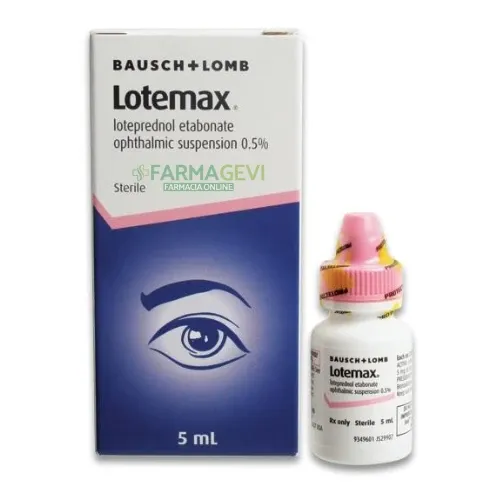
Table of Contents
Package leaflet: information for the user
LOTEMAX 0.5% Eye Drops, Suspension
Loteprednol Etabonate
Please read this leaflet carefully before using this medicine because it contains
important information for you.
- Keep this leaflet. You may need to read it again.
- If you have any questions, ask your doctor or pharmacist.
- This medicine has been prescribed for you only. Do not give it to other people, even if their symptoms are the same as yours, as it may be harmful.
- If you experience any side effects, including those not listed in this leaflet, consult your doctor or pharmacist. See section 4.
Contents of this leaflet:
- What Lotemax is and what it is used for
- What you need to know before using Lotemax
- How to use Lotemax
- Possible side effects
- How to store Lotemax
- Contents of the pack and other information
1. What LOTEMAX is and what it is used for
LOTMAX is a ophthalmic suspension.
LOTMAX is used to treat post-operative inflammation of the eye.
Sometimes the eye can become inflamed (red and painful). Loteprednol etabonate belongs to a class of medicines called corticosteroids. It works by reducing inflammation and relieving symptoms. Since it is used in small doses directly on the affected area, its action is limited to the site of application.
2. What you need to know before using LOTEMAX
Do not use LOTEMAX:
- if you are allergic to the active substance (loteprednol) or to any of the other ingredients of this medicine (listed in section 6).
- if you have ever been allergic to any corticosteroid.
- if you have eye diseases caused by viruses, such as herpes simplex, vaccinia, or varicella.
- if you have eye diseases caused by mycobacteria or fungi.
- if you are breastfeeding.
Warnings and precautions
Tell your doctor if you have glaucoma.
Tell your doctor if you develop eye pain, or if redness, itching, or inflammation worsen.
Consult your doctor if symptoms do not improve within the first two days. Your doctor may wish to re-evaluate your condition.
Do not use Lotemax for longer than ten days unless your eye pressure has been checked by your doctor.
Long-term use of Lotemax or other steroid eye drops may cause glaucoma or increase intraocular pressure, leading to optic nerve damage, vision problems, and cataracts.
Long-term use of Lotemax or other steroid eye drops may reduce resistance to infections and increase the risk of developing eye infections, including herpes simplex.
The use of steroid eye drops such as Lotemax may worsen and prolong the duration of viral eye diseases.
Contact lenses
Wearing contact lenses after cataract surgery is not recommended. If you normally wear contact lenses, your doctor will advise you to wear glasses for a certain period after cataract surgery. This allows your eyes to heal after the procedure. Your doctor will inform you when you can resume wearing contact lenses (see also “Lotemax contains benzalkonium chloride”).
Other medicines and Lotemax
Tell your doctor or pharmacist if you are taking or have recently taken any other medicines, including those obtained without a prescription. In particular, inform your doctor if you are using:
- medicines known as anticholinergics (used to treat various conditions such as abdominal cramps, muscle spasms, urge incontinence, or asthma),
- eye drops used to treat high intraocular pressure.
Pregnancy and breastfeeding
If you are pregnant, breastfeeding, think you may be pregnant, or are planning to become pregnant, consult your doctor or pharmacist before using this medicine.
You may still be prescribed Lotemax, but an alternative treatment may also be considered.
Lotemax must not be used during breastfeeding.
Driving and using machines
The eye drops may blur your vision. This usually passes quickly. Do not drive or operate machinery until your vision has returned to normal.
Lotemax contains benzalkonium chloride.
The preservative benzalkonium chloride may cause ocular irritation.
Avoid contact with soft contact lenses.
Remove contact lenses before applying the drops and wait at least 15 minutes before reinserting them. Benzalkonium chloride is known to discolor soft contact lenses.
3. How to use LOTEMAX
4. How to use LOTEMAX
Use this medicine exactly as directed by your doctor or pharmacist.
If you are unsure, ask your doctor or pharmacist.
The recommended dose in adults and elderly patients is 1–2 drops four times a day.
Treatment with Lotemax usually begins 24 hours after surgery and continues for two weeks.
Use in adults:
- Shake the Lotemax bottle well before use.
- Look upward and gently pull down the lower eyelid of the affected eye(s).
- Instill one or two drops of Lotemax into the space between the eyeball and the eyelid, four times a day or as prescribed by your doctor.
- Avoid letting the tip of the bottle touch any surface, as this may contaminate the medicine.
- Close the bottle immediately after use.
- • Your doctor will advise you on the duration of treatment with Lotemax. Do not stop treatment without first consulting your doctor.
Use in children and adolescents
Lotemax must not be used in children and adolescents until further data are available.
If you use more Lotemax than you should
Tell your doctor or pharmacist.
If you forget to use Lotemax
Do not take a double dose to make up for a missed dose.
Wait until the next scheduled dose and continue as normal.
If you stop using Lotemax
Use this medicine exactly as your doctor has instructed. Do not stop using Lotemax without first talking to your doctor.
If you have any doubts about how to use this medicine, ask your doctor or pharmacist.
5. Possible side effects
Like all medicines, this medicinal product can cause side effects, although not
everyone experiences them.
If you experience any of the following symptoms: redness, itching or swelling of the membrane
covering the white part of the eye and/or the eyelid(s), or generalised symptoms such as
difficulty breathing, difficulty swallowing, facial redness or flushing, or swelling of the
face or tongue, you must stop using this medicine and seek immediate medical help.
These may be signs of a severe allergic reaction.
Because you may require urgent medical treatment, contact your doctor immediately
if you experience any of the following adverse events:
- worsening of eye pain, especially with exposure to bright light, and eye redness during treatment with this medicine. This may be due to inflammation of the coloured part of the eye, called iritis – uncommon side effect (may occur in up to 1 in 100 people),
- lump or thickening in an area of the breast, change in size, shape or sensitivity of the breast, swelling or lump under the arm, or change in the shape of the nipple. These may be symptoms of breast cancer, which is a rare side effect (may occur in up to 1 in 1,000 people),
- involuntary muscle contraction (muscle twitching) – rare side effect (may occur in up to 1 in 1,000 people),
- nervousness – rare side effect (may occur in up to 1 in 1,000 people),
- ringing in the ears (tinnitus) – rare side effect (may occur in up to 1 in 1,000 people),
- chest pain – rare side effect (may occur in up to 1 in 1,000 people).
The following side effects listed below may occur during treatment
with this medicine:
Common side effects (may occur in up to 1 in 10 people):
Ocular side effects:
corneal disorders, eye discharge, eye discomfort, dry eye,
tearing, sensation of foreign body in the eye, eye redness, eye itching,
burning sensation at the site of instillation, and increased intraocular pressure.
General side effects:
headache.
Uncommon side effects (may occur in up to 1 in 100 people):
Ocular side effects:
abnormal vision, blurred vision, conjunctival swelling, conjunctivitis, eye irritation,
eye pain, mild elevation of the conjunctiva, light sensitivity,
eye inflammation, inflammation of the cornea and conjunctiva, eye infection, and
lens opacities.
General side effects:
fatigue, runny nose, and sore throat.
Rare side effects (may occur in up to 1 in 1,000 people):
General side effects: migraine, taste disturbance, dizziness,
numbness, feeling of cold, fever and pain, cough, urinary tract infection or inflammation,
urticaria, rash, dry skin, eczema, diarrhoea, nausea and vomiting, weight gain.
Reporting of side effects
If you experience any side effect, including those not listed in
this leaflet, please contact your doctor or pharmacist. You can also report side effects directly via
http://www.agenziafarmaco.gov.it/it/responsabili.
By reporting side effects, you can help provide more information on the safety of this medicine.
5. How to store LOTEMAX
Keep this medicine out of the sight and reach of children.
Store the container in an upright position.
Store at a temperature not exceeding 25°C. Do not freeze.
Do not use this medicine after the expiry date stated on the packaging and
on the bottle after Expiry. The expiry date refers to the last day of that month.
Discard the product 28 days after opening.
Do not dispose of any medicine via wastewater or household waste. Ask your
pharmacist how to dispose of medicines no longer in use. This will help protect
the environment.
DO NOT USE IF THE PROTECTIVE SEAL IS NOT INTACT
6. Package contents and other information
What Lotemax contains
- The active substance is Loteprednol Etabonate. Each ml contains 5 mg (0.5%) of Loteprednol Etabonate.
- The excipients are: Disodium Edetate, Glycerol, Povidone, Purified Water, and Tyloxapol.
- Benzalkonium Chloride (0.01%) is added as a preservative.
- Sodium Hydroxide and/or Hydrochloric Acid are added to adjust the pH.
Description of the appearance of Lotemax and contents of the pack
Lotemax is a milky ophthalmic suspension.
Lotemax is available in bottles of 2.5 ml, 5 ml, or 10 ml.
It is possible that not all pack sizes are marketed.
Marketing Authorisation Holder and Manufacturer
Marketing Authorisation Holder
Bausch & Lomb-IOM S.p.A
Viale Martesana 12
20090 Vimodrone (MI), Italy
Manufacturer
Dr. Mann Pharma
Brunsbütteler Damm 173
13581 Berlin, Germany
Other sources of information
For any information about this medicinal product, please contact Bausch & Lomb-IOM S.p.A, Via Pasubio, 34, 20846 Macherio (MB), Italy.
Lotemax is a registered trademark of Bausch & Lomb Incorporated.
©Bausch & Lomb Incorporated