LoramyC
Italy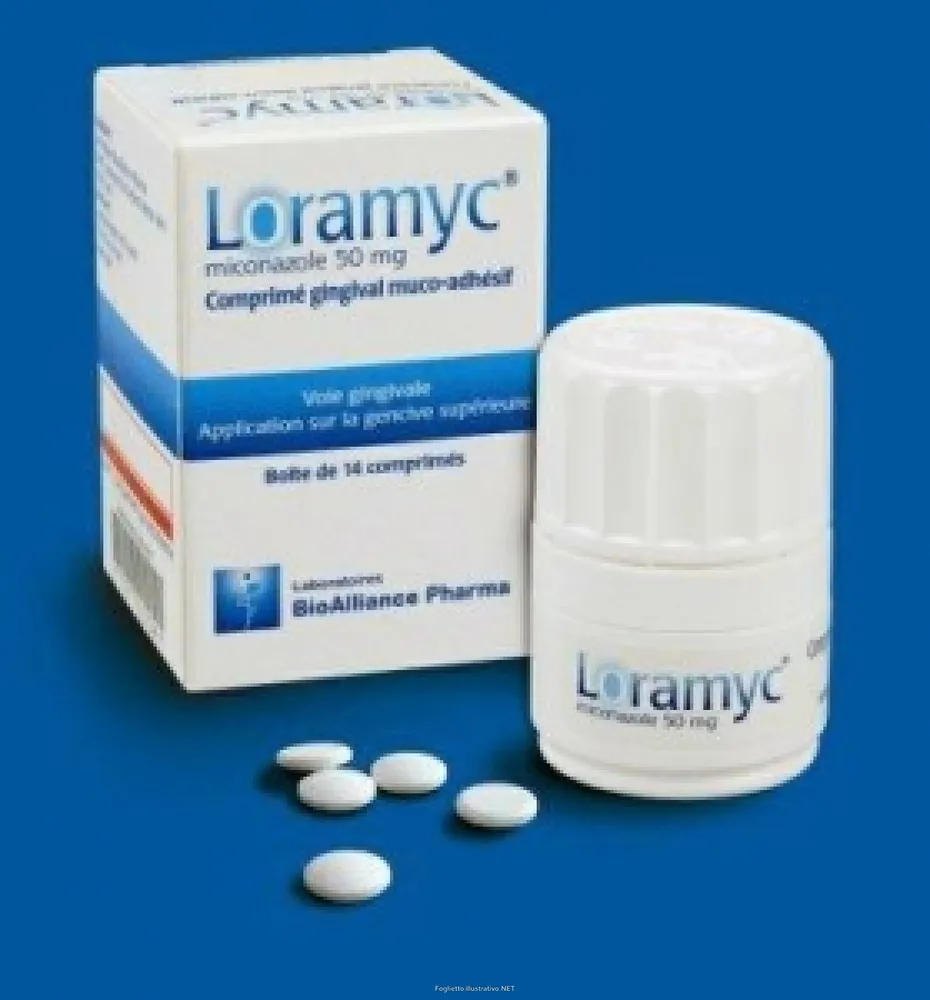
Table of Contents
- PACKAGE LEAFLET: INFORMATION FOR THE USER
- LORAMYC 50 mg, mucoadhesive buccal tablets
- 1. WHAT LORAMYC 50 mg, tablets IS AND WHAT IT IS USED FOR
- 2. WHAT YOU SHOULD KNOW BEFORE USING LORAMYC 50 mg tablets
- 3. HOW TO USE LORAMYC 50 mg tablets
- 4. POSSIBLE ADVERSE REACTIONS
- 5. HOW TO STORE LORAMYC 50 mg, tablets
- 6. PACK CONTENT AND OTHER INFORMATION
PACKAGE LEAFLET: INFORMATION FOR THE USER
LORAMYC 50 mg, mucoadhesive buccal tablets
Miconazole
Please read this leaflet carefully before using this medicine because it contains important information for you.
- Keep this leaflet. You may need to read it again.
- If you have any questions, ask your doctor or pharmacist.
- This medicine has been prescribed for you only. Do not give it to other people, even if their symptoms are the same as yours, as it may be harmful.
- If you experience any side effects, including those not listed in this leaflet, tell your doctor or pharmacist. See section 4.
Contents of this leaflet:
- What LORAMYC is and what it is used for
- What you need to know before using LORAMYC
- How to use LORAMYC
- Possible side effects
- How to store LORAMYC
- Contents of the pack and other information
1. WHAT LORAMYC 50 mg, tablets IS AND WHAT IT IS USED FOR
This medicinal product is used for the treatment of (yeast) infections of the mouth and
throat caused by Candida in patients with compromised immune systems.
2. WHAT YOU SHOULD KNOW BEFORE USING LORAMYC 50 mg tablets
Do not use LORAMYC 50 mg tablets:
- If you are allergic (hypersensitive) to the active substance (miconazole), or to other similar antifungal medicines, or to any of the excipients of LORAMYC (listed in section 6),
- If you are allergic to milk or its derivatives,
- If you have hepatic insufficiency (liver dysfunction),
- With oral anticoagulants (medicines that slow blood clotting), hypoglycemic sulfonamides (medicines used to treat diabetes), cisapride (a medicine used to treat gastroesophageal reflux), pimozide (a medicine used to treat psychiatric disorders), and ergot alkaloids: ergotamine, dihydroergotamine (medicines used to treat migraine) (see section "Other medicines and LORAMYC").
Warnings and precautions
- Avoid all situations that may interfere with tablet adhesion: do not touch or press the area where the tablet is placed; avoid chewing gum.
- If brushing your teeth during the day, avoid touching the tablet with the toothbrush and rinse your mouth carefully.
- If your mouth is dry, it is recommended to moisten the gum before applying the tablet.
- If LORAMYC is accidentally swallowed, drink a glass of water. If swallowed within the first 6 hours after application, the tablet should be replaced only once.
- If the tablet detaches within the first 6 hours but is not swallowed, it must be immediately replaced.
Other medicines and LORAMYC
LORAMYC must not be used if you are already taking any of the following medicines:
- oral anticoagulants (medicines that slow blood clotting)
- cisapride (a medicine used to treat gastroesophageal reflux)
- pimozide (a medicine used to treat psychiatric disorders)
- hypoglycemic sulfonamides (medicines used to treat diabetes)
- ergot alkaloids: ergotamine, dihydroergotamine (medicines used to treat migraine).
LORAMYC is not recommended if you are already using:
- halofantrine (a medicine used to treat malaria).
LORAMYC should be avoided, if possible, if you are already using:
- phenytoin (a medicine used to treat epilepsy).
Inform your doctor or pharmacist if you are taking, or have recently taken, any other
medicine, including those not requiring a prescription.
LORAMYC with food and drink
LORAMYC may be used with food and drink.
Pregnancy, breastfeeding and fertility
Pregnancy:
It is preferable to avoid using this medicine during pregnancy.
If you discover you are pregnant during treatment, consult your doctor. Only your doctor
can assess whether continuing treatment is necessary.
Ask your doctor or pharmacist for advice before taking any medicine.
Breast-feeding:
It is not known whether LORAMYC passes into human milk. Ask your doctor for advice before using
this medicine.
If your baby is being treated with a medicine containing cisapride, you must not use this
medicine during breastfeeding.
Ask your doctor or pharmacist for advice before using any medicine.
Driving and using machines
No effects of LORAMYC on the ability to drive vehicles or use machines are expected.
Important information about certain components of LORAMYC 50 mg tablets:
LORAMYC contains lactose, milk derivatives, and sodium lauryl sulfate.
LORAMYC contains lactose. If your doctor has diagnosed you with an intolerance to certain
sugars, contact him or her before taking this medicine.
Do not use in case of allergy to milk or milk derivatives.
LORAMYC contains 5.18 mg of sodium lauryl sulfate per tablet. Sodium lauryl sulfate may
cause skin irritation (sensation of stinging or burning) or intensify skin reactions caused by other medicines when applied to the same area.
3. HOW TO USE LORAMYC 50 mg tablets
DO NOT SWALLOW LORAMYC
Instructions for correct use
LORAMYC must be applied to the upper gum, directly above a front tooth.
- Before applying the tablet, locate the area on the upper gum above a front tooth.
- Open the bottle and remove one tablet. Once removed from the bottle, the tablet must be applied immediately. Note that the tablet has one rounded side and one flat side marked with the letter "L".
- Place the rounded side in contact with the upper gum.
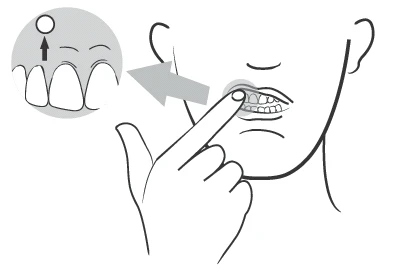
- Hold the tablet in place for 30 seconds by applying gentle pressure with your finger on the upper lip. This will allow the tablet to adhere to the gum. Avoid touching the tablet with your tongue for several minutes after application.
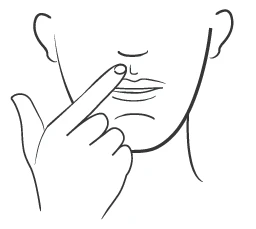
- Apply LORAMYC in the morning, preferably after brushing your teeth. Do not suck, chew, or swallow the tablet.
- If you accidentally swallow a LORAMYC tablet, drink a glass of water.
- Alternate the side of the gum for each application.
- Reapply the tablet if it does not adhere properly.
The shape of the tablet may change as it absorbs saliva, adapting to the shape of the gum.
Dosage
Always use LORAMYC exactly as described in this leaflet or as your doctor has instructed you. If you have any doubts, consult your doctor or pharmacist.
This medicine is for adults only.
The usual dose is one LORAMYC tablet applied once daily.
Apply LORAMYC to the upper gum in the morning, preferably after brushing your teeth.
If you feel that the effect of LORAMYC 50 mg tablets is too strong or too weak, consult your doctor or pharmacist.
Duration of treatment
The usual duration of treatment is 7 to 14 days.
If you use or ingest more LORAMYC 50 mg tablets than you should:
In case of overdose, nausea and vomiting may occur.
Contact your doctor or pharmacist immediately.
If you forget to use LORAMYC 50 mg tablets:
Do not take a double dose to make up for the forgotten tablet.
If you stop using LORAMYC 50 mg tablets:
Do not stop taking this medicine unless advised by your doctor. Premature discontinuation may result in treatment failure.
If you have any doubts about how to use this medicine, consult your doctor or pharmacist.
4. POSSIBLE ADVERSE REACTIONS
Like all medicines, LORAMYC 50 mg, tablets can cause adverse reactions,
although not everyone experiences them.
If any of the following adverse reactions occur, stop using LORAMYC 50 mg,
mucoadhesive buccal tablets and contact your doctor immediately:
Swelling of the face, tongue or throat; difficulty swallowing; hives and breathing difficulties
(angioedema, anaphylactic reaction) (very rare).
- A severe allergic reaction with skin rash*, commonly presenting as blisters or sores in the mouth, eyes, and other mucous membranes, for example, in the genital area (frequency not known)
- Severe and widespread skin damage* (detachment of the epidermis and superficial mucous membranes) (toxic epidermal necrolysis, TEN, frequency not known)
* These severe skin reactions have been reported with other products belonging to the same
therapeutic class as LORAMYC following systemic administration. Therefore, occurrence of
these adverse reactions following local administration of LORAMYC cannot be ruled out,
even though its systemic absorption is much lower.
Inform your doctor or pharmacist if you notice any of the following adverse reactions:
Common adverse reactions (occurring in more than 1 out of 100 patients, less than 1 out of 10):
- Nausea, diarrhea, abdominal pain, vomiting, dry mouth, oral disorders, gingival pain,
- Headache, taste alteration,
- Itching, skin rash,
- Application site irritation (gums), fatigue, pain,
- Nasopharyngeal infection.
Uncommon adverse reactions (occurring in more than 1 out of 1,000 patients, less than 1 out of 100):
- Tongue pain, gingival itching, mouth ulceration,
- Loss of appetite,
- Hot flushes.
Frequency not known:
- Skin rash with pustular blisters (acute generalized exanthematous pustulosis).
Reporting of adverse reactions
If you experience any adverse reaction, including those not listed in this leaflet, talk to your doctor or pharmacist. You may also report adverse reactions directly via the national reporting system at
https://www.aifa.gov.it/content/segnalazioni-reazioni-avverse . By reporting adverse reactions, you can help provide more information on the safety of this medicine.
5. HOW TO STORE LORAMYC 50 mg, tablets
Keep this medicine out of the sight and reach of children.
This medicine does not require any special storage temperature.
Store in the original bottle tightly closed to protect the medicine from moisture.
Do not use LORAMYC after the expiry date stated on the bottle and the outer box. The expiry date refers to the last day of that month.
6. PACK CONTENT AND OTHER INFORMATION
What LORAMYC contains:
The active substance is miconazole.
Each mucoadhesive buccal tablet contains 50 mg of miconazole.
The other components are hypromellose 2208, milk protein concentrate, corn starch,
lactose monohydrate, sodium lauryl sulfate, magnesium stearate, talc.
Description of the appearance of LORAMYC and pack contents:
This medicine is a mucoadhesive buccal tablet, white to light yellow in color, with a rounded side and a flat side marked with the letter "L". Each LORAMYC pack contains a bottle of 14 tablets.
Marketing Authorization Holder and Manufacturer:
Marketing Authorization Holder:
Istituto Gentili S.r.l.
Via San Giuseppe Cottolengo, 15
20143 Milan, Italy
Manufacturer:
Catalent Germany Schorndorf GmbH
Steinbeisstraße 2
73614 Schorndorf
Postfach 1460
73603 Schorndorf
Germany
This medicinal product is authorized in the European Economic Area countries and in the United Kingdom (Northern Ireland) under the following names:
France, Germany, Italy, United Kingdom (Northern Ireland): LORAMYC