Lonsurf
Italy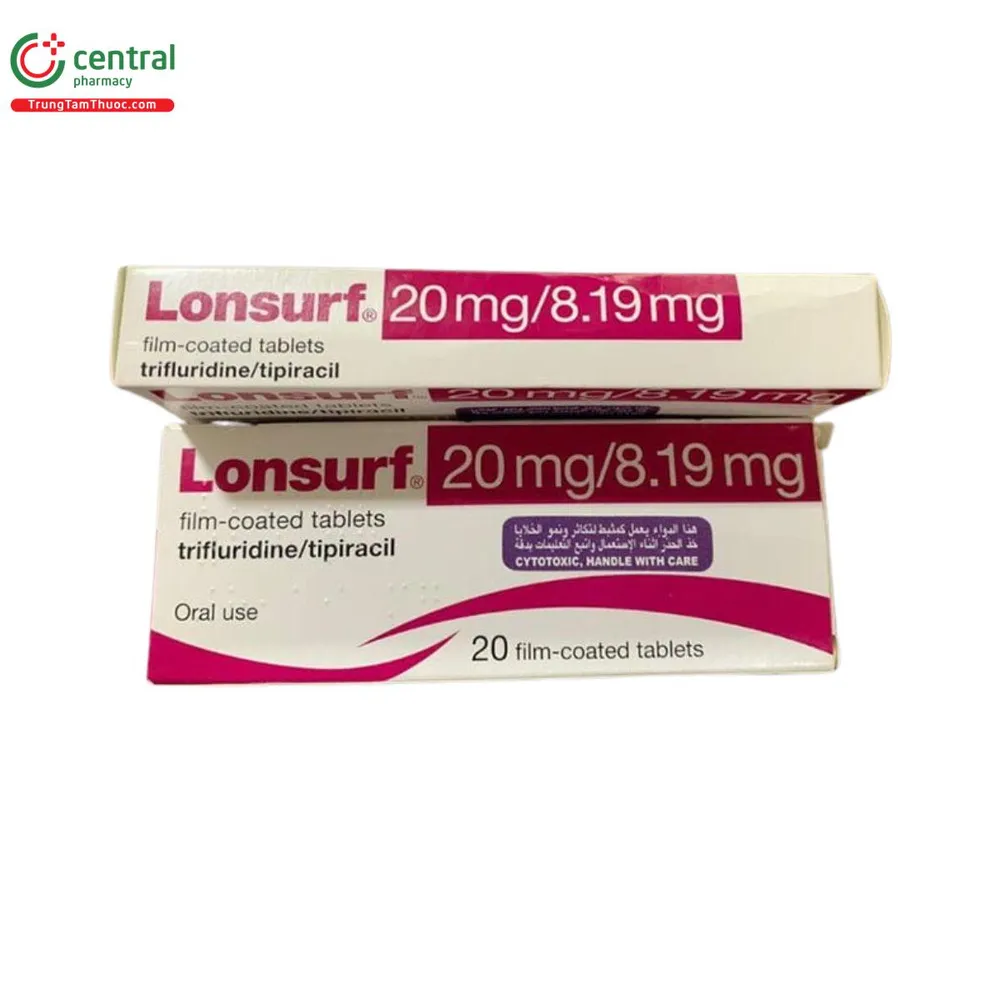
Table of Contents
- Patient Information Leaflet
- Lonsurf 15 mg/6.14 mg film-coated tablets, 20 mg/8.19 mg film-coated tablets
- 1. What Lonsurf is and what it is used for
- 2. What you need to know before taking Lonsurf
- 3. How to take Lonsurf
- 4. Possible side effects
- 5. How to store Lonsurf
- 6. Package contents and other information
Patient Information Leaflet
Lonsurf 15 mg/6.14 mg film-coated tablets, 20 mg/8.19 mg film-coated tablets
trifluridine/tipiracil
Please read all of this leaflet carefully before taking this medicine, because it contains important information for you.
- Keep this leaflet. You may need to read it again.
- If you have any questions, ask your doctor or pharmacist.
- This medicine has been prescribed for you only. Do not pass it on to other people, even if they have the same symptoms as you, because it may be harmful.
- If you experience any side effects, including those not listed in this leaflet, talk to your doctor or pharmacist. See section 4.
Contents of this leaflet:
- What Lonsurf is and what it is used for
- What you need to know before taking Lonsurf
- How to take Lonsurf
- Possible side effects
- How to store Lonsurf
- Contents of the pack and other information
1. What Lonsurf is and what it is used for
Lonsurf is a chemotherapy medicine belonging to a group of medicines called "antimetabolite cytostatic agents".
Lonsurf contains two different active substances: trifluridine and tipiracil.
- Trifluridine blocks the growth of tumour cells.
- Tipiracil prevents the breakdown of trifluridine within the body, thereby helping it to remain active for longer.
Lonsurf is used to treat adults with colon or rectal cancer – sometimes referred to as "colorectal cancer" – and stomach cancer (including cancer of the gastro-oesophageal junction).
- It is used when the cancer has spread to other parts of the body (metastasis).
- It is used when other treatments have not worked – or when other treatments are not considered suitable for you.
Lonsurf may be given in combination with bevacizumab. It is important to also read the bevacizumab package leaflet. If you have any questions about this medicine, please consult your doctor.
2. What you need to know before taking Lonsurf
Do not take Lonsurf
- if you are allergic to trifluridine or tipiracil, or to any of the other ingredients of this medicine (listed in section 6). Do not take Lonsurf if any of the above conditions apply to you. If you are unsure, consult your doctor before taking Lonsurf.
Warnings and precautions
Talk to your doctor or pharmacist before taking Lonsurf if:
- you have kidney problems
- you have liver problems. If you are unsure, consult your doctor or pharmacist before taking Lonsurf.
Treatment may lead to the following side effects (see section 4):
- a reduced number of certain types of white blood cells (neutropenia), which are important for protecting the body against bacterial or fungal infections. As a consequence of neutropenia, fever (febrile neutropenia) and blood infection (septic shock) may occur;
- a reduced number of red blood cells (anaemia);
- a reduced number of platelets in the blood (thrombocytopenia), which are important for stopping bleeding by aggregating and clotting at sites of blood vessel injury;
- gastrointestinal problems.
Tests and monitoring
- Your doctor will perform blood tests before each cycle of Lonsurf. You will start a new cycle every 4 weeks. These tests are necessary because Lonsurf may sometimes affect blood cells.
Children and adolescents
- This medicine is not recommended for children and adolescents under 18 years of age, as it may not be effective or safe.
Other medicines and Lonsurf
Inform your doctor or pharmacist if you are taking, have recently taken, or might take any other medicines. This includes medicines obtained without a prescription or herbal medicines. This is because Lonsurf may alter the effect of other medicines, and other medicines may alter the effect of Lonsurf.
In particular, inform your doctor or pharmacist if you are taking medicines used to treat HIV infection, such as zidovudine, as zidovudine may not work properly if you are taking Lonsurf. Talk to your doctor about the possibility of switching to a different anti-HIV medicine.
If any of the above applies to you (or if you are unsure), consult your doctor or pharmacist before taking Lonsurf.
Pregnancy and breastfeeding
If you are pregnant, suspect you may be pregnant, planning to become pregnant, or breastfeeding, consult your doctor or pharmacist before taking this medicine. Lonsurf may cause harm to the unborn child.
If you become pregnant, you and your doctor will need to assess whether the benefits of Lonsurf outweigh the risk of harm to the baby.
Do not breastfeed while taking Lonsurf, as it is not known whether Lonsurf is excreted in breast milk.
Contraception
You must not become pregnant while being treated with this medicine. This is because the medicine may cause harm to the fetus.
During treatment with this medicine, you and your partner must use effective contraceptive methods. You must continue using contraception for 6 months after stopping treatment. If you become pregnant during this period, you must speak to your doctor or pharmacist immediately.
Fertility
Lonsurf may affect your ability to have a child. Consult your doctor for advice before taking this medicine.
Driving and using machines
It is not known whether Lonsurf affects the ability to drive or operate machinery. Do not drive or operate tools or machines if you experience symptoms that impair your concentration or reaction ability.
Lonsurf contains lactose
If your doctor has informed you that you have an intolerance to certain sugars, consult your doctor before taking this medicine.
3. How to take Lonsurf
Take this medicine exactly as instructed by your doctor or pharmacist. If you have
any doubts, consult your doctor or pharmacist.
Dosage
- Your doctor will determine the correct dose for you – the dose depends on your body weight and height, and whether you have kidney problems.
- Lonsurf is available in two strengths. Your doctor may prescribe both strengths as part of your prescribed treatment regimen.
- Your doctor will tell you how many tablets to take each time.
- You will take a dose twice daily.
When to take Lonsurf
During the first 2 weeks, you will take Lonsurf for 10 days, followed by a 2-week break from treatment. This 4-week period is called a “cycle”. The specific dosing schedule is as follows:
- First week
- Take the dose twice daily for 5 days
- Stop treatment for 2 days – no medication
- Second week
- Take the dose twice daily for 5 days
- Stop treatment for 2 days – no medication
- Third week
- No medication
- Fourth week
- No medication
Then start another 4-week cycle, following the instructions above.
- No medication
How to take it
- Take this medicine by mouth.
- Swallow the tablets whole with a glass of water.
- Take the medicine within 1 hour after the morning and evening meals.
- Wash your hands after handling the medicine.
If you take more Lonsurf than you should
If you take more Lonsurf than prescribed, inform your doctor or go to the hospital immediately. Take the medicine package(s) with you.
If you forget to take Lonsurf
- If you miss a dose, inform your doctor or pharmacist.
- Do not take a double dose to make up for a missed dose.
If you have any doubts about how to use this medicine, consult your doctor or pharmacist.
4. Possible side effects
Like all medicines, this medicine can cause side effects, although not everyone will experience them.
The following side effects may occur with this medicine when taken alone or in combination with bevacizumab:
Serious side effects
Tell your doctor immediately if you notice any of the following serious side effects (many of these side effects may be detected through laboratory tests – for example, those concerning blood cells):
- Neutropenia (very common), febrile neutropenia (common), and septic shock (rare). Symptoms may include chills, fever, sweating, or other signs of bacterial or fungal infection (see section 2).
- Anaemia (very common). Symptoms include shortness of breath, fatigue, or paleness (see section 2).
- Vomiting (very common) and diarrhoea (very common), which, if severe or persistent, may lead to dehydration.
- Severe gastrointestinal problems: abdominal pain (common), ascites (rare), colitis (uncommon), acute pancreatitis (rare), ileus (uncommon), and subileus (rare). Symptoms include severe stomach or abdominal pain, which may be accompanied by vomiting, complete or partial blockage of the intestine, fever, or abdominal swelling.
- Thrombocytopenia (very common). Symptoms include unusual bruising or bleeding (see section 2).
- Pulmonary embolism (uncommon): blood clots in the lungs. Symptoms include shortness of breath, chest pain, and leg pain.
- Interstitial lung disease has been reported in patients treated with this medicine. Symptoms include difficulty breathing, shortness of breath, cough, or fever.
Some of these serious side effects may result in death.
Other side effects
Tell your doctor if you notice any of the following side effects. Many of these side effects may be detected through laboratory tests – for example, those concerning blood cells. Your doctor will evaluate these side effects based on test results.
Very common (may affect more than 1 in 10 people):
- decreased appetite
- feeling of tiredness (fatigue)
- feeling unwell (nausea)
- reduction in white blood cells called leucocytes – may increase the risk of infection
- swelling of the mucous membranes in the mouth
Common (may affect up to 1 in 10 people):
- fever
- hair loss
- weight loss
- changes in taste
- constipation
- general feeling of weakness (malaise)
- low levels of albumin in the blood
- increased bilirubin in the blood – may cause yellowing of the skin or eyes
- reduction in the number of white blood cells called lymphocytes – may increase the risk of infection
- swelling of the hands, legs, or feet
- mouth problems or pain
- swelling of mucous membranes – this may occur in the nose, throat, eyes, vagina, intestine, or lungs
- increased liver enzymes
- presence of protein in the urine
- skin rash, itchy or dry skin
- shortness of breath, respiratory or lung infection, chest infections
- viral infections
- joint pain
- dizziness, headache
- high blood pressure
- mouth ulcers
- muscle pain
Uncommon (may affect up to 1 in 100 people):
- low blood pressure
- test results showing coagulation problems leading to increased tendency to bleed
- more noticeable heartbeat, chest pain
- abnormally increased or decreased heart rate
- increase in white blood cells
- increase in white blood cells called monocytes
- increased blood levels of lactate dehydrogenase
- low levels of phosphate, sodium, potassium, or calcium in the blood
- reduction in white blood cells called monocytes – may increase the risk of infection
- high blood sugar levels (hyperglycaemia), increased levels of urea, creatinine, and potassium in the blood
- blood test results showing inflammation (increased C-reactive protein)
- sensation of dizziness (vertigo)
- runny or bleeding nose, sinus problems
- sore throat, hoarseness, voice problems
- redness, itching, eye infections, tearing
- dehydration
- bloating, passing gas, indigestion
- inflammation in the lower part of the digestive tract
- swelling or bleeding in the intestine
- inflammation or increased acid in the stomach or oesophagus, reflux
- pain in the tongue, vomiting
- tooth decay, dental problems, gum infections
- skin redness
- pain or discomfort in the arms or legs
- pain, including cancer-related pain
- bone pain, muscle weakness, or spasms
- feeling cold
- herpes zoster (pain and blistering rash on the skin along the nerve pathway affected by inflammation from the herpes zoster virus)
- liver disease
- inflammation or infection of the bile ducts
- kidney failure
- cough, sinus, or throat infection
- bladder infection
- blood in the urine
- problems passing urine (urinary retention), loss of bladder control (incontinence)
- changes in menstrual cycle
- anxiety
- non-serious neurological disorders
- itchy raised skin rash, hives, acne
- excessive sweating, nail problems
- difficulty sleeping or falling asleep
- sensation of numbness or tingling in the hands or feet
- redness, swelling, pain on the palms of the hands and soles of the feet (hand-foot syndrome)
Rare (may affect up to 1 in 1000 people):
- inflammation and infection of the intestine
- athlete’s foot – fungal infections of the feet, yeast infections
- reduction in white blood cells called granulocytes – may increase the risk of infection
- swelling or pain in the big toes
- joint swelling
- increased levels of salts in the blood
- burning sensation, unpleasant sensation of increased or decreased touch
- fainting (syncope)
- vision problems such as blurred vision, double vision, reduced vision, cataract
- dry eyes
- ear pain
- inflammation in the upper part of the digestive tract
- pain in the upper and lower parts of the digestive tract
- fluid accumulation in the lungs
- bad breath, gum problems, bleeding gums
- polyps inside the mouth
- inflammation or bleeding in the intestine
- dilation of the bile duct
- red, raised skin, blisters, skin peeling
- light sensitivity
- bladder inflammation
- changes in urine tests
- blood clots, for example in the brain or legs
- changes in the heart trace (ECG – electrocardiogram)
- low levels of total protein in the blood
Reporting of side effects
If you experience any side effect, including those not listed in this leaflet, talk to your doctor or pharmacist. You can also report side effects directly via the national reporting system listed in Annex V. By reporting side effects, you can help provide more information on the safety of this medicine.
5. How to store Lonsurf
Keep this medicine out of the sight and reach of children.
Do not use this medicine after the expiry date stated on the outer carton or blister after "Exp.". The expiry date refers to the last day of that month.
This medicine does not require any special storage conditions.
Do not dispose of any medicine via wastewater or household waste. Ask your pharmacist how to dispose of medicines you no longer use. This will help protect the environment.
6. Package contents and other information
What Lonsurf contains
Lonsurf 15 mg/6.14 mg, film-coated tablets
- The active substances are trifluridine and tipiracil. Each film-coated tablet contains 15 mg of trifluridine and 6.14 mg of tipiracil.
- The other ingredients (excipients) are:
- Tablet core: monohydrate lactose, pregelatinized starch (maize), and stearic acid (see section 2, “Lonsurf contains lactose”).
- Film coating of the tablet: hypromellose, macrogol (8000), titanium dioxide (E171), and magnesium stearate.
- Printing ink: shellac, red iron oxide (E172), yellow iron oxide (E172), titanium dioxide (E171), indigo carmine aluminium lake (E132), carnauba wax, and talc.
Lonsurf 20 mg/8.19 mg, film-coated tablets
- The active substances are trifluridine and tipiracil. Each film-coated tablet contains 20 mg of trifluridine and 8.19 mg of tipiracil.
- The other ingredients (excipients) are:
- Tablet core: monohydrate lactose, pregelatinized starch (maize), and stearic acid (see section 2, “Lonsurf contains lactose”).
- Film coating of the tablet: hypromellose, macrogol (8000), titanium dioxide (E171), red iron oxide (E172), and magnesium stearate.
- Printing ink: shellac, red iron oxide (E172), yellow iron oxide (E172), titanium dioxide (E171), indigo carmine aluminium lake (E132), carnauba wax, and talc.
Description of the appearance of Lonsurf and the contents of the pack
Lonsurf 15 mg/6.14 mg is a white, biconvex, round, film-coated tablet, printed on one side with "15" and on the other side with "102" and "15 mg" in grey ink.
Lonsurf 20 mg/8.19 mg is a light red, biconvex, round, film-coated tablet, printed on one side with "20" and on the other side with "102" and "20 mg" in grey ink.
Each pack contains 20 film-coated tablets (2 blisters of 10 tablets each), or 40 film-coated tablets (4 blisters of 10 tablets each), or 60 film-coated tablets (6 blisters of 10 tablets each). A desiccant is incorporated into the foil of each blister.
Not all pack sizes may be marketed.
Marketing Authorization Holder
Les Laboratoires Servier
50 rue Carnot
92284 Suresnes Cedex
France
Manufacturer
Les Laboratoires Servier Industrie
905, route de Saran
45520 Gidy
France
Servier (Ireland) Industries Limited
Gorey Road,
Arklow,
Co. Wicklow,
Y14 E284,
Ireland
For further information about this medicinal product, please contact the local representative of the Marketing Authorization Holder:
België/Belgique/Belgien Lietuva
S.A. Servier Benelux N.V. UAB “SERVIER PHARMA”
Tel: +32 (0)2 529 43 11 Tel: +370 (5) 2 63 86 28
България Luxembourg/Luxemburg
Сервие Медикал ЕООД S.A. Servier Benelux N.V.
Тел.: +359 2 921 57 00 Tel: +32 (0)2 529 43 11
Česká republika Magyarország
Servier s.r.o. Servier Hungaria Kft.
Tel: +420 222 118 111 Tel: +36 1 238 7799
Danmark Malta
Servier Danmark A/S V.J. Salomone Pharma Ltd
Tlf: +45 36 44 22 60 Tel: +356 21 22 01 74
Deutschland Nederland
Servier Deutschland GmbH Servier Nederland Farma B.V.
Tel: +49 (0)89 57095 01 Tel: +31 (0)71 5246700
Eesti Norge
Servier Laboratories OÜ Servier Danmark A/S
Tel:+ 372 664 5040 Tlf: +45 36 44 22 60
Eλλάδα Österreich
ΣΕΡΒΙΕ ΕΛΛΑΣ ΦΑΡΜΑΚΕΥΤΙΚΗ ΕΠΕ Servier Austria GmbH
Τηλ: +30 210 939 1000 Tel: +43 (1) 524 39 99
España Polska
Laboratorios Servier S.L. Servier Polska Sp. z o.o.
Tel: +34 91 748 96 30 Tel: +48 (0) 22 594 90 00
France Portugal
Les Laboratoires Servier Servier Portugal, Lda
Tel: +33 (0)1 55 72 60 00 Tel.: +351 21 312 20 00
Hrvatska România
Servier Pharma, d. o. o. Servier Pharma SRL
Tel.: +385 (0)1 3016 222 Tel: +4 021 528 52 80
Ireland Slovenija
Servier Laboratories (Ireland) Ltd. Servier Pharma d. o. o.
Tel: +353 (0)1 663 8110 Tel.: +386 (0)1 563 48 11
Ísland Slovenská republika
Servier Laboratories
c/o Icepharma hf
Sími: +354 540 8000
Servier Slovensko spol. s r.o.
Tel.:+421 (0) 2 5920 41 11
Italia Suomi/Finland
Servier Italia S.p.A. Servier Finland Oy
Tel: +39 06 669081 P. /Tel: +358 (0)9 279 80 80
Κύπρος Sverige
C.A. Papaellinas Ltd. Servier Sverige AB
Τηλ: +357 22741741 Tel : +46 (0)8 522 508 00
Latvija United Kingdom (Northern Ireland)
SIA Servier Latvia Servier Laboratoires (Ireland) Ltd
Tel: +371 67502039 Tel: +44 (0)1753 666409
Other sources of information
More detailed information on this medicinal product is available on the website of the European Medicines Agency: http://www.ema.europa.eu