Livogiva
Italy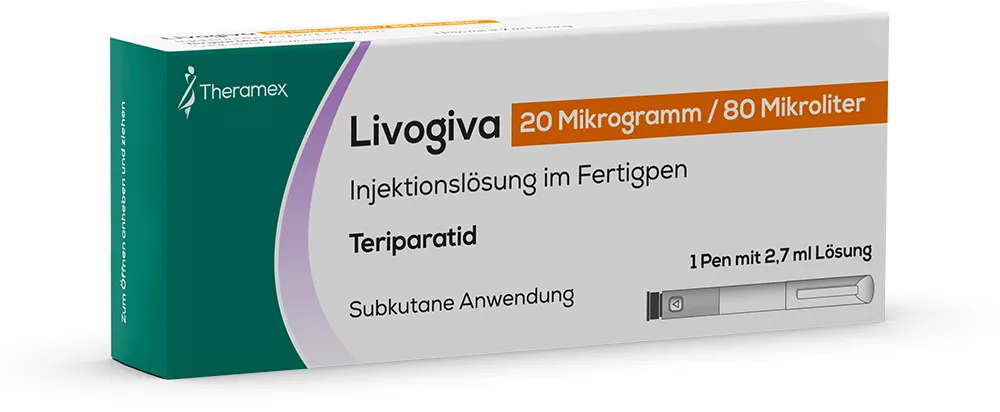
Table of Contents
- Package leaflet: Information for the user
- Livogiva 20 micrograms/80 microliters solution for injection in pre-filled pen
- 1. What Livogiva is and what it is used for
- 2. What you need to know before taking Livogiva
- 3. How to take Livogiva
- 4. Possible side effects
- 5. How to store Livogiva
- 6. Package contents and other information
Package leaflet: Information for the user
Livogiva 20 micrograms/80 microliters solution for injection in pre-filled pen
teriparatide
Please read all of this leaflet carefully before you start using this medicine because it contains important information for you.
- Keep this leaflet. You may need to read it again.
- If you have any questions, ask your doctor or pharmacist.
- This medicine has been prescribed for you only. Do not give it to others, even if their symptoms are the same as yours, as it may be harmful.
- If you experience any side effects, including those not listed in this leaflet, tell your doctor or pharmacist. See section 4.
Contents of this leaflet
- What Livogiva is and what it is used for
- What you need to know before using Livogiva
- How to use Livogiva
- Possible side effects
- How to store Livogiva
- Contents of the pack and other information
1. What Livogiva is and what it is used for
Livogiva contains the active substance teriparatide, which is used to strengthen bones and reduce the risk of fractures by stimulating bone regeneration.
Livogiva is used to treat osteoporosis in adults. Osteoporosis is a disease that causes bones to become thin and fragile. This condition is particularly common in women after menopause, but it can also occur in men. Osteoporosis is also common in patients receiving corticosteroid treatment.
2. What you need to know before taking Livogiva
Do not take Livogiva
- if you are allergic to teriparatide or to any of the other ingredients of this medicine (listed in section 6)
- if you have high levels of calcium (pre-existing hypercalcemia)
- if you have severe kidney problems
- if you have ever been diagnosed with bone cancer or other cancers that have spread to the bones (metastases)
- if you have other bone diseases; if you have a bone disease, inform your doctor
- if you have high levels of alkaline phosphatase in the blood of unknown origin, which may indicate Paget's disease of the bone (a disease causing abnormal bone changes); if you are unsure, ask your doctor
- if you have undergone radiotherapy involving the bones
- if you are pregnant or breastfeeding.
Warnings and precautions
Livogiva may cause an increase in calcium levels in the blood or urine.
Talk to your doctor or pharmacist before or during treatment with Livogiva:
- if you continuously experience nausea, vomiting, constipation, fatigue, or muscle weakness. These may be signs of excessive calcium in the blood;
- if you suffer from kidney stones or have had kidney stones in the past;
- if you have kidney problems (moderate renal impairment).
Some patients may experience dizziness or rapid heartbeat after taking the first doses. During the initial doses, if you feel dizzy, inject Livogiva in a place where you can sit or lie down.
The recommended treatment period of 24 months must not be exceeded.
Livogiva must not be used in young adults.
Children and adolescents
Livogiva must not be used in children and adolescents (under 18 years of age).
Other medicines and Livogiva
Inform your doctor or pharmacist if you are taking, have recently taken, or might take any other medicines, as interactions may occasionally occur (e.g. digoxin/digitalis, a medicine used to treat heart conditions).
Pregnancy and breastfeeding
Do not take Livogiva if you are pregnant or breastfeeding. If you are a woman of childbearing age, you must use effective contraception during treatment with Livogiva. If you become pregnant, Livogiva must be discontinued. Ask your doctor or pharmacist for advice before taking any medicine.
Driving and using machines
Some patients may experience dizziness after injection of Livogiva. If you feel dizzy, do not drive or operate machinery until you feel better.
Livogiva contains sodium
This medicine contains less than 1 mmol of sodium (23 mg) per dose, i.e. essentially 'sodium-free'.
3. How to take Livogiva
Take this medicine exactly as instructed by your doctor. If you have any doubts, consult your doctor or pharmacist.
The recommended dose is 20 micrograms administered once daily by subcutaneous injection (injection under the skin) in the thigh or abdomen. To help you remember to take the medicine, inject it at the same time each day.
Inject Livogiva every day for the length of time prescribed by your doctor. The total duration of treatment with Livogiva must not exceed 24 months. You must not receive more than one 24-month course of treatment in your lifetime.
Your doctor may advise you to take Livogiva with calcium and vitamin D and will tell you how much calcium and vitamin D to take each day.
Read the user manual included in the pack for instructions on how to use Livogiva.
Injection needles are not included in the pen pack. You may use pen needles with gauge 29–31 (diameter 0.25–0.33 mm).
You should proceed with the injection of Livogiva shortly after removing the pen from the refrigerator, as described in the user manual. After use, immediately return the pen to the refrigerator. Use a new needle for each injection and dispose of it after each use. Never store the pen with the needle attached. Never share your Livogiva pen with other people.
Livogiva may be taken regardless of meals.
If you take more Livogiva than you should
If you accidentally take more Livogiva than you should, contact your doctor or pharmacist.
Expected effects of an overdose include nausea, vomiting, dizziness, and headache.
If you forget or are unable to take Livogiva at your usual time,
administer the injection as soon as possible during the day. Do not use a double dose to make up for a forgotten dose. Do not administer more than one injection on the same day. Do not try to make up for a missed dose.
If you stop treatment with Livogiva
If you are considering stopping treatment with Livogiva, discuss this first with your doctor. Your doctor will advise you and decide how long you should continue treatment with Livogiva.
If you have any questions about how to use this medicine, consult your doctor or pharmacist.
4. Possible side effects
Like all medicines, this medicine can cause side effects, although not everybody gets them.
The most common side effects are limb pain (frequency: very common, may affect more than 1 in 10 people) and nausea, headache, and dizziness (frequency: common).
If you feel dizzy after the injection, you should sit or lie down until you feel better. If you do not feel better, contact your doctor before continuing treatment. Cases of fainting have been reported with the use of teriparatide.
If you experience discomfort such as skin redness, pain, swelling, itching, localized small bruising, or minimal bleeding around the injection site (frequency: common), this should resolve within a few days or weeks. Otherwise, contact your doctor as soon as possible.
Some patients have experienced allergic reactions shortly after injection, including shortness of breath, facial swelling, skin rash, and chest pain (frequency: rare). In rare cases, severe and potentially life-threatening allergic reactions, including anaphylaxis, may occur.
Other side effects include:
Common: may affect up to 1 in 10 people
- increased cholesterol levels in the blood
- depression
- neuralgic leg pain
- feeling of weakness
- irregular heartbeat
- shortness of breath
- increased sweating
- muscle cramps
- loss of energy
- fatigue
- chest pain
- decrease in blood pressure
- heartburn (a sensation of pain or burning just below the breastbone)
- general feeling of malaise (vomiting)
- presence of a hernia in the tube that carries food to the stomach (hiatal hernia)
- decrease in haemoglobin or number of red blood cells in the blood (anaemia)
Uncommon: may affect up to 1 in 100 people
- increased heart rate
- abnormal heart sounds
- laboured breathing
- haemorrhoids
- involuntary loss or leakage of urine
- increased need to pass fluids (increased urination)
- weight gain
- kidney stones
- muscle pain and joint pain. Some patients have experienced severe cramps or back pain requiring hospitalization
- increased calcium levels in the blood
- increased uric acid levels in the blood
- increase in an enzyme called alkaline phosphatase
Rare: may affect up to 1 in 1,000 people
- reduced kidney function, including kidney impairment
- development of swelling, particularly in the hands, feet, and legs.
Reporting of side effects
If you experience any side effects, including those not listed in this leaflet, talk to your doctor or pharmacist. You can also report side effects directly via the national reporting system referred to in Annex V.
By reporting side effects, you can help provide more information on the safety of this medicine.
5. How to store Livogiva
Keep this medicine out of the sight and reach of children.
Do not use this medicine after the expiry date which is stated on the carton and on the pen after
"Exp.". The expiry date refers to the last day of that month.
Livogiva must always be stored in a refrigerator (temperature from 2°C to 8°C). You may use Livogiva
for up to 28 days after the first injection; during this period, the pen should be kept in the refrigerator
(temperature from 2°C to 8°C).
Avoid placing the pens near the freezer compartment of the refrigerator to prevent freezing. Do not use Livogiva if it has been frozen.
After 28 days, each pen must be properly disposed of, even if it is not completely empty.
Livogiva contains a clear, colourless solution. Do not use Livogiva if you notice the presence of solid particles or if the solution appears cloudy or discoloured.
Do not dispose of any medicine via wastewater or household waste. Ask your pharmacist how to dispose of medicines no longer required. This will help protect the environment.
6. Package contents and other information
What Livogiva contains
-
The active substance is teriparatide. Each millilitre of injectable solution contains 250 micrograms of teriparatide. Each 2.7 mL pre-filled pen contains 675 micrograms of teriparatide (equivalent to 250 micrograms per mL).
-
The excipients are glacial acetic acid, sodium acetate trihydrate, mannitol, metacresol and water for injections. See section 2.
Description of the appearance of Livogiva and contents of the pack
Livogiva is a clear, colourless solution. Livogiva is supplied in a cartridge contained within a single-use pre-filled pen. Each pen contains 2.7 mL of solution, sufficient for 28 doses.
Livogiva is available in packs containing one or three pre-filled pens.
Not all pack sizes may be available.
Marketing Authorisation Holder
Theramex Ireland Limited
3rd Floor Kilmore House, Park Lane, Spencer Dock
DO1 YE64 Dublin 1
Ireland
Manufacturer
Eurofins PROXY Laboratories (PRX)
Archimedesweg 25 2333 CM Leiden
The Netherlands
Further information
More detailed information on this medicine is available on the European Medicines Agency website: http://www.ema.europa.eu.
USER MANUAL
Livogiva 20 micrograms/80 microlitres solution for injection in pre-filled pen
IMPORTANT INFORMATION
DO NOT begin the administration procedure before carefully reading the package leaflet and this user manual included in the Livogiva carton. Follow the instructions carefully when using the Livogiva pen.
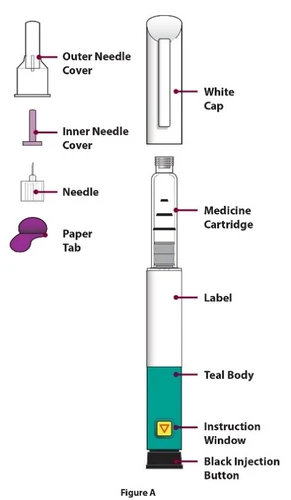
Livogiva pen and parts
Needles with gauge 29-31 (diameter 0.25-0.33 mm) may be used.
Needles not included.
Instructions for use
Preparation for injection
Step 1 A) Wash your hands before each
Prepare the injection.
and remove the B) Prepare the injection site (thigh
cap or abdomen) as recommended
by your doctor or pharmacist.
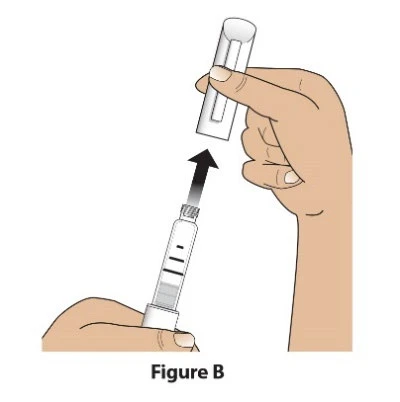
C) Remove the white cap
by pulling it off the device
(Figure B).
Step 2 A) Check the pen.
Check the DO NOT use the Livogiva pen if it is
pen, damaged.
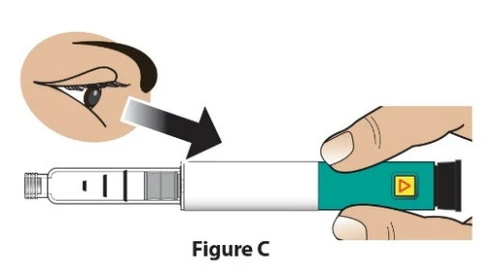
the pen label B) Check the pen label.
and the DO NOT use the pen if it contains the
medicinal product wrong medicinal product or if the
medicinal product has expired (Figure C).
C) Check the cartridge of
medicinal product. The liquid
should be clear and transparent.
DO NOT use the medicinal product if it is cloudy,
coloured or contains suspended particles. (Figure C).
Step 3 A) Remove the paper tab
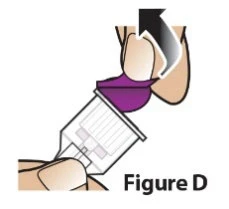
Attach a new (Figure D).
needle
B) Push the needle
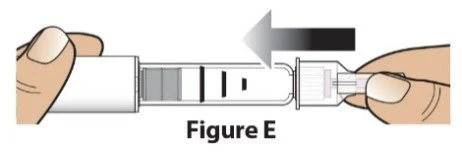
perpendicularly into the
medicinal product cartridge (Figure
E).
Screw the needle on clockwise until
it is securely attached
(Figure F).
Do not overtighten the needle.
Step 4 Remove the large outer needle
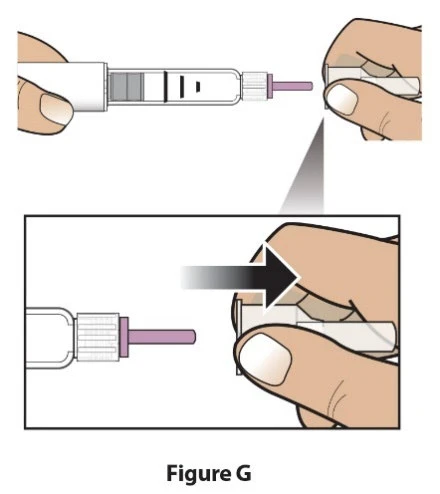
Remove the cap and keep it for later use
outer needle (see Step 9).
cap
Step 5 Push the black button outward for
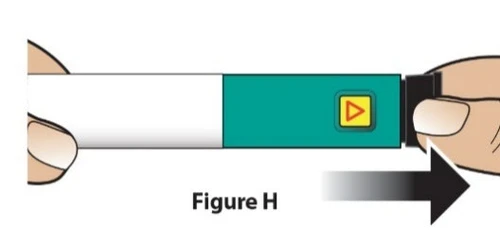
Set the dose injection until it stops. (Figure H).
Check to ensure that the red line is visible
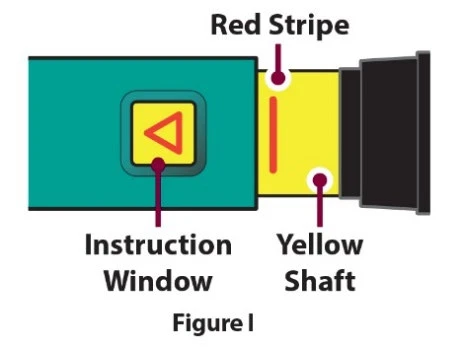
The instruction window will also
display an arrow pointing towards
the end of the pen containing the
needle (Figure I).
Troubleshooting dose setting
If the pen does not set completely or if you cannot pull back the black injection button, refer to Troubleshooting E.
Administration of the injection
Step 6 Remove the small inner needle
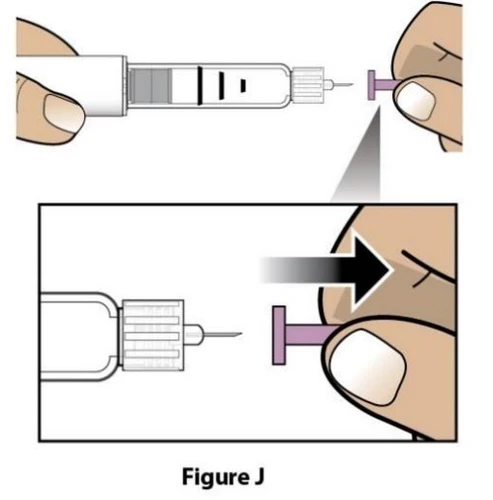
Remove the cap and dispose of it. (Figure J). The
inner needle needle is now visible.
cap
Step 7 Gently pinch a fold of skin on the
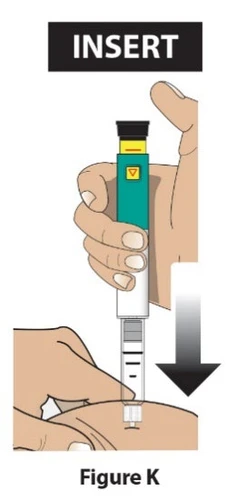
Inject the dose thigh or abdomen and insert the needle
perpendicularly into the pinched skin
(Figure K).
B) Press the black injection button until
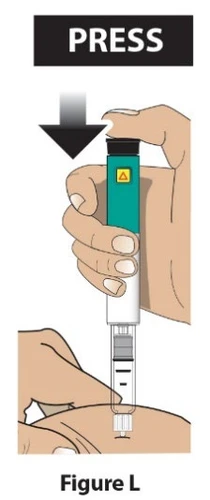
it stops and hold it in place
(Figure L).
C) Hold it in place and c-o-u-n-t s-l-o-w-l-y to 5
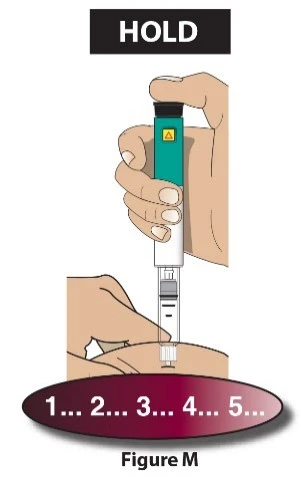
to ensure the full dose is delivered (Figure M).
You may not see the black injection button move. To confirm that the dose has been delivered, refer to Step 8 “Dose confirmation”.
D) Remove the needle from the skin (Figure N).
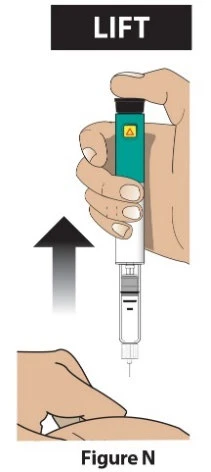
When the needle is removed from the skin, remove your thumb from the black injection button.
After injection
Step 8 Check to ensure that the black
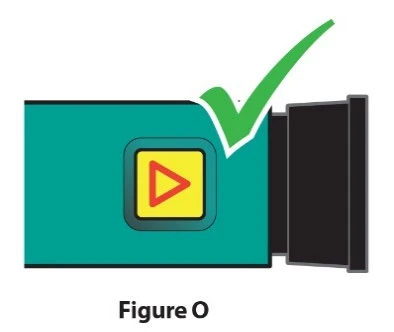
Confirm the dose injection button is fully depressed. The
instruction window will show an arrow
pointing TOWARDS the black button.
If the yellow rod is not visible, the injection steps have been completed correctly. (Figure O)
Important
DO NOT see any part of the yellow rod. If you do see it and have already injected the medicine, DO NOT administer a second injection on the same day.
Instead, YOU MUST reset the pen.
Refer to Troubleshooting A.
Step 9 A) Place the large outer needle
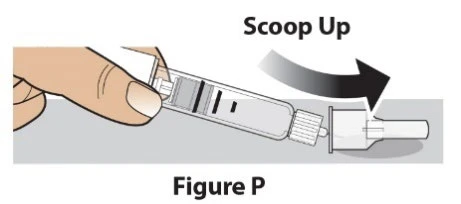
Remove and cap back over the needle by
dispose of the picking it up and pressing the
needle needle against it (Figure P and Q). Do not attempt to replace the needle cap with your hands.
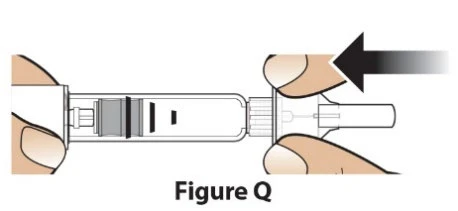
B) Unscrew the capped needle completely by rotating the large outer needle cap 3-5 times counterclockwise (Figure R).
Pull the needle off firmly (Figure S).
C) Dispose of the needle in a sharps container according to local regulations (Figure T).
DO NOT reuse the needle.
Needle disposal
For more information on proper needle disposal, refer to the section Disposal information.
Step 10
A) Replace the white cap
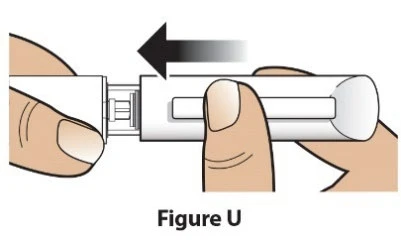
Recap and (Figure U).
store the pen
B) After use, always store the pen in the refrigerator with the white cap attached (Figure V).
DO NOT store the pen with a needle attached.
Troubleshooting
| Problem | Solution |
|------------|-------------|
| A The white rod is still visible after pushing the black injection button. How do I reset Livogiva? | To reset the Livogiva pen, follow these steps:
1) If you have already injected, DO NOT administer a second injection on the same day. Use a new needle for the next day’s injection.
2) Remove the needle.
3) Attach a new needle, remove the large outer needle cap and keep it.
4) Remove the inner needle cap and dispose of it.
5) Point the needle downward into an empty container. Push the black injection button until it stops. Hold it and count slowly to 5. You may see liquid flow or leakage. When finished, the black injection button must be fully depressed.
6) If the yellow rod is still visible, do not use this pen; contact your doctor or pharmacist.
7) Place the large outer needle cap over the needle. Unscrew the needle completely by rotating the cap 3-5 times counterclockwise. Remove and dispose of the cap as instructed by your doctor or pharmacist. Recap the pen and return Livogiva to the refrigerator.
This problem can be avoided by always using a NEW needle for each injection and pushing the black injection button fully and counting slowly to 5. |
| B How can I tell if Livogiva is working? | Livogiva is designed to deliver the full dose every time it is used according to the instructions in the Instructions for use section. The black injection button must be fully depressed to confirm that the full dose of medicine has been administered. Always use a new needle to ensure Livogiva functions correctly. |
| C I see an air bubble inside Livogiva. | A small air bubble will not affect the dose and is not dangerous. You may continue to use the dose as normal. |
| D I cannot remove the needle. | 1) Place the large outer needle cap over the needle.
2) Use the large outer needle cap to unscrew the needle.
3) Unscrew the needle completely by rotating the large outer needle cap 3-5 times counterclockwise.
4) If you still cannot remove the needle, ask someone for help.
See Step 9 “Removing and disposing of the needle”. |
| E What should I do if I cannot pull back the black injection button? | Use a new Livogiva pen to administer the dose as instructed by your doctor or nurse. When it becomes difficult to pull back the black injection button, this means there is not enough medicine left in the Livogiva pen for another dose. You may still notice some medicine remaining in the cartridge. |
Cleaning and storage
How to clean the Livogiva pen
- Clean the outside of Livogiva with a damp cloth.
- Do not immerse Livogiva in water, and do not wash or clean the pen with any liquid.
How to store the Livogiva pen
- Read and follow the storage instructions in the Package leaflet.
- DO NOT store Livogiva with a needle attached. Doing so may compromise the sterility of the medicine for subsequent injections.
- Store Livogiva with the white cap attached.
- If Livogiva has been left out of the refrigerator, do not discard the pen. Return it to the refrigerator and contact your doctor or pharmacist.
Disposal information
Disposal of pen needles and the Livogiva pen
- Before discarding the Livogiva pen, ensure the needle is removed.
- Place used needles in a sharps container or in a hard plastic container with a tightly secured lid. Do not dispose of needles directly into household waste.
- Do not recycle a full sharps container.
Other important notes
- DO NOT transfer the medicine into a syringe.
- During injection, you may hear one or more clicks – this is part of the pen’s normal operation.
- Livogiva is not recommended for use by blind or visually impaired persons without assistance from someone trained in the correct use of the pen.
This user manual was last updated on: