Litfulo
Italy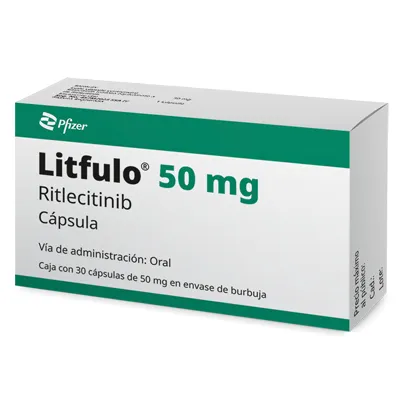
Table of Contents
Patient Information Leaflet
Litfulo 50 mg Hard Capsules
ritlecitinib

This medicinal product is subject to additional monitoring. This will allow for rapid identification of new safety information. You can help by reporting any side effects you experience while taking this medicine. See the end of section 4 for information on how to report side effects.
Please read this leaflet carefully before taking this medicine, as it contains important information for you.
- Keep this leaflet. You may need to read it again.
- If you have any questions, consult your doctor or pharmacist.
- This medicine has been prescribed for you only. Do not give it to others, even if their symptoms are the same as yours, as it could be harmful.
- If you experience any side effect, including those not listed in this leaflet, consult your doctor or pharmacist. See section 4.
In addition to this patient information leaflet, your doctor will provide you with a patient card containing important safety information you should be aware of. Keep this patient card with you.
Contents of this leaflet
- What Litfulo is and what it is used for
- What you need to know before taking Litfulo
- How to take Litfulo
- Possible side effects
- How to store Litfulo
- Contents of the pack and other information
1. What Litfulo is and what it is used for
Litfulo contains the active substance ritlecitinib. It is used to treat severe alopecia areata in adults and adolescents aged 12 years and older. Alopecia areata is a disease in which the body's immune system attacks the hair follicles, causing inflammation that leads to hair loss on the scalp and/or other body areas.
Litfulo works by reducing the activity of enzymes called JAK3 and TEC kinases, which are involved in hair follicle inflammation. By doing so, it reduces inflammation and promotes regrowth of hair and body hair in patients with alopecia areata.
2. What you should know before taking Litfulo
Do not take Litfulo
- if you are allergic to ritlecitinib or to any of the other ingredients of this medicine (listed in section 6);
- if you have a severe infection, including tuberculosis;
- if you have severe liver problems;
- if you are pregnant or breastfeeding (see the section “Pregnancy, contraception, breastfeeding and fertility”).
Warnings and precautions
Talk to your doctor or pharmacist before and during treatment with Litfulo if:
- you have an infection (possible signs may include fever, sweating, chills, muscle aches, cough, shortness of breath, blood in phlegm, weight loss, diarrhoea, stomach pain, burning during urination, urinating more frequently than usual, or feeling acutely tired). Litfulo may reduce your body’s ability to fight infections, which could worsen an existing infection or increase the risk of developing a new one;
- you have diabetes or are over 65 years old, as you may have a higher risk of developing infections;
- you have or have had tuberculosis, or have been in close contact with someone who has tuberculosis, or if you live in or travel to areas where tuberculosis is common. Your doctor will test you for tuberculosis before starting treatment with Litfulo and may repeat the test during treatment;
- you have previously had a herpes infection (such as chickenpox or Herpes Zoster), as Litfulo could cause it to reappear. Inform your doctor if you develop a painful skin rash with blisters, as this may be a sign of Herpes Zoster;
- you have previously had hepatitis B or hepatitis C; your doctor will test you for hepatitis before starting treatment with Litfulo and may repeat the test during treatment;
- you have or have had cancer; it is not clear whether Litfulo increases the risk of cancer, and your doctor will assess with you whether treatment with this medicine is appropriate and whether you will need monitoring during treatment, including regular skin checks;
- you have previously had blood clots in the veins of your legs (deep vein thrombosis) or in your lungs (pulmonary embolism). Inform your doctor if you experience leg pain or swelling, chest pain, or shortness of breath, as these may be signs of blood clots in the veins;
- you have previously had a blood clot in an artery of the eye (retinal occlusion) or in the heart (heart attack). Inform your doctor if you experience sudden changes in vision (blurred vision, partial or complete vision loss), chest pain, or shortness of breath, as these may be signs of blood clots in the arteries;
- you have recently received or plan to receive a vaccination (immunisation), as certain vaccines (live vaccines) are not recommended while taking Litfulo. Before starting treatment with Litfulo, check with your doctor whether your vaccinations are up to date and whether any further vaccinations are needed, including vaccination against herpes zoster;
- you experience unexplained symptoms caused by a nervous system problem while taking Litfulo. Your doctor will assess together with you whether treatment should be suspended.
Additional monitoring tests
Your doctor will perform blood tests to check for low white blood cell count or low platelet count before starting and approximately 4 weeks after starting treatment with Litfulo, and may adjust your treatment if necessary.
Children
This medicine is not approved for use in children under 12 years of age, as the safety and benefits of Litfulo have not been established in this age group.
Other medicines and Litfulo
Inform your doctor or pharmacist if you are taking, have recently taken, or might take any other medicines.
In particular, inform your doctor or pharmacist before taking Litfulo if you are taking any of the following medicines for:
- anxiety or sleep disorders (such as midazolam);
- heart rhythm problems (such as quinidine);
- gout (such as colchicine);
- organ transplant rejection (such as cyclosporine, everolimus, tacrolimus and sirolimus);
- migraine (such as dihydroergotamine and ergotamine);
- schizophrenia and chronic psychosis (such as pimozide);
- asthma (such as theophylline);
- muscle spasms (such as tizanidine);
- idiopathic pulmonary fibrosis (such as pirfenidone).
Litfulo may increase the levels of these medicines in your blood.
If any of the above conditions apply to you or if you have any doubts, talk to your doctor or pharmacist before taking Litfulo.
Pregnancy, contraception, breastfeeding and fertility
If you are pregnant, suspect you may be pregnant, are planning to become pregnant, or are breastfeeding, consult your doctor or pharmacist before taking this medicine.
Contraception in women
If you are a woman of childbearing age, you must use effective contraceptive methods during treatment with Litfulo and for at least one month after the last dose. Your doctor may advise you on appropriate contraceptive methods.
Pregnancy
Do not use Litfulo if you are pregnant, suspect you may be pregnant, or are planning a pregnancy. This medicine may harm the developing baby. Inform your doctor immediately if you become pregnant or think you may have become pregnant during treatment.
Breastfeeding
Do not use Litfulo if you are breastfeeding, as it is not known whether this medicine is excreted in breast milk or whether it may affect the infant. You and your doctor must decide whether you will breastfeed or use this medicine.
Fertility
It is not known whether Litfulo reduces fertility in women or men of reproductive age.
Driving and using machines
Litfulo does not affect or has a negligible effect on the ability to drive or use machinery.
Litfulo contains lactose
If your doctor has diagnosed you with an intolerance to certain sugars, contact them before taking this medicine.
3. How to take Litfulo
Take this medicine exactly as directed by your doctor. If you have any doubts, consult your doctor or pharmacist.
The recommended dose is 50 mg once daily, taken orally.
You must swallow the capsule whole with water. Do not open, crush, or chew the capsule before swallowing, as this could alter the amount of medicine absorbed by your body.
You may take the capsule regardless of meals.
If you take more Litfulo than you should
If you take more Litfulo than prescribed, contact your doctor, as you may experience some of the adverse reactions described in section 4.
If you forget to take Litfulo
- If you forget a dose, take it as soon as you remember, unless there is less than 8 hours remaining before your next scheduled dose.
- If less than 8 hours remain before your next dose, skip the missed dose and take the next dose at the usual time.
- Do not take a double dose to make up for the missed capsule.
If you stop taking Litfulo
Do not stop taking Litfulo without first discussing it with your doctor.
If it is necessary to interrupt treatment with Litfulo for a short period (not longer than 6 weeks), the risk of hair loss is low.
If you have any questions about the use of this medicine, consult your doctor or pharmacist.
4. Possible side effects
Like all medicines, this medicine can cause side effects, although not everybody gets them.
Serious side effects
Contact your doctor immediately if you experience signs of:
- herpes zoster, a painful skin rash with blisters, with or without fever
- urticaria, a skin rash accompanied by itching
Other side effects
Common ( may affect up to 1 in 10 people)
- Infections of the nose, throat or trachea
- Diarrhoea
- Dizziness
- Acne
- Skin rash (different from urticaria and herpes zoster)
- Inflammation (swelling) of the hair follicles which may be itchy or painful (folliculitis)
- Increase in an enzyme called creatine phosphokinase, evident from blood tests (increased blood creatine phosphokinase)
Uncommon ( may affect up to 1 in 100 people)
- Low platelet count evident from blood tests (decreased platelet count)
- Low white blood cell count evident from blood tests (decreased lymphocyte count)
- Increase in liver enzymes in the blood (increased ALT and AST)
Reporting of side effects
If you experience any side effect, including those not listed in this leaflet, tell your doctor or pharmacist.
You can also report side effects directly via the national reporting system listed in Annex V. By reporting side effects, you can help provide more information on the safety of this medicine.
5. How to store Litfulo
Keep this medicine out of the sight and reach of children.
Do not use this medicine after the expiry date which is stated on the carton, vial, or blister after Exp. The expiry date refers to the last day of that month.
This medicine does not require any special storage temperature conditions.
Store in the original packaging to protect the medicine from light.
Do not dispose of medicines via wastewater or household waste. Ask your pharmacist how to dispose of medicines you no longer use. This will help protect the environment.
6. Package contents and other information
What Litfulo contains
- The active substance is ritlecitinib. Each hard capsule contains ritlecitinib tosylate equivalent to 50 mg of ritlecitinib.
- The other components are:
Contents of the hard capsule: microcrystalline cellulose, lactose monohydrate, crospovidone, glyceryl dibehenate (see section 2, “Litfulo contains lactose monohydrate”).
Capsule shell: hypromellose (E464), titanium dioxide (E171), iron oxide yellow (E172), brilliant blue FCF (E133).
Printing ink: shellac, propylene glycol, concentrated ammonia solution, iron oxide black (E172), potassium hydroxide.
Description of the appearance of Litfulo and package contents
The 50 mg opaque hard capsules of Litfulo have a yellow body and a blue cap, are approximately 16 mm long and 6 mm wide, with “RCB 50” printed on the body and “Pfizer” printed on the cap in black.
The 50 mg hard capsules are supplied in high-density polyethylene (HDPE) bottles with a polypropylene closure containing 28 hard capsules, or in OPA/Al/PVC/Al blisters containing 30 or 90 hard capsules. The bottle contains a silica gel desiccant to keep the capsules dry. Do not ingest the silica gel desiccant.
It is possible that not all pack sizes are marketed.
Marketing Authorisation Holder
Pfizer Europe MA EEIG
Boulevard de la Plaine 17
1050 Brussels
Belgium
Manufacturer
Pfizer Manufacturing Deutschland GmbH
Mooswaldallee 1
79108 Freiburg im Breisgau
Germany
For further information on this medicinal product, please contact the local representative of the Marketing Authorisation Holder:
België/Belgique/Belgien