Liserdol
Italy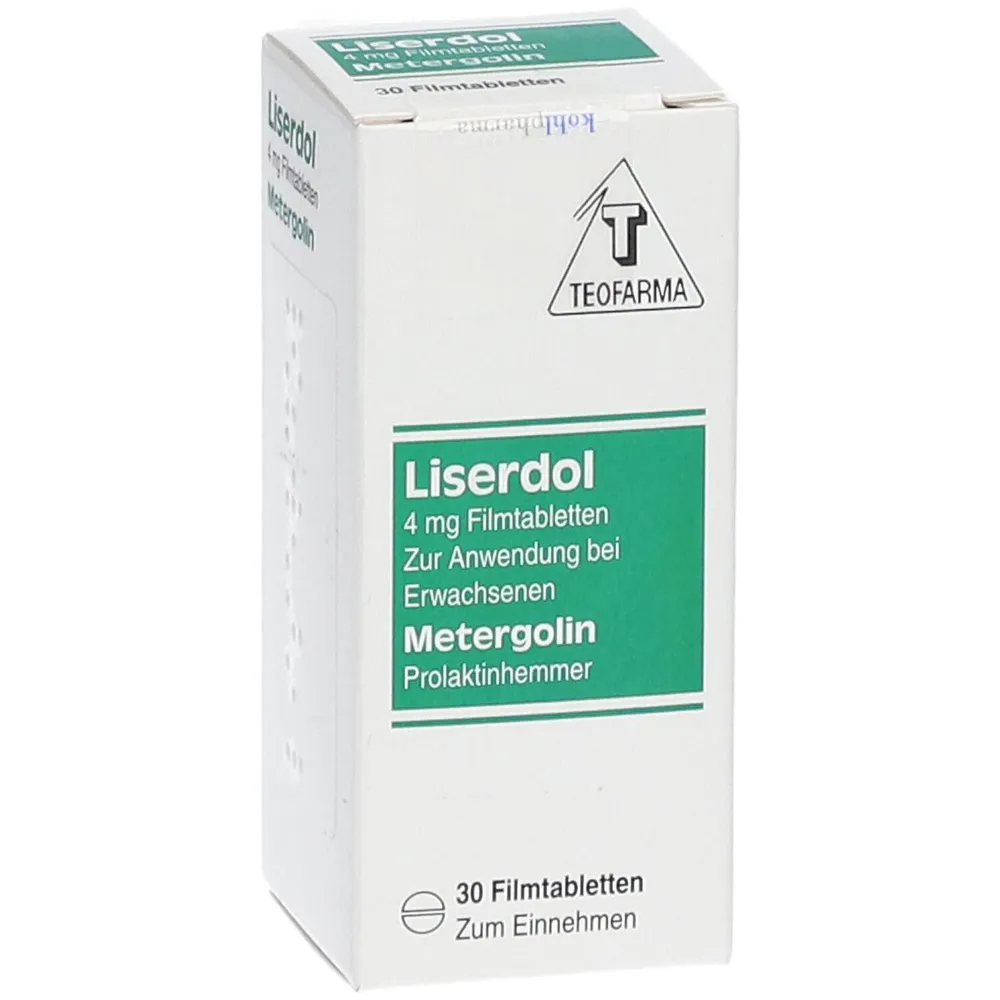
Table of Contents
Package leaflet: Information for the patient
LISERDOL 4 mg film-coated tablets
Metergoline
Please read this leaflet carefully before taking this medicine because it contains important information for you.
- Keep this leaflet. You may need to read it again.
- If you have any questions, ask your doctor or pharmacist.
- This medicine has been prescribed for you only. Do not give it to other people, even if their symptoms are the same as yours, as it could be harmful.
- If you experience any adverse reactions, including those not listed in this leaflet, contact your doctor or pharmacist. See section 4.
Contents of this leaflet:
- What LISERDOL is and what it is used for
- What you need to know before taking LISERDOL
- How to take LISERDOL
- Possible side effects
- How to store LISERDOL
- Contents of the pack and other information
1. What LISERDOL is and what it is used for
LISERDOL contains the active substance metergoline, which belongs to a group of medicines called antiserotonics, acting as a prolactin inhibitor. It is used for:
- prevention and suppression of breast milk production;
- treatment of absence of menstruation when this is due to elevated prolactin levels;
- migraine and preventive treatment of vascular headaches, i.e. those caused by alterations in the brain's blood vessels;
- gastrointestinal dumping syndrome in patients who have undergone gastric resection; diarrhea due to intestinal hypermotility;
- rare intestinal tumours (chromaffinomas).
Consult your doctor if you do not feel better or if you feel worse after a short period of time.
2. What you should know before using LISERDOL
Do not use LISERDOL:
- if you are allergic to the active substance or to any of the other ingredients of this medicine (listed in section 6);
- if you suffer from postpartum hypertension or uncontrolled hypertension;
- if you have severe peripheral circulatory disorders or coronary insufficiency;
- if you are taking phenylpropanolamine at the same time;
- in case of pre-eclampsia/eclampsia;
- if you suffer from severe psychiatric disorders;
- if you have a history of drug-induced pulmonary adverse effects such as pleuritis and fibrosis associated with the use of dopaminergic agonists;
- if you have impaired renal function or impaired hepatic function;
- for long-term treatment if echocardiographic evidence of valvular heart disease is present before treatment;
- during pregnancy and while breastfeeding (see section “Pregnancy and breastfeeding”).
Warnings and precautions
Talk to your doctor before taking Liserdol.
Hyperprolactinemia
Hyperprolactinemia may be caused by physiological factors (pregnancy, breastfeeding), hypothalamic or pituitary tumors, or by medications. Your doctor will determine the cause of hyperprolactinemia before starting causal therapy.
Inform your doctor if you have:
- severe cardiovascular diseases. As with other ergot derivatives, Liserdol should be used with caution in patients with severe cardiovascular diseases;
- Raynaud’s syndrome (white or bluish discoloration of fingers and toes after cold exposure, accompanied by numbness, coldness, stiffness);
- peptic ulcer or gastrointestinal bleeding, severe psychiatric disorders, particularly psychotic disorders;
- severe lung diseases such as pleuritis, pleural effusion, pleural fibrosis, pulmonary fibrosis;
- heart, lung, or kidney diseases characterized by fibrotic or scar tissue formation, leading to pericarditis, pericardial effusion, or retroperitoneal fibrosis. If prolonged treatment is planned, your doctor will perform an echocardiogram (heart ultrasound) before starting treatment and at regular intervals during treatment, paying particular attention to signs and symptoms suggestive of fibrotic or serous inflammatory disease. If fibrotic disease is suspected, treatment with Liserdol will be discontinued.
Impulse control disorders
Talk to your doctor if you or people around you notice the onset of symptoms related to impaired impulse control, such as pathological gambling, increased libido, hypersexuality, compulsive spending or shopping, bulimic episodes, or compulsive eating. If such symptoms occur, your doctor may consider reducing the dose or gradually discontinuing treatment.
Central nervous system impairment
Rare cases of hypertension, myocardial infarction, seizures, and stroke (symptoms known as postpartum angiopathy) have been reported when Liserdol was used to prevent or stop lactation. If any of these events occur, contact your doctor immediately, who will discontinue treatment with Liserdol.
Hypertension
Regular monitoring of blood pressure is essential during treatment with metergoline, as cases of severe postpartum hypertension and reversible cerebral angiopathy have been reported.
Orthostatic hypotension
In the first days of treatment, blood pressure may drop when moving from a sitting or lying position to standing. Since orthostatic hypotension may rarely lead to syncope, it is recommended to measure blood pressure in both lying and standing positions during the initial days of treatment. This is particularly important for patients with severe heart disease.
Confusional states
Hallucinations, nightmares, disorientation, and confusion may occur during treatment with dopaminergic agonists, especially in elderly patients and at high doses.
At the beginning of treatment, your doctor will closely monitor for these phenomena. If they persist, the doctor will decide whether the dose should be reduced or treatment discontinued.
Cerebrospinal fluid leakage
Contact your doctor immediately or go to the nearest emergency room if you have a prolactin-producing pituitary adenoma and experience leakage of cerebrospinal fluid through the nose.
There is a risk of developing meningitis if the leakage does not stop.
Neuroleptic malignant syndrome
Symptoms suggestive of neuroleptic malignant syndrome have been reported following abrupt discontinuation of dopaminergic therapy. Therefore, your doctor will explain how to gradually stop the treatment.
Combination of dopaminergic agonists and sedative drugs
Caution is recommended if you are taking sedative drugs (e.g., benzodiazepines, antipsychotics, or antidepressants) together with dopaminergic agonists, as the sedative effect may be enhanced (see section “Other medicines and Liserdol”).
Ending lactation
When stopping lactation, the baby should not be allowed to breastfeed and milk should not be expressed with a breast pump, in order to eliminate lactation stimulation.
Prolactin-induced fertility problems
During treatment for amenorrhea/galactorrhea, pregnancy may occur even without the return of menstruation. If pregnancy is confirmed, treatment with Liserdol must be stopped (see section “Pregnancy and breastfeeding”). Women of childbearing age who do not wish to become pregnant should be advised to use non-hormonal contraception.
Interaction with fluoxetine
In patients treated with fluoxetine, a recurrence of obsessive-compulsive symptoms and premenstrual syndrome symptoms has been observed 24 hours after taking metergoline. Therefore, patients with a history of such symptoms should be monitored (see “Other medicines and Liserdol”).
Liserdol contains lactose.
If your doctor has diagnosed you with an intolerance to certain sugars, please consult him before taking this medicine.
Other medicines and LISERDOL
Tell your doctor or pharmacist if you are taking, have recently taken, or might take any other medicines.
A delayed relapse of symptoms of obsessive-compulsive disorder has been observed in patients treated with fluoxetine. Various interactions with other dopamine D2 receptor agonists have been reported, which must be taken into account in this therapy.
A reduced prolactin-lowering effect is theoretically expected if drugs with strong dopamine antagonistic properties (e.g., neuroleptics) are taken concomitantly.
In patients treated with antipsychotics (except clozapine) and dopaminergic agonists simultaneously, there is a risk of reduced efficacy.
The effect of dopaminergic agonists such as Liserdol may be weakened or nullified if administered together with dopamine antagonists (e.g., certain phenothiazine or butyrophenone neuroleptics). In such cases, an appropriate adjustment of the Liserdol dosage is necessary.
Although interactions with other ergot alkaloids (e.g., methylergometrine) have not been demonstrated, simultaneous use of these with Liserdol is discouraged after childbirth and during the puerperium.
Particular caution is recommended if treatment with drugs affecting blood pressure has been used previously or concurrently.
When used in combination with levodopa-containing medicines, the dose of levodopa should be reduced after increasing the dose of dopaminergic agonists, in order to reduce the occurrence of typical levodopa-related side effects.
Antiparkinsonian anticholinergic drugs: risk of increased neuropsychiatric disorders.
Alpha-sympathomimetics (oral and/or nasal) and indirect sympathomimetics: risk of vasoconstriction and/or hypertensive crisis.
Phenylpropanolamine: risk of vasoconstriction and/or hypertensive crisis (see section “Contraindications”).
Vasoconstrictive ergot alkaloids: risk of vasoconstriction and/or hypertensive crisis.
As with other ergot derivatives, Liserdol should not be taken together with macrolide antibiotics (e.g., erythromycin), as this may lead to increased plasma levels of metergoline. Interactions with other antihypertensive drugs should also be considered.
Alcohol
The effects of alcohol on the overall tolerability of Liserdol are currently unknown.
Pregnancy and breastfeeding
If you are pregnant, suspect you may be pregnant, are planning a pregnancy, or are breastfeeding, consult your doctor before taking this medicine.
Pregnancy
The use of Liserdol is contraindicated during pregnancy. If pregnancy is confirmed during treatment, Liserdol must be discontinued.
Breastfeeding
Breastfeeding is contraindicated during treatment with Liserdol.
Driving and using machines
Liserdol may impair your ability to drive and use machinery, as it may cause drowsiness and, occasionally, sudden drops in blood pressure.
Alcohol consumption should be avoided during treatment with Liserdol.
3. How to use LISERDOL
Take this medicine exactly as directed by your doctor or pharmacist. If you have any doubts,
consult your doctor or pharmacist.
Prevention of lactation
1 tablet three times a day.
Treatment should be started within 24 hours after childbirth. The duration of treatment is 7 days, up to a
maximum of 10 days.
In rare cases of milk flow appearing after discontinuation of treatment, this can be stopped
by continuing treatment with Liserdol for another 5 days.
Suppression of lactation
1 tablet three times a day.
Treatment ends 3 days after cessation of milk flow.
Diseases and conditions causally related to increased prolactin levels, such as
✓ Absence of menstruation (amenorrhea)
✓ Abnormal milk production (galactorrhea)
½ tablet orally three times a day for the first 3–4 days of treatment, subsequently 1 tablet
three times a day. Treatment should be continued until the return of menstrual cycles, and in any case for
no less than 90 days.
Migraine and vascular headaches
½–2 tablets daily orally in divided doses.
Syndromes associated with accelerated intestinal transit
½–1 tablet orally per day, one and a half to two hours before meals.
Intestinal chromaffinomas
1–3 tablets daily orally, in divided doses.
There is no information on metergoline dosing in cases of renal or hepatic impairment (see
section “What you need to know before using LISERDOL”).
Liserdol should be taken away from meals. Tablets must be swallowed with some liquid,
without chewing.
The tablet may be divided into equal doses.
If you take more LISERDOL than you should:
In case of accidental ingestion/overdose of Liserdol, contact your doctor immediately or go to the nearest hospital, as symptoms such as increasing nausea, vomiting, dizziness, sudden drop in blood pressure upon standing (orthostatic hypotension), circulatory collapse, confusion/psychosis, or hallucinations may occur.
No specific antidotes exist. Usually, no further measures are required beyond discontinuation or interruption of therapy.
If you forget to take LISERDOL
Do not take a double dose to make up for a missed tablet.
If you stop treatment with LISERDOL
If you have any doubts about using this medicine, consult your doctor.
4. Possible side effects
Like all medicines, this medicine can cause side effects, although not everyone gets them.
The following side effects may occur:
Uncommon (may affect up to 1 in 100 people)
- Nausea, vomiting
- Headaches, dizziness
Frequency not known (frequency cannot be estimated from the available data)
- Drop in blood pressure up to circulatory collapse or tendency towards it.
- Inflammation of the pericardium, i.e. the lining membrane of the heart (pericarditis), and accumulation of fluid between the pericardium and the heart itself (pericardial effusion).
- During treatment with ergotamine derivatives such as Liserdol, changes in heart valves (including regurgitation) have been observed.
- Asthenia
- Abnormal liver enzyme values
- Somnolence
- Anxiety, disturbances in body image, confusion, conversion disorders, depression, restlessness
You might also notice the following side effects: Inability to resist the impulse or temptation to do certain things that could harm yourself or others, including:
- Gambling addiction regardless of serious personal or family consequences
- Altered or increased sexual interests and behaviours causing significant concern to you or others, for example increased sexual desire
- Uncontrolled excessive spending or shopping
- Binge eating (consuming large amounts of food in a short time) or compulsive eating (eating larger than normal amounts of food and beyond the feeling of fullness)
If any of these behaviours concern you, inform your doctor. The doctor will discuss with you the measures to prevent or resolve the symptoms.
Reporting of side effects
If you experience any side effects, including those not listed in this leaflet, talk to your doctor or pharmacist. You can also report side effects directly through the national reporting system at www.aifa.gov.it/content/segnalazioni-reazioni-avverse. By reporting side effects, you can help provide more information on the safety of this medicine.
5. How to store LISERDOL
Keep this medicine out of the sight and reach of children.
Do not use this medicine after the expiry date which is stated on the packaging after "Exp".
The expiry date refers to the last day of that month. Do not use this medicine if you notice any visible signs
of deterioration.
This medicine does not require any special storage precautions.
Do not dispose of any medicine via wastewater or household waste. Ask your pharmacist how to dispose of medicines you no longer use. This will help protect the environment.
6. Package contents and other information
What LISERDOL contains
Each film-coated tablet contains:
The active substance is metergoline 4 mg.
The other components are sodium carboxymethylcellulose, magnesium stearate, povidone, maize starch, lactose,
titanium dioxide (E171), hydroxypropylmethylcellulose, silicone, macrogol 6000.
Description of the appearance of LISERDOL and package contents
LISERDOL is available as film-coated tablets packed in a bottle containing 30 tablets.
Marketing Authorization Holder
TEOFARMA Srl
Via F.lli Cervi, 8 - 27010 Valle Salimbene (PV)
Manufacturer
TEOFARMA Srl
Viale Certosa, 8/A - 27100 Pavia