Liometacen
Italy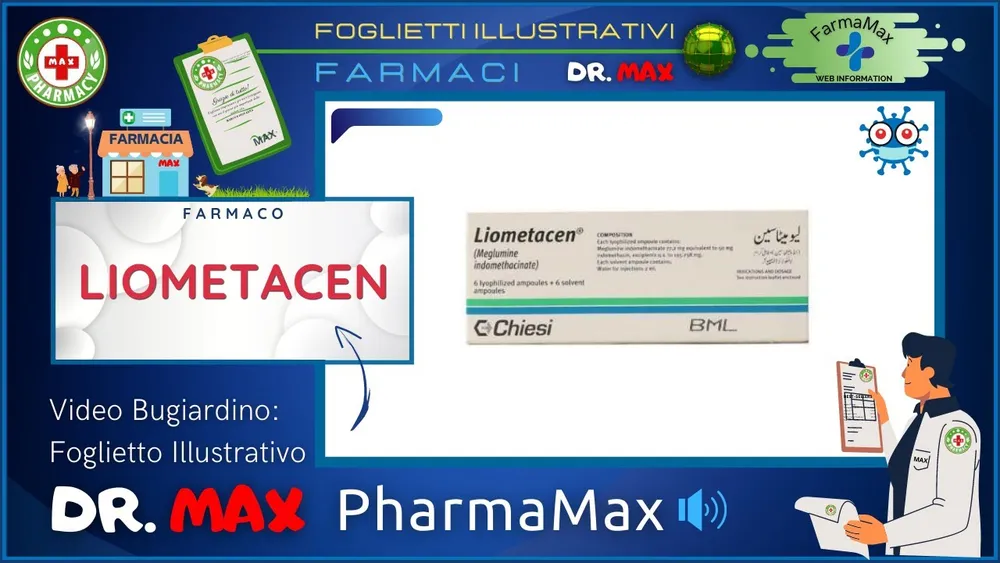
Table of Contents
- Package leaflet: Information for the patient and user
- LIOMETACEN 50 mg/2 ml powder and solvent for injectable solution for intravenous use, 25 mg/2 ml powder and solvent for injectable solution for intravenous use
- 1. What LIOMETACEN is and what it is used for
- 2. What you need to know before using LIOMETACEN
- 3. How to use LIOMETACEN
- 4. Possible side effects
- 5. How to store LIOMETACEN
- 6. Package contents and other information
Package leaflet: Information for the patient and user
LIOMETACEN 50 mg/2 ml powder and solvent for injectable solution for intravenous use, 25 mg/2 ml powder and solvent for injectable solution for intravenous use
Indometacin meglumine
Please read all of this leaflet carefully before using this medicine because it contains important information for you.
- Keep this leaflet. You may need to read it again.
- If you have any questions, ask your doctor or pharmacist.
- This medicine has been prescribed for you only. Do not give it to other people, even if their symptoms are the same as yours, as it may be harmful.
- If you experience any side effects, including those not listed in this leaflet, tell your doctor or pharmacist. See section 4.
Contents of this leaflet:
- What LIOMETACEN is and what it is used for
- What you need to know before using LIOMETACEN
- How to use LIOMETACEN
- Possible side effects
- How to store LIOMETACEN
- Package contents and other information
1. What LIOMETACEN is and what it is used for
This medicine contains the active substance indometacina meglumina and belongs to a class of medicines called NSAIDs (non-steroidal anti-inflammatory drugs) which act against pain, fever and inflammation.
LIOMETACEN is used to reduce pain (acute) caused by inflammation of the muscles and joints (musculoskeletal system).
2. What you need to know before using LIOMETACEN
Do not use LIOMETACEN if:
- you are allergic to the active substance or to any of the other components of this medicine (listed in section 6);
- you have had an allergic reaction after taking acetylsalicylic acid, known as aspirin;
- you suffer from stomach and/or duodenal (peptic) ulcer or intestinal ulcer;
- you have experienced two or more separate episodes of stomach or intestinal ulcer, perforation, or bleeding (including blood in vomit or during bowel movements, or black, tarry stools);
- you have experienced even a single episode of stomach or intestinal ulcer, perforation, or bleeding caused by taking medications;
- you suffer from severe heart problems (severe heart failure);
- you are taking diuretic drugs at high doses (intensive diuretic therapy);
- you have bleeding or are predisposed to blood loss (hemorrhagic diathesis), for example, if you are taking blood-thinning drugs (anticoagulants);
- you suffer from epilepsy;
- you suffer from parkinsonism, which may manifest as resting tremor, muscle rigidity, slowed movements, or difficulty maintaining balance;
- you are pregnant or breastfeeding.
LIOMETACEN must not be administered to children and adolescents under 14 years of age.
Warnings and precautions
Consult your doctor or nurse before LIOMETACEN is administered to you.
Inform your doctor if:
- you are taking other drugs that reduce pain (analgesics) and inflammation (NSAIDs);
- you have had stomach or intestinal disorders, such as Crohn's disease or ulcerative colitis;
- you are elderly, as you have a higher likelihood of developing adverse effects from this medicine;
- you have asthma or are prone to asthma attacks;
- you have kidney problems (e.g., hypoperfusion);
- you have liver problems such as cirrhosis or severe hepatitis;
- you have heart or blood vessel problems, a history of stroke or heart attack, suffer from heart failure, or think you may be at risk for these conditions (for example, if you have high blood pressure, diabetes, high cholesterol, or smoke), since medicines like LIOMETACEN may be associated with a modest increase in the risk of heart attack (myocardial infarction) or stroke. IN ALL THESE CASES, YOUR DOCTOR WILL EVALUATE WHETHER TO USE LIOMETACEN OR IF MONITORING TESTS ARE NEEDED DURING TREATMENT.
BE CAREFUL, because during treatment with all pain and inflammation medicines (NSAIDs):
- at any time, with or without warning symptoms, even in patients without previous serious stomach or intestinal (gastrointestinal) problems, bleeding, ulceration, or perforation of the stomach or intestine have been reported, which may be fatal; very rarely, severe skin reactions, some of which have been fatal, have been reported, presenting as redness, blistering, and skin peeling (e.g., exfoliative dermatitis, Stevens-Johnson syndrome, and toxic epidermal necrolysis). These events are more likely at the beginning of treatment, particularly during the first month of therapy.
- signs of infection may be masked.
The risk of adverse effects increases with higher doses and prolonged treatment. LIOMETACEN will be administered at the lowest effective dose and for the shortest duration possible.
After administration of LIOMETACEN, you may experience a short-term drop in blood pressure.
Contact your doctor if, during treatment with LIOMETACEN:
- you notice any symptoms affecting the stomach or intestine (gastrointestinal), especially if they involve bleeding;
- a skin rash, mucosal lesions, or any other sign of an allergic reaction appears (e.g., redness, itching, swelling of the face and throat, sudden drop in blood pressure);
- you develop eye problems;
- you experience headache (especially if severe and persistent). IN ALL THESE CASES, YOUR DOCTOR WILL EVALUATE WHETHER TO MODIFY OR DISCONTINUE TREATMENT.
Other medicines and LIOMETACEN
Inform your doctor or pharmacist if you are taking, have recently taken, or might take any other medicine. Some medicines may interact with LIOMETACEN or increase the risk of adverse events, even serious ones.
In particular, inform your doctor if you are taking:
- drugs containing cortisone (corticosteroids);
- blood-thinning drugs (anticoagulants and antiplatelet agents), e.g., warfarin, acetylsalicylic acid (known as aspirin);
- drugs for high blood pressure (hypertension) such as: diuretics, ACE inhibitors, furosemide, angiotensin II receptor antagonists;
- drugs called 'selective serotonin reuptake inhibitors' (SSRIs), used as antidepressants;
- calcitonin, used to lower blood calcium levels and treat osteoporosis;
- probenecid, a drug used for gout;
- proglumide, a drug used to treat ulcers;
- sulfonamide antibiotics, drugs used against infections;
- other drugs that reduce pain and inflammation (NSAIDs, phenylbutazone).
Pregnancy, breastfeeding, and fertility
If you are pregnant, suspect you may be pregnant, are planning a pregnancy, or are breastfeeding, consult your doctor or nurse before this medicine is administered.
LIOMETACEN will not be administered during pregnancy, as such treatment may harm the fetus or cause problems during childbirth.
NSAIDs may cause kidney and heart problems in the fetus. They may affect the bleeding tendency in both mother and baby and may delay or prolong labor more than expected. From week 20 of pregnancy, NSAIDs may cause kidney problems in the fetus, thereby reducing the levels of amniotic fluid surrounding the baby (oligohydramnios) or cause narrowing of a blood vessel (ductus arteriosus) in the baby's heart.
LIOMETACEN will not be administered if you are breastfeeding.
Administration of LIOMETACEN will be suspended in case of fertility problems or if you are undergoing fertility investigations; it should also be used with caution if you are planning a pregnancy. In all these cases, inform your doctor.
Driving and using machines
Indometacin may cause dizziness, fatigue, lightheadedness, and vision problems. Exercise caution before driving or operating machinery.
LIOMETACEN contains sodium
This medicine contains less than 1 mmol (23 mg) of sodium per dose, i.e., it is practically 'sodium-free'.
LIOMETACEN contains potassium
This medicine contains potassium, less than 1 mmol (39 mg) per dose, i.e., essentially 'potassium-free'.
3. How to use LIOMETACEN
LIOMETACEN must be used only in a hospital setting. It will be administered to you as an intravenous injection (intravenous route) exclusively by qualified personnel, such as a doctor or nurse.
The usual dose is 1-2 vials, to be diluted with 250 or 500 ml of physiological saline or glucose solution.
The intravenous infusion must be administered "drop by drop" at an infusion rate of 25-35 drops/minute.
It is preferable not to combine other preparations in the same container (e.g. bag, infusion bottle) used for the administration of LIOMETACEN.
If you use more LIOMETACEN than recommended.
Undesirable effects affecting the stomach or intestine may occur.
If you have any doubts about the use of this medicine, consult your doctor or nurse.
4. Possible side effects
Like all medicines, this medicine can cause side effects, although not everybody will experience them.
Following the instructions contained in this leaflet reduces the risk of side effects.
The use of LIOMETACEN must be stopped immediately if any of the following conditions occur:
- severe allergic reactions such as: swelling (angioedema) of the face, eyes, lips, or throat with breathing difficulties, sudden drop in blood pressure (anaphylactic shock);
- severe breathing difficulties (asthma, dyspnea);
- serious stomach problems, burning sensation or abdominal pain due to stomach or duodenal (peptic) ulcer;
- sudden, severe pain in the upper abdomen (perforated ulcer);
- vomiting blood (haematemesis) or black stools (melena), associated with bleeding from the stomach or intestine (gastrointestinal), or unusual fatigue accompanied by reduced urine output (due to non-visible bleeding);
- severe skin rashes with redness, blistering, and peeling (e.g. Stevens-Johnson syndrome, toxic epidermal necrolysis).
Other side effects
- nausea, vomiting, diarrhoea, intestinal gas (flatulence), difficulty passing stools (constipation), indigestion (dyspepsia), abdominal pain, inflammation of the mouth mucosa with ulcers (ulcerative stomatitis), worsening of colitis or Crohn's disease, gastritis;
- changes in blood parameters such as reduced red blood cells (anaemia due to bleeding, aplastic anaemia, haemolytic anaemia), reduced white blood cells (leucopenia, agranulocytosis), reduced platelets leading to red spots on the skin or bleeding (thrombocytopenic purpura), increased blood sugar levels (hyperglycaemia);
- depression and confusion, headache, dizziness, vertigo, fainting (syncope);
- visual disturbances, such as deposits in the cornea or retinal disorders;
- hearing disturbances, ringing in the ears (tinnitus);
- heart attack (myocardial infarction) or stroke, swelling (oedema), high blood pressure (hypertension), reduced heart function (heart failure);
- nosebleeds (epistaxis);
- inflammation of the liver (hepatitis) with yellowing of the skin or whites of the eyes (jaundice), which may be fatal;
- more or less sudden appearance of skin lesions, for example discoloured patches or widespread skin rashes, urticaria, itching;
- presence of blood (haematuria) or sugar (glucosuria) in the urine, changes in kidney function (renal failure);
- vaginal bleeding;
- fatigue.
Reporting of side effects
If you experience any side effect, including those not listed in this leaflet, talk to your doctor or pharmacist.
You can also report side effects directly via the national reporting system at: “https://www.aifa.gov.it/content/segnalazioni-reazioni-avverse”.
By reporting side effects, you can help provide more information on the safety of this medicine.
5. How to store LIOMETACEN
Keep this medicine out of the sight and reach of children.
Do not store at temperatures above 30 °C.
Do not use this medicine after the expiry date stated on the packaging after the word "EXP". The expiry date refers to the last day of that month. This date applies to the product in its original, unopened packaging, properly stored.
Do not dispose of any medicine via wastewater or household waste. Ask your pharmacist how to dispose of medicines you no longer use. This will help protect the environment.
6. Package contents and other information
What LIOMETACEN contains
The active substance is indometacin meglumine.
The excipients are:
- in the powder vial: mannitol, meglumine, disodium phosphate dihydrate, potassium dihydrogen phosphate;
- in the solvent vial: water for injections.
Each vial of LIOMETACEN 25 mg/2 ml and 50 mg/2 ml powder contains 38.6 and 77.2 mg of indometacin meglumine (equivalent to 25 and 50 mg of indometacin).
Each vial contains 2 ml of solvent.
Description of the appearance of LIOMETACEN and contents of the pack
LIOMETACEN 25 mg/2 ml and 50 mg/2 ml is available in packs containing 6 powder vials and 6 solvent vials of 2 ml each.
Marketing Authorisation Holder and Manufacturer
Marketing Authorisation Holder
PROMEDICA S.r.l., Via Palermo 26/A – 43122 Parma
Manufacturer
ALFASIGMA S.p.A., Via Enrico Fermi, 1 - Alanno (PE)