Libradin
Italy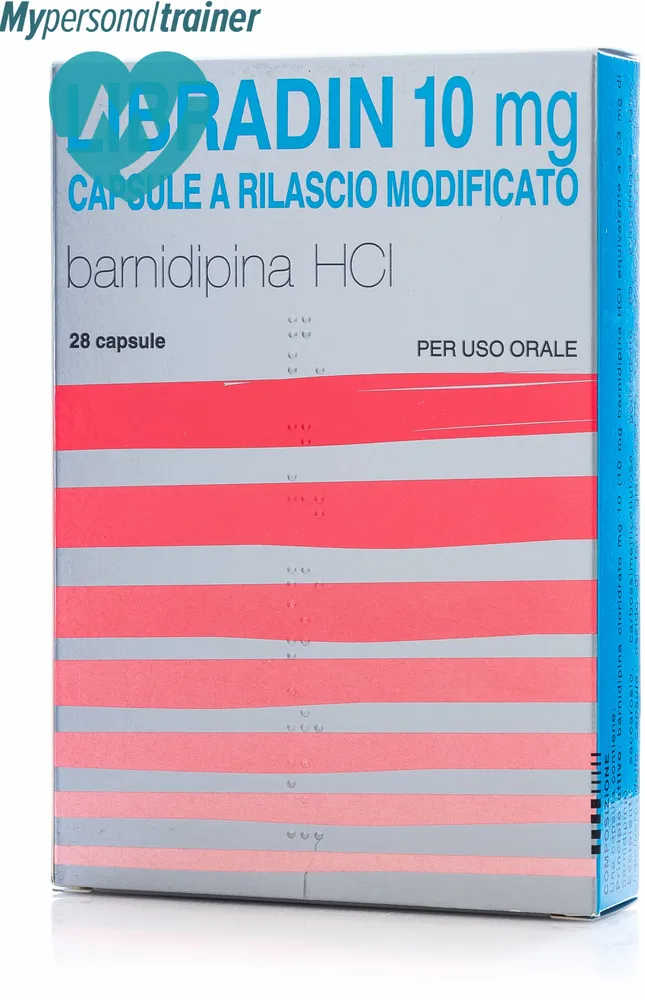
Table of Contents
- PACKAGE LEAFLET: INFORMATION FOR THE PATIENT
- LIBRADIN 10 mg modified-release capsules, 20 mg modified-release capsules
- 1. What LIBRADIN is and what it is used for
- 2. What you need to know before taking LIBRADIN
- 3. How to take LIBRADIN
- 4. Possible side effects
- 5. How to store LIBRADIN
- 6. Package contents and other information
PACKAGE LEAFLET: INFORMATION FOR THE PATIENT
LIBRADIN 10 mg modified-release capsules, 20 mg modified-release capsules
Barnidipine hydrochloride
Please read this leaflet carefully before taking this medicine because it contains
important information for you.
- Keep this leaflet. You may need to read it again.
- If you have any questions, ask your doctor or pharmacist.
- This medicine has been prescribed for you only. Do not give it to other people, even if their symptoms are the same as yours, as it may be harmful.
- If you experience any side effects, including those not listed in this leaflet, contact your doctor or pharmacist.
Contents of this leaflet:
- What LIBRADIN is and what it is used for
- What you need to know before taking LIBRADIN
- How to take LIBRADIN
- Possible side effects
- How to store LIBRADIN
- Contents of the pack and other information
1. What LIBRADIN is and what it is used for
The active substance in LIBRADIN belongs to a group of medicines called calcium antagonists.
LIBRADIN causes dilation of blood vessels, resulting in a lowering of blood pressure.
LIBRADIN capsules are "extended-release". This means that the active substance is gradually absorbed by the body and its effect lasts over time. For this reason, once-daily administration is sufficient.
LIBRADIN is used for the treatment of arterial hypertension.
2. What you need to know before taking LIBRADIN
Do not take LIBRADIN
- if you are allergic to barnidipine or to any of the other ingredients of this medicine (listed in section 6)
- if you are allergic to dihydropyridines (substances found in medicines used to treat hypertension)
- if you have liver disease
- if you have severe kidney disease
- if you have any of the following heart conditions: untreated heart failure, certain forms of chest pain (due to unstable angina pectoris), or acute heart failure
- if you are taking any of the following medicines: protease inhibitors (medicines used to treat AIDS), ketoconazole or itraconazole (medicines used to treat fungal infections), erythromycin or clarithromycin (antibiotics).
Warnings and precautions
Talk to your doctor or pharmacist before taking LIBRADIN
- if you have kidney disease
- if you have heart disease
Children and adolescents
LIBRADIN must not be given to children or adolescents under 18 years of age.
Other medicines and LIBRADIN
Inform your doctor or pharmacist if you are taking, have recently taken, or might take any other medicine.
This is particularly important if you are taking any of the following medicines, as they must not be taken together with LIBRADIN:
- protease inhibitors (medicines used to treat AIDS)
- ketoconazole or itraconazole (medicines used to treat fungal infections)
- erythromycin or clarithromycin (antibiotics)
Also inform your doctor if you are taking:
- other medicines for the treatment of hypertension, as they may cause a further drop in blood pressure
- cimetidine (a medicine used to treat stomach disorders), as it may increase the effect of LIBRADIN
- phenytoin or carbamazepine (medicines used to treat epilepsy) or rifampicin (an antibiotic), as a higher dose of LIBRADIN may be required. If you stop treatment with any of these medicines, your doctor may reduce your dose of LIBRADIN.
LIBRADIN with food and alcohol
Exercise particular caution when consuming alcohol or grapefruit juice, as these beverages may increase the effect of LIBRADIN.
Pregnancy and breastfeeding
If you are pregnant, think you may be pregnant, are planning to become pregnant, or are breastfeeding, consult your doctor or pharmacist before taking this medicine.
You must not use LIBRADIN during pregnancy unless strictly necessary.
Do not use LIBRADIN if you are breastfeeding. It may be excreted in breast milk.
Driving and using machines
There are no data suggesting that LIBRADIN may impair the ability to drive or use machinery. However, LIBRADIN may cause dizziness; therefore, you must ensure how this medicine affects you before driving or operating machinery.
LIBRADIN capsules contain sucrose. If your doctor has diagnosed you with an intolerance to certain sugars, contact him or her before taking this medicine.
3. How to take LIBRADIN
Dosage
Take this medicine exactly as your doctor has told you. If you are not sure, consult your doctor or pharmacist.
The usual starting dose is 1 capsule of LIBRADIN 10 mg once daily. Your doctor may increase this dose to 1 capsule of LIBRADIN 20 mg once daily, or two 10 mg capsules once daily.
If you are elderly, you can use the normal dosage. However, your doctor will likely monitor you more closely at the beginning of treatment.
Instructions for correct use
- Take the capsule once daily in the morning. It is preferable to associate taking the capsule with a daily routine, such as brushing your teeth or having breakfast.
- Swallow the capsules whole, preferably with a glass of water. You may take LIBRADIN before, during, or after meals, as you prefer.
- Even if you do not experience signs or symptoms of high blood pressure, it is important that you continue taking LIBRADIN every day to achieve the full benefits related to lowering blood pressure.
If you take more LIBRADIN than you should
If you accidentally take a large quantity of capsules at once, you must contact your doctor immediately or go to the nearest hospital emergency department.
Symptoms that may occur following an overdose include weakness, decreased or increased heart rate, drowsiness, confusion, nausea, vomiting, and seizures.
If you forget to take LIBRADIN
If you forget to take LIBRADIN at your usual time, take the missed dose as soon as possible the same day. If you only remember the next day, do not take a double dose to make up for the missed capsule, but continue regularly with your daily dose.
If you have any doubts about how to use this medicine, consult your doctor or pharmacist.
4. Possible side effects
Like all medicines, this medicine can cause side effects, although not everyone experiences them.
If you have a severe allergic reaction causing difficulty breathing or dizziness, you must inform your doctor or nurse immediately.
LIBRADIN may cause:
Very common: affects more than 1 in 10 people
- headache
- facial flushing
- fluid accumulation (oedema) in the arms and legs
Common: affects up to 1 in 10 people
- dizziness
- palpitations
Not known: frequency cannot be estimated from the available data
- increased heart rate
- blood tests showing changes in liver function
- skin rash
These side effects usually decrease or disappear during treatment (within one month for fluid accumulation, and within two weeks for facial flushing, headache, and palpitations).
If you experience any side effect, including those not listed in this leaflet, consult your doctor or pharmacist.
5. How to store LIBRADIN
Keep this medicine out of the sight and reach of children.
Store LIBRADIN capsules at a temperature not exceeding 25°C.
Do not use LIBRADIN after the expiry date stated on the carton after "EXP." The expiry date refers to the last day of that month.
Do not dispose of medicines via wastewater or household waste. Ask your pharmacist how to dispose of medicines no longer in use. This will help protect the environment.
6. Package contents and other information
What LIBRADIN contains
- The active substance is 10 mg or 20 mg of barnidipine hydrochloride, equivalent to 9.3 mg and 18.6 mg of barnidipine, respectively.
- The other components are: Capsule contents: carboxymethyl ethylcellulose, polysorbate 80, sucrose, ethylcellulose and talc. Capsule shell: titanium dioxide (E 171), yellow iron oxide (E 172) and gelatin. Printing ink: shellac, propylene glycol (E 1520), black iron oxide (E 172) and ammonia.
Description of the appearance of LIBRADIN and package contents
Yellow capsules.
LIBRADIN 10 mg capsules are marked with the code 155 10.
LIBRADIN 20 mg capsules are marked with the code 155 20.
LIBRADIN capsules are packaged in aluminum/aluminum blisters (with PVC and polyamide coating), contained in cardboard cartons of 10, 14, 20, 28, 30, 50, 56, 98 or 100 capsules. Not all pack sizes may be marketed.
Marketing Authorization Holder
LIBRADIN capsules are registered by Alfasigma S.p.A. - Viale Sarca, No. 223 – 20126 Milan (MI), Italy
Manufacturer responsible for batch release
Astellas Pharma Europe B.V.
Sylviusweg 62, PO Box 344
2333 AH Leiden
The Netherlands
This medicinal product is authorized in the Member States of the European Economic Area under the following names:
Spain: Barnix
The Netherlands, Portugal: Cyress
Italy: LIBRADIN
This Patient Information Leaflet was last approved in: August 2017