Levocetirizine Mylan
Italy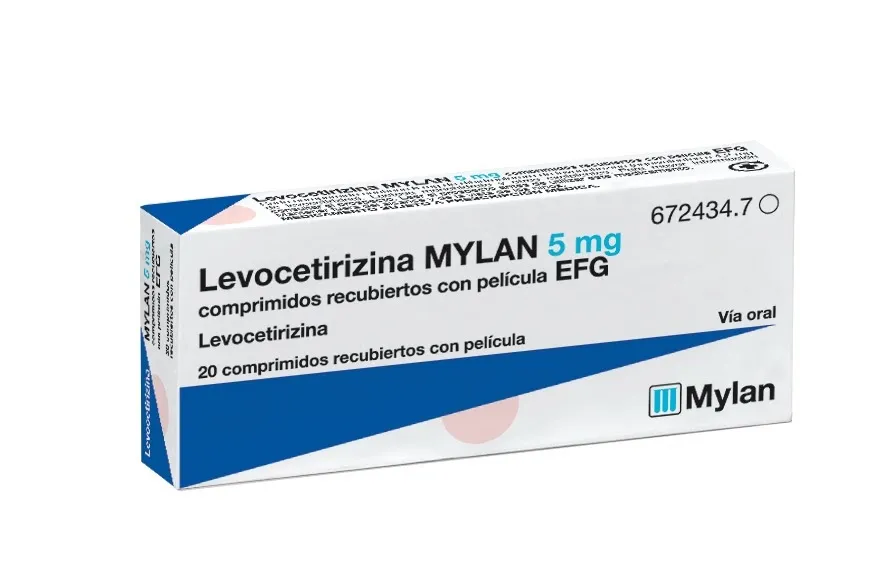
Table of Contents
- Package leaflet: Information for the patient
- Levocetirizine Mylan 5 mg film-coated tablets
- 1. What Levocetirizine Mylan is and what it is used for
- 2. What you need to know before taking Levocetirizine Mylan
- 3. How to take Levocetirizine Mylan
- 4. Possible side effects
- 5. How to store Levocetirizine Mylan
- 6. Package contents and other information
Package leaflet: Information for the patient
Levocetirizine Mylan 5 mg film-coated tablets
levocetirizine dihydrochloride
equivalent medicine
Please read this leaflet carefully before you start taking this medicine, as it contains important information for you.
- Keep this leaflet. You may need to read it again.
- If you have any questions, ask your doctor or pharmacist.
- This medicine has been prescribed for you only. Do not pass it on to other people, even if their symptoms are the same as yours, as it may be harmful.
- If you experience any adverse reactions, including those not listed in this leaflet, contact your doctor or pharmacist. See section 4.
Contents of this leaflet:
- What Levocetirizine Mylan is and what it is used for
- What you need to know before taking Levocetirizine Mylan
- How to take Levocetirizine Mylan
- Possible side effects
- How to store Levocetirizine Mylan
- Contents of the pack and other information
1. What Levocetirizine Mylan is and what it is used for
Levocetirizine is an antiallergic agent used to treat symptoms associated with allergic conditions, such as:
allergic rhinitis (including persistent allergic rhinitis)
urticaria.
2. What you need to know before taking Levocetirizine Mylan
Do not take Levocetirizine Mylan
- if you are allergic to levocetirizine, cetirizine, hydroxyzine, or other medicines known as piperazines, or to any of the other ingredients of this medicine (listed in section 6)
- if you have severe renal insufficiency (severe kidney failure with creatinine clearance below 10 ml/min)
Warnings and precautions
Talk to your doctor or pharmacist before taking Levocetirizine Mylan.
If you are unable to empty your bladder (due to conditions such as spinal cord injury or enlarged prostate), consult your doctor.
If you suffer from epilepsy or are at risk of seizures, consult your doctor, as the use of Levocetirizine Mylan may worsen seizure episodes.
If you need to undergo an allergy test, ask your doctor whether you should stop taking Levocetirizine Mylan for a few days before the test. This medicine may alter the results of allergy testing.
Children
The use of Levocetirizine Mylan is not recommended in children under 6 years of age, as the tablets cannot be split to allow dose adjustment.
Other medicines and Levocetirizine Mylan
Inform your doctor or pharmacist if you are taking, have recently taken, or might take any other medicines.
The effects of other medicines may be influenced by levocetirizine, or conversely, may influence the effects of levocetirizine.
Levocetirizine Mylan and alcohol
Caution is advised when taking Levocetirizine Mylan together with alcohol or other substances acting on the brain. In sensitive individuals, this may cause further reduction in alertness and impairment of performance.
Pregnancy and breastfeeding
If you are pregnant, think you may be pregnant, planning to become pregnant, or breastfeeding, consult your doctor or pharmacist before taking this medicine.
Driving and using machines
In some patients, levocetirizine may cause drowsiness, fatigue, tiredness, or lethargy. Specific tests have not shown any impairment of mental alertness, reaction ability, or driving skills in healthy individuals taking levocetirizine at the recommended dose. However, if you experience any of these symptoms, refrain from driving and using any machinery.
Levocetirizine Mylan contains lactose
These tablets contain lactose; if your doctor has diagnosed you with an intolerance to certain sugars, consult your doctor before taking this medicine.
3. How to take Levocetirizine Mylan
Take this medicine exactly as directed by your doctor or pharmacist. If you have
any doubts, consult your doctor or pharmacist.
The tablet should be swallowed whole with water and may be taken with or without food.
The recommended dose for adults and children aged 6 years and older is one tablet per day. Children under 6
years of age must not take Levocetirizine Mylan.
Dosing instructions for specific patient populations:
If you have mild to moderate renal impairment, your doctor may prescribe a lower dose depending on the severity of the kidney disease.
Patients with hepatic impairment only should take the usual prescribed dose.
Patients with concomitant hepatic and renal impairment may take a reduced dose depending on the severity of the renal disease.
No dose adjustment is required in elderly patients, provided their renal function is normal.
Use in children and adolescents
Levocetirizine Mylan is not recommended for children under 6 years of age, as the tablets cannot be divided to achieve the correct dose. For children aged between 2 and 6 years, a pediatric formulation is recommended.
In children with reduced renal function, the dose will be calculated based on renal function and body weight; the dose will be determined by the doctor.
If you take more Levocetirizine Mylan than you should
If you have taken more Levocetirizine Mylan than you should, drowsiness/stupor may occur in adults.
Children may initially show signs of excitement and restlessness, followed by drowsiness/stupor.
If you think you have taken an excessive dose of Levocetirizine Mylan, inform your doctor, who will decide which measures need to be taken.
If you forget to take Levocetirizine Mylan
Do not take a double dose to make up for the missed dose. Skip the missed dose and take the next tablet at your usual time.
If you stop taking Levocetirizine Mylan
Stopping treatment is not expected to cause negative effects. However, itching may occur even if it was not present before starting treatment. This symptom may resolve spontaneously or may worsen, and it may be necessary to restart treatment.
If you have any further questions about the use of this medicine, consult your doctor or pharmacist.
4. Possible side effects
Like all medicines, this medicine can cause side effects, although not everybody gets them.
Immediately inform your doctor or contact the nearest emergency room if you experience the following
serious side effects:
Not known (frequency cannot be estimated from the available data)
- Allergic reactions, such as swelling of the mouth, face and/or throat or difficulty swallowing with hives (angioedema), breathing difficulties or sudden drop in blood pressure leading to collapse or shock, which may be fatal.
- Seizures or epileptic fits.
- Recurrent thoughts of self-harm and suicide.
Other side effects are:
Common (may affect up to 1 in 10 people):
- Dry mouth
- Headache
- Tiredness
- Drowsiness/lethargy
Uncommon (may affect up to 1 in 100 people):
- Weakness
- Abdominal pain
Not known (frequency cannot be estimated from the available data):
- Aggression
- Agitation
- Vision disorders
- Oculogyric crisis (eyes with uncontrollable circular movements)
- Palpitations
- Nausea
- Diarrhea
- Liver inflammation
- Itching
- Rash
- Hives
- Muscle pain
- Joint pain
- Weight gain
- Changes in liver function tests
- Increased heart rate
- Tingling sensations
- Dizziness
- Fainting
- Tremor
- Dysgeusia (altered sense of taste)
- Sensation of spinning or movement
- Blurred vision
- Painful or difficult urination
- Inability to completely empty the bladder
- Skin rash
- Shortness of breath
- Hallucinations (seeing, hearing or sensing things that do not exist)
- Depression
- Insomnia (difficulty sleeping)
- Nightmares
- Vomiting
- Edema (swelling due to fluid accumulation)
- Increased appetite.
Itching (pruritus) may occur when stopping treatment.
Additional side effects in children:
Common (may affect up to 1 in 10 children):
- Diarrhea
- Constipation
- Difficulty sleeping
Reporting of side effects
If you experience any side effect, including those not listed in this leaflet, talk to your doctor or pharmacist. You can also report side effects directly via the Italian Medicines Agency (Agenzia Italiana del Farmaco) at www.agenziafarmaco.gov.it/content/come-segnalare-una-sospetta-reazione-avversa. By reporting side effects, you can help provide more information on the safety of this medicine.
5. How to store Levocetirizine Mylan
Keep this medicine out of the sight and reach of children.
Do not use this medicine after the expiry date which is stated on the packaging after "Exp.". The first two digits indicate the month, the last four the year.
The expiry date refers to the last day of that month.
Store the medicine in its original packaging to protect it from moisture.
Do not dispose of any medicine via wastewater or household waste. Ask your pharmacist how to dispose of medicines you no longer use. This will help protect the environment.
6. Package contents and other information
What Levocetirizina Mylan contains
The active substance is levocetirizine. Levocetirizine is present as levocetirizine dihydrochloride (5 mg),
corresponding to 4.2 mg of levocetirizine.
The excipients are microcrystalline cellulose, lactose monohydrate, magnesium stearate (core), and
hypromellose (E464), titanium dioxide (E171) and macrogol (coating).
Description of the appearance of Levocetirizina Mylan and package contents
Film-coated tablets, white to off-white, oval, biconvex, with "L9CZ" imprinted on one side and "5" on the other.
Blister packs are available, containing 20 tablets per box.
Not all pack sizes may be marketed.
Marketing Authorization Holder and Manufacturer
Marketing Authorization Holder:
Mylan SpA
Via Vittor Pisani 20
20124 Milano
Manufacturer responsible for batch release
Synthon BV
Microweg 22, 6545CM Nijmegen
The Netherlands
Synthon Hispania SL
Castelló 1, Polígono Las Salinas, 08830 Sant Boi de Llobregat
Spain
This medicinal product is authorized in the European Economic Area Member States under the following
names:
Italy – Levocetirizina Mylan