Leviogel
Italy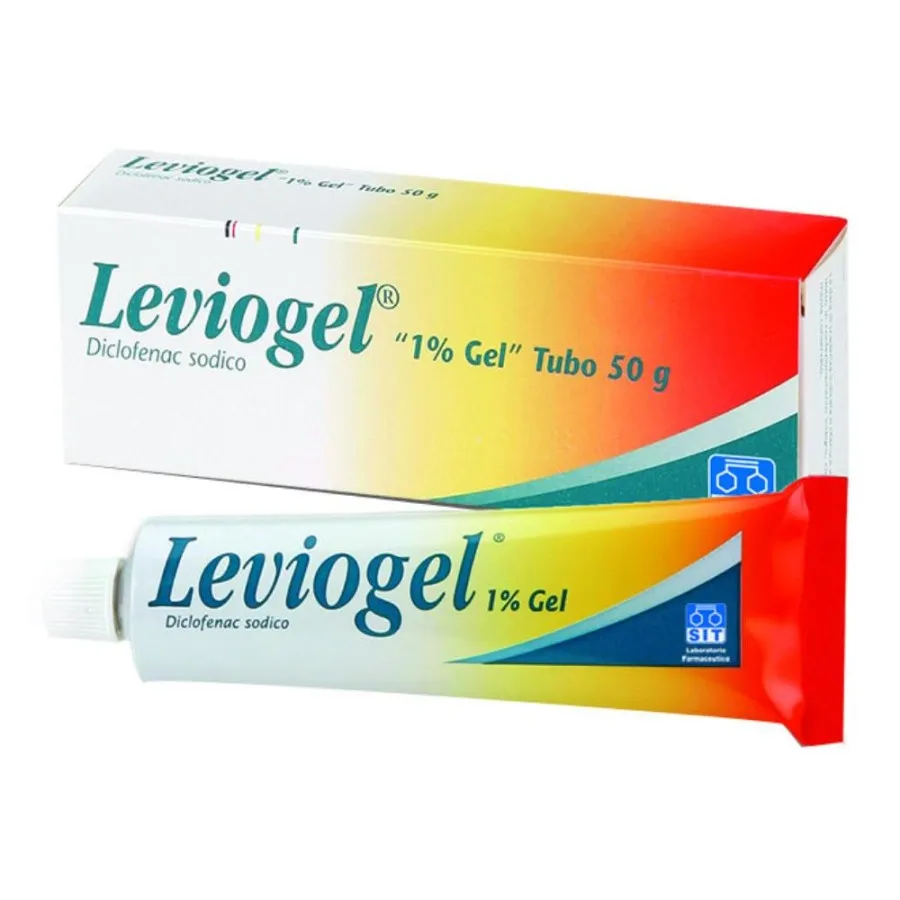
Table of Contents
Patient Information Leaflet
LEVIOGEL 10 mg/g gel
Sodium diclofenac
Please read all of this leaflet carefully before you start using this medicine because it contains important information for you.
Always use this medicine exactly as described in this leaflet or as your doctor or pharmacist has told you to.
- Keep this leaflet. You may need to read it again.
- If you want more information or advice, consult your pharmacist.
- If you experience any side effects, including those not listed in this leaflet, tell your doctor or pharmacist. See section 4.
- Consult your doctor if you do not notice any improvement or if your symptoms worsen.
Contents of this leaflet:
- What LEVIOGEL is and what it is used for
- What you need to know before using LEVIOGEL
- How to use LEVIOGEL
- Possible side effects
- How to store LEVIOGEL
- Contents of the pack and other information
1. What LEVIOGEL is and what it is used for
LEVIOGEL contains sodium diclofenac, which belongs to the group of Non-Steroidal Anti-Inflammatory Drugs (NSAIDs) that work by reducing the pain and swelling typical of inflammation.
This medicine is used to relieve pain, swelling, and inflammation of joints, muscles, tendons, and ligaments in cases of rheumatic conditions or injuries.
Consult your doctor if you do not feel better or if you feel worse.
2. What you need to know before using LEVIOGEL
Do not use LEVIOGEL
- if you are allergic to the active substance or to any of the other ingredients of this medicine (listed in section 6);
- if you have previously experienced an allergic reaction to diclofenac or to other non-steroidal anti-inflammatory drugs (NSAIDs) such as aspirin, associated with breathing difficulties (asthma), skin rash with hives (urticaria), or sudden onset of nasal congestion (acute rhinitis);
- if you are in the last three months of pregnancy (see section 2 “Pregnancy and breastfeeding”);
- in children and adolescents under 14 years of age.
Warnings and precautions
Consult your doctor or pharmacist before using LEVIOGEL.
If a skin rash develops after applying the product to the skin,
discontinue treatment and consult your doctor.
Avoid using this medicine over large areas of skin and for prolonged periods.
This medicine should only be used on intact, healthy skin. Do not apply the product to wounds or open lesions. After application, do not cover the treated area with an occlusive dressing (a dressing that does not allow the skin to breathe) (see section 3 “How to use LEVIOGEL”).
This medicine must not come into contact with the eyes, nose, or mouth (mucous membranes).
For external use only. Do not swallow.
Children and adolescents
This medicine is not suitable for children and adolescents under 14 years of age (see section 2 “Do not use LEVIOGEL”).
Other medicines and LEVIOGEL
Inform your doctor or pharmacist if you are taking, have recently taken, or might take any other medicines.
Pregnancy and breastfeeding
If you are pregnant, think you might be pregnant, planning to become pregnant, or breastfeeding, consult your doctor or pharmacist before taking this medicine.
Pregnancy
Do not use LEVIOGEL during the last three months of pregnancy, as it may harm the fetus or cause complications during delivery. Do not use LEVIOGEL during the first six months of pregnancy unless strictly necessary and as directed by your doctor. If treatment is required during this period, the lowest possible dose for the shortest possible duration should be used.
Oral forms (e.g. tablets) containing diclofenac may cause adverse effects in the newborn. It is not known whether the same risk applies to LEVIOGEL when used on the skin.
Breastfeeding
This medicine should only be used under medical advice during breastfeeding, as diclofenac passes into breast milk in small amounts.
If you are breastfeeding, use this medicine only if your doctor considers it necessary and under their supervision. Avoid applying the product to the breast or over large skin areas and for prolonged periods.
Consult your doctor or pharmacist for further information if you are pregnant or breastfeeding.
Driving and using machines
This medicine does not impair your ability to drive or operate machinery.
3. How to use LEVIOGEL
Use this medicine exactly as stated in this leaflet or as directed by your doctor or pharmacist. If you have any doubts, consult your doctor or pharmacist.
For external use only.
Adults
The recommended dose in adults is 3–4 applications per day.
Use only for short periods of treatment.
Use in children and adolescents
In adolescents aged between 14 and 18 years, the product should be used for no more than 7 days. If after 7 days the pain has not subsided or symptoms worsen, consult your doctor.
The recommended dose is 3–4 applications per day.
LEVIOGEL must not be used in children under 14 years of age (see section 2, "Do not use LEVIOGEL").
Method of administration
Apply a quantity of gel, varying from the size of a cherry to that of a walnut, depending on the area to be treated, with gentle friction.
The treated area may be covered with a breathable dressing (NON-occlusive dressing).
Caution: After application, wash your hands thoroughly to remove any residual gel.
If you use more LEVIOGEL than you should
In case of accidental ingestion/overdose of LEVIOGEL, contact your doctor immediately or go to the nearest hospital.
If you have any doubts about the use of this medicine, consult your doctor or pharmacist.
4. Possible side effects
Like all medicines, this medicine can cause side effects, although not everybody will experience them.
The following side effects may occur with the use of this medicine, listed by frequency:
Common (may affect up to 1 in 10 people):
- skin rash, skin disorders characterized by the appearance of lesions (eczema) or redness (erythema), inflammation of the skin (dermatitis), including that caused by contact with an irritant substance (contact dermatitis), itching.
Rare (may affect up to 1 in 1,000 people):
- skin lesion characterized by the appearance of blisters (bullous dermatitis).
Very rare (may affect up to 1 in 10,000 people):
- hypersensitivity reactions (allergic reactions), swelling of the skin and mucous membranes (angioedema);
- skin eruption characterized by the appearance of pustules (rash);
- excessive sensitivity of the skin to sunlight and UV rays (photosensitivity reaction);
- breathing difficulties (asthma).
Not known (frequency cannot be estimated from the available data):
- burning sensation at the application site;
- dry skin.
Reporting of side effects
If you experience any side effect, including those not listed in this leaflet, talk to your doctor or pharmacist.
You can also report side effects directly via the national reporting system at https://www.aifa.gov.it/content/segnalazioni-reazioni-avverse .
By reporting side effects, you can help provide more information on the safety of this medicine.
5. How to store LEVIOGEL
Do not store above 25°C.
Keep this medicine out of the sight and reach of children.
Do not use this medicine after the expiry date stated on the packaging after "Exp.". The expiry date refers to the last day of that month.
Do not dispose of any medicine via wastewater or household waste. Ask your pharmacist how to dispose of medicines you no longer use. This will help protect the environment.
6. Contents of the pack and other information
What LEVIOGEL contains
In 1 g of gel:
- The active substance is sodium diclofenac 10 mg.
- The other components are ethanol 96 percent, isopropyl alcohol, carbomers, concentrated ammonia solution, purified water.
Description of the appearance of LEVIOGEL and pack contents
LEVIOGEL is available in tubes containing 50 g or 100 g of gel.
It is possible that not all pack sizes are marketed.
Marketing Authorization Holder and Manufacturer
Laboratorio Farmaceutico SIT Srl – Via Cavour, 70 – 27035 Mede (PV)