Lencya
Italy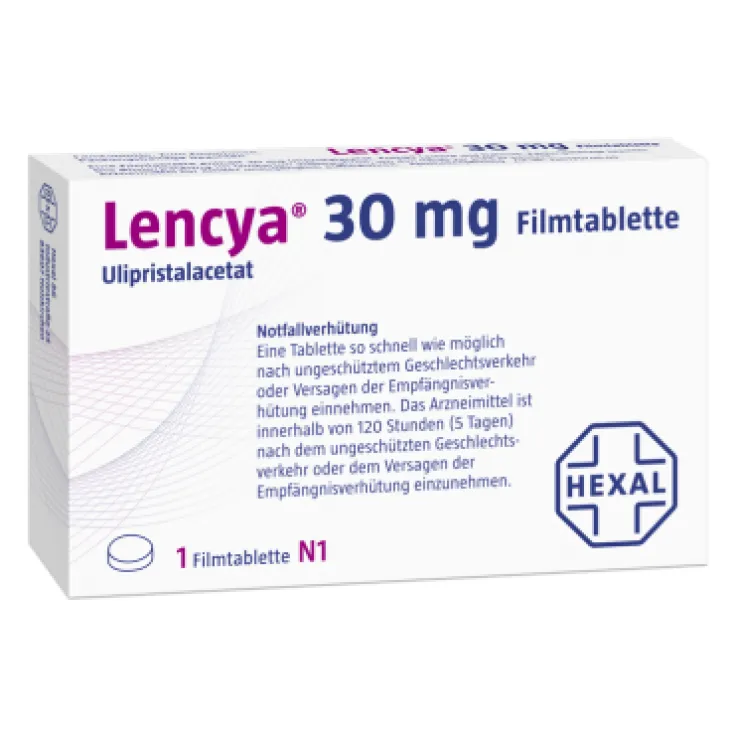
Table of Contents
Patient Information Leaflet
Lencya 30 mg film-coated tablets
Ulipristal acetate
Equivalent medicine
Please read this leaflet carefully before taking this medicine because it contains
important information for you.
Always take this medicine exactly as described in this leaflet or as your pharmacist,
doctor, or other healthcare professional has instructed you.
- Keep this leaflet. You may need to read it again.
- If you need more information or advice, consult your pharmacist.
- If you experience any side effects, including those not listed in this leaflet, contact your pharmacist, doctor, or nurse. See section 4.
Contents of this leaflet:
- What Lencya is and what it is used for
- What you need to know before taking Lencya
- How to take Lencya
- Possible side effects
- How to store Lencya
- Contents of the pack and other information
- Useful information about contraception
1. What Lencya is and what it is used for
Lencya is an emergency contraceptive
Lencya is a contraceptive intended to prevent pregnancy after unprotected sexual intercourse
or following failure of a contraceptive method. For example:
if you had unprotected sexual intercourse;
if you or your partner's condom broke, slipped off or came out, or if you forgot to use it;
if you did not take your contraceptive pill according to the instructions.
You must take the tablet as soon as possible after sexual intercourse, and no later than 5
days (120 hours) at the latest. Sperm can survive up to 5 days inside the body after intercourse.
This medicine is suitable for any woman of reproductive age, including adolescents.
The tablet may be taken at any time during the menstrual cycle.
Lencya does not work if pregnancy is already established.
If your period is late, there is a possibility of pregnancy. If your period is delayed or if you experience symptoms of pregnancy (heavy breasts, morning nausea), you must consult a doctor or healthcare provider before taking the tablet.
If you have unprotected sexual intercourse after taking the tablet, this medicine will not prevent pregnancy. Unprotected sexual intercourse at any time during the cycle may result in pregnancy.
Lencya must not be used as a regular contraceptive
If you are not using a regular contraceptive method, speak with a doctor or healthcare provider to choose one suitable for you.
How Lencya works
Lencya contains the active substance ulipristal acetate, which works by modifying the activity of the natural hormone progesterone, necessary for ovulation to occur. As a result, this medicine acts by delaying ovulation. Emergency contraception is not effective in all cases. Out of 100 women who take this medicine, approximately 2 will become pregnant.
This medicine is a contraceptive used to prevent a pregnancy from occurring. If you are already pregnant, the medicine will not interrupt the existing pregnancy.
Emergency contraception does not protect against sexually transmitted infections.
Only the use of a condom provides protection against sexually transmitted infections. This medicine does not protect against HIV infection or other sexually transmitted diseases (for example, Chlamydia, genital Herpes, genital warts, gonorrhoea, hepatitis B and syphilis). If you are concerned about this, consult a healthcare provider.
At the end of this leaflet you will find further information about contraception.
2. What you should know before taking Lencya
Do not take Lencya
if you are allergic to ulipristal acetate or to any of the other ingredients of this medicine
(listed in section 6).
Warnings and precautions
Talk to your pharmacist, doctor, or another healthcare professional before taking this medicine
if your menstrual period is late or if you have symptoms of pregnancy (such as breast tenderness, morning nausea), as you may already be pregnant (see section “Pregnancy, breastfeeding and fertility”);
if you have severe asthma;
if you have severe liver disease.
In all women, emergency contraception should be taken as soon as possible after unprotected intercourse. According to some data, this medicine may be less effective with increasing body weight or body mass index (BMI), but these data are limited and inconclusive. Therefore, ulipristal acetate is recommended for all women regardless of weight or BMI.
If you are concerned about potential problems related to taking emergency contraception, speak with a healthcare professional.
If you become pregnant despite taking this medicine, it is important that you see a doctor. See section “Pregnancy, breastfeeding and fertility” for further information.
Other contraceptives and Lencya
Taking this medicine may temporarily reduce the effectiveness of regular hormonal contraceptives, such as pills and patches. If you are taking a hormonal contraceptive, continue using it regularly after taking this medicine, but use a condom every time you have sexual intercourse until your next menstrual period.
Do not take this medicine together with another emergency contraceptive pill containing levonorgestrel. Taking both medicines together may reduce the effectiveness of this medicine.
Other medicines and Lencya
Tell your pharmacist, doctor, or another healthcare professional if you are taking, have recently taken, or might take any other medicines, including those obtained without a prescription or herbal medicines.
Some medicines may prevent Lencya from working effectively. If you have taken any of the medicines listed below during the past 4 weeks, Lencya may be less suitable for you. Your doctor may prescribe another type (non-hormonal) of emergency contraception, namely a copper intrauterine device (Cu-IUD):
medicines used to treat epilepsy (e.g. primidone, phenobarbital, phenytoin, fosphenytoin, carbamazepine, oxcarbazepine, and barbiturates)
medicines used to treat tuberculosis (e.g. rifampicin, rifabutin)
HIV treatment (ritonavir, efavirenz, nevirapine)
a medicine used to treat fungal infections (griseofulvin)
herbal preparations containing St. John’s wort (Hypericum perforatum).
Talk to your doctor or pharmacist before using Lencya if you are currently using (or have recently used) any of the medicines listed above.
Pregnancy, breastfeeding and fertility
Pregnancy
Before taking this medicine, if your menstrual period is late, inform your pharmacist, doctor, or another healthcare professional, or perform a pregnancy test to make sure you are not already pregnant (see section “Warnings and precautions”).
This medicine is a contraceptive used to prevent pregnancy from occurring. If you are already pregnant, it will not terminate the existing pregnancy.
If you become pregnant despite taking this medicine, there is no evidence that it negatively affects the pregnancy. However, it is important that you see a doctor. As with any pregnancy, your doctor may decide to check whether the pregnancy is occurring outside the uterus (ectopic pregnancy). This check is particularly important if you experience severe abdominal pain or bleeding, or if you have previously had an ectopic pregnancy, tubal surgery, or a chronic genital infection.
If you become pregnant despite taking Lencya, ask your doctor to enter your pregnancy data into an official registry. You may also report this information directly at www.hra-pregnancy-registry.com. Your data will remain anonymous – no one will know the information refers to you. Sharing your data may help other women in the future understand the safety or risks of Lencya during pregnancy.
Breastfeeding
If you take this medicine while breastfeeding, do not breastfeed for one week after taking it. During this period, it is recommended to express milk to stimulate and maintain milk production, but discard the milk. The effects of breastfeeding during the week following intake of this medicine are unknown.
Fertility
This medicine will not have any negative effects on your future fertility. If you have unprotected sexual intercourse after taking this medicine, it will not prevent pregnancy. It is therefore important to use a condom until your next menstrual period.
If you wish to start or continue using a regular contraceptive method after using this medicine, you may do so, but you must also use a condom until your next menstrual period.
Driving and use of machines
After taking this medicine, some women report dizziness, drowsiness, blurred vision and/or loss of concentration (see section 4). If you experience these symptoms, do not drive and do not operate machinery.
Lencya contains lactose and sodium
If your doctor has diagnosed you with an intolerance to certain sugars, contact them before taking this medicine.
Lencya contains less than 1 mmol (23 mg) of sodium per tablet, i.e. essentially ‘sodium-free’.
3. How to take Lencya
Take this medicine exactly as described in this leaflet or as instructed by your pharmacist, doctor, or other healthcare professional. If you have any doubts, consult your pharmacist or doctor.
How to take the Lencya tablet
Take one tablet orally as soon as possible, and in any case within and no later than 5 days (120 hours) after unprotected sexual intercourse or contraceptive failure. Do not delay taking the tablet.
The tablet can be taken at any time during the menstrual cycle.
The tablet can be taken at any time of the day, before, during, or after a meal.
If you are taking any medicines that may reduce the effectiveness of Lencya (see section 2 “What you need to know before taking Lencya”) or if you have taken any of these medicines in the past 4 weeks, Lencya may be less effective for you. Consult your doctor or pharmacist before using Lencya. Your doctor may prescribe another type of emergency contraception (non-hormonal), such as a copper intrauterine device (Cu-IUD).
If you vomit after taking Lencya
If you vomit (feel sick, bring up) within 3 hours after taking the tablet, take another tablet as soon as possible.
If you have further unprotected sexual intercourse after taking Lencya
If you have unprotected sexual intercourse after taking the tablet, this medicine will not prevent pregnancy. After taking the tablet and until your next menstrual period, you must always use a condom for every sexual intercourse.
If your next menstrual period is delayed after taking Lencya
It is normal for your next menstrual period to be delayed by a few days after taking the tablet. However, if your period is more than 7 days late, or if the bleeding is unusually light or unusually heavy, or if you experience symptoms such as abdominal pain, breast tenderness, vomiting, or nausea, you may be pregnant. You should perform a pregnancy test immediately. If pregnancy occurs, it is important that you see a doctor (see section “Pregnancy, breastfeeding and fertility”).
If you take more Lencya than you should
No harmful effects have been reported with doses higher than the recommended dose of this medicine. Nevertheless, consult your pharmacist, doctor, or another healthcare professional for advice.
If you have any questions about the use of this medicine, consult your pharmacist, doctor, or other healthcare professional.
4. Possible side effects
Like all medicines, this medicine can cause side effects, although not everyone gets them.
Some symptoms, such as breast pain and abdominal pain (stomach ache), vomiting and nausea, may also be possible signs of pregnancy. If you miss a period and experience these symptoms after taking Lencya, you should perform a pregnancy test (see section "Pregnancy, breastfeeding and fertility").
Common side effects (may affect up to 1 in 10 people)
nausea, abdominal pain (stomach ache) or discomfort, vomiting
painful periods, pelvic pain, breast pain
headache, dizziness, mood swings
muscle pain, back pain, tiredness
Uncommon side effects (may affect up to 1 in 100 people)
diarrhoea, heartburn, flatulence (intestinal gas), dry mouth
unusual or irregular vaginal bleeding, heavy or prolonged periods, premenstrual syndrome, vaginal irritation or discharge, decreased or increased libido (sex drive)
hot flushes
changes in appetite, emotional disturbances, anxiety, restlessness, difficulty falling asleep, drowsiness, migraine, visual disturbances
influenza
acne, skin lesions, itching
fever, chills, malaise
Rare side effects (may affect up to 1 in 1000 people)
genital pain or itching, pain during sexual intercourse, rupture of ovarian cyst, unusually light periods
loss of concentration, dizziness, tremors, disorientation, fainting
abnormal sensation in the eyes, eye redness, light sensitivity
dry throat, taste disturbances
urticaria (itchy rash), feeling thirsty
Reporting of side effects
If you experience any side effect, including those not listed in this leaflet, please contact your doctor, pharmacist or nurse. You can also report side effects directly via the national reporting system at the following website: https://www.aifa.gov.it/content/segnalazioni-reazioni-avverse.
By reporting side effects, you can help provide more information on the safety of this medicine.
5. How to store Lencya
Keep this medicine out of the sight and reach of children.
Do not use this medicine after the expiry date stated on the carton and blister after
Exp. The expiry date refers to the last day of that month.
This medicine does not require any special storage temperature. Keep the blister inside the carton to protect the medicine from light.
Do not dispose of any medicine via wastewater or household waste. Ask your pharmacist how to dispose of medicines you no longer use. This will help protect the environment.
6. Package contents and other information
What Lencya contains
The active substance is ulipristal acetate. Each film-coated tablet contains 30 milligrams of ulipristal acetate.
The other components are:
Tablet core: monohydrate lactose, pregelatinized starch (from maize),
sodium carboxymethyl starch (type A), magnesium stearate. See section 2 “Lencya contains lactose and sodium”.
Tablet coating: hypromellose, hydroxypropylcellulose, stearic acid, talc, titanium dioxide (E171).
Description of the appearance of Lencya and contents of the pack
Film-coated tablet, round, white, biconvex, marked with “U30” on one side, with an approximate diameter of 9 mm and a thickness of 4.5 mm.
PVC/PVDC/Aluminum blister containing 1 film-coated tablet.
Marketing Authorization Holder
Sandoz S.p.A., L.go U. Boccioni 1, 21040 Origgio (VA), Italy
Manufacturer
Haupt Pharma Münster GmbH
Schleebrüggenkamp 15
48159 Münster
Germany
Salutas Pharma GmbH
Otto-von-Guericke-Allee 1
39179 Barleben
Germany
This medicinal product is authorized in the European Economic Area countries under the following names:
Austria Lencya 30 mg - Filmtabletten
Denmark Lencya
Finland Lencya 30 mg kalvopäällysteinen tabletti
France Lencya 30 mg comprimé pelliculé
Germany Lencya
Italy Lencya
Norway Lencya
Czech Republic Lencya
Sweden Lencya 30 mg filmdragerad tabletti
USEFUL INFORMATION ON CONTRACEPTION
ADDITIONAL INFORMATION ON EMERGENCY CONTRACEPTION
The shorter the time between unprotected intercourse and taking emergency contraception, the higher the likelihood of preventing pregnancy.
Emergency contraception will not have any negative effects on your fertility.
Emergency contraception may delay ovulation within a menstrual cycle, but it will not prevent pregnancy if you have another unprotected sexual intercourse. After taking emergency contraception and until your next menstrual period, you must always use a condom for every sexual intercourse.
ADDITIONAL INFORMATION ON REGULAR CONTRACEPTION
If you have taken emergency contraception and you are not using a regular contraceptive method (or have not found a suitable contraceptive method for you), speak to your doctor or visit a family planning clinic.
There are many different types of contraceptives available, and you should be able to find one that suits you.
Examples of regular contraceptive methods:
Daily methods
Oral contraceptive pill
Weekly or monthly methods
Contraceptive patch Vaginal ring
Long-acting methods
Contraceptive implant IUD (intrauterine device)