Latanoprost Ratiopharm Italia
Italy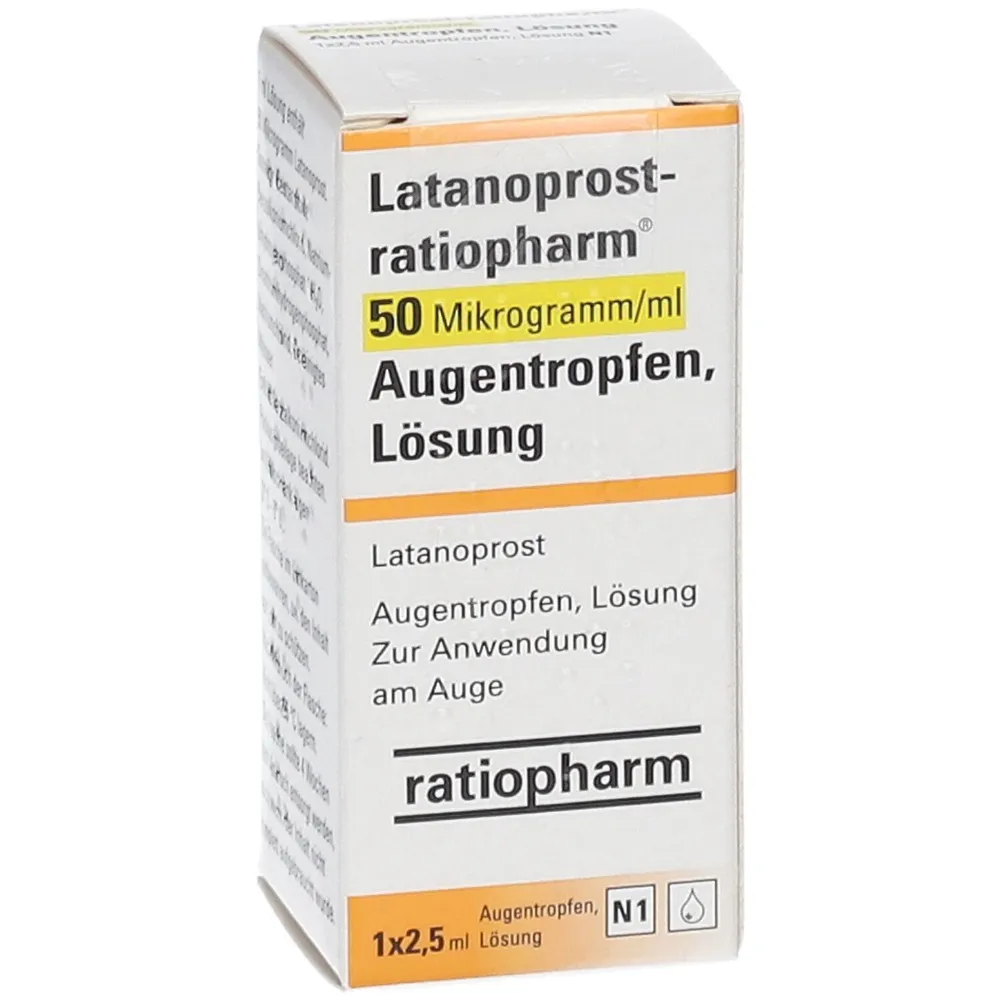
Table of Contents
- Package leaflet: Information for the user
- Latanoprost ratiopharm Italia 50 micrograms/ml eye drops, solution
- 1. What Latanoprost ratiopharm Italia is and what it is used for
- 2. What you need to know before using Latanoprost ratiopharm Italia
- 3. How to use Latanoprost ratiopharm Italia
- 4. Possible side effects
- 5. How to store Latanoprost ratiopharm Italia
- 6. Pack contents and other information
Package leaflet: Information for the user
Latanoprost ratiopharm Italia 50 micrograms/ml eye drops, solution
Equivalent medicine
Please read this leaflet carefully before you start using this medicine
because it contains important information for you.
- Keep this leaflet. You may need to read it again.
- If you have any questions, ask your doctor or the doctor treating your child or your pharmacist.
- This medicine has been prescribed for you or your child only. Do not give it to other people, even if their symptoms are the same as yours, as it may be harmful.
- If you experience any side effect, including those not listed in this leaflet, contact your doctor, the doctor treating your child, or your pharmacist. See section 4.
Contents of this leaflet:
- What Latanoprost ratiopharm Italia is and what it is used for
- What you need to know before using Latanoprost ratiopharm Italia
- How to use Latanoprost ratiopharm Italia
- Possible side effects
- How to store Latanoprost ratiopharm Italia
- Contents of the pack and other information
1. What Latanoprost ratiopharm Italia is and what it is used for
Latanoprost ratiopharm Italia belongs to a class of medicines known as prostaglandin analogues. It works by increasing the natural outflow of fluid from inside the eye into the bloodstream.
Latanoprost ratiopharm Italia is used in the treatment of conditions known as open-angle glaucoma and ocular hypertension. Both of these conditions are associated with increased intraocular pressure, which may eventually impair vision.
Latanoprost ratiopharm Italia is also used in the treatment of elevated intraocular pressure and glaucoma in children of all ages and in newborns.
2. What you need to know before using Latanoprost ratiopharm Italia
Latanoprost ratiopharm Italia can be used in adult women and men (including elderly people) and in children from birth to 18 years of age. The use of Latanoprost ratiopharm Italia in premature neonates (with a gestational age of less than 36 weeks) has not been studied.
Do not use Latanoprost ratiopharm Italia:
- if you are allergic to latanoprost or to any of the other ingredients of this medicine (listed in section 6)
- if you are pregnant or planning to become pregnant
- if you are breastfeeding
Warnings and precautions
Talk to your doctor, your child’s doctor, or pharmacist before taking Latanoprost ratiopharm Italia or before giving this medicine to your child if you think any of the following conditions apply to you or your child:
- If you or your child is about to undergo or has recently undergone eye surgery (including cataract surgery)
- If you or your child has eye problems (such as eye pain, irritation or inflammation, blurred vision)
- If you or your child suffers from dry eye
- If you or your child has severe asthma or asthma that is not well controlled
- If you or your child wears contact lenses. You may still use Latanoprost ratiopharm Italia, following the instructions for contact lens wearers provided in section 3
- If you or your child has had or currently has a viral eye infection caused by the herpes simplex virus (HSV).
Other medicines and Latanoprost ratiopharm Italia
Latanoprost ratiopharm Italia may interact with other medicines. Inform your doctor, your child’s doctor, or pharmacist if you or your child are taking/using, have recently taken/used, or might take/use any other medicines, including over-the-counter medicines (or eye drops).
Pregnancy and breastfeeding
Do not use Latanoprost ratiopharm Italia during pregnancy or breastfeeding.
Inform your doctor immediately if you are pregnant, suspect you may be pregnant, are planning a pregnancy, or are breastfeeding.
Driving and using machines
When using Latanoprost ratiopharm Italia, you may experience transient blurred vision. If this occurs, you must not drive or operate machinery until your vision is clear again.
Latanoprost ratiopharm Italia contains benzalkonium chloride
Latanoprost ratiopharm Italia contains a preservative called benzalkonium chloride.
Benzalkonium chloride may be absorbed by soft contact lenses and may change the colour of contact lenses. Contact lenses must be removed before applying this medicine, but may be reinserted 15 minutes after administration.
Benzalkonium chloride may also cause eye irritation, particularly in patients with dry eye or corneal disorders (the clear layer at the front of the eye).
If patients experience any unusual sensation in the eye, burning, or eye pain after using this medicine, they should contact their doctor.
3. How to use Latanoprost ratiopharm Italia
Use this medicine exactly as directed by your doctor or the doctor treating your child or by the pharmacist. If you have any doubts, consult your doctor or the doctor treating your child or the pharmacist.
The recommended dose for adults (including elderly patients) and children is one drop in the affected eye, once daily, preferably in the evening.
Do not use Latanoprost ratiopharm Italia more than once a day, as the effectiveness of treatment may be reduced if the medicine is administered more frequently.
Use Latanoprost ratiopharm Italia as directed by your doctor or the doctor treating your child, until your doctor tells you to stop treatment.
Contact lens wearers
If you or your child wears contact lenses, remove them before applying Latanoprost ratiopharm Italia. After applying Latanoprost ratiopharm Italia, wait 15 minutes before reinserting the contact lenses.
Instructions for use
Follow the instructions below. They will help you use Latanoprost ratiopharm Italia correctly:
- Wash your hands and sit or position yourself comfortably.
- Remove the cap from the bottle.
- Use a finger to gently pull down the lower eyelid of the affected eye.
- Hold the dropper tip close to the eye without touching it.
- Gently squeeze the bottle so that a single drop falls into the eye, then release the lower eyelid.
- Press gently with a finger on the inner corner of the affected eye (near the nose). Keep the eye closed for one minute.
- Repeat the procedure in the other eye if your doctor has instructed you to do so.
- Replace the cap on the bottle.
If you use Latanoprost ratiopharm Italia with another eye drop
Wait at least 5 minutes between administering Latanoprost ratiopharm Italia and another eye drop.
If you use more Latanoprost ratiopharm Italia than you should
Putting too many drops into the eyes may cause mild irritation, tearing, and eye redness. These effects should be temporary, but if you are concerned, contact your doctor or the doctor treating your child for advice.
Contact your doctor as soon as possible if you or your child has accidentally swallowed Latanoprost ratiopharm Italia.
If you forget to use Latanoprost ratiopharm Italia
Continue using the usual dose at the usual time. Do not use a double dose to make up for the missed dose. If you have any doubts, consult your doctor or pharmacist.
If you stop using Latanoprost ratiopharm Italia
You must inform your doctor or the doctor treating your child if you intend to stop treatment with Latanoprost ratiopharm Italia.
If you have further doubts about the use of this medicine, ask your doctor or pharmacist.
4. Possible side effects
Like all medicines, this medicine can cause side effects, although not everyone gets them.
The following are known adverse reactions associated with the use of Latanoprost ratiopharm Italia:
Very common (may affect more than 1 in 10 people):
-
Gradual change in eye colour due to increased amount of brown pigment in the coloured part of the eye called the iris. This change is more likely if your eyes are of mixed colour (blue-brown, grey-brown, yellow-brown or green-brown) rather than uniform colour (blue, grey, green or brown). Any change in eye colour may occur after years, although it generally appears within the first 8 months of treatment. The change in colour may be permanent and may be more noticeable if you use latanoprost in only one eye. There appear to be no problems associated with the change in eye colour. After discontinuation of latanoprost treatment, no further change in eye colour has been observed.
-
Red eyes.
-
Eye irritation (burning sensation, gritty feeling, itching, stinging pain, prickling sensation or foreign body sensation in the eyes). If you experience eye irritation severe enough to cause excessive tearing, stop using this medicine and consult your doctor or pharmacist immediately (within one week). It may be necessary to review your treatment to ensure you continue to receive appropriate therapy for your condition.
-
Gradual changes in the eyelashes of the treated eye and changes in the fine hair around the treated eye, observed mostly in people of Japanese origin. These changes include increased pigmentation (darkening), length, thickness and number of eyelashes.
Common (may affect up to 1 in 10 people):
- Eye surface irritation or abrasion, inflammation of the eyelid margin (blepharitis), eye pain and light sensitivity (photophobia), conjunctivitis.
Uncommon (may affect up to 1 in 100 people):
- Swelling of the eyelids, dry eyes, inflammation or irritation of the eye surface (keratitis), blurred vision, inflammation of the coloured part of the eye (uveitis), swelling of the retina (macular edema).
- Skin rash.
- Chest pain (angina), awareness of heartbeat (palpitations).
- Asthma, shortness of breath (dyspnea).
- Chest pain.
- Headache, dizziness.
- Muscle pain, joint pain.
Rare (may affect up to 1 in 1,000 people):
- Inflammation of the iris (iritis), symptoms of swelling or scratches/damage to the eye surface, swelling around the eyes (periorbital edema), misdirected eyelashes or abnormal eyelash growth, scarring of the eye surface, fluid-filled area in the coloured part of the eye (iris cyst).
- Skin reactions on the eyelids, darkening of the eyelid skin.
- Worsening of asthma.
- Intense skin itching.
- Development of a viral eye infection caused by the herpes simplex virus (HSV).
Very rare (may affect up to 1 in 10,000 people):
- Worsening of angina in patients already suffering from heart disease.
- Sunken appearance of the eye (hollowing of the eye socket).
Side effects observed more frequently in children than in adults are runny and itchy nose, fever.
In very rare cases, some patients with severe damage to the outer layer of the eye (cornea) have developed white spots on the cornea due to calcium deposits during treatment.
Reporting of side effects
If you experience any side effects, including those not listed in this leaflet, please contact your doctor or pharmacist. You can also report side effects directly via the national reporting system at: www.agenziafarmaco.gov.it/content/come-segnalare-una-sospetta-reazione-avversa.
By reporting side effects, you can help provide more information on the safety of this medicine.
5. How to store Latanoprost ratiopharm Italia
Keep this medicine out of the sight and reach of children.
Do not use this medicine after the expiry date stated on the carton and bottle after EXP.
The expiry date refers to the last day of that month.
Store in the refrigerator (2°C - 8°C). Keep the container in the outer packaging to protect it from light.
After first opening of the bottle: do not store above 25°C. The medicine must be discarded four weeks after first opening, even if not completely used.
Do not dispose of medicines via wastewater or household waste. Ask your pharmacist how to dispose of medicines no longer required. This will help protect the environment.
6. Pack contents and other information
What Latanoprost ratiopharm Italia contains
The active substance is latanoprost.
One ml of eye drops contains 50 micrograms of latanoprost.
One drop contains approximately 1.5 micrograms of latanoprost.
The other components are: benzalkonium chloride, monosodium phosphate monohydrate, disodium
phosphate anhydrous, sodium chloride, purified water.
Description of the appearance of Latanoprost ratiopharm Italia and pack contents
Latanoprost ratiopharm Italia is practically a clear, colourless solution for eye drops, in an LDPE bottle
with a screw cap made of HPDE.
Each bottle contains 2.5 ml of eye drop solution, corresponding to approximately 80 drops of solution.
Latanoprost ratiopharm Italia is available in packs of 1 x 2.5 ml, 3 x 2.5 ml and 6 x 2.5 ml.
It is possible that not all pack sizes are marketed.
Marketing Authorisation Holder and Manufacturer
Marketing Authorisation Holder:
Teva B.V.
Swensweg 5
2031 GA Haarlem
The Netherlands
Manufacturers:
HBM Pharma – Sklabinská 30, 03680 Martin (Slovak Republic)
Jadran Galenski Laboratorij dd, Pulac 4A, Rijeka, 51000 (Croatia)
Jadran Galenski Laboratorij d.d., Svilno 20, 51000 Rijeka (Croatia)
Merckle GmbH Ludwig-Merckle-Strasse 3, 89143 Blaubeuren (Germany)
This medicinal product is authorised in the Member States of the European Economic Area under the
following names:
Italy: Latanoprost ratiopharm Italia 50 microgram/ml eye drops, solution
Spain: Latanoprost ratiopharm 50 microgramos/ml colirio en solución
The Netherlands: Latanoprost 50 microgram/ml Teva, oogdruppels, oplossing