Lariam
Italy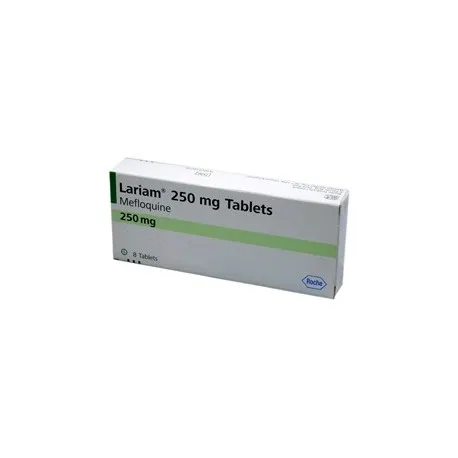
Table of Contents
Package leaflet: Information for the patient
LARIAM 250 mg tablets
Mefloquine hydrochloride
Please read this leaflet carefully before you start taking this medicine because it contains important information for you.
- Keep this leaflet. You may need to read it again.
- If you have any questions, ask your doctor or pharmacist.
- This medicine has been prescribed for you only. Do not give it to others, even if they have the same symptoms as you, because it could be harmful.
- If you experience any adverse reaction, including those not listed in this leaflet, contact your doctor or pharmacist. See section 4.
Contents of this leaflet:
- What Lariam is and what it is used for
- What you need to know before taking Lariam
- How to take Lariam
- Possible side effects
- How to store Lariam
- Contents of the pack and other information
1. What Lariam is and what it is used for
Lariam contains the active substance mefloquine hydrochloride, a medicine belonging to a group of drugs called antimalarials.
Malaria is a disease spread through the bite of an infected mosquito, which transmits the malaria parasite into the bloodstream.
Lariam is indicated:
- for the prevention of malaria in travelers visiting endemic areas where the risk of infection with P. falciparum strains resistant to other antimalarial drugs is high;
- for the treatment of malaria caused by P. falciparum strains infecting humans, including strains resistant to other antimalarials. In cases of malaria caused simultaneously by P. falciparum and P. vivax strains, after treatment with Lariam, the doctor will consider administering an 8-aminoquinoline derivative such as primaquine to eliminate the hepatic forms of P. vivax. When prescribing antimalarial medicines, the doctor will take into account the guidelines issued by the Ministry of Health in accordance with recommendations from the WHO (World Health Organization);
- for self-treatment of malaria: the doctor may prescribe Lariam for use during travel to high-risk areas as an emergency measure in suspected cases of malaria when prompt medical advice is not available.
2. What you need to know before taking Lariam
Do not take Lariam
- if you are allergic to mefloquine, to substances chemically closely related (e.g. quinine, quinidine), or to any of the other ingredients of this medicine (listed in section 6)
- for malaria prevention, if you suffer from depression (or have suffered from it in the past), or other mental disorders and conditions such as generalized anxiety, psychosis, suicidal thoughts or attempts, self-harming behaviors, schizophrenia, or other psychiatric disorders
- if you currently suffer or have previously suffered from seizures characterized by uncontrolled body movements (convulsions) of any origin (see sections “Warnings and precautions” and “Other medicines and Lariam”)
- if you have previously suffered from blackwater fever, a complication of malaria caused by a specific strain of parasites (Plasmodium falciparum), characterized by massive breakdown of red blood cells (intravascular hemolysis), leading to loss of hemoglobin—the protein that carries oxygen in the blood—through urine (hemoglobinuria)
- if you have severe liver disease (see sections “Warnings and precautions” and “Possible side effects”)
- during pregnancy and breastfeeding (see “Pregnancy and breastfeeding”).
Another medicine called halofantrine must not be used during prophylactic treatment with Lariam,
or during treatment of malaria, or within 15 weeks after the last dose of Lariam,
due to the risk of potentially life-threatening heart effects (i.e. changes known
as QTc interval prolongation) (see sections “Warnings and precautions” and “Other
medicines and Lariam”).
Warnings and precautions
Talk to your doctor or pharmacist before taking Lariam.
Children and adolescents
Experience with the use of Lariam in children weighing less than 5 kg or younger than 3 months of age is limited.
Your doctor will pay special attention if you have:
- epilepsy, because this medicine may increase the risk of seizures (see “Possible side effects” and “Other medicines and Lariam”). Your doctor will prescribe Lariam only as a treatment (not for self-treatment) and only if there are valid medical reasons for using the medicine;
- liver disease, because you have a higher risk of experiencing adverse effects;
- kidney disease;
- congenital hyperinsulinemic hypoglycemia, an inherited condition causing low blood glucose levels due to excessive insulin production, because with this medicine you are at risk of developing hypoglycemia;
- diabetes and are taking other medicines (anticoagulants);
- diseases affecting the hemolymphopoietic system (the system of organs and tissues where blood cells—red blood cells, white blood cells, and platelets—are produced).
Side effects
During treatment with this medicine, you may experience side effects that may
require discontinuation of treatment (see section 4 “Possible side effects”).
Mefloquine can cause serious psychiatric problems in some patients. Inform your doctor
immediately if, during treatment with mefloquine, you develop insomnia.
Prolonged use
If you need to be treated with Lariam for a prolonged period (more than 1 year), your doctor
will need to closely monitor your health and may ask you to undergo laboratory tests,
including liver function tests and eye examinations.
Geographic drug resistance
Certain geographic areas, especially regions of Southeast Asia, are more likely to have
parasites resistant to antimalarial drugs. This may require different malaria prevention depending on the destination.
For up-to-date information on resistance in different geographic areas, consult specialized centers with national experts.
Additionally, in some geographic areas mixed forms of malaria may occur; in such cases, your doctor
will prescribe, in addition to preventive treatment with Lariam, other antimalarial medicines (e.g.
primaquine).
Other medicines and Lariam
Inform your doctor or pharmacist if you are taking, have recently taken, or might take
any other medicines, especially:
- halofantrine (another antimalarial medicine): using halofantrine during mefloquine therapy for prevention or treatment of malaria, or within 15 weeks after the last dose of Lariam, causes undesirable effects on the heart (QTc interval prolongation) (see section “What you need to know before taking Lariam”);
- other medicines that can alter cardiac conduction (e.g. antiarrhythmics, beta-blockers, calcium channel blockers, antihistamines or H1-antagonists, tricyclic antidepressants, and phenothiazines): concomitant use of these medicines may contribute to heart-related effects;
- ketoconazole (an antifungal medicine), due to the risk of heart-related effects (QTc interval prolongation), if taken during Lariam therapy or within 15 weeks after the last dose of Lariam (see section “Warnings and precautions”);
- anticonvulsants and medicines that lower the seizure threshold (e.g. valproic acid, carbamazepine, phenobarbital, or phenytoin): concomitant use of Lariam reduces control of seizures, so in some cases your doctor may consider it necessary to adjust the dosage of antiepileptic medicines; the concomitant administration of mefloquine and medicines that act by lowering the seizure threshold (such as tricyclic antidepressants or selective serotonin reuptake inhibitors (SSRIs), bupropion, antipsychotics, tramadol, chloroquine, or certain antibiotics) may increase the risk of seizures (see section “Warnings and precautions”);
- vaccines: when Lariam is taken simultaneously or shortly before oral typhoid vaccines, a reduced immune response to these vaccines may occur. Therefore, typhoid vaccination should be completed at least 3 days before the first dose of Lariam, bearing in mind that malaria prophylaxis with Lariam must begin 10 days before entering a malaria-endemic area;
- other interactions/inhibitors and inducers of CYP3A4: it is unlikely that mefloquine alters the metabolism of concomitantly administered drugs. However, there are some medicines, known as inducers (rifampicin, carbamazepine, phenytoin, efavirenz) or inhibitors (ketoconazole) of the CYP3A4 isoenzyme, which may cause decreased or increased blood concentrations of mefloquine. The clinical consequences of these effects are unknown, and close clinical monitoring must be ensured (see section “Precautions for use”);
- anticoagulants: if you are taking anticoagulants, you should be monitored before traveling to a malaria-endemic area.
Do not take Lariam if you are already taking quinine or chemically related substances (e.g.
quinidine, chloroquine, quinolones), which may cause changes in the electrocardiographic trace and increase the risk of seizures (see “How to take Lariam”).
Lariam with food, drinks, and alcohol
Take Lariam preferably after a meal (see section 3 “How to take Lariam”).
Pregnancy and breastfeeding
Pregnancy
Do not use Lariam during pregnancy (see section “Do not take Lariam”), unless your doctor
decides that your clinical condition requires treatment with mefloquine.
In case of unintended pregnancy, taking Lariam for malaria chemoprophylaxis
does not constitute a reason to terminate the pregnancy.
Breastfeeding
Do not use Lariam during breastfeeding (see section “Do not take Lariam”).
Driving and using machines
Some side effects such as feelings of instability, disturbances in sense of balance, or disorders
affecting the central or peripheral nervous system, may reduce your concentration and reaction ability and, therefore, may pose a risk if you drive vehicles (including bicycles), operate
machinery, or perform any other activity requiring good alertness and motor coordination.
In a limited number of patients, dizziness, vertigo, and loss of balance may
persist for several months or longer, even after stopping the medicine
(see section “Possible side effects”).
Lariam contains lactose
If your doctor has diagnosed you with an intolerance to certain sugars, contact him before taking this
medicine.
3. How to take Lariam
Take this medicine exactly as directed by your doctor or pharmacist. If you have
any doubts, consult your doctor or pharmacist.
Take Lariam tablets with at least one glass of liquid and preferably after a meal. You may
break and/or dissolve the tablets in a small amount of water, milk, or another beverage for administration to
younger children or if you have difficulty swallowing.
➢ Treatment of malaria
The recommended dose varies according to body weight.
Your doctor may instruct you to divide the dose into 2–3 administrations, spaced 6–8 hours apart (e.g.:
3+1, or 3+2, or 3+2+1 tablets) to reduce the likelihood of possible side effects.
| Body weight | Weekly dose |
| Less than 20 kg | 1/4 tablet/2.5-3 kg |
| >20 and ≤30 kg | 2-3 tablets |
| >30 and ≤45 kg | 3-4 tablets |
| >45 and ≤60 kg | 5 tablets |
| Over 60 kg | 6 tablets |
For body weight over 60 kg:
There is no specific experience with total doses exceeding 6 tablets in patients with very high body weight.
If you vomit:
- within 30 minutes after taking the medicine, take a second full dose;
- between 30 and 60 minutes after taking the medicine, take half a dose again.
➢ Malaria prevention
The recommended dose varies according to body weight and is approximately 5 mg/kg to be taken once weekly.
| Body weight / Adults and children | Weekly dose |
| less than 20 kg | ¼ tablet |
| > 20 and 30 kg | ½ tablet |
| > 30 and 45 kg | ¾ tablet |
| > 45 kg | 1 tablet |
Initial dose
Your doctor will recommend that you take the first dose 10 days before departure and the second dose 3 days before departure.
Subsequent doses
Take subsequent doses once weekly, always on the same day.
If this is not possible, a loading dose must be administered: in adults weighing more than 45 kg, this corresponds to 1 Lariam tablet daily (250 mg of mefloquine) for 3 days, followed by 1 tablet weekly.
To reduce the risk of malaria, prophylaxis must be continued for an additional 4 weeks after leaving the endemic area.
- Self-treatment of malaria
The recommended initial dose varies according to body weight and is approximately 15 mg/kg (e.g., in patients weighing equal to or more than 45 kg, the initial dose will be 3 Lariam tablets).
Subsequent doses
If medical assistance is not available within 24 hours or if no severe adverse effects have occurred, a second fraction of the total dose (2 tablets in patients weighing equal to or more than 45 kg) may be taken 6–8 hours later.
Patients weighing more than 60 kg should take an additional tablet 6–8 hours after the second dose (see previously recommended treatment regimen for malaria).
Use in children and adolescents
Experience with the use of Lariam in children weighing less than 5 kg or younger than 3 months of age is limited.
If you take more Lariam than you should
In case of accidental ingestion/overdose of Lariam, contact your doctor immediately or go to the nearest hospital.
Symptoms
If you take more Lariam than you should, an intensification of the adverse effects described in section “Possible side effects” may occur.
Treatment
Your doctor will establish appropriate therapy to treat the symptoms. There are no specific antidotes; however, oral activated charcoal may be used, which reduces the absorption of mefloquine.
If you forget to take Lariam
Do not take a double dose to make up for the missed dose.
If you stop taking Lariam
If you have any doubts about using this medicine, consult your doctor or pharmacist.
4. Possible side effects
Like all medicines, this medicine can cause side effects, although not everyone will experience them.
If you experience any side effects while taking Lariam, inform your doctor immediately. The doctor will assess whether treatment should be discontinued and an alternative medicine prescribed.
Mefloquine may cause:
- Symptoms affecting mental state, such as abnormal dreams, insomnia, depression, anxiety, suicide, suicidal ideation and suicide attempts, self-harming behaviours, mood swings between depression and euphoria (bipolar disorders), various types of psychiatric disorders including delirium, depersonalization, mania and schizophrenia/schizoaffective disorder, paranoia, panic attacks, confusion, hallucinations, aggression, agitation, restlessness, mood swings, and attention disorders. These side effects occur especially during preventive use of Lariam. They may also appear after discontinuation of the medicine or persist for months or longer even after stopping treatment.
- Symptoms of nervous system impairment, such as dizziness, headache, symptoms of nervous system impairment including brain disease (encephalopathy), paralysis of cranial nerves, uncontrolled body movements (seizures), memory loss (sometimes prolonged, lasting more than 3 months), syncope, speech disorders, amnesia, balance disorders, gait disturbances, somnolence. These side effects occur especially during preventive use of Lariam. They may also appear after discontinuation of the medicine or persist for months or longer even after stopping treatment.
- Nerve damage affecting peripheral sensory nerves, including pain, burning, tingling, numbness and/or weakness; nerve damage affecting motor nerves, including altered sensation in limbs or other body parts (paresthesia), tremor, and difficulty performing certain movements (ataxia).
- Eye disorders, optic nerve damage and retinal disorders (may occur during or after treatment with Lariam).
- Allergic reactions, more frequently reported in predisposed individuals, which may manifest in various ways, e.g. skin reactions ranging from mild to severe, with rapid onset (anaphylactic reactions and Stevens-Johnson syndrome).
- Heart-related symptoms, such as changes in heart rhythm (including tachycardia or bradycardia) or awareness of one's own heartbeat (palpitations), irregular heartbeat, extrasystoles, as these symptoms may precede even serious heart-related side effects such as transient disturbances in the heart's electrical conduction system, including atrioventricular block.
- Symptoms of pneumonia, such as difficulty breathing (dyspnoea), dry cough or fever, as they may indicate allergic-type pneumonia.
The possible side effects observed after marketing of Lariam and in a study conducted on a number of patients are listed below by frequency:
Very common (may affect more than 1 in 10 people)
- Abnormal dreams, insomnia.
Common (may affect up to 1 in 10 people)
- Depression, anxiety;
- Dizziness, headache;
- Impaired visual acuity (visual deficit);
- Nausea, vomiting. These side effects occur especially during preventive use of Lariam. They are generally mild in intensity and may decrease with prolonged use of the medicine;
- Diarrhoea, abdominal pain, mouth lesions;
- Itching (pruritus).
Not known (frequency cannot be estimated from available data)
- Decreased number of white blood cells in the blood (leucopenia), particularly granulocytes (agranulocytosis), inadequate production of blood cells in the bone marrow (aplastic anaemia), increased number of white blood cells in the blood (leucocytosis), decreased number of platelets in the blood (thrombocytopenia);
- Decreased appetite;
- Symptoms of nervous system impairment such as brain disease (encephalopathy), paralysis of cranial nerves, uncontrolled body movements (convulsions), memory loss (sometimes prolonged, lasting more than 3 months), syncope, speech disorders, amnesia, balance disorders, gait disturbances, somnolence;
- Damage to nerves responsible for peripheral sensation (peripheral sensory neuropathy), damage to nerves responsible for movement (peripheral motor neuropathy);
- Loss of transparency of the eye's natural lens (cataract) and blurred vision. These side effects may occur during or after treatment with Lariam;
- Balance disorders, ringing in the ears (tinnitus), partial deafness (sometimes prolonged), hearing problems, increased sensitivity to sound (hyperacusis);
- Decreased (hypotension) or increased (hypertension) blood pressure, hot flushes;
- Inflammation of the pancreas (pancreatitis), discomfort in the upper abdomen (dyspepsia);
- Impaired liver function, inflammation of the liver (hepatitis), yellowing of the skin (jaundice), transient increase in liver enzymes detected in blood tests (transaminases: ALT, AST, GGT);
- Pneumonitis, pneumonitis of possible allergic origin, difficulty breathing (dyspnoea);
- Severe skin rash (Stevens-Johnson syndrome), appearance of red skin lesions (erythema multiforme), skin rash, skin irritation (erythema), appearance of red or white wheals of varying sizes (urticaria), hair and scalp hair loss (alopecia), excessive sweating (hyperhidrosis);
- Muscle weakness, muscle cramps, muscle and joint pain;
- Oedema, chest pain, lack of strength (asthenia), malaise, fatigue, chills, fever;
- Impaired kidney function (acute renal failure), inflammation of the kidneys (nephritis), increased creatinine in the blood;
- Heart-related symptoms such as changes in heart rhythm (including tachycardia or bradycardia) or awareness of one's own heartbeat (palpitations), irregular heartbeat, extrasystoles;
- Symptoms affecting mental state, such as suicide, suicidal ideation and suicide attempts, self-harming behaviours, mood swings between depression and euphoria (bipolar disorders), various types of psychiatric disorders including delirium, depersonalization, mania and schizophrenia/schizoaffective disorder, paranoia, panic attacks, confusion, aggression, agitation, restlessness, mood swings, attention disorders.
Reporting of side effects
If you experience any side effect, including those not listed in this leaflet, consult your doctor or pharmacist. You may also report side effects directly via the national reporting system at the website: www.agenziafarmaco.gov.it/content/come-segnalare-una-sospetta-reazione-avversa.
By reporting side effects, you can help provide more information on the safety of this medicine.
5. How to store Lariam
Keep in the original packaging to protect the medicine from moisture.
Keep this medicine out of the sight and reach of children.
Do not use this medicine after the expiry date which is stated on the carton after EXP. The expiry
date refers to the last day of that month.
Do not dispose of medicines via wastewater or household waste. Ask your pharmacist how to
dispose of medicines no longer required. This will help protect the environment.
6. Package contents and other information
What Lariam contains
One tablet contains:
- The active substance is mefloquine hydrochloride 274.09 mg (equivalent to 250 mg of mefloquine base).
- The other components are microcrystalline cellulose, lactose (see section “Lariam contains lactose”), crospovidone, maize starch, ammonium-calcium alginates, poloxamer, talc, magnesium stearate.
Description of the appearance of Lariam and contents of the pack
Lariam is presented as white tablets contained in blisters.
Lariam is available in packs of 8 tablets of 250 mg.
Marketing Authorization Holder
CHEPLAPHARM Arzneimittel GmbH
Ziegelhof 24
17489 Greifswald
Germany
Manufacturer
CHEPLAPHARM Arzneimittel GmbH
Ziegelhof 23-24
17489 Greifswald
Germany