Lamzede
Italy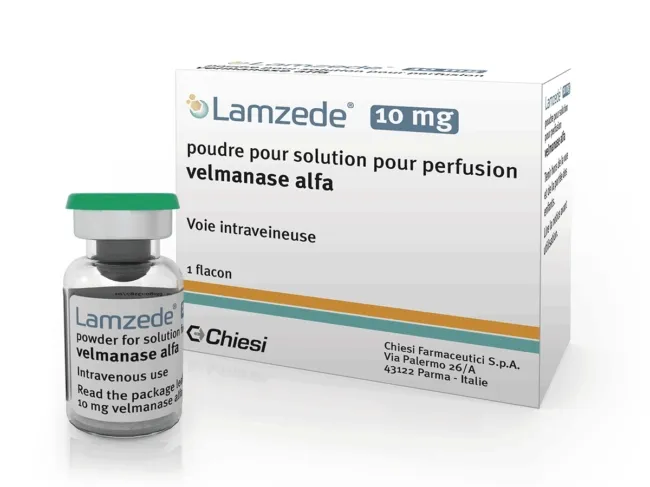
Instructions for Use
Table of Contents
- Lamzede 10 mg powder for solution for infusion
- 1. What Lamzede is and what it is used for
- 2. What you need to know before using Lamzede
- 3. How to use Lamzede
- 4. Possible side effects
- 5. How to store Lamzede
- 6. Package contents and other information
- The following information is intended exclusively for healthcare professionals:
Package leaflet: Information for the patient
Lamzede 10 mg powder for solution for infusion
velmanase alfa
This medicinal product is subject to additional monitoring. This will allow for the rapid identification of new safety information. You can help by reporting any side effects you may experience while taking this medicine. See the end of section 4 for information on how to report side effects.
Please read this leaflet carefully before using this medicine because it contains important information for you.
- Keep this leaflet. You may need to read it again.
- If you have any questions, ask your doctor.
- If you experience any side effects, including those not listed in this leaflet, talk to your doctor, pharmacist, or nurse. See section 4.
Contents of this leaflet
- What Lamzede is and what it is used for
- What you need to know before using Lamzede
- How to use Lamzede
- Possible side effects
- How to store Lamzede
- Contents of the pack and other information
1. What Lamzede is and what it is used for
Lamzede contains the active substance velmanase alfa, which belongs to a group of medicines known as enzyme replacement therapies. It is used to treat patients with mild to moderate alpha-mannosidosis. It is administered to treat the non-neurological manifestations of the disease.
Alpha-mannosidosis is a rare genetic disease caused by the deficiency of an enzyme called alpha-mannosidase, which is needed to break down certain sugars (called "mannose-rich oligosaccharides") in the body. When this enzyme is missing or does not function properly, these sugars accumulate inside cells and cause the signs and symptoms of the disease. Typical manifestations of the disease include characteristic facial features, intellectual delay, difficulty controlling movements, hearing and speech difficulties, frequent infections, skeletal problems, muscle pain and weakness.
Velmanase alfa acts by replacing the missing enzyme in patients with alpha-mannosidosis.
2. What you need to know before using Lamzede
Do not use Lamzede
- if you are allergic to velmanase alfa or to any of the other ingredients of this medicine (listed in section 6).
Warnings and precautions
Talk to your doctor before using Lamzede.
Hypersensitivity reactions may occur with the administration of Lamzede. In general, these
reactions occur during or shortly after the infusion and may present with various
symptoms, such as localized or widespread skin reactions, gastrointestinal symptoms, or swelling of the throat, face, lips, or tongue (see section 4 “Possible side effects”). If the hypersensitivity reaction is severe, administration of Lamzede should be stopped immediately and standard medical emergency treatment measures should be followed.
Less severe hypersensitivity reactions may be managed by temporarily pausing the infusion or reducing the infusion rate; your doctor may consider administering medications used to treat allergies.
If you are treated with Lamzede, you may experience an adverse reaction during or immediately after the intravenous infusion (see section 4 “Possible side effects”). This adverse reaction is called an infusion-related reaction and can sometimes be serious.
- Your doctor may decide to monitor you for one hour or more after the infusion for possible infusion-related reactions.
- Infusion-related reactions include dizziness, headache, nausea, low blood pressure, fatigue, and fever. If you experience an infusion-related reaction, you must inform your doctor immediately.
- If you have an infusion-related reaction, you may be given additional medications to treat or help prevent future reactions. These may include medications used to treat allergies (antihistamines), medications used to treat fever (antipyretics), and medications used to control inflammation (corticosteroids).
- If the infusion-related reaction is severe, your doctor will immediately stop the infusion and initiate appropriate medical treatment.
- If infusion-related reactions are severe and/or if there is a loss of effectiveness of this medicine, your doctor will perform a blood test to check for antibodies that could interfere with treatment outcomes.
- In general, you may continue to receive Lamzede even if you experience an infusion-related reaction.
Antibodies may play a role in the hypersensitivity and infusion-related reactions observed with the use of Lamzede. Although 24% of patients developed antibodies against Lamzede during the clinical development of the medicine, no clear correlation has been observed between antibody titers and reduced efficacy or the occurrence of hypersensitivity reactions.
Other medicines and Lamzede
Inform your doctor if you are taking, have recently taken, or might take any other medicines.
Pregnancy and breastfeeding
If you are pregnant, think you may be pregnant, planning a pregnancy, or are breastfeeding, consult your doctor before using this medicine.
Do not take this medicine during pregnancy unless your doctor considers it absolutely necessary. Your doctor will discuss this with you.
It is not known whether velmanase alfa passes into breast milk. Lamzede can be used during breastfeeding, as velmanase alfa is not absorbed by the breastfed infant.
Driving and using machines
Lamzede has no or negligible influence on the ability to drive and use machines.
Lamzede contains sodium
This medicine contains less than 1 mmol (23 mg) of sodium per dose, i.e. essentially ‘sodium-free’.
3. How to use Lamzede
This medicinal product should only be used under the supervision of a physician experienced in the
treatment of alpha-mannosidosis or similar diseases and must be administered only by a healthcare professional.
Lamzede is used exclusively under the supervision of a physician experienced in treating patients with
alpha-mannosidosis. Your doctor may recommend home treatment, provided you meet certain criteria. Contact your doctor if you wish to receive treatment at home.
Dosage
The recommended dose of Lamzede is 1 mg/kg body weight, administered once weekly.
Use in children and adolescents
Lamzede may be administered to children and adolescents at the same dose and frequency as in adults.
Administration
Lamzede is supplied in a vial as a powder for infusion, which is dissolved in water for injections before administration.
After preparation, the medicine is administered via an intravenous infusion pump (drip), over a period of at least 50 minutes, under medical supervision.
If you have any doubts about how to use this medicine, consult your doctor, pharmacist, or nurse.
4. Possible side effects
Like all medicines, this medicine can cause side effects, although not everybody gets them. Most side effects occur during or shortly after the infusion ("infusion-related reaction", see section 2 “Warnings and precautions”).
During treatment with Lamzede, you may experience some of the following reactions:
Serious side effects
Common side effects (may affect up to 1 in 10 people)
- loss of consciousness (fainting which may be preceded by dizziness, mental confusion or disorientation)
- acute kidney failure (kidney problems recognizable by fluid retention, swelling of the legs, ankles or feet, drowsiness, shortness of breath or fatigue)
- hypersensitivity and severe allergic reaction (symptoms include localized or widespread skin itching, dizziness, difficulty breathing, chest pain, chills, fever, gastrointestinal symptoms such as nausea, vomiting, diarrhea or abdominal pain, swelling of the throat, face, lips or tongue)
If you experience any of these side effects, inform your doctor immediately.
Other side effects
Very common side effects (may affect more than 1 in 10 people)
- diarrhea
- weight gain
- fever/increased body temperature
Common side effects (may affect up to 1 in 10 people)
- slow heart rate (bradycardia)
- blue skin and lips (cyanosis)
- psychotic behaviour (mental illness with hallucinations, difficulty thinking clearly and understanding reality, anxiety), initial difficulty sleeping
- confusion, fainting, tremor, dizziness, headache
- intestinal pain (abdominal), stomach irritation caused by digestive acids (reflux gastritis), nausea, vomiting
- pain at the infusion site, chills, feeling hot, malaise, fatigue (tiredness)
- skin rashes (urticaria), increased sweating (hyperhidrosis)
- nosebleed
- joint pain, back pain, joint stiffness, muscle pain, limb pain (hands, feet)
- eye irritation, eyelid swelling (eyelid edema), eye redness
- increased appetite
Side effects – frequency not known (frequency cannot be estimated from the available data)
- infection of the inner lining of the heart wall (endocarditis)
- boil
- infection caused by a bacterium called staphylococcus
- decreased appetite
- agitation, fecal incontinence, nervousness
- inability to coordinate muscle movements
- drowsiness
- increased lacrimation
- deafness
- aortic valve incompetence (a condition that prevents the aortic valve from closing properly)
- fast and/or rapid heartbeat
- low blood pressure
- vascular fragility
- oropharyngeal pain
- wheezing
- painful swallowing
- skin redness
- joint swelling, joint warmth sensation
- weakness
Reporting of side effects
If you experience any side effect, including those not listed in this leaflet, please tell your doctor. You can also report side effects directly via the national reporting system listed in Annex V. Reporting side effects can help provide more information on the safety of this medicine.
5. How to store Lamzede
Keep this medicine out of the sight and reach of children.
Do not use this medicine after the expiry date stated on the label and carton after
Exp/EXP. The expiry date refers to the last day of that month.
Store and transport in a refrigerator (2 °C – 8 °C). Do not freeze.
Keep in the original packaging to protect the medicine from light.
After reconstitution, the medicine should be used immediately. If not used immediately, the reconstituted solution may be stored at 2 °C – 8 °C for a maximum of 24 hours.
This medicine must not be used if the reconstituted solution contains opaque particles or shows changes in colour.
Do not dispose of any medicine via wastewater or household waste. Ask your pharmacist how to dispose of medicines no longer required. This will help protect the environment.
6. Package contents and other information
What Lamzede contains
- The active substance is velmanase alfa. One vial contains 10 mg of velmanase alfa. After reconstitution, 1 mL of solution contains 2 mg of velmanase alfa (10 mg/5 mL).
- The other ingredients are disodium phosphate dihydrate, monosodium phosphate dihydrate (see section 2 “Lamzede contains sodium”), mannitol (E 421), and glycine.
Description of the appearance of Lamzede and contents of the pack
Lamzede is a white to off-white powder for solution for infusion, contained in a glass vial.
Each carton contains 1, 5 or 10 vials.
Not all pack sizes may be marketed.
Marketing Authorisation Holder
Chiesi Farmaceutici S.p.A.
Via Palermo 26/A
43122 Parma
Italy
Manufacturer
Chiesi Farmaceutici S.p.A.
Via San Leonardo, 96
43122 Parma
Italy
For further information on this medicinal product, please contact the local representative of the Marketing Authorisation Holder:
België/Belgique/Belgien Lietuva
Chiesi sa/nv Chiesi Pharmaceuticals GmbH
Tél/Tel: + 32 (0)2 788 42 00 Tel: + 43 1 4073919
България Luxembourg/Luxemburg
Chiesi Bulgaria EOOD Chiesi sa/nv
Teл.: + 359 29201205 Tél/Tel: + 32 (0)2 788 42 00
Česká republika Magyarország
Chiesi CZ s.r.o. Chiesi Hungary Kft.
Tel: + 420 261221745 Tel.: + 36-1-429 1060
Danmark Malta
Chiesi Pharma AB Chiesi Farmaceutici S.p.A.
Tlf: + 46 8 753 35 20 Tel: + 39 0521 2791
Deutschland Nederland
Chiesi GmbH Chiesi Pharmaceuticals B.V.
Tel: + 49 40 89724-0 Tel: + 31 88 501 64 00
Eesti Norge
Chiesi Pharmaceuticals GmbH Chiesi Pharma AB
Tel: + 43 1 4073919 Tlf: + 46 8 753 35 20
Ελλάδα Österreich
Chiesi Hellas AEBE Chiesi Pharmaceuticals GmbH
Τηλ: + 30 210 6179763 Tel: + 43 1 4073919
España Polska
Chiesi España, S.A.U. Chiesi Poland Sp. z.o.o.
Tel: + 34 93 494 8000 Tel.: + 48 22 620 1421
France Portugal
Chiesi S.A.S. Chiesi Farmaceutici S.p.A.
Tél: + 33 1 47688899 Tel: + 39 0521 2791
Hrvatska România
Chiesi Pharmaceuticals GmbH Chiesi Romania S.R.L.
Tel: + 43 1 4073919 Tel: + 40 212023642
Ireland Slovenija
Chiesi Farmaceutici S.p.A. CHIESI SLOVENIJA, d.o.o.
Tel: + 39 0521 2791 Tel: + 386-1-43 00 901
Ísland Slovenská republika
Chiesi Pharma AB Chiesi Slovakia s.r.o.
Sími: +46 8 753 35 20 Tel: + 421 259300060
Italia Suomi/Finland
Chiesi Italia S.p.A. Chiesi Pharma AB
Tel: + 39 0521 2791 Puh/Tel: +46 8 753 35 20
Κύπρος Sverige
Chiesi Farmaceutici S.p.A. Chiesi Pharma AB
Τηλ: + 39 0521 2791 Tel: +46 8 753 35 20
Latvija United Kingdom (Northern Ireland)
Chiesi Pharmaceuticals GmbH Chiesi Farmaceutici S.p.A.
Tel: + 43 1 4073919 Tel: + 39 0521 2791
This medicinal product has been granted a marketing authorisation under “exceptional circumstances”. This means that, due to the rarity of the disease, it has not been possible to obtain complete information about this medicinal product. The European Medicines Agency will review any new information on this medicinal product annually, and this patient information leaflet will be updated as necessary.
Further sources of information
More detailed information on this medicinal product is available on the website of the European Medicines Agency: http://www.ema.europa.eu. In addition, links to other websites on rare diseases and their treatments are provided.
The following information is intended exclusively for healthcare professionals:
Lamzede must be reconstituted and is intended for intravenous infusion only.
Each vial is for single use only.
Instructions for reconstitution and administration
Lamzede must be reconstituted and administered by a healthcare professional.
Aseptic techniques must be used during preparation. Filter needles must not be used during preparation.
a) Calculate the number of vials to be used based on the patient's body weight. Determine the recommended dose of 1 mg/kg using the following calculation:
- Patient's weight (kg) × dose (mg/kg) = patient dose (in mg).
- Patient dose (in mg) divided by 10 mg/vial (content per vial) = number of vials to be reconstituted. If the calculated number of vials is a decimal, it must be rounded up to the next whole number.
- Approximately 30 minutes before reconstitution, remove the required number of vials from the refrigerator. Prior to reconstitution, the vials must reach room temperature (between 15 °C and 25 °C). Reconstitute each vial by slowly injecting 5 mL of water for injections, directing the stream against the inner wall of each vial. Each mL of reconstituted solution contains 2 mg of velmanase alfa. Only administer the volume corresponding to the recommended dose. Example:
- Patient's weight (44 kg) × dose (1 mg/kg) = patient dose (44 mg).
- 44 mg divided by 10 mg/vial = 4.4 vials; therefore, 5 vials must be reconstituted.
- From the total reconstituted volume, only 22 mL (corresponding to 44 mg) should be administered.
b) Reconstitute the powder in the vial by slowly adding, drop by drop, water for injections, directing the stream along the inner wall of the vial and not directly onto the lyophilized powder. To minimize foam formation, avoid forcefully expelling the water for injections from the syringe onto the powder. Allow the reconstituted vials to stand on the table for approximately 5–10 minutes. Then, gently tilt and rotate each vial for 15–20 seconds to facilitate the dissolution process. Do not invert, vortex, or shake the vial.
c) Immediately after reconstitution, visually inspect the solution for particles and discoloration. The solution should be clear. Do not use the solution if opaque particles are observed or if discoloration occurs. Due to the nature of the medicinal product, the reconstituted solution may occasionally contain protein particles in the form of fine white threads or translucent fibers, which will be removed by the in-line filter during infusion (see point e).
d) Carefully and slowly withdraw the reconstituted solution from each vial to avoid foam formation in the syringe. If the volume of solution exceeds the capacity of a single syringe, prepare the necessary number of syringes so that syringes can be rapidly replaced during infusion.
e) The reconstituted solution must be administered using an infusion set equipped with an infusion pump and a 0.22 µm in-line, low protein-binding filter.
The total infusion volume is determined based on the patient's body weight and must be administered over a period of at least 50 minutes. It is recommended to always use the same concentration (2 mg/mL). In patients weighing less than 18 kg who therefore receive less than 9 mL of reconstituted solution, the infusion rate must be adjusted so that the infusion time is ≥ 50 minutes. The maximum infusion rate is 25 mL/hour. The infusion time can be calculated using the following table:
| Body weight (kg) | Dose (mL) | Maximum infusion rate (mL/h) | Minimum infusion time (min) |
| 5 | 2.5 | 3 | 50 |
| 6 | 3 | 3.6 | 50 |
| 7 | 3.5 | 4.2 | 50 |
| 8 | 4 | 4.8 | 50 |
| 9 | 4.5 | 5.4 | 50 |
| 10 | 5 | 6 | 50 |
| 11 | 5.5 | 6.6 | 50 |
| 12 | 6 | 7.2 | 50 |
| 13 | 6.5 | 7.8 | 50 |
| 14 | 7 | 8.4 | 50 |
| 15 | 7.5 | 9 | 50 |
| 16 | 8 | 9.6 | 50 |
| 17 | 8.5 | 10.2 | 50 |
| 18 | 9 | 10.8 | 50 |
| 19 | 9.5 | 11.4 | 50 |
| 20 | 10 | 12 | 50 |
| 21 | 10.5 | 12.6 | 50 |
| 22 | 11 | 13.2 | 50 |
| 23 | 11.5 | 13.8 | 50 |
| 24 | 12 | 14.4 | 50 |
| 25 | 12.5 | 15 | 50 |
| 26 | 13 | 15.6 | 50 |
| 27 | 13.5 | 16.2 | 50 |
| 28 | 14 | 16.8 | 50 |
| 29 | 14.5 | 17.4 | 50 |
| 30 | 15 | 18 | 50 |
| 31 | 15.5 | 18.6 | 50 |
| 32 | 16 | 19.2 | 50 |
| 33 | 16.5 | 19.8 | 50 |
| 34 | 17 | 20.4 | 50 |
| 35 | 17.5 | 21 | 50 |
| 36 | 18 | 21.6 | 50 |
| 37 | 18.5 | 22.2 | 50 |
| 38 | 19 | 22.8 | 50 |
| 39 | 19.5 | 23.4 | 50 |
| 40 | 20 | 24 | 50 |
| 41 | 20.5 | 24.6 | 50 |
| 42 | 21 | 25 | 50 |
| Body weight (kg) | Dose (mL) | Maximum infusion rate (mL/h) | Minimum infusion time (min) |
| 53 | 26.5 | 25 | 64 |
| 54 | 27 | 25 | 65 |
| 55 | 27.5 | 25 | 67 |
| 56 | 28 | 25 | 67 |
| 57 | 28.5 | 25 | 68 |
| 58 | 29 | 25 | 70 |
| 59 | 29.5 | 25 | 71 |
| 60 | 30 | 25 | 72 |
| 61 | 30.5 | 25 | 73 |
| 62 | 31 | 25 | 74 |
| 63 | 31.5 | 25 | 76 |
| 64 | 32 | 25 | 77 |
| 65 | 32.5 | 25 | 78 |
| 66 | 33 | 25 | 79 |
| 67 | 33.5 | 25 | 80 |
| 68 | 34 | 25 | 82 |
| 69 | 34.5 | 25 | 83 |
| 70 | 35 | 25 | 84 |
| 71 | 35.5 | 25 | 85 |
| 72 | 36 | 25 | 86 |
| 73 | 36.5 | 25 | 88 |
| 74 | 37 | 25 | 89 |
| 75 | 37.5 | 25 | 90 |
| 76 | 38 | 25 | 91 |
| 77 | 38.5 | 25 | 92 |
| 78 | 39 | 25 | 94 |
| 79 | 39.5 | 25 | 95 |
| 80 | 40 | 25 | 96 |
| 81 | 40.5 | 25 | 97 |
| 82 | 41 | 25 | 98 |
| 83 | 41.5 | 25 | 100 |
| 84 | 42 | 25 | 101 |
| 85 | 42.5 | 25 | 102 |
| 86 | 43 | 25 | 103 |
| 87 | 43.5 | 25 | 104 |
| 88 | 44 | 25 | 106 |
| 89 | 44.5 | 25 | 107 |
| 90 | 45 | 25 | 108 |
Weight Dose Speed Time
| Patient weight (kg) | Dose (mL) | Maximum infusion rate (mL/h) | Minimum infusion time (min) |
| 43 | 21.5 | 25 | 52 |
| 44 | 22 | 25 | 53 |
| 45 | 22.5 | 25 | 54 |
| 46 | 23 | 25 | 55 |
| 47 | 23.5 | 25 | 56 |
| 48 | 24 | 25 | 58 |
| 49 | 24.5 | 25 | 59 |
| 50 | 25 | 25 | 60 |
| 51 | 25.5 | 25 | 61 |
| 52 | 26 | 25 | 62 |
Patient (mL) Maximum Minimum
(kg) Infusion Infusion
(mL/h) (min)
91 45.5 25 109
92 46 25 110
93 46.5 25 112
94 47 25 113
95 47.5 25 114
96 48 25 115
97 48.5 25 116
98 49 25 118
99 49.5 25 119
f) When the last syringe is empty, replace the dosing syringe with a 20 mL syringe filled with sodium chloride 9 mg/mL (0.9%) injectable solution. Administer a volume of 10 mL of sodium chloride solution through the infusion system to flush any residual Lamzede remaining in the infusion line.
Disposal
Any unused medicinal product and waste materials derived from this medicinal product must be disposed of in accordance with local regulations.
This page has been machine-translated and may contain inaccuracies. The original data is available in the manufacturing country's language.
Last data check: May 11, 2026 · Data source: Agenzia Italiana del Farmaco (AIFA)