Kythera
Italy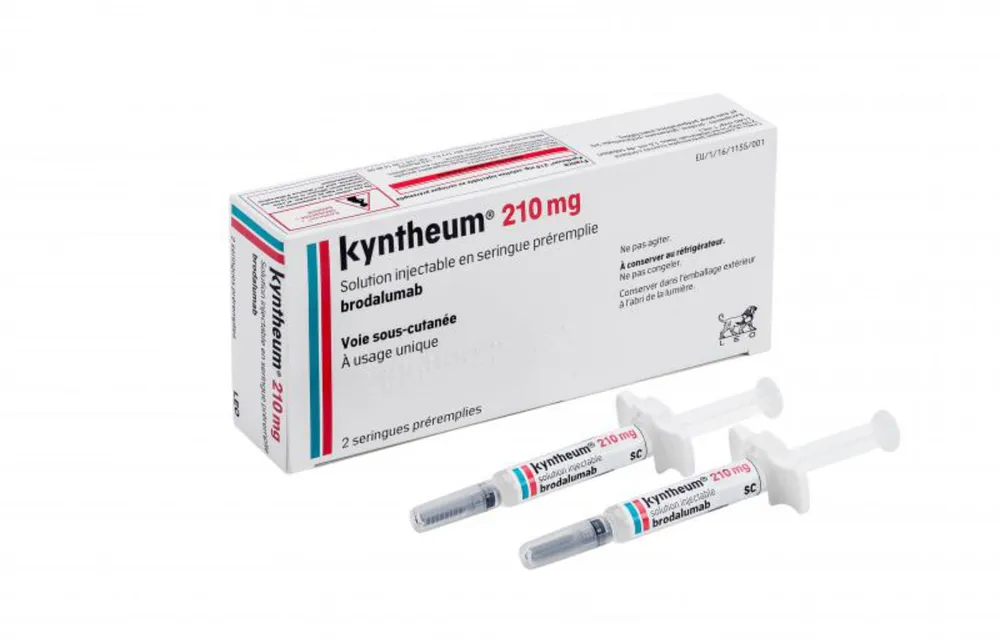
Table of Contents
- Package leaflet: Information for the patient
- Kyntheum 210 mg solution for injection in pre-filled syringe
- 1. What Kyntheum is and what it is used for
- 2. What you need to know before using Kyntheum
- 3. How to use Kyntheum
- 4. Possible side effects
- 5. How to store Kyntheum
- 6. Package contents and other information
- Instructions for use:
- Kyntheum 210 mg
Package leaflet: Information for the patient
Kyntheum 210 mg solution for injection in pre-filled syringe
brodalumab
Please read all of this leaflet carefully before you start using this medicine because it contains important information for you.
- Keep this leaflet. You may need to read it again.
- If you have any questions, ask your doctor, pharmacist, or nurse.
- This medicine has been prescribed for you only. Do not pass it on to others. It may be harmful to other people even if their symptoms are the same as yours.
- If you get any side effects, talk to your doctor, pharmacist, or nurse. This includes any side effects not listed in this leaflet. See section 4.
Contents of this leaflet
- What Kyntheum is and what it is used for
- What you need to know before using Kyntheum
- How to use Kyntheum
- Possible side effects
- How to store Kyntheum
- Contents of the pack and other information
1. What Kyntheum is and what it is used for
Kyntheum contains the active substance brodalumab. Brodalumab is a monoclonal antibody, a type of specialized protein that binds to certain proteins in the body.
Brodalumab belongs to a group of medicines called interleukin (IL) inhibitors. This medicine works by blocking the activity of proteins called IL-17, which are present at increased levels in diseases such as psoriasis.
Kyntheum is used to treat a skin condition called "plaque psoriasis", which causes inflammation of the skin and the formation of scaly plaques. Kyntheum is used in adults with moderate to severe plaque psoriasis affecting large areas of the body.
Treatment with Kyntheum will provide you with benefits, resulting in improvement of skin manifestations and reduction of signs and symptoms of psoriasis such as itching, redness, scaling, burning, stinging pain, cracking, flaking, and pain.
2. What you need to know before using Kyntheum
Do not use Kyntheum
- if you are allergic to brodalumab or to any of the other ingredients of this medicine (listed in section 6). If you think you may be allergic, ask your doctor for advice before using Kyntheum.
- if you have active Crohn's disease
- if you have an infection that your doctor considers significant (for example, active tuberculosis).
Warnings and precautions
Talk to your doctor, pharmacist, or nurse before using Kyntheum:
- if you have an inflammatory bowel disease called Crohn's disease
- if you have inflammation of the large intestine called ulcerative colitis
- if you have ever had or currently have suicidal thoughts or actions, depression, anxiety, or mood disorders
- if you currently have an infection or get infections frequently
- if you have a long-term (chronic) infection
- if you have tuberculosis (TB), tested positive for TB, or have been in close contact with someone who has TB. Before starting treatment with Kyntheum, you may need to be treated with another medicine for TB
- if you have recently received or are planning to receive a vaccination. During treatment with Kyntheum, you must not receive certain types of vaccines (called "live vaccines")
- if you received Kyntheum during the last three months of pregnancy, consult your doctor before vaccinating your baby
- if you are receiving any other type of treatment for psoriasis, such as another immunosuppressant or ultraviolet (UV) light phototherapy.
After starting Kyntheum, contact your doctor, pharmacist, or nurse immediately:
- if your doctor has informed you that you have developed Crohn's disease
- if you feel depressed, anxious, have suicidal thoughts, or experience unusual changes in mood
- if you have an infection or any of the signs of infection listed in section 4 "Possible side effects"
- if you have been diagnosed with tuberculosis.
Inflammatory bowel disease (Crohn's disease or ulcerative colitis)
If you experience abdominal cramps and pain, diarrhea, weight loss, or blood in your stool (any signs of intestinal problems), stop using Kyntheum and contact your doctor or seek medical help immediately.
Be cautious about allergic reactions
Kyntheum may potentially cause serious side effects, including allergic reactions. While using Kyntheum, you should be alert for signs of such conditions.
Stop using Kyntheum and contact your doctor or seek immediate medical help if you notice any signs indicating an allergic reaction. These signs are listed in section 4 "Serious side effects".
Children and adolescents
Kyntheum is not recommended for children and adolescents (under 18 years of age) as it has not been studied in this age group.
Other medicines and Kyntheum
Inform your doctor or pharmacist:
- if you are taking, have recently taken, or might take any other medicines
- if you have recently received a vaccination or if you or your child are due to receive one; refer to "Warnings and precautions" in section "2. What you need to know before using Kyntheum".
Pregnancy and breastfeeding
If you are pregnant, think you might be pregnant, planning a pregnancy, or are breastfeeding, consult your doctor or pharmacist before taking this medicine. Kyntheum has not been studied in pregnant women, and it is unknown whether this medicine may cause harm to the unborn baby. Therefore, it is preferable to avoid using Kyntheum during pregnancy. If you are a woman of childbearing potential, you will be advised to avoid pregnancy and to use an effective method of contraception during treatment with Kyntheum and for at least 12 weeks after the last dose. It is not known whether brodalumab passes into breast milk. Inform your doctor if you are breastfeeding or plan to breastfeed. Your doctor will help you decide whether to stop breastfeeding or stop using Kyntheum, taking into account the benefits of breastfeeding for your baby and the benefits of Kyntheum for you.
Driving and using machines
It is unlikely that Kyntheum will affect your ability to drive or operate machinery.
3. How to use Kyntheum
Kyntheum must be prescribed by a doctor experienced in the diagnosis and treatment of psoriasis.
Always use this medicine exactly as instructed by your doctor, pharmacist, or nurse. If you have any doubts, consult your doctor, pharmacist, or nurse.
How much Kyntheum is administered
- Your doctor will decide how much Kyntheum you should receive and for how long. The recommended dose is 210 mg (one injection).
- After the first dose, you will receive one injection per week in week 1 (the week following the first dose) and week 2 (two weeks after the first dose). After that, you will receive one injection every two weeks.
- Kyntheum is a long-term treatment. Your doctor will regularly monitor your condition to check whether the treatment is having the desired effect. Inform your doctor if you feel that the signs and symptoms of psoriasis are not improving with Kyntheum.
How Kyntheum is administered
Kyntheum is administered via an injection under the skin (called a subcutaneous injection).
Instructions for self-administration
See the “Instructions for use” provided with this medicine for detailed information on how to properly store, prepare, and administer the injections at home.
- If your doctor decides that you or a caregiver may administer the injections at home, you or the caregiver must receive training on the correct way to prepare and inject Kyntheum. Do not attempt to inject Kyntheum yourself until your doctor or nurse has shown you or your caregiver how to do so.
- Do not shake the pre-filled syringe before use.
- Kyntheum is injected into the upper legs (thighs) or the stomach area (abdomen) by you or your caregiver. The caregiver may also administer the injection into the outer upper part of one arm.
- Do not inject the medicine into areas where the skin is tender, bruised, red, hardened, or affected by psoriasis.
If you use more Kyntheum than you should
If you have received more medicine than prescribed or if the dose was administered earlier than scheduled, inform your doctor.
If you forget to use Kyntheum
If you have forgotten to inject a dose of Kyntheum, inject the next dose as soon as possible after the missed dose. Then, consult your doctor to determine when to administer the following dose. Do not use a double dose to make up for the missed dose.
If you stop using Kyntheum
Do not stop treatment with Kyntheum without first discussing it with your doctor. If you stop treatment, symptoms of psoriasis may return.
If you have any doubts about how to use this medicine, consult your doctor, pharmacist, or nurse.
4. Possible side effects
Like all medicines, this medicine can cause side effects, although not everyone gets them.
Serious side effects
Stop using Kyntheum and contact your doctor or seek immediate medical help if you experience any of the following side effects. Your doctor will decide whether and when it is possible to restart treatment:
Severe allergic reactions (may occur in up to 1 in 1000 people), signs may include:
- difficulty breathing or swallowing
- low blood pressure, which may cause dizziness or mild confusion
- swelling of the face, lips, tongue, and throat
- severe itching of the skin, with red rash or raised bumps.
Possible severe infections (may occur in up to 1 in 100 people), signs may include:
- fever, flu-like symptoms, night sweats
- tiredness or shortness of breath, persistent cough
- skin that is warm, red, and painful, or painful rash with blisters.
Other side effects
Common (may occur in up to 1 in 10 people)
- diarrhoea
- feeling unwell
- redness, pain, itching, bruising, or bleeding at the injection site
- tiredness
- mouth or throat pain
- fungal infections (ringworm) (including feet and groin)
- influenza
- headache
- joint pain
- muscle pain.
Uncommon (may occur in up to 1 in 100 people)
- Candida (fungal) infection of mouth, throat, or genitals
- eye discharge with itching, redness, and swelling (conjunctivitis)
- low white blood cell count.
Most of these side effects are mild to moderate in severity. If any of these side effects worsen, inform your doctor, pharmacist, or nurse.
With IL-17 inhibitors, such as Kyntheum, abdominal cramps and pain, diarrhoea, weight loss, or blood in the stool (signs of intestinal problems) have also been reported.
Reporting of side effects
If you experience any side effect, including those not listed in this leaflet, talk to your doctor, pharmacist, or nurse. You can also report side effects directly via the national reporting system listed in Annex V. By reporting side effects, you can help provide more information on the safety of this medicine.
5. How to store Kyntheum
Keep this medicine out of the sight and reach of children.
Do not use this medicine after the expiry date stated on the carton and on the label of the pre-filled syringe after "Exp" or "EXP". The expiry date refers to the last day of that month.
Keep the pre-filled syringe in the outer packaging to protect the medicine from light.
Store in a refrigerator (2°C – 8°C). Do not freeze.
Kyntheum may be stored at room temperature up to 25°C, in the outer packaging, for up to 14 days. Discard Kyntheum if not used within 14 days of storage at room temperature.
Do not use this medicine if you notice that the solution is cloudy or contains lumps, flakes or particles, or if the colour has changed.
Do not dispose of any medicine via wastewater or household waste. Ask your pharmacist how to dispose of medicines you no longer use. This will help protect the environment.
6. Package contents and other information
What Kyntheum contains
- The active substance is brodalumab. Each pre-filled syringe contains 210 mg of brodalumab in 1.5 ml of solution.
- The other components are proline, glutamate, polysorbate 20 and water for injections.
Description of the appearance of Kyntheum and contents of the pack
Kyntheum is an injectable solution ranging from clear to slightly pearly, colourless to slightly yellow, free from particles.
Kyntheum is available in single packs containing 2 pre-filled syringes and in multiple packs consisting of 3 boxes, each containing 2 pre-filled syringes. Not all pack sizes may be marketed.
Marketing Authorisation Holder
LEO Pharma A/S
Industriparken 55
DK-2750 Ballerup
Denmark
Manufacturer
Laboratoires LEO
39 route de Chartres
28500 Vernouillet
France
LEO Pharma A/S
Industriparken 55
DK-2750 Ballerup
Denmark
For further information about this medicinal product, please contact the local representative of the Marketing Authorisation Holder:
België/Belgique/Belgien Lietuva
LEO Pharma N.V./S.A LEO Pharma A/S
Tél/Tel: +32 3 740 7868 Tel: +45 44 94 58 88
България Luxembourg/Luxemburg
Borola Ltd LEO Pharma N.V./S.A
Teл.: +359 2 9156 136 Tél/Tel: +32 3 740 7868
Česká republika Magyarország
LEO Pharma s.r.o. LEO Pharma
Tel: +420 225 992 272 Tel: +36 1 888 0525
Danmark Malta
LEO Pharma AB E.J. Busuttil Ltd
Tlf: +45 70 22 49 11 Tel: +356 2144 7184
Deutschland Nederland
LEO Pharma GmbH LEO Pharma B.V.
Tel: +49 6102 2010 Tel: +31 205104141
Eesti Norge
LEO Pharma A/S LEO Pharma AS
Tel: +45 44 94 58 88 Tlf: +47 22514900
Ελλάδα Österreich
LEO Pharmaceutical Hellas S.A. LEO Pharma GmbH
Τηλ: +30 210 68 34322 Tel: +43 1 503 6979
España Polska
Laboratorios LEO Pharma, S.A. LEO Pharma Sp. z o.o.
Tel: +34 93 221 3366 Tel.: +48 22 244 18 40
France Portugal
LEO Pharma LEO Farmacêuticos Lda.
Tél: +33 1 3014 4000 Tel: +351 21 711 0760
Hrvatska România
Remedia d.o.o LEO Pharma Romania
Tel: +385 1 3778 770 Tel: +40 213121963
Ireland Slovenija
LEO Laboratories Ltd PHARMAGAN d.o.o.
Tel: +353 (0) 1 490 8924 Tel: +386 4 2366 700
Ísland Slovenská republika
Vistor hf. LEO Pharma s.r.o.
Sími: +354 535 7000 Tel: +421 2 5939 6236
Italia Suomi/Finland
LEO Pharma S.p.A LEO Pharma Oy
Tel: +39 06 52625500 Puh/Tel: +358 20 721 8440
Κύπρος Sverige
The Star Medicines Importers Co. Ltd. LEO Pharma AB
Τηλ: +357 2537 1056 Tel: +46 40 3522 00
Latvija United Kingdom (Northern Ireland)
LEO Pharma A/S LEO Laboratories Ltd
Tel: +45 44 94 58 88 Tel: +44 (0) 1844 347333
Other sources of information
More detailed information on this medicinal product is available on the website of the European Medicines Agency, http://www.ema.europa.eu/ .
Instructions for use:
Kyntheum 210 mg
injectable solution in a pre-filled syringe
brodalumab
For subcutaneous use
Kyntheum is available as a single-use pre-filled syringe. Each syringe contains a dose of 210 mg
of Kyntheum. Your doctor, pharmacist, or nurse will tell you how often to inject the
medication. Each pre-filled syringe of Kyntheum must only be used once.
If your doctor decides that you or the person caring for you may administer the injections at
home, you or the caregiver must receive training on the correct way to prepare and inject Kyntheum. Do not attempt to inject the medication yourself until healthcare professionals have shown you the proper technique.
Before using the pre-filled syringe of Kyntheum, read all instructions carefully. If you or the caregiver have any doubts about the correct way to inject Kyntheum, consult your doctor, pharmacist, or nurse.
Guide to components
Before use After use
Used plunger
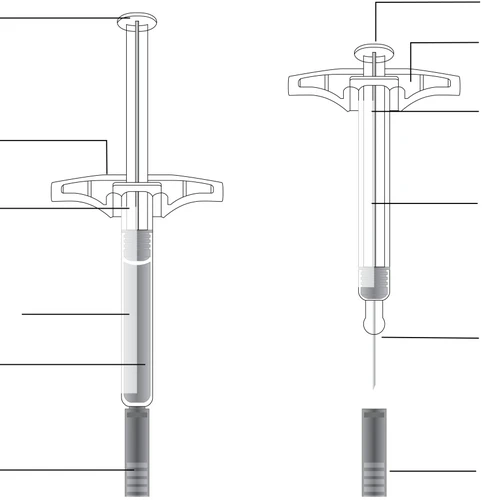
Plunger
Grip
Label and
expiry date
Grip
Label and
expiry date
Used syringe
barrel
Syringe
barrel
Used needle
Medication
Cap
Removed
needle cap
Inserted
needle cap
Important: the needle is inside
Before using a pre-filled syringe of Kyntheum, read these important instructions:
Storage of pre-filled syringes of Kyntheum
- Keep out of the sight and reach of children.
- Keep the pre-filled syringe in its outer packaging to protect the medication from light and physical damage.
- Store in a refrigerator (2°C – 8°C).
- If necessary, the pre-filled syringe of Kyntheum may be stored at room temperature up to 25°C for a maximum of 14 days. Discard Kyntheum if it has been stored at room temperature for more than 14 days.
- Do not freeze.
Use of the pre-filled syringe of Kyntheum
- Do not use after the expiry date stated on the label.
- Do not shake.
- Do not remove the needle cap until you are ready to perform the injection.
- Do not use a pre-filled syringe of Kyntheum if it has fallen on a hard surface, especially if the syringe is broken.
Step 1: Preparation
A. Remove the pre-filled syringe of Kyntheum from the box
Grasp the syringe barrel to remove the syringe from the tray.
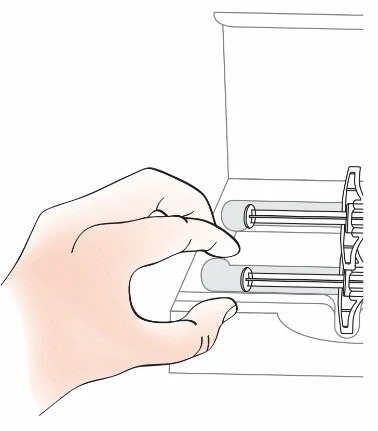
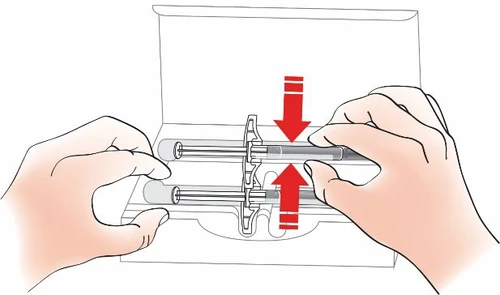
Place a finger or thumb on the Grasp here
edge of the tray to hold it
while removing the syringe.
Return any unused syringes to the refrigerator in their box.
For safety:
- Do not hold the syringe by the plunger.
- Do not grasp the needle cap.
- Do not remove the needle cap until you are ready to perform the injection.
- Do not remove the grip. It is part of the syringe.
Allow the syringe to reach room temperature for at least 30 minutes before injection.
- Do not return the syringe to the refrigerator after it has reached room temperature.
- Do not attempt to warm the syringe using any heat source such as hot water or a microwave oven.
- Do not leave the syringe exposed to direct sunlight.
- Do not shake the syringe.
Important: always hold the pre-filled syringe by the syringe barrel.
B. Check the pre-filled syringe of Kyntheum
Label and expiry
date
Syringe
barrel
Plunger
Grip
Needle cap
Medication
inserted
Check that the solution in the syringe is from clear to slightly opalescent and from colourless to
slightly yellow.
- Do not use the syringe if:
- the solution is cloudy or contains particles, flakes, or clumps, or if the colour has changed
- any part appears damaged or broken.
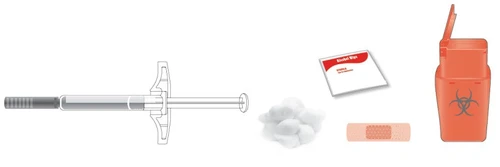
C. Prepare all necessary materials
Wash hands thoroughly with soap and water.
On a clean, well-lit work surface, place:
- new syringe
- alcohol swabs
- cotton ball or gauze pad
- adhesive bandage
- sharps disposal container (the colour and appearance of the container may vary depending on national requirements).
D. Prepare and clean the injection site
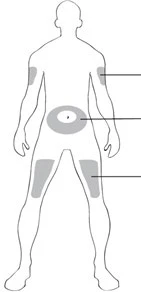
Upper arm
Abdomen
Stomach area
Thigh
You or your caregiver may inject into:
- the thigh
- the stomach area (abdomen), except for a 5-centimetre area around the navel.
Only the caregiver may inject into:
- the outer area of the upper arm.
Injection site:
- Do not inject into areas where the skin is tender, bruised, red, or hardened.
- Avoid injecting into areas with scars or stretch marks.
- Avoid injecting directly into raised, thickened, red, or scaly skin patches or lesions.
- Clean the intended injection site with an alcohol swab. Allow the skin to dry.
- Do not touch the area again before the injection.
- If you wish to use the same general injection area each time, ensure you do not use the exact same spot used for a previous injection.
Step 2: Preparing for injection
E. When ready to inject, remove the needle cap with a straight motion, away from your body
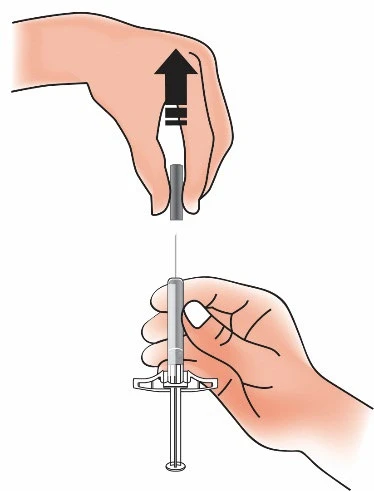
- Dispose of the needle cap in the sharps disposal container.
- Do not twist or bend the needle cap.
- Do not recap the needle onto the syringe.
You may notice a small air bubble in the syringe or a drop of liquid at the tip of the needle. Both are normal and should not be removed.
F. Pinch the skin to create a taut surface
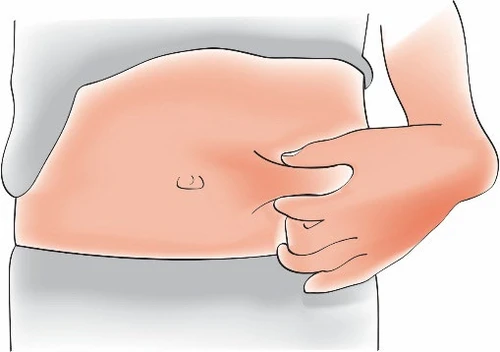
Firmly pinch the skin between your thumb and fingers, creating an area about 5 centimetres wide.
Important: keep the skin pinched until the injection is complete.
Step 3: Injection
G. Keep the skin pinched. Insert the syringe, with needle cap removed, into the skin at an angle between approximately 45 and 90 degrees
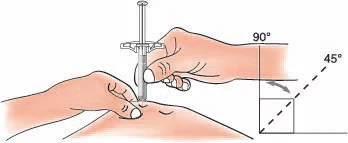
Do not place your finger on the plunger while inserting the needle.
H. Using slow, steady pressure, push the plunger all the way down until it stops moving
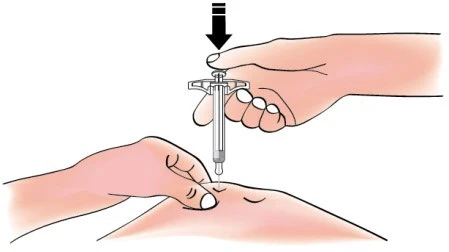
I. At the end, remove your thumb. Then gently remove the syringe from the skin
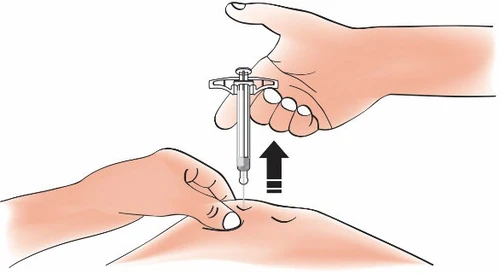
Important: if, upon removing the syringe, it appears that some medication remains inside, this means a full dose has not been administered. Contact your doctor, pharmacist, or nurse immediately.
Step 4: Conclusion
J. Dispose of the used syringe
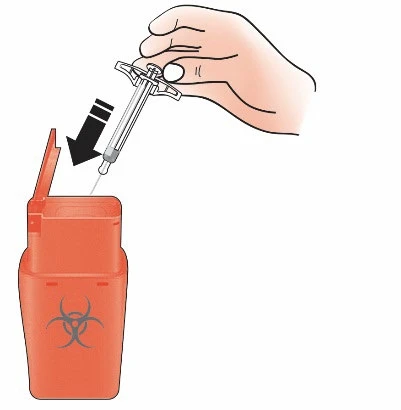
- Immediately after use, place the used pre-filled syringe into a puncture-resistant sharps disposal container.
- Do not reuse the syringe.
- Do not recycle the syringe or sharps disposal container, or dispose of them in household waste.
Important: always keep the sharps disposal container out of sight and reach of children.
K. Check the injection site
If bleeding occurs, press a cotton ball or gauze pad over the injection site.
Do not rub the injection site. If needed, cover it with an adhesive bandage.