Kybernin P
Italy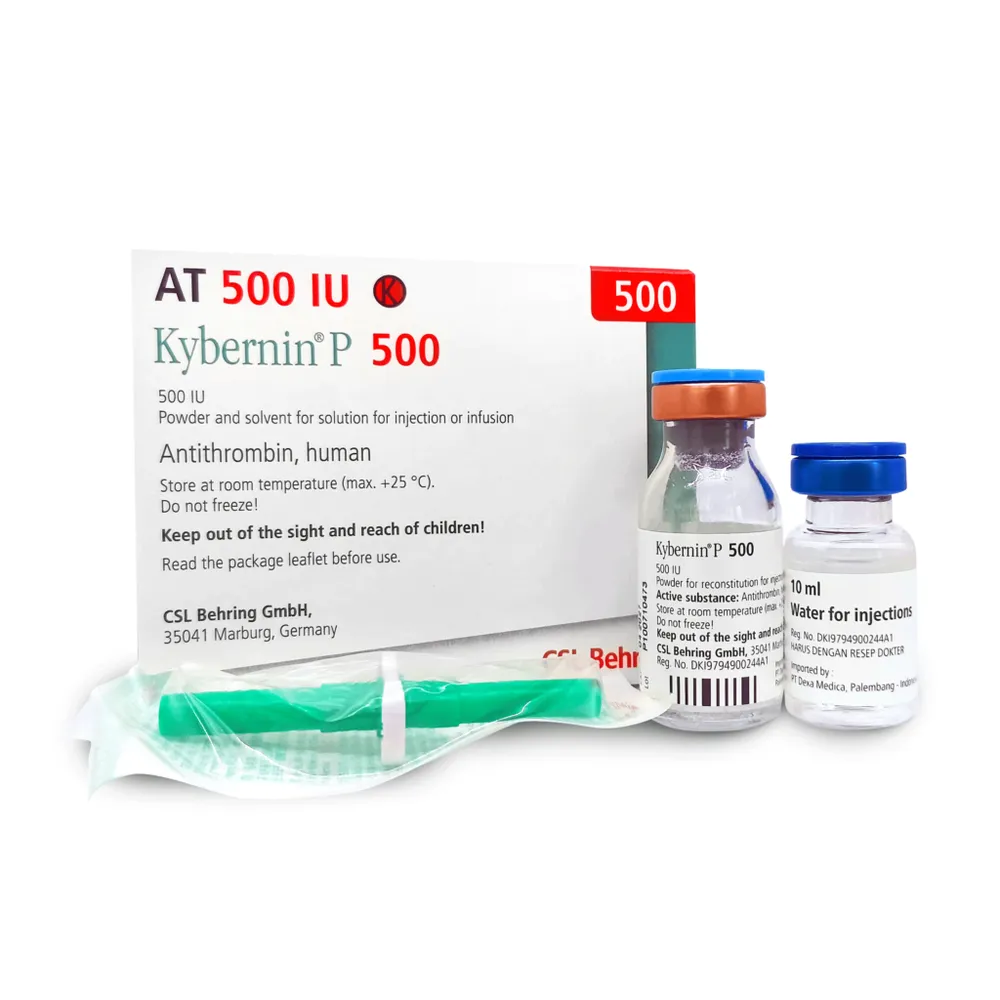
Table of Contents
- Package leaflet: Information for the user
- KYBERNIN P 500 IU powder and solvent for solution for infusion, 1000 IU powder and solvent for solution for infusion
- 1. What KYBERNIN P is and what it is used for
- 2. What you should know before using KYBERNIN P
- 3. How to use KYBERNIN P
- 4. Possible side effects
- 5. How to store KYBERNIN P
- 6. Package contents and other information
Package leaflet: Information for the user
KYBERNIN P 500 IU powder and solvent for solution for infusion, 1000 IU powder and solvent for solution for infusion
Human Antithrombin III
Please read all of this leaflet carefully before you start using this medicine because it contains important information for you.
- Keep this leaflet. You may need to read it again.
- If you have any questions, ask your doctor or nurse.
- If you get any side effects, talk to your doctor or nurse. This includes any possible side effects not listed in this leaflet. See section 4.
What this leaflet contains:
- What KYBERNIN P is and what it is used for
- What you need to know before you use KYBERNIN P
- How to use KYBERNIN P
- Possible side effects
- How to store KYBERNIN P
- Contents of the pack and other information
1. What KYBERNIN P is and what it is used for
KYBERNIN P contains the active substance human antithrombin III, an important protein produced
by the human body to regulate the normal blood coagulation process.
This medicine is indicated in people who do not produce sufficient amounts of antithrombin III (congenital or acquired antithrombin deficiency) for:
- preventing blood coagulation disorders that may cause problems in the legs or arms (deep vein thrombosis), or more serious problems in the lungs (pulmonary embolism), particularly when undergoing surgery or after childbirth, and when being treated with heparin, a medicine used for certain blood coagulation disorders;
- preventing the worsening of blood coagulation disorders that may cause problems in the legs or arms (progression of deep vein thrombosis), or more serious problems in the lungs (progression of pulmonary embolism), while being treated with heparin, a medicine used for certain blood coagulation disorders;
- preventing and treating a severe and life-threatening blood coagulation disorder (disseminated intravascular coagulation) caused by certain complications, for example following a systemic infection (septic complications) or shock.
2. What you should know before using KYBERNIN P
Do not use KYBERNIN P
- if you are allergic to human antithrombin III or to any of the other ingredients of this medicine (listed in section 6);
- if you have previously suffered from reduced production of certain blood cells called platelets (thrombocytopenia) due to the use of heparin, a medicine used for blood clotting disorders (see section “Other medicines and KYBERNIN P”).
Warnings and precautions
Talk to your doctor or nurse before using KYBERNIN P.
If you have antithrombin III deficiency, severe allergic reactions (anaphylactic reactions) may occur after administration of KYBERNIN P; the first symptoms of allergic hypersensitivity are:
- skin irritation (urticaria), even widespread;
- difficulty breathing (dyspnea), continuous whistling sounds when breathing (wheezing);
- reduction in blood pressure (hypotension) and anaphylaxis.
For these reasons, during administration of Kybernin P, patients must be closely monitored by trained personnel throughout the entire infusion period. If allergic or anaphylactic reactions are suspected, administration of this medicine must be immediately stopped and, in case of shock, the doctor must initiate appropriate treatment for this condition.
Viral safety
For medicines derived from human blood or plasma, certain safety measures are adopted to prevent transmission of infections to patients. These safety measures include:
- careful selection of donors;
- testing of each individual donation and pooled plasma from multiple donors for signs of viral/infectious agents.
Manufacturers of these medicines include in the blood and plasma processing steps aimed at inactivating or removing potential viruses. Despite these measures, when administering medicines derived from human blood or plasma, the risk of transmitting infections can never be completely ruled out. This also applies to unknown or new viruses or other types of infections.
The measures taken are considered effective against enveloped viruses such as human immunodeficiency virus (HIV, the AIDS virus), hepatitis B virus (HBV), and hepatitis C virus (HCV), as well as non-enveloped viruses such as hepatitis A virus (HAV) and Parvovirus B19.
Parvovirus B19 may cause severe infections especially if you are pregnant (fetal infection), if you have immune system problems (patients with immunodeficiency), or if you have certain types of anemia (e.g. sickle cell anemia or hemolytic anemia).
If you regularly or repeatedly receive medicines obtained from blood fluid (plasma), your doctor may recommend appropriate vaccinations (hepatitis A, hepatitis B).
It is recommended to record the following information in your treatment diary each time KYBERNIN P is administered:
- Date of administration;
- Medicinal product batch number;
- Injected volume.
Please note that if you are simultaneously using heparin (used for blood clotting disorders), your doctor will perform blood tests at close intervals, especially immediately after starting treatment with this medicine, to monitor certain parameters (degree of anticoagulation, anti-FXa activity, antithrombin levels).
To adjust the individual dose, antithrombin levels must be monitored daily due to the risk of decreased antithrombin levels caused by prolonged treatment with unfractionated heparin.
In patients with an increased risk of bleeding, concomitant administration of heparin at doses exceeding 500 IU must be carefully evaluated. Careful monitoring of coagulation parameters and antithrombin III activity is required.
Children
KYBERNIN P is not recommended for children under 6 years of age due to lack of data on safety and efficacy.
Other medicines and KYBERNIN P
Inform your doctor or nurse if you are taking, have recently taken, or might take any other medicines.
This medicine will be administered to you with caution if you are taking heparin or activated protein C, medicines used for certain blood clotting disorders, as severe bleeding (hemorrhage) may occur.
Your doctor will carefully monitor levels of certain blood substances and keep you under close observation during treatment with this medicine (see section “Warnings and precautions”).
Pregnancy and breastfeeding
If you are pregnant, suspect you may be pregnant, are planning a pregnancy, or are breastfeeding, ask your doctor or nurse for advice before using this medicine.
Administration of Kybernin P in women with antithrombin III deficiency who are pregnant or breastfeeding will only be performed if absolutely necessary and if the doctor considers it strictly required.
Driving and use of machines
This medicine does not impair the ability to drive vehicles or operate machinery.
KYBERNIN P contains sodium
This medicine contains 342.5 mg (14.9 mmol) of sodium per maximum dose (6000 IU twice daily). This should be taken into consideration in individuals with impaired renal function or those following a low-sodium diet.
3. How to use KYBERNIN P
Use this medicine exactly as instructed by your doctor or nurse. If you have any doubts,
consult your doctor or nurse.
This medicine will be administered to you as a slow intravenous injection (into a vein) in a hospital or other
specialized center by experienced medical personnel.
Your doctor will determine the appropriate dose of KYBERNIN P for you based on the severity of your condition,
your overall health, and the results of your blood tests. Please note that your doctor may decide to adjust
the dose according to your response to treatment with this medicine.
If you use more KYBERNIN P than you should
This medicine will be administered by specialized personnel. There are no known specific symptoms in case
of overdose.
If you have any questions about the use of this medicine, consult your doctor or nurse.
4. Possible side effects
Like all medicines, this medicine can cause side effects, although not everybody gets them.
The following side effects may occur:
Rarely:
- swelling of the face, especially around the mouth and eyes (angioedema);
- burning or irritation at the injection site;
- chills, fever;
- redness, even widespread (generalized erythema), skin irritation (urticaria);
- headache, drowsiness (lethargy);
- decrease in blood pressure (hypotension);
- nausea, vomiting;
- restlessness, palpitations (tachycardia);
- sensation of suffocation (feeling of chest tightness), difficulty in breathing (dyspnea);
- tingling sensations (paraesthesia).
Reporting of side effects
If you experience any side effect, including those not listed in this leaflet, talk to your doctor or pharmacist.
You may also report side effects directly through the national reporting system at www.agenziafarmaco.gov.it/it/responsabili. By reporting side effects, you can help provide more information on the safety of this medicine.
5. How to store KYBERNIN P
Medical and nursing staff are aware of the storage requirements for this medicine.
Keep this medicine out of the sight and reach of children.
Do not use this medicine after the expiry date stated on the packaging after "Exp". The expiry date refers to the last day of that month.
Store below 25°C and do not freeze.
Do not dispose of any medicine via wastewater or household waste. Ask your pharmacist how to dispose of medicines you no longer use. This will help protect the environment.
6. Package contents and other information
What KYBERNIN P 500 U.I. powder and solvent for solution for infusion contains
- The active substance is antithrombin III, human. Each vial of powder contains 309 mg of human plasma fraction (corresponding to 500 IU of human antithrombin III).
- Other components are: Vial of powder: aminoacetic acid, sodium chloride, sodium citrate, hydrochloric acid or sodium hydroxide for pH adjustment. Vial of solvent: water for injections.
What KYBERNIN P 1000 U.I. powder and solvent for solution for infusion contains
- The active substance is antithrombin III, human. Each vial of powder contains 619 mg of human plasma fraction (corresponding to 1000 IU of human antithrombin III).
- Other components are: Vial of powder: aminoacetic acid, sodium chloride, sodium citrate, hydrochloric acid or sodium hydroxide for pH adjustment. Vial of solvent: water for injections.
Description of the appearance of KYBERNIN P and contents of the pack
KYBERNIN P 500 U.I. powder and solvent for solution for infusion
Pack containing one 500 IU powder vial, one 10 ml solvent vial and a transfer device.
KYBERNIN P 1000 U.I. powder and solvent for solution for infusion
Pack containing one 1000 IU powder vial, one 20 ml solvent vial and a transfer device.
Marketing Authorization Holder
CSL Behring GmbH – Emil von Behring St. 76 - 35041 Marburg (Germany)
Representative in Italy:
CSL Behring S.p.A. – Viale del Ghisallo, 20 – 20151 Milano.
Manufacturer:
CSL Behring GmbH – Emil von Behring St. 76 - 35041 Marburg (Germany)
Package leaflet: information for the physician
The following information is intended exclusively for physicians or healthcare professionals:
Qualitative and quantitative composition
| Packaging | ||
| Kybernin P 500 U.I. | Kybernin P 1000 U.I. | |
| Antithrombin III | 500 U.I. | 1000 U.I. |
| Solvent volume for reconstitution | 10 ml | 20 ml |
| Total U.I. after reconstitution with solvent | 500 U.I./10 ml | 1000 U.I./20 ml |
| U.I./ml of reconstituted solution | 50 U.I./ml | 50 U.I./ml |
| Total proteins | 95 mg | 190 mg |
| The method used to determine potency is the chromogenic substrate method, as described in monograph 2.7.17 of the European Pharmacopoeia. Specific activity is approximately 5 U.I./mg of protein | ||
After reconstitution with the solvent supplied in the package, the resulting solution contains 50 IU/mL of
antithrombin III.
Special warnings and precautions for use
In the event of allergic or anaphylactic reactions (see also section 4), infusion of Kybernin P must be
immediately discontinued and appropriate medical treatment initiated. In case of shock, current therapeutic
guidelines for this condition should be followed.
If necessary, the following additional therapies may be adopted:
a) Mild reactions: Administer corticosteroids and antihistamines,
b) Severe or potentially life-threatening reactions (e.g. anaphylactic shock), depending on the severity of the
reaction:
- administer adrenaline immediately by slow intravenous infusion,
- add high-dose corticosteroids by slow intravenous infusion,
- if necessary, plasma volume replacement and oxygen therapy.
Viral safety
Kybernin P is manufactured from human plasma. Standard measures to prevent infections from medicines
prepared from human blood or plasma include donor selection, screening of individual donations and plasma
pools for specific markers of infection, and inclusion of production steps effective for virus inactivation/removal.
Nevertheless, when medicines prepared from human blood or plasma are administered, the possibility of
transmitting infectious agents cannot be completely excluded. This also applies to unknown or emerging viruses
and other pathogens.
To reduce the risk of infectious agents, strict controls are applied in the selection of donors and donations.
Furthermore, the manufacturing process of Kybernin P includes viral inactivation/removal procedures:
- Kybernin P is prepared exclusively from plasma donations that tested negative for antibodies to HIV-1, HIV-2, HCV, and for HBs antigen.
- The plasma pool is additionally tested for antibodies to HIV-1, HIV-2, and HBs antigen, and for the genetic material of HBV, HCV, and HIV-1 using Nucleic Acid Amplification Technology (NAT), e.g., Polymerase Chain Reaction (PCR). The latter is the most sensitive method, unlike antibody testing, because it directly detects the genetic material of any potentially present viruses. The plasma pool is only used for further processing if test results are negative.
- The manufacturing process of Kybernin P includes several steps that contribute to virus inactivation/removal. For viral inactivation, a heat treatment in aqueous solution at 60°C for 10 hours has been introduced.
Patients receiving regular administrations of products derived from human plasma, including Kybernin P
(antithrombin III), should be appropriately vaccinated (Hepatitis A and Hepatitis B).
For patient safety, it is recommended that each time Kybernin P is administered, the product name and batch
number be recorded.
Dosage and method of administration
Treatment must be initiated under the supervision of a physician experienced in managing patients with
antithrombin deficiency.
Dosage
The dosage and duration of replacement therapy depend on the severity of the disorder and clinical condition.
In congenital deficiency, the dosage should be individualized for each patient, taking into account family history
of thromboembolic events and actual clinical risk factors.
In acquired deficiency, the dosage and duration of replacement therapy depend on the plasma antithrombin
level, presence of signs of increased turnover, underlying disease, and severity of the clinical condition.
The volume to be administered and the frequency of administration should be based on clinical efficacy and
laboratory test results in individual cases.
The number of antithrombin units administered is expressed in International Units (IU), referenced to the
current WHO standard for antithrombin. Antithrombin activity in plasma is expressed as a percentage (relative
to normal human plasma) or in International Units (relative to the International Standard for antithrombin in
plasma).
One unit of antithrombin III corresponds to the antithrombin III activity present in 1 mL of normal citrated
human plasma. This concentration is considered equal to 100%. Administration of 1 IU of Kybernin P per kg
body weight increases antithrombin III activity by 1.5%.
The initial dose is calculated according to the following formula:
units required =
body weight (kg) × [100 - actual antithrombin III activity (in %)] × 2/3
The dose must be determined based on laboratory tests for antithrombin III activity. These tests should be
performed at least twice daily until the patient's condition is stabilized, then once daily, preferably just before
the next infusion of Kybernin P.
Dosage adjustments should take into account both signs of increased antithrombin turnover based on
laboratory monitoring and the clinical course.
Initially, an antithrombin III activity of 100% should be targeted, and activity should be maintained above 80%
throughout treatment, unless clinical conditions indicate a different effective level.
It should be noted that the half-life of antithrombin III may be significantly reduced under certain clinical
conditions, such as disseminated intravascular coagulation.
In congenital deficiency, the usual initial dose would be 30–50 IU/kg. Subsequently, dosage, frequency of
administration, and duration of treatment should be adjusted based on biological data and clinical status.
Dosage in neonates and children
There are insufficient data to recommend the use of Kybernin P in children under 6 years of age.
In general, therapy should continue until antithrombin III activity normalizes and symptoms have resolved.
Method of administration
Reconstitute the preparation and inject slowly intravenously (not exceeding 4 mL/min).
For infusion, a 5% albumin solution may be used as a diluent. For dilutions of 1:5, the following may also be
used: Ringer's lactate solution, saline (physiological) solution, 5% glucose solution, polygelin.
Incompatibilities
The use of hydroxyethyl starch (HES) as a diluent (for infusion) is not recommended, as a decrease in AT III
activity has been observed.
Kybernin P must not be mixed with other medicinal products in the same syringe/infusion set.
Dopamine, dobutamine, and furosemide must not be administered through the same venous access used for
Kybernin P administration.
Shelf life
3 years if stored in original unopened packaging.
Kybernin P must not be used after the expiry date stated on the packaging.
Once the container has been opened, the contents should be used immediately.
After reconstitution with the solvent, physical/chemical stability has been demonstrated for 8 hours at a
temperature not exceeding +25°C.
From a microbiological standpoint, since Kybernin P does not contain preservatives, the reconstituted product
should be used immediately.
If the solution is not administered immediately, it may be stored for no more than 8 hours at a temperature not
exceeding +25°C.
Any unused portions of the product must be properly discarded.
Special precautions for disposal and handling
The powder must be completely reconstituted under sterile conditions using the solvent supplied in the
package.
The solution is normally clear or slightly opalescent.
Do not use cloudy solutions or those containing residues (deposits/particulates).
For further information, consult the Summary of Product Characteristics.